Best Pictory alternative for full AI video creation

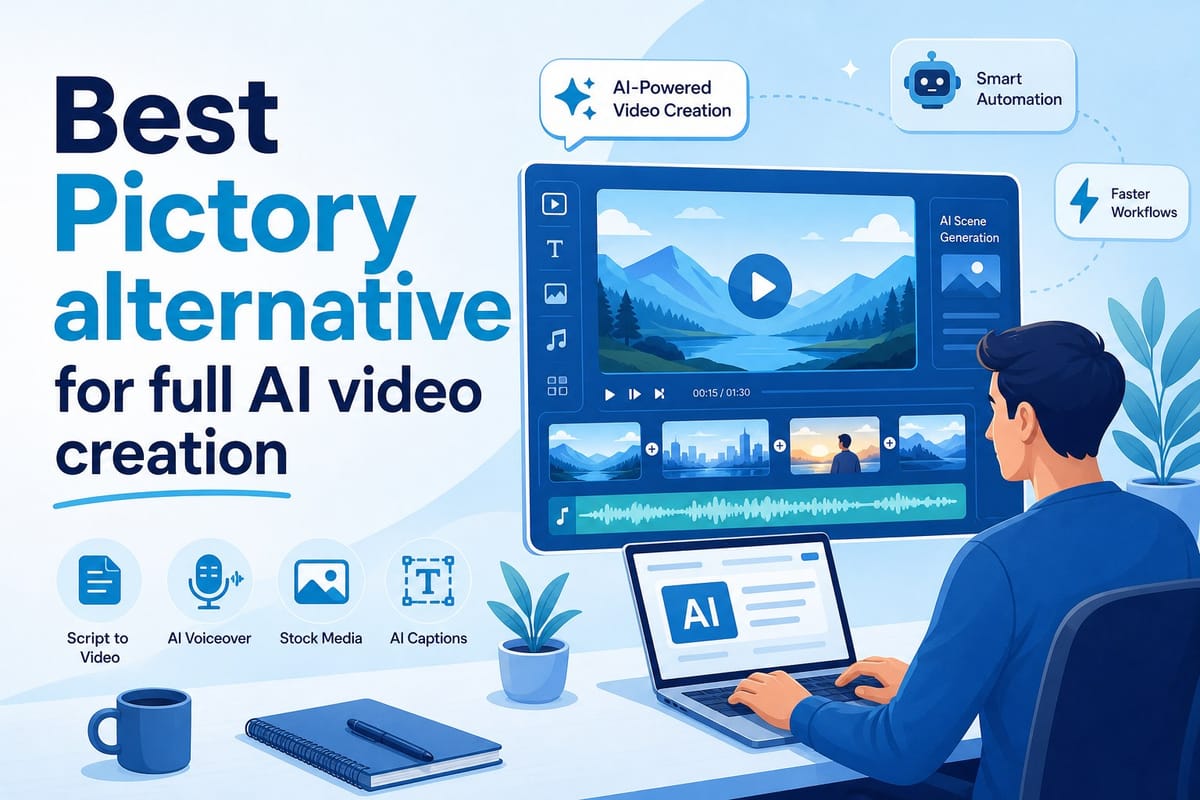
Table of contents
1. What most text-to-video tools get right and wrong
2. How Cliptude approaches full AI video creation differently
3. Who should use Cliptude and when it makes the most sense
If you have been searching for a solid pictory alternative, you are probably tired of the same limitations most AI video tools share. You upload a script, the tool slaps some stock footage on it, and you end up with something that looks like every other AI video on the internet. That gets old fast, especially when you are trying to build a real audience or run a faceless YouTube channel that actually makes money. I want to walk you through what makes a true full-stack AI video creation platform different, and why Cliptude is worth a serious look if you are ready to move beyond basic text-to-video tools.
What most text-to-video tools get right and wrong
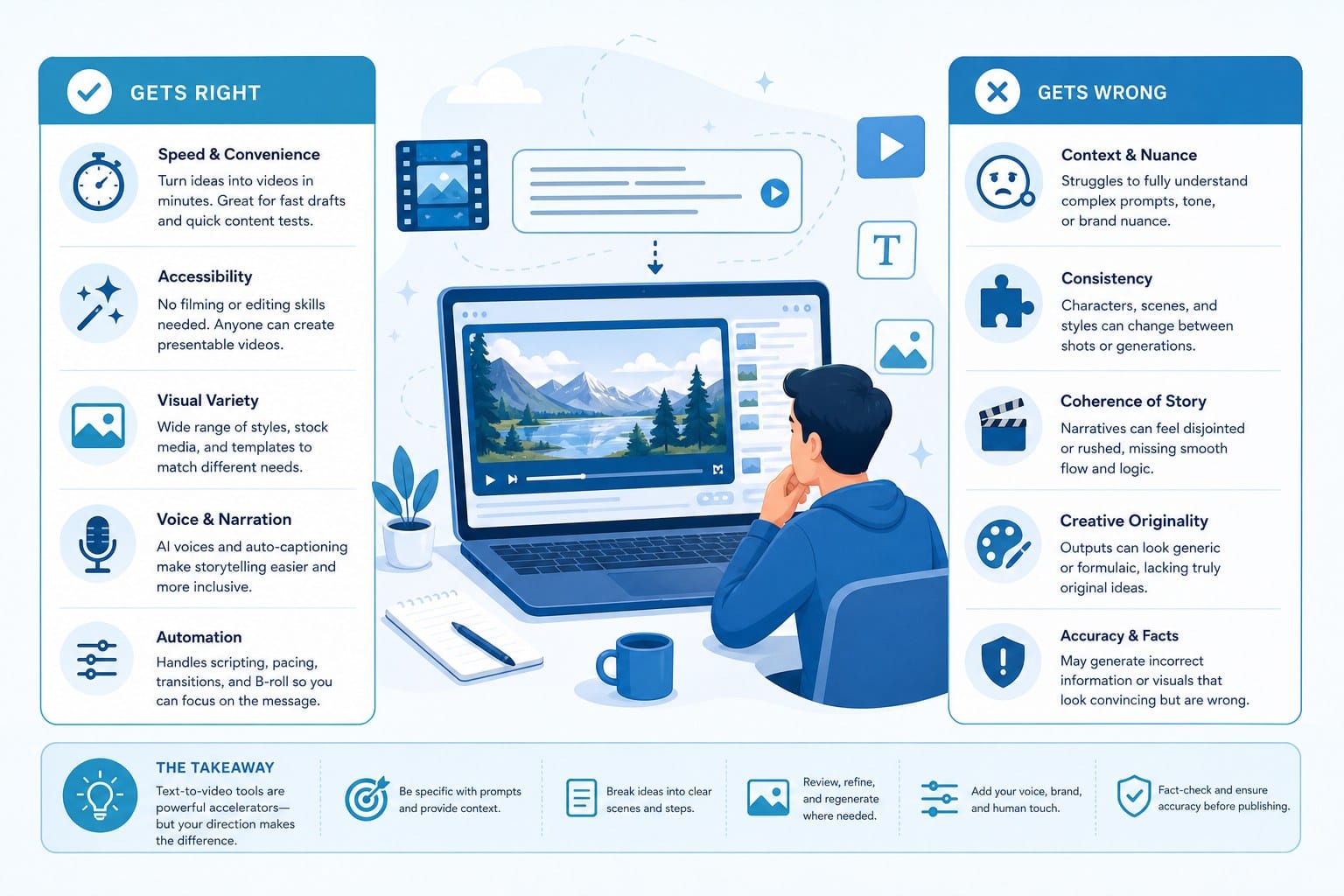
Let me be straightforward about something. Most AI video tools solve a narrow problem. They take your existing script or article and generate a rough video cut with stock footage and captions. That is useful for quick social clips or repurposing blog content. But it is not a full video production workflow.
The gap shows up quickly when you try to produce something more ambitious. Say you want to create a 15-minute documentary about the history of the Roman Empire, or a listicle video about the top ten fastest animals on Earth. You need a researched script, relevant footage, a coherent narrative structure, smooth transitions, motion graphics, and a finished edit that holds a viewer's attention from start to finish. Basic text-to-video tools were not built for that. They expect you to already have the script and the vision. They just handle the visual layer.
That means you are still doing the hardest parts yourself. You are still researching topics, writing scripts, hunting for usable footage, and figuring out how to make everything feel cohesive. The tool saves you some editing time, but it does not save you the creative and strategic work that actually takes hours.
This is the core problem with most platforms that get recommended when people search for a pictory alternative. They compete on the same narrow feature set: stock footage matching, captions, and basic transitions. If your goal is to produce polished, long-form YouTube content at scale without sitting on camera, those tools leave you with a significant production gap to fill on your own.
Another issue is quality consistency. When you are running a faceless channel and publishing multiple videos a week, you need every video to meet a baseline of quality. You cannot afford to spend hours tweaking each one. You need a platform that handles the full pipeline so your output stays professional without your constant intervention.
There is also the question of format variety. Some creators need long-form documentary content. Others need YouTube Shorts, TikTok clips, or Instagram Reels. Some want animated explainer videos with whiteboard or stickman styles. Most tools are built for one format and do it awkwardly when you try to push them into another. That forces you to either limit your content strategy or juggle multiple subscriptions.
I think the right way to evaluate any video creation tool is to ask: how much of the work does it actually take off my plate? If the answer is just the editing layer, that is a useful tool but not a full solution. The best pictory alternative is one that removes friction across the entire pipeline, from the initial idea all the way to a finished video ready to upload.
How Cliptude approaches full AI video creation differently
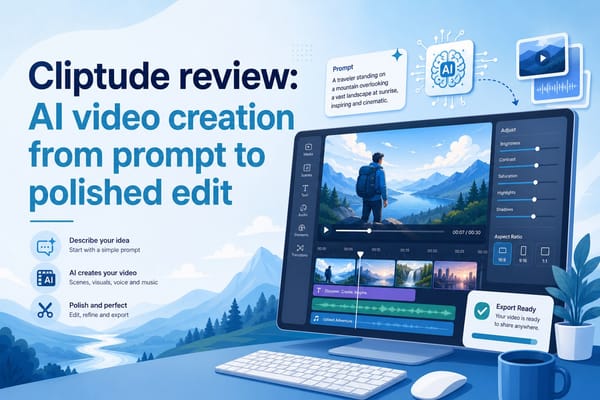
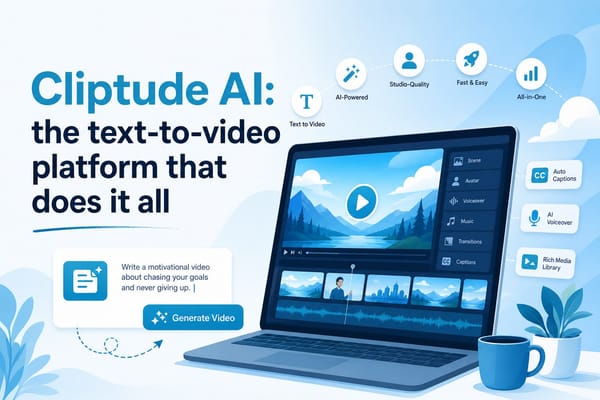
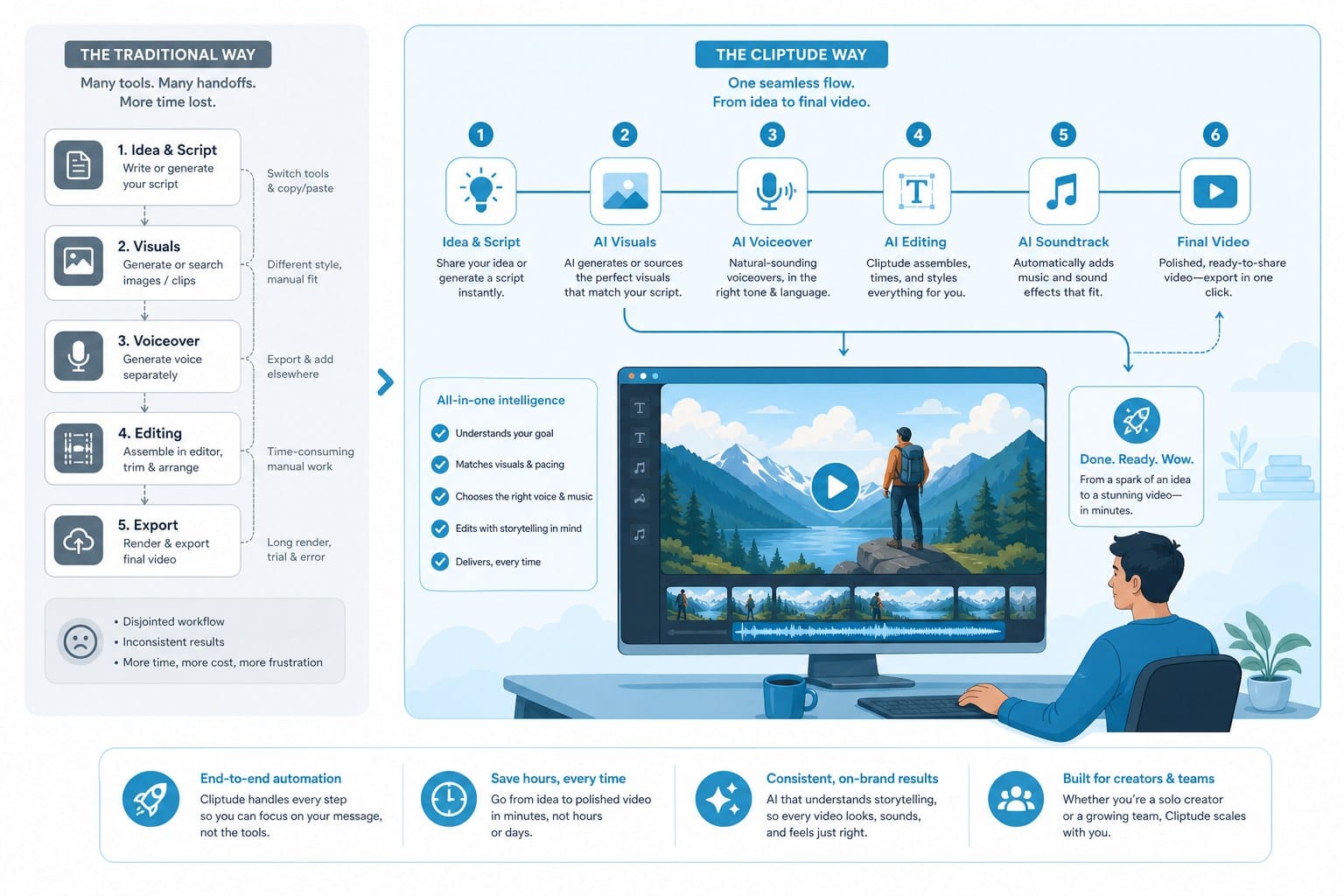
Cliptude is built around a different idea. Instead of starting with your script, it starts with your prompt. You describe what you want, and the platform handles the research, scripting, footage sourcing, motion graphics, and final edit. That is a fundamentally different scope than what most text-to-video tools offer.
Let me break down what that actually looks like in practice.
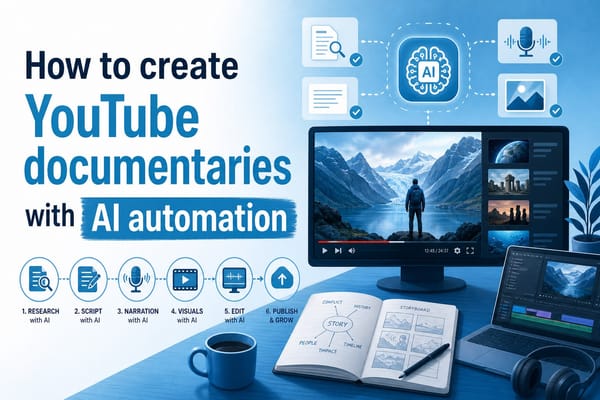
First, the research layer. When you give Cliptude a topic, it does not just generate text from thin air. It researches the topic to build a factual foundation for the script. If you are making a documentary about deep-sea creatures, you are not starting from scratch. The platform gathers the context it needs to write something substantive. This matters a lot for creators building educational or documentary channels, because accuracy and depth are what keep viewers watching and coming back.
Second, the scripting. The platform writes the script based on that research. This is where a lot of time gets saved. Writing a solid 12-minute script for a YouTube documentary can take hours if you do it manually. When the platform handles it, you can review and adjust rather than build from zero. That shifts your role from writer to editor, which is a much faster workflow.
Third, footage sourcing. Cliptude automatically finds and pulls relevant footage to match the script. This is one of the most tedious parts of producing faceless video content manually. You spend enormous amounts of time searching through stock libraries, downloading clips, trimming them, and checking licensing. Automating that step alone changes the economics of running a faceless channel.
Fourth, motion graphics. This is where Cliptude goes further than most competitors. The platform generates motion graphics as part of the production, which means your video does not just look like a basic stock footage slideshow. This matters for production quality and viewer retention. Viewers notice when a video has thoughtful visual elements versus when it is just raw footage with text overlaid.
Fifth, the final edit. Everything comes together in a finished cut. You are not left with a rough draft that needs extensive post-production work. The output is ready to review and upload.
Now let me talk about format flexibility, because this is important for creators with diverse output goals. Cliptude handles long-form YouTube videos, documentaries, listicles, YouTube Shorts, animations, and music videos. If you want a whiteboard animation or a stickman-style explainer, the platform supports those formats. That means you can diversify your content strategy without needing separate tools for each format.
For creators who are thinking about building across multiple platforms, this flexibility is genuinely valuable. You might produce long-form content for your YouTube channel and short-form clips for TikTok or Instagram Reels from the same workflow. That kind of output variety is hard to maintain when your tools are not built for it.
The pricing model is usage-based credits rather than a flat monthly subscription. This is worth paying attention to if you are a solo creator or a small team. You pay for what you actually use rather than being locked into a plan that may not match your production volume in a given month. When you are scaling up or experimenting with new content formats, that flexibility matters.
Commercial rights are included, which is critical for monetization. If you are running a channel with the goal of generating ad revenue or licensing your content, you need to know you own what you create. That is not something every AI video platform makes clear upfront, so it is worth noting that Cliptude is built with commercial use in mind.
I also want to address the faceless channel use case specifically, because it is one of the primary audiences Cliptude is built for. Running a successful faceless YouTube channel requires consistent output, strong research, good scripting, and visual quality that keeps viewers engaged without a presenter on screen. That combination of requirements is exactly what Cliptude's pipeline is designed to deliver. You can produce documentary-style content, listicles, and educational videos at a volume that would be impossible to sustain with a purely manual workflow.
For creators who want to understand more about the difference between content creators and influencers and how that shapes your platform strategy, this breakdown of are content creators and influencers the same thing is worth reading. It helps clarify what kind of creator you are and what kind of tool fits your goals.
Cliptude also supports multilingual content creation, which opens the door for creators targeting non-English speaking audiences. If you are creating content in Urdu or Nepali, for example, the platform can serve those workflows too. Creators working in Urdu can find practical guidance in this AI video generator in Urdu: a practical guide, and Nepali creators can explore what is possible with this AI video generator for Nepali content creators overview. Reaching a regional audience with AI-generated content is a growing opportunity, and having a platform that handles the full pipeline in multiple languages is a real advantage.
Who should use Cliptude and when it makes the most sense
Not every creator has the same needs, so I want to be specific about who gets the most value from a platform like Cliptude.
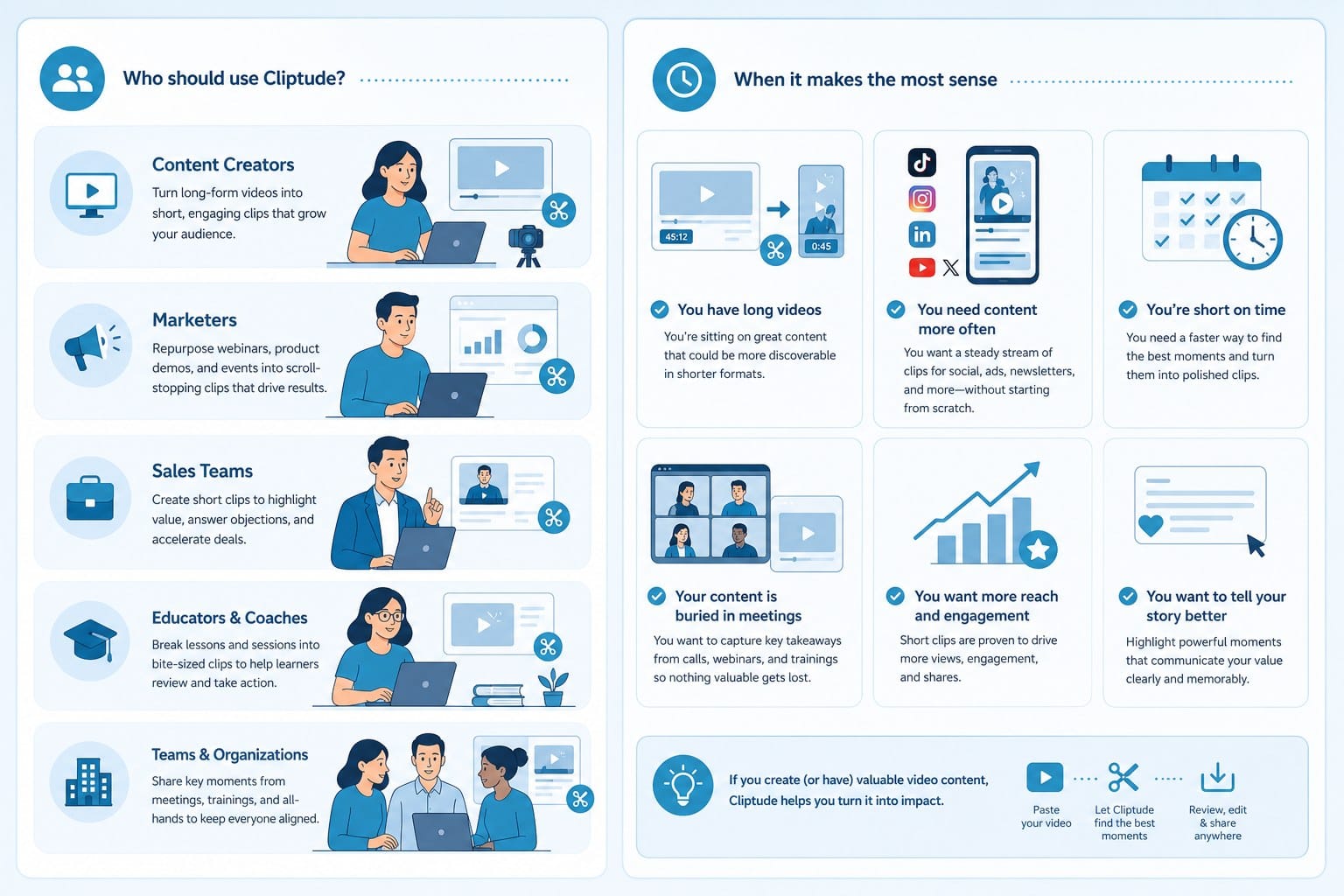
The clearest fit is the faceless YouTube creator who wants to produce long-form content consistently. If your channel is built around documentaries, history, science, true crime, finance, or similar topics, you are producing research-heavy scripts and sourcing a lot of footage every week. That is an enormous amount of work to do manually. Cliptude takes on the research and scripting phases, which are the most time-consuming parts. The result is that you can realistically publish more often without working more hours.
Let me put some concrete numbers around this. A manually produced 15-minute documentary video might take a dedicated creator 10 to 20 hours of work, factoring in research, scripting, voiceover coordination, footage sourcing, editing, and thumbnail creation. If you are trying to publish twice a week, that is 20 to 40 hours of production work per week on top of any channel management, community interaction, or strategy work. That pace is not sustainable for most solo creators. A platform that handles the research, scripting, footage, and editing cuts that workload dramatically. You spend your time reviewing and refining rather than building from zero.
The second strong fit is the creator or small media team scaling output across platforms. If you are producing content for YouTube, TikTok, Instagram Reels, and YouTube Shorts, you are dealing with different aspect ratios, different lengths, and different audience expectations. Managing that manually across even two platforms doubles your production load. Cliptude's ability to handle multiple formats from the same workflow means you can repurpose and produce across platforms without the usual overhead.
The third fit is the solo entrepreneur or small business owner who wants professional video content but does not have editing skills or a production budget. Video is one of the most effective forms of content marketing, but it has historically required either significant skill or significant budget. An AI platform that handles the full pipeline changes that calculation. You can produce explainer videos, educational content, or brand documentaries without hiring a production team or learning a complex editing suite.
The fourth fit is the creator focused on animated educational content. Whiteboard animations and stickman-style explainer videos are popular formats for educational channels because they work well for explaining complex ideas in a visual and engaging way. Producing these manually requires either animation skills or expensive software. Cliptude supports these animation formats as part of its video creation pipeline, which makes it accessible to creators who want that style without the production barrier.
The fifth fit is the creator or marketer thinking seriously about monetization. If you are building a channel with the goal of generating revenue, commercial rights are not optional, they are foundational. Cliptude includes full commercial rights with the content you create, which means you can run ads on your videos, license your content, or use it in paid marketing campaigns without additional licensing concerns. That is not a given with every AI video platform, so it is an important factor to weigh when you are evaluating your options.
Let me also talk about the creators who might need to think carefully before committing. If you are a creator who has highly specific creative preferences and wants to control every frame of the visual output, a fully automated pipeline may feel too restrictive. Automation is powerful, but it works best when you are optimizing for speed and volume rather than frame-by-frame creative control. Cliptude is built for efficiency and quality at scale. If your workflow requires extremely granular control over every editing decision, you might want to use the platform for the research and scripting phases and then take the output into a manual editing process.
Also worth considering is your content niche. Cliptude performs well across a wide range of general and educational topics. For highly specialized technical content where accuracy is critical and sources need to be verified carefully, you will want to build in a review step for the script output. The platform does the research, but for topics like medical information, legal content, or financial advice, human review is always a responsible practice regardless of what tool you use.
For creators thinking about budget, the usage-based credit model at Cliptude is worth understanding in detail. Because you are paying for what you use rather than a fixed monthly fee, your costs scale with your production volume. When you are starting out and publishing less frequently, you spend less. As your channel grows and you ramp up output, your costs scale up with your revenue potential. That alignment between cost and output is one of the practical advantages of usage-based pricing for independent creators.
One thing I find genuinely useful about Cliptude's approach is that it treats the video as a complete product from the start rather than a series of disconnected steps. The research informs the script. The script drives the footage sourcing. The footage is paired with motion graphics that match the narrative. The result is a video where the parts fit together because they were produced as a unified whole. That coherence is hard to achieve when you are stitching together outputs from multiple separate tools.
For creators building a real business around their content, that coherence translates into viewer retention. A video that feels well-structured and visually consistent keeps people watching longer. Longer watch time signals to platforms that your content is valuable, which affects how broadly it gets recommended. The production quality of your videos is not just an aesthetic choice, it is a distribution strategy.
If you are running a faceless channel or scaling your video output and you have been looking for a genuine pictory alternative that goes further than basic text-to-video, Cliptude is worth testing. The platform is built around the full production workflow, from idea to finished video, and it is designed specifically for the kinds of creators who need volume, quality, and format flexibility without a large production team behind them.
The case for switching from a narrower text-to-video tool to a full AI video creation platform comes down to this: if you are still doing most of the work yourself, the tool is not actually solving your problem. A real pictory alternative should take the research, scripting, footage, motion graphics, and editing off your plate so you can focus on strategy, growth, and the creative decisions that actually move your channel forward.
Ready to take the next step?
Ready to see what a full AI video creation workflow looks like? Visit Cliptude and start producing research-backed, professionally edited videos from a single prompt. Whether you are building a faceless documentary channel, scaling short-form content, or creating animated explainers, Cliptude handles the full pipeline so you can focus on growing your audience.