Vidrush alternative: meet Cliptude for AI video creation

Table of contents
1. What creators are actually looking for in a Vidrush alternative
2. What Cliptude does from prompt to finished video
3. How to get the most out of Cliptude for your channel
If you have been searching for a Vidrush alternative, you are not alone. A lot of creators want a tool that handles the full video production pipeline without requiring any on-camera presence, advanced editing software, or a large budget. I have spent time exploring what is out there, and I want to walk you through why Cliptude deserves a serious look. Whether you run a faceless YouTube channel, produce short-form content for TikTok and Instagram Reels, or just want to publish more videos without hiring an editor, this breakdown will help you decide if Cliptude fits your workflow.
What creators are actually looking for in a Vidrush alternative
When creators go looking for a Vidrush alternative, the wish list tends to follow a pretty consistent pattern. They want a platform that takes a topic or script and turns it into a finished, publish-ready video. Not a rough cut they still need to polish for three hours. A finished video.
That sounds simple, but most tools fall short somewhere in the chain. Some give you a decent script but no footage. Others source footage but leave the editing to you. A handful handle the whole process but produce results that look robotic or templated in a way that feels embarrassing to post.
Here is what creators actually need when they evaluate any tool in this category.
Research capability. The best faceless channels publish content about topics the creator did not already know inside and out. That means the tool needs to do at least some of the background work automatically. If you have to spend two hours researching before you can even start the video, the tool has only solved half the problem. You end up trading one bottleneck for another, and the time savings disappear fast.
This matters especially for creators covering niches like history, science, finance, or world events. These topics require accurate, structured background information before a single word of narration gets written. A tool that skips the research phase forces you to do that work yourself, which defeats most of the purpose of using AI for production in the first place.
Script quality. A script that reads like it was written by a committee or scraped from Wikipedia will tank your watch time. The script needs to flow the way a good narrator actually speaks, with a clear structure, punchy sentences, and natural transitions. Filler phrases, passive constructions, and awkward segues are the fastest way to lose a viewer in the first ninety seconds.
Good AI-generated scripts are written at a readable level, use concrete language, and build toward a point rather than circling it. Bad ones repeat themselves, use vague generalizations, and feel like they are summarizing a topic rather than actually explaining it. The difference shows up immediately in retention data.
Footage sourcing. For long-form documentary or listicle content, B-roll is not optional. The tool should pull relevant clips automatically and not force you to manually hunt through libraries and download individual files. When footage sourcing is manual, a single ten-minute video can require two to three hours of browsing and downloading before editing even starts. That time adds up fast across a content calendar.
The quality and relevance of the footage also matters. Generic stock clips that barely connect to the topic make a video feel cheap and unfocused. The footage should visually reinforce what the narrator is saying, not just fill the frame while audio plays over it.
Motion graphics and visual polish. Text overlays, animated titles, lower thirds, and smooth cuts separate professional-looking channels from ones that look like they were assembled in five minutes. These elements are not decorative. They orient the viewer, reinforce key points, and create a visual rhythm that keeps attention from drifting. A good tool builds those in without you having to touch a timeline editor.
For creators without editing backgrounds, the motion graphics layer is usually the steepest part of the learning curve. Learning to use After Effects or even basic title tools in Premiere takes real time. When a platform handles that layer automatically, it removes one of the most common reasons new creators stall out before they ever publish.
Format flexibility. You might want a ten-minute documentary one week and a sixty-second short the next. The platform should handle both without requiring a completely different workflow for each. Switching tools between long-form and short-form production creates friction, breaks your rhythm, and often means learning two separate systems instead of one.
Creators who post across YouTube, TikTok, and Instagram Reels need different aspect ratios, different pacing, and different hook structures for each platform. A platform that handles all of those natively is worth significantly more than one that specializes in a single format.
Commercial rights. If you are monetizing on YouTube or selling sponsored content, you need to own what you produce. That means full commercial rights to the output, including any footage or audio baked into the final video. Some platforms retain partial rights to AI-generated content or restrict commercial use unless you upgrade to a higher tier. For anyone building a business around video, that restriction is a dealbreaker.
Pricing that scales. Many creators start small and grow fast. A tool that charges a flat monthly fee whether you publish two videos or fifty ends up feeling expensive at low volume and like a bargain at high volume. Usage-based pricing fits the reality of how creators actually work. Some months you publish aggressively. Others you are focused on strategy, research, or other parts of the business. Your cost should reflect that variation rather than staying fixed regardless of how much you use the platform.
When I stack those requirements against what Cliptude offers, the alignment is strong. The platform was built around the specific problems faceless channel creators and small content teams actually run into, and the feature set reflects that. Let me walk through what it does at each stage of production and why that matters for your channel.
What Cliptude does from prompt to finished video
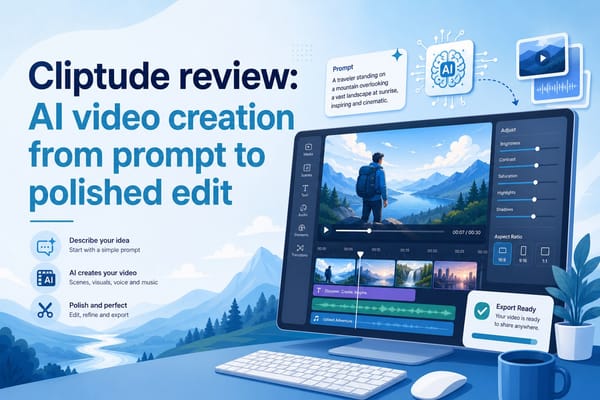
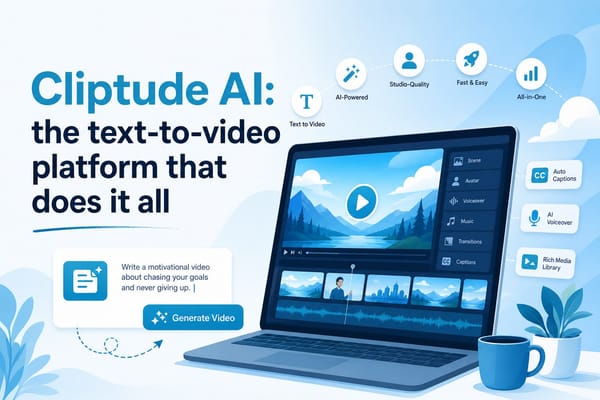
Cliptude describes itself as an AI-powered text-to-video platform, and that label is accurate but undersells the scope of what it actually does. The process starts with a prompt or a script you supply. From there, Cliptude handles research, scripting, footage sourcing, motion graphics generation, and final editing automatically. The output is a polished video ready for upload.
Let me break down each stage so you can see where the real value lives.
Research and scripting
If you start with just a topic rather than a full script, Cliptude does the background research and writes the script for you. This is genuinely useful for faceless channel creators who want to publish content in niches they are still learning. You do not need to become an expert before you can publish. The platform finds the relevant information, structures it logically, and writes narration that sounds like it came from a knowledgeable human rather than a content farm.
The scripting quality matters more than almost any other part of the pipeline. Even with perfect footage and polished motion graphics, a poorly written script will drive viewers away before the video finishes. Cliptude produces scripts that follow a clear narrative arc, use concrete examples rather than vague generalizations, and are written at a level that holds attention through a full watch.
If you already have a script, you can supply it directly and skip the automated writing stage. That flexibility matters if you have a specific angle, brand voice, or set of talking points you want to protect. Some creators write their own outlines and let the platform fill in the narration. Others supply complete scripts word for word. Both approaches work, and the platform adjusts accordingly.
Footage sourcing
For documentary and listicle videos, B-roll is everything. Cliptude automatically sources footage to match the script. This is where a lot of competing tools stumble. They either give you generic clips that barely relate to the topic, or they require you to browse and select each clip manually. Cliptude pulls relevant footage automatically based on what is being discussed in each segment of the script.
For creators running channels in news, history, travel, science, or finance, this alone saves multiple hours per video. Consider what manual footage sourcing actually costs: browsing a stock library, previewing clips, downloading files, organizing them by segment, and then cutting them into the timeline. On a ten-minute video covering a topic like the history of space exploration or the causes of the 2008 financial crisis, that process can take three hours or more before any editing begins. Cliptude removes that entire stage from your workflow.
The footage that gets pulled is also matched to the topic rather than pulled from a generic category. A segment about volcanic eruptions gets footage of eruptions, not just vague geological imagery. That specificity matters for viewer experience and for how professional the finished video actually looks.
Motion graphics and animation
Cliptude supports multiple visual formats, and this is one of the more interesting parts of the platform. Beyond standard B-roll coverage, you can produce whiteboard animations and stickman-style explainer videos. If you run an educational or explainer channel, these formats tend to perform well because they match the visual style audiences expect from that kind of content.
Title cards, text overlays, transitions, and lower thirds are generated automatically. You are not manually placing text on a timeline, adjusting keyframes, or matching fonts across thirty cuts. The platform builds the visual layer as part of the production process, and the result looks consistent and intentional rather than assembled in a hurry.
For creators who have tried to learn video editing and found the learning curve too steep, or who have spent money hiring editors only to be disappointed with turnaround time, this automated visual layer is the part that changes the economics of the whole operation.
Final editing and output
The finished video comes out edited. Cuts are made, audio is synced, transitions are in place, and the overall pacing matches what you specified. You are not handed a pile of assets and told to assemble them. You get a video.
For creators without editing skills, this is the part that changes everything. The gap between having a good idea and publishing a professional video used to require either years of practice with editing software or the budget to hire someone who had already put in that time. Cliptude closes that gap without requiring either.
For creators with editing experience, the value is in speed. What used to take an afternoon now takes significantly less time, and you can redirect that freed-up time toward strategy, audience development, or simply producing more videos.
Format options
Cliptude produces YouTube videos, YouTube Shorts, documentaries, TikTok-ready content, Instagram Reels, animations, and music videos. That range covers most of what a creator working across platforms actually needs. You can use the same platform for your long-form channel content and your short-form distribution without switching tools or learning a second system.
The format flexibility also means you can repurpose content intelligently. A ten-minute documentary on a topic can generate multiple short-form clips, each serving as a standalone piece of content while also driving traffic to the full video. That kind of content pyramid approach multiplies your output from a single production session without proportionally increasing your workload.
Commercial rights
Creators and marketers using Cliptude retain full commercial rights to the content they produce. That means you can monetize on YouTube, run ads through brand deals, license the content, or use it in client work without worrying about IP conflicts. For solo entrepreneurs and small media teams building a business around video, this is not a minor detail. It determines what you can actually do with the work you produce.
Some platforms in this category retain rights to the AI-generated elements or restrict commercial use to higher-priced tiers. Cliptude does not operate that way. You produce the content, you own the rights, and you decide how to monetize it.
Credit-based pricing
Cliptude uses usage-based credit pricing rather than a flat monthly subscription. This structure makes sense for the way most creators actually work. If you publish four videos one month and twelve the next, your cost reflects your actual usage. You are not paying for capacity you do not use, and you are not locked into a tier that caps your output right when your channel starts to grow.
For small teams producing videos for clients, this pricing model also makes project-based billing straightforward. You know your production cost per video, and you can build that into your project pricing without guessing at how many videos a flat monthly fee will realistically cover.
Multilingual production
One thing worth noting for creators building content for specific regional audiences: Cliptude supports video production in multiple languages. If you want to reach viewers in regions where English is not the primary language, that capability opens real opportunities. The barriers to producing multilingual content are low when the platform handles the production side, and the competitive landscape in many non-English niches is far less crowded than in English-language content.
For context on how language-specific AI video production works in practice, this piece on a free Urdu AI video generator for creators covers the underlying approach well. And if you are curious about non-English production more broadly, this guide on how to make an AI video in Nepali language shows how the same workflow translates across different languages and writing systems.
How to get the most out of Cliptude for your channel
Using a platform like Cliptude well is not just about knowing the features. It is about fitting the tool into a workflow that actually scales. Here are practical approaches for different creator types, along with general principles that apply regardless of what kind of channel you run.
For faceless YouTube documentary channels
This is arguably the strongest use case for Cliptude. Documentary-style content is research-heavy, footage-heavy, and time-consuming to script and edit manually. A channel covering true crime, history, science, or world events can use Cliptude to take a topic from zero to upload-ready in a fraction of the time it would take a human editor working alone.
The key is giving the tool enough directional information at the prompt stage. Instead of a one-word topic like 'volcanoes,' try a more specific angle: 'the five most destructive volcanic eruptions in recorded history, explained for a general audience who has never studied geology.' That kind of specificity helps the research and scripting phases produce content that actually matches your channel's niche rather than generic overview material that could have come from any source.
Think about what makes your channel distinct. Is it tone? Pacing? A particular perspective on topics? The more you encode that into your initial prompt or your supplied script, the more the output will feel like your channel rather than a generic AI product. The platform gives you tools, but the editorial direction still comes from you.
For documentary channels posting on a regular schedule, Cliptude's speed advantage compounds over time. If producing one video used to take you ten hours and now takes three, that difference does not just let you publish more videos. It gives you back time to focus on the parts of channel growth that actually require human judgment: reading your analytics, engaging with your audience, identifying which topics are gaining traction, and refining your positioning within your niche.
For short-form creators on TikTok and Instagram Reels
Short-form content lives and dies on its first three seconds. The hook determines everything. When you are using AI to produce shorts, you want to pay close attention to how the opening of your script lands before you let the platform run with it. If you supply your own script rather than using the auto-generated one, you can control the hook directly and make sure it earns the viewer's next twenty seconds.
For creators thinking about click performance more broadly, understanding how titles and thumbnails drive views is worth your time alongside the production side. This article on how to use a clickbait text generator to boost video clicks covers that angle in practical terms and pairs well with the production efficiency Cliptude provides.
One workflow that works well for short-form creators: produce a long-form video first, then use the short-form format to create clips that promote the main piece. Cliptude handles both formats, so you can build a content pyramid from a single topic without switching tools or workflows. You spend one session on topic development and prompt writing, and you come out with both a full-length video and several short-form pieces that drive traffic back to it.
For TikTok in particular, consistency of posting matters more than any individual video's quality. The algorithm rewards regular publishing. When production is fast, you can maintain that consistency without burning out on the manual work that used to make it unsustainable.
For solo entrepreneurs and small media teams
If you are a solo operator or a team of two or three people, your bottleneck is almost always time. You have ideas. You have a topic calendar. You know what you want to publish. But producing the videos takes so long that the calendar slips and posting frequency drops. One delayed video becomes two, and then the whole publishing rhythm breaks.
Cliptude removes most of the production work from your plate. You can focus on strategy, topic selection, and audience development while the platform handles the heavy lifting of actually making the videos. That shift in where you spend your time is significant if you are trying to grow a channel alongside running a business. The two things used to compete with each other for the same hours. With production handled, they do not have to.
For small teams producing videos for clients, the credit-based pricing also helps with project-based billing. If you are producing videos professionally, you pay for what you produce and can build that cost directly into your project pricing. You are not carrying a flat monthly overhead that erodes your margin on smaller projects.
One practical tip for small teams: designate a single person as the prompt writer and editorial lead, even if multiple people are involved in topic research. The consistency of the output improves significantly when the same person is writing the initial prompts and reviewing the scripts before production runs. It keeps the voice and angle consistent across videos rather than having the output shift depending on who set up the job.
For educational and explainer channels
Whiteboard and stickman animation formats are a strong fit for topics in math, science, economics, language learning, and professional skill development. The visual format signals 'educational' to an audience immediately, which sets expectations and often improves watch time for information-dense content. Viewers who click on an explainer video are already primed to pay attention. The format reinforces that intention.
If you run a channel in this space, Cliptude's animation output gives you a professional visual style without the cost of hiring an animator or learning animation software yourself. Professional animation work is expensive. Even basic whiteboard-style animation, when hired out, can run hundreds of dollars per finished minute. At that rate, producing a consistent library of educational content requires either a substantial budget or a willingness to do the work yourself, which takes time most solo creators do not have.
The scripts for educational content tend to benefit from being more structured than entertainment content. Clear numbered steps, explicit transitions between concepts, and concrete examples at each stage all improve comprehension and retention. Supplying your own detailed outline or full script before the platform fills in the narration can produce cleaner results than starting from a broad topic prompt. The more structure you bring in, the more the output reflects a carefully designed lesson rather than a general overview.
For creators monetizing AI-generated content
Monetization strategy matters from day one, even before your channel qualifies for ad revenue. YouTube's Partner Program requires channels to meet certain watch time and subscriber thresholds before ad revenue begins. In the meantime, many creators use affiliate marketing, sponsorships, or digital product sales to generate income from their audience.
Because Cliptude gives you full commercial rights to the output, you have real flexibility here. You can run brand integrations, sell the content to media companies, build a subscription-based content library, or license individual videos for commercial use. The platform does not restrict what you do with the videos you produce, which means your monetization options are determined by your strategy and your audience, not by the terms of your production tool.
For creators in the business or finance niche, affiliate deals can generate meaningful income long before ad revenue becomes significant. For educational creators, selling a companion course or workbook alongside your YouTube content can outperform ad revenue even at high subscriber counts. Cliptude's commercial rights provision supports all of those paths.
General principles for getting better output
First, treat your initial prompt or script as the most important input in the process. The more specific and well-structured your starting point, the better the output across every subsequent stage. Garbage in, garbage out is a real dynamic in AI video production. A vague prompt produces a generic video. A specific, well-framed prompt produces something that actually feels tailored to your niche and audience.
Second, review the script before committing to production if the platform allows for review steps. Catching a factual error or an awkward phrase at the script stage is far easier than noticing it after the video is fully rendered. This is especially important for channels where accuracy matters, like finance, science, or history. A single significant error can cost you credibility with an audience that knows the subject.
Third, think about your posting schedule before you start producing. It is tempting to produce ten videos in a week when the tool makes production fast. But publishing ten videos in a single week and then going quiet for a month is worse for channel growth than a consistent one or two videos per week over time. Use the efficiency Cliptude gives you to build a content buffer, not to flood your upload queue all at once. A buffer of four to six finished videos gives you room to stay consistent even when other parts of your life or business demand more attention than usual.
Fourth, track what performs. The platform speeds up production, but distribution, topic selection, and audience feedback are still your job. Pay attention to which videos get the best watch time, click-through rate, and comment engagement. Use that data to guide your next batch of prompts. The feedback loop between production and performance is where a channel actually improves over time, and no platform automates that part for you.
Fifth, use the language support strategically. If there is a growing audience for your topic in a specific language and not many channels serving that audience well, producing content in that language can be a real competitive advantage. The barriers to doing that are low when the platform handles the production side. You are competing in a less crowded space with the same production quality as you would have in English, and that combination can accelerate growth faster than adding another English-language channel to an already saturated niche.
Cliptude sits in a category of tools that is growing quickly because the demand is real. Creators want to publish more without working longer hours. Small teams want professional output without production budgets. Solo entrepreneurs want to compete with larger media operations on both quality and volume. The technology now exists to support all of that, and Cliptude is one of the more capable platforms I have come across for doing it end to end.
If you have been using Vidrush or evaluating it alongside other options, the comparison comes down to what you actually need from the full pipeline. Cliptude covers research, scripting, footage sourcing, motion graphics, editing, and final output in one workflow, with commercial rights and usage-based pricing that scales with how you actually work. That combination is worth testing seriously if you are building a video content operation that needs to run efficiently at whatever pace your channel demands.
Ready to take the next step?
Ready to see what Cliptude can do for your channel? Head over to Cliptude and try it with a topic you have been wanting to cover. The credit-based pricing means you can test it on a real project without committing to a flat monthly plan before you know how well the output fits your workflow.