
Vidrush referral code: Is Cliptude a better alternative

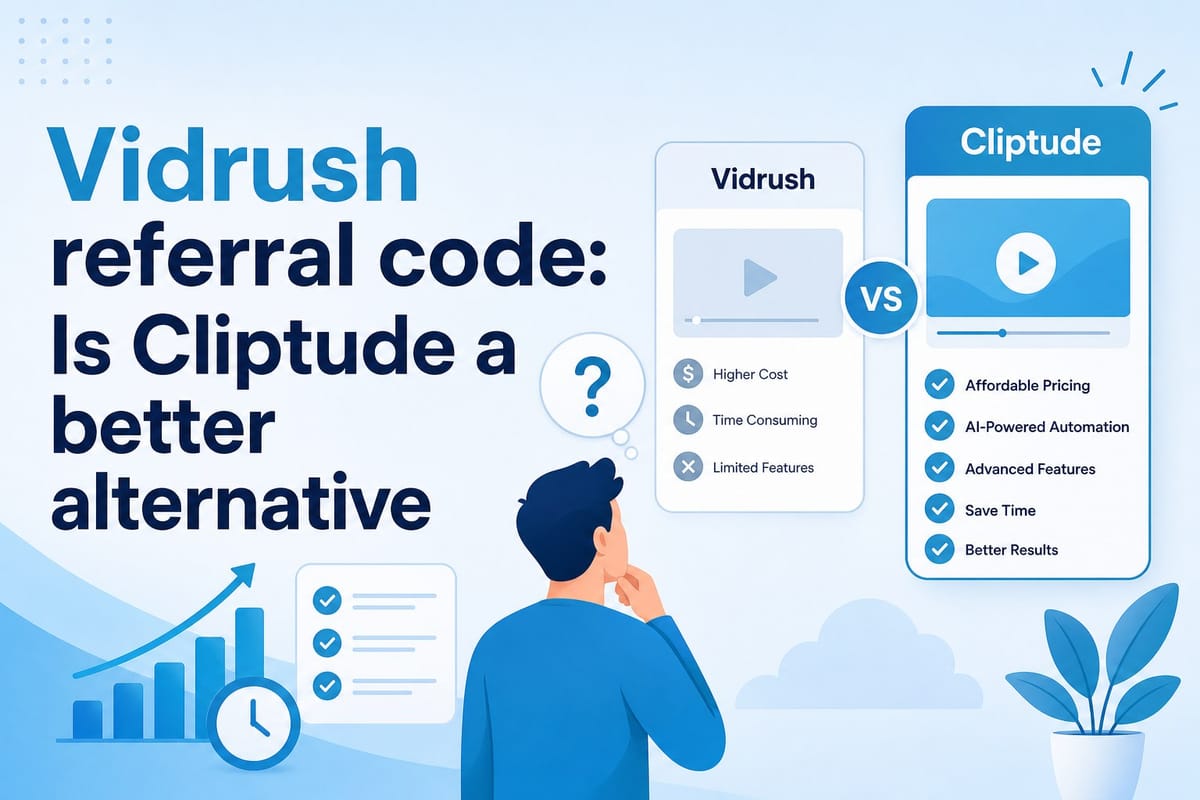
Table of contents
1. What you are actually looking for when you search for a vidrush referral code
2. How Cliptude compares to what Vidrush offers
3. Who should seriously consider switching to Cliptude
If you have been searching for a vidrush referral code, you are probably looking for a discount or bonus on a video creation platform. That search makes sense. Video tools can be expensive, and any way to lower the cost matters. But before you spend time hunting down a working code, it is worth asking a bigger question: is Vidrush actually the right tool for what you want to build? I have looked at what Vidrush offers, and I want to walk you through how it compares to Cliptude, an AI-powered text-to-video platform that handles the entire production process from a single prompt. By the end, you will have a clear picture of which tool fits your goals, your budget, and the kind of content you want to make.
What you are actually looking for when you search for a vidrush referral code
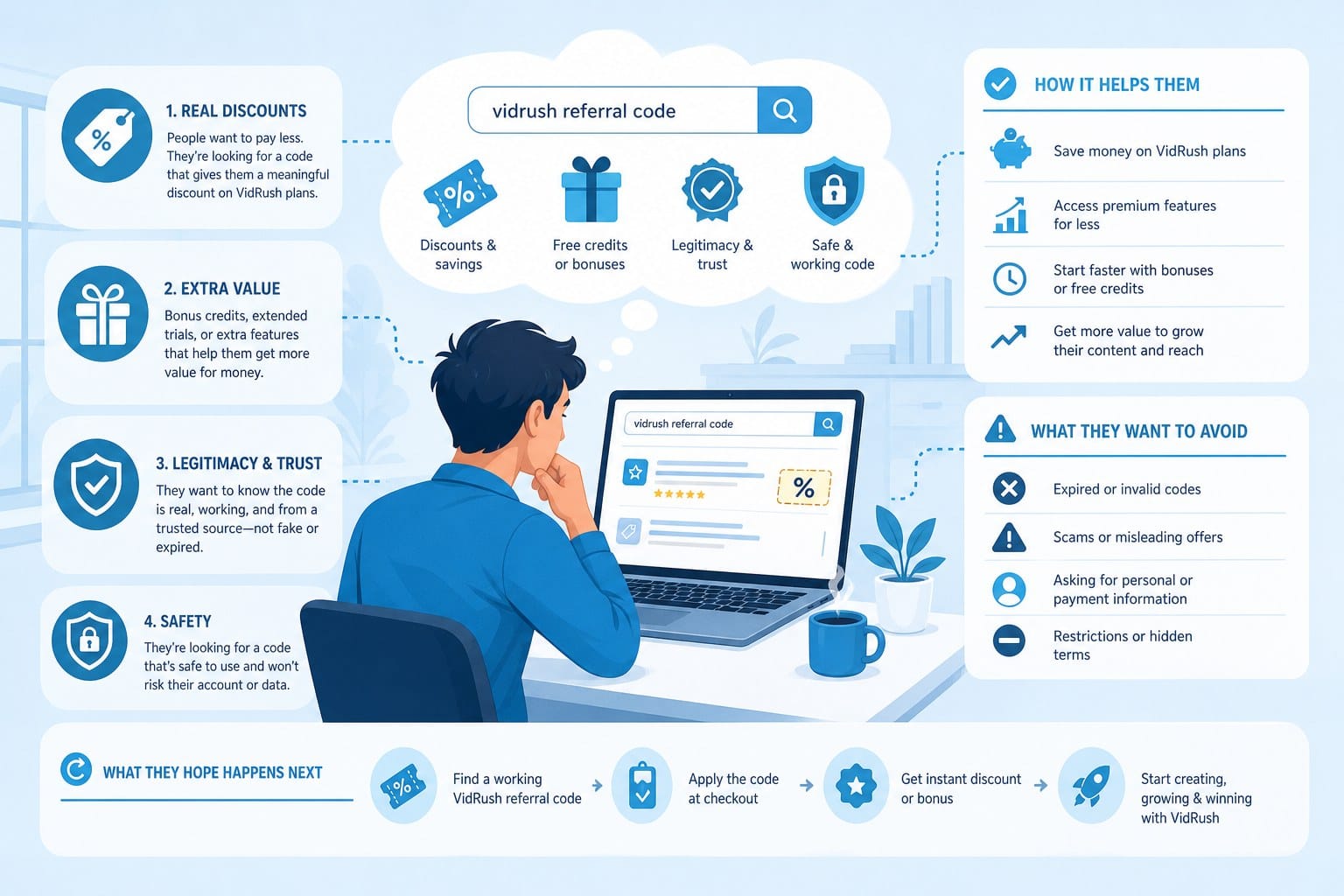
Let me be honest about what the vidrush referral code search usually signals. Most people typing that phrase are not deeply loyal to one platform. They are creators who want to produce videos faster and cheaper, and they are hoping a discount code will make that happen. That is a completely reasonable goal. But referral codes are a short-term fix. They might save you a few dollars on your first purchase, but they do not change whether a tool is actually the right fit for the work you are doing.
VidRush is marketed as a platform that helps creators produce faceless YouTube videos using stock footage, voiceovers, and automated editing. It appeals to people who want to run YouTube channels without appearing on camera. If that describes you, then you are in the right category of tools. But the category has grown a lot in the past two years, and the options inside it vary widely in terms of what they can actually produce.
When creators look for a vidrush referral code, they are often also signaling that they are early in their research. They have seen ads or heard about the tool from another creator, and they want to try it at a lower price point before committing. That caution is smart. The problem is that many creators spend weeks on a platform before realizing it cannot produce the quality or format of video they actually need.
So instead of just chasing a discount, I want to help you evaluate what you need from a video creation platform. Ask yourself a few direct questions. Do you want to produce long-form documentary content, or are you focused on short-form clips? Do you need animation formats like whiteboard or stickman videos, or are you happy with stock footage edits? Do you want a tool that writes the script for you, or do you already have scripts ready to go? Do you need commercial rights to everything the tool produces? Your answers to these questions will do more for your channel than any referral code ever could.
Here is another thing worth knowing. Many creators who start searching for a vidrush referral code eventually end up evaluating several platforms side by side. That comparison process is where the real decision gets made. And Cliptude keeps coming up in those comparisons because it handles more of the production pipeline automatically than most competing tools.
Cliptude is built for creators who want to go from a simple idea to a finished, polished video without touching editing software. You type a prompt or paste a script, and the platform researches the topic, writes or refines the script, sources footage, generates motion graphics, adds voiceovers, and edits everything into a complete video. That is a meaningfully different offering from a tool that automates some of the editing but still expects you to supply your own script or footage.
If you are building a faceless YouTube channel around documentary content, educational explainers, or listicle videos, the difference matters a lot. Producing that kind of content consistently requires a workflow that does not bottleneck at the script or the edit. Cliptude removes both of those bottlenecks by handling them inside the platform.
How Cliptude compares to what Vidrush offers
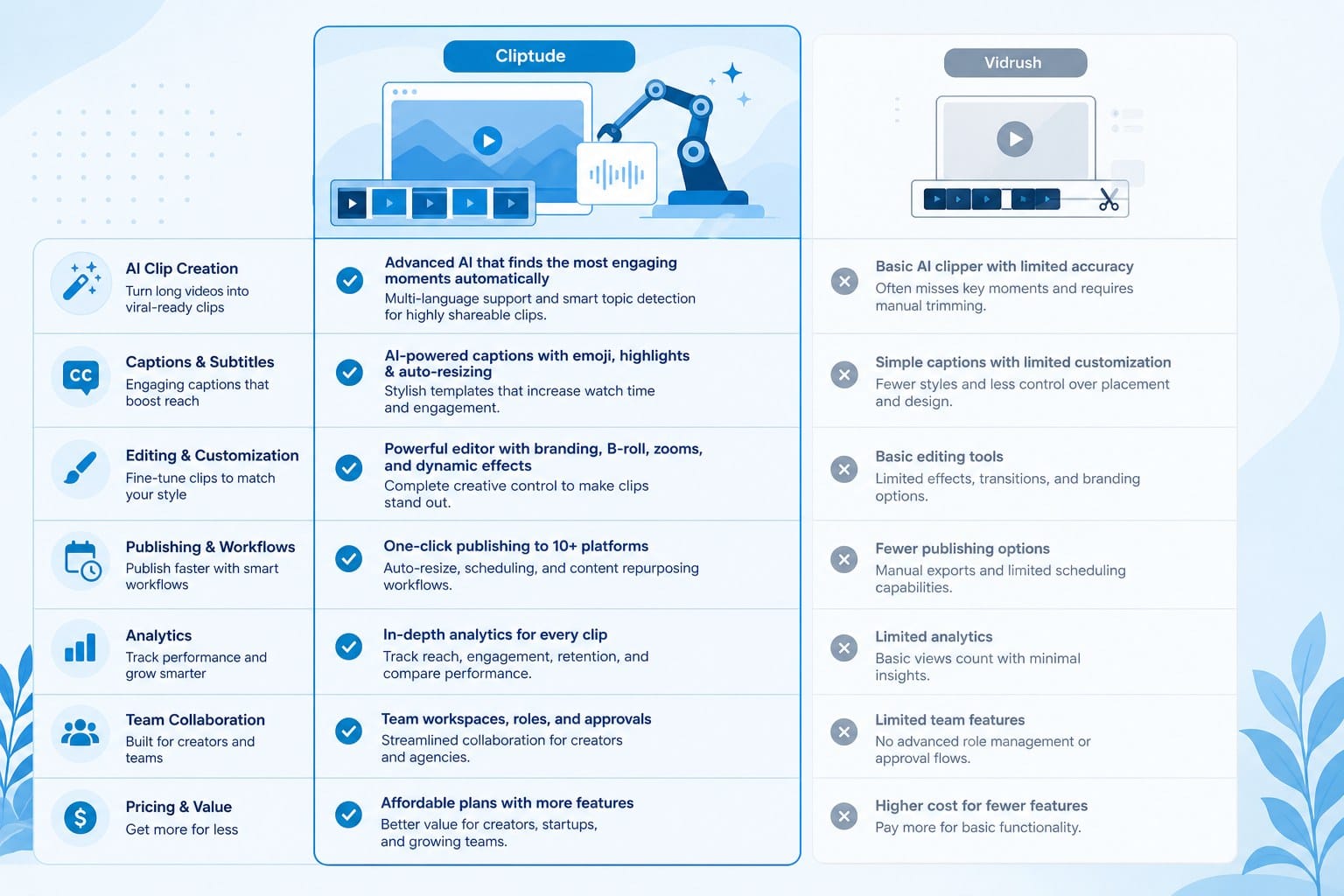
To make a fair comparison, I want to walk through the core functions that matter to faceless YouTube creators and short-form content producers. These are the areas where the two platforms take noticeably different approaches.
The first area is script and research generation. When you are building a channel around topics like history, true crime, science, finance, or travel, you need a steady supply of well-researched scripts. Writing those scripts yourself takes hours. Hiring a writer adds cost. Cliptude handles this automatically. You describe the video you want, and the platform researches the topic and produces a structured script ready for production. That single feature saves a significant amount of time for creators who are publishing multiple videos per week.
Vidrush focuses more on the editing and assembly side of production. It works well if you already have a script or know exactly what you want to say. But for creators who are starting from just an idea, that gap in the workflow means you are still spending hours on research and writing before the tool even becomes useful.
The second area is footage sourcing. Both platforms use stock footage to build videos, but the way they source and integrate that footage is different. Cliptude pulls footage automatically based on the content of the script, which means the visuals are matched to what the narration is actually saying at each moment. This produces a more coherent viewing experience. You are not left with generic b-roll that vaguely relates to the topic. The footage choices are driven by the specific content.
For creators making documentary-style content, this matters enormously. A video about the history of a specific city needs footage that reflects that place and that time period, not just generic cityscapes. When the footage sourcing is automated and context-aware, the final video feels more intentional and professional.
The third area is animation and motion graphics. Cliptude supports multiple video formats including stickman animations, whiteboard videos, and motion graphics for educational content. This is a significant advantage for creators in the education and explainer space. Animation is one of the most effective formats for teaching complex concepts, and it does not require any on-camera presence. But producing animated videos traditionally requires either expensive software or a skilled animator. Cliptude generates these formats from a prompt, which makes them accessible to solo creators and small teams who do not have those resources.
For creators focused on YouTube Shorts, TikTok, and Instagram Reels, Cliptude also handles short-form video production. You can generate polished vertical videos that are ready to publish without any additional editing. This matters for creators who want to maintain a presence on multiple platforms without doubling or tripling their workload.
The fourth area is commercial rights. If you are monetizing your content through YouTube ad revenue, brand sponsorships, or selling videos to clients, you need full commercial rights to everything the platform produces. Cliptude provides those rights, which means you can use the videos however you want without worrying about licensing issues down the line.
I also want to address the music video use case specifically, because it comes up more often than people expect. Some creators use AI video platforms to produce music videos for original songs or for content set to music. Cliptude handles this format as well, generating visuals that match the tone and pacing of the audio. If this is something you are working on, it is worth reading more about how AI music video generators create professional videos from a prompt to understand what is possible with this approach.
Pricing is also worth addressing directly. Cliptude uses usage-based credit pricing, which means you pay for what you produce rather than a flat monthly subscription whether you use the tool or not. For creators who are building toward consistent output but are not yet publishing every single day, this pricing model makes more sense than a subscription that charges the same amount regardless of how many videos you actually make. And because the pricing is usage-based, there is no need to hunt for a referral code or wait for a promotion to make the cost reasonable. You start at a level that matches your current output and scale up as your channel grows.
The comparison I keep coming back to is this. If you are already producing high volumes of video and you just need a faster editing tool, Vidrush might serve that specific function. But if you are trying to build a serious content operation where you go from zero to finished video consistently and at scale, Cliptude covers more of the production process and does it in a way that is designed for the formats and audiences that matter most to faceless YouTube creators and short-form content producers.
Who should seriously consider switching to Cliptude
I want to be specific here because not every creator has the same needs. There are some situations where Cliptude is clearly the stronger choice, and I want to describe those situations in enough detail that you can honestly assess whether you fall into one of them.
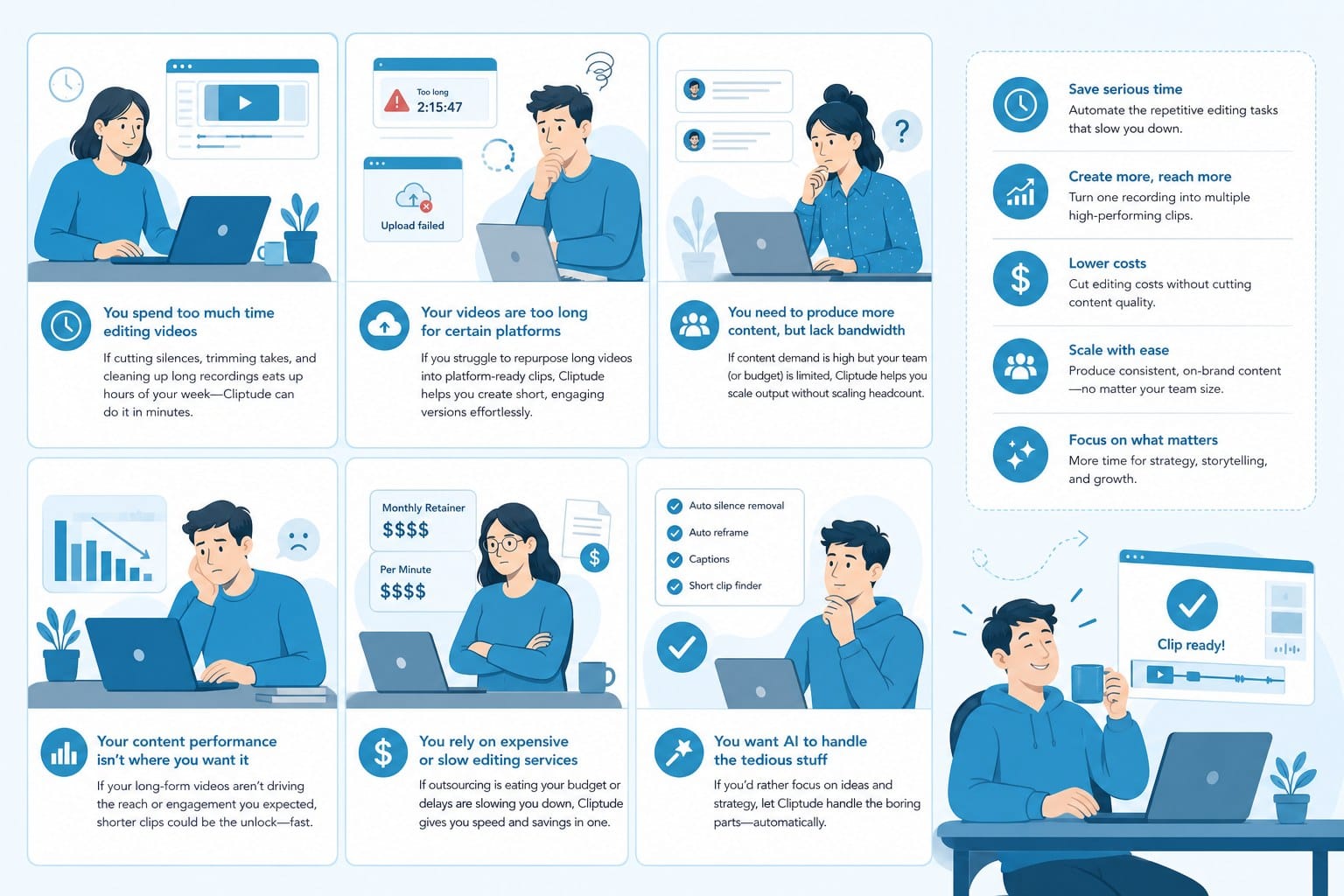
The first situation is creators who are building faceless YouTube channels around documentary or listicle content. This category includes channels about history, geography, true crime, finance, psychology, science, and similar topics. These channels work well because the content is research-driven and does not require a host to be on camera. But the research and scripting process is the most time-consuming part of production, and it is the part that most video tools do not help with.
Cliptude removes that bottleneck by handling research and scripting inside the platform. You describe the video you want, and the platform builds the foundation. Then it sources footage, generates graphics, adds a voiceover, and edits everything together. For a creator who wants to publish three or four videos per week without a team, this kind of end-to-end automation is not a luxury. It is a requirement.
The second situation is solo entrepreneurs and small media teams who want professional video output without hiring editors or animators. Video production is expensive when you outsource it. A professionally edited 10-minute YouTube video can cost hundreds of dollars per video if you hire a freelance editor. Multiply that by the number of videos you want to publish each month, and the cost becomes prohibitive for most solo creators and small teams.
Cliptude brings that cost down significantly by automating the production process. The videos it produces are polished and ready to publish, which means you are not paying for an editor's time and you are not spending your own hours in a timeline trying to piece clips together.
The third situation is creators who want to produce content in multiple languages or serve audiences in specific regions. Faceless video formats work especially well for international content because there is no host with a specific accent or regional identity attached to the channel. If you are creating content for Hindi-speaking audiences or Nepali-speaking audiences, for example, Cliptude supports those production workflows. You can learn more about how to make AI YouTube videos in Hindi with the right tools and how the platform handles Nepali AI video generation for YouTube to get a sense of what that looks like in practice.
The fourth situation is creators and marketers who want to monetize AI-generated video content through YouTube ad revenue or client work. For this to work, you need full commercial rights to the content you produce, and you need videos that meet the quality bar for platform monetization. Cliptude provides both. The videos are high enough quality to be competitive on YouTube, and the commercial rights are included so you can use them however you want.
I want to address something that comes up often in creator communities around this topic. Some creators worry that AI-generated videos will not perform as well on YouTube because the algorithm or viewers will identify them as low-quality. That concern is valid when applied to tools that produce obvious, templated output. But when the production quality is high and the content is well-researched and structured, viewers and the algorithm respond to it the same way they respond to any other well-made video. The format matters less than the quality and the relevance.
Cliptude is designed to produce videos that hold up to that quality standard. The footage is matched to the content, the narration is clear, the editing is tight, and the motion graphics are professional. That is the output that gets views and builds a channel audience over time.
For creators who are scaling output for TikTok, Instagram Reels, and YouTube Shorts simultaneously, the platform handles the short-form formats as well as long-form. This is important because building an audience on multiple platforms at once requires a volume of content that is not sustainable if you are editing every video by hand. Cliptude lets you generate short-form clips that are native to each platform format without adding significant time to your workflow.
One more thing I want to address directly: the appeal of referral codes and discount programs. I understand why creators look for a vidrush referral code or similar discounts on video platforms. Budget matters, especially when you are early in building a channel and revenue is not yet coming in consistently. But the better financial move is usually to find a tool with pricing that genuinely matches your production volume, rather than finding a discount on a tool that is only a partial fit for your needs.
Cliptude's usage-based credit system means you are not locked into a subscription level that assumes you are publishing every day when you might only be publishing twice a week. You use credits when you make videos, and the cost scales with your actual output. That kind of pricing structure gives you more control over your spending than a monthly subscription with a referral code applied to the first month.
If you are still on the fence, the most useful thing you can do is think concretely about the videos you want to make over the next three months. How many videos? What topics? What format? How long? Once you have those answers, it becomes much clearer which platform can actually deliver what you need. For most faceless YouTube creators, short-form producers, and solo entrepreneurs who want professional video output without a production team, Cliptude covers more ground and does it in a way that is built to scale with you as your channel grows.
Ready to take the next step?
If you are ready to build a real content operation without spending all your time scripting, editing, or hunting for referral codes, visit Cliptude at https://cliptude.com and see what your first video looks like. The platform is designed to take you from a prompt to a finished, publish-ready video faster than any workflow you have tried before.



