Vidrush referral code on Reddit: what creators found instead

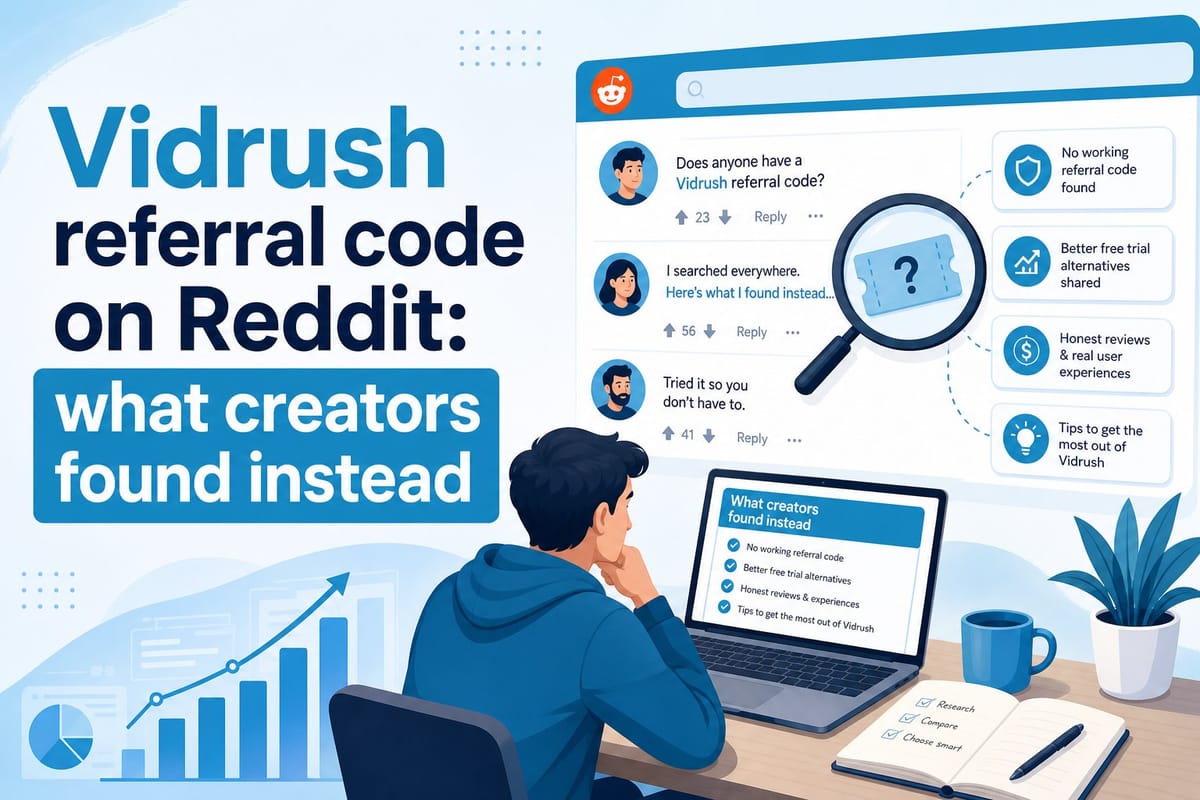
Table of contents
1. What people actually find when they search for a Vidrush referral code on Reddit
2. Why chasing referral codes distracts creators from decisions that actually matter
3. What creators found instead, and why Cliptude is worth a serious look
If you have spent any time searching for a vidrush referral code reddit thread, you already know how the story goes. You find a post that looks promising, click through, and end up staring at a dead link, an expired code, or a comment section full of people asking the same question you are. That rabbit hole is a real time sink, and it almost never pays off. This article breaks down what creators actually find when they search for Vidrush referral codes on Reddit, why that search rarely produces anything useful, and what smarter options exist for creators who want to produce more video content without burning through their budget chasing discounts that may not even exist. By the end, you will have a clearer picture of how to choose AI video tools based on what actually matters rather than what happens to have a promo code floating around this week.
What people actually find when they search for a Vidrush referral code on Reddit
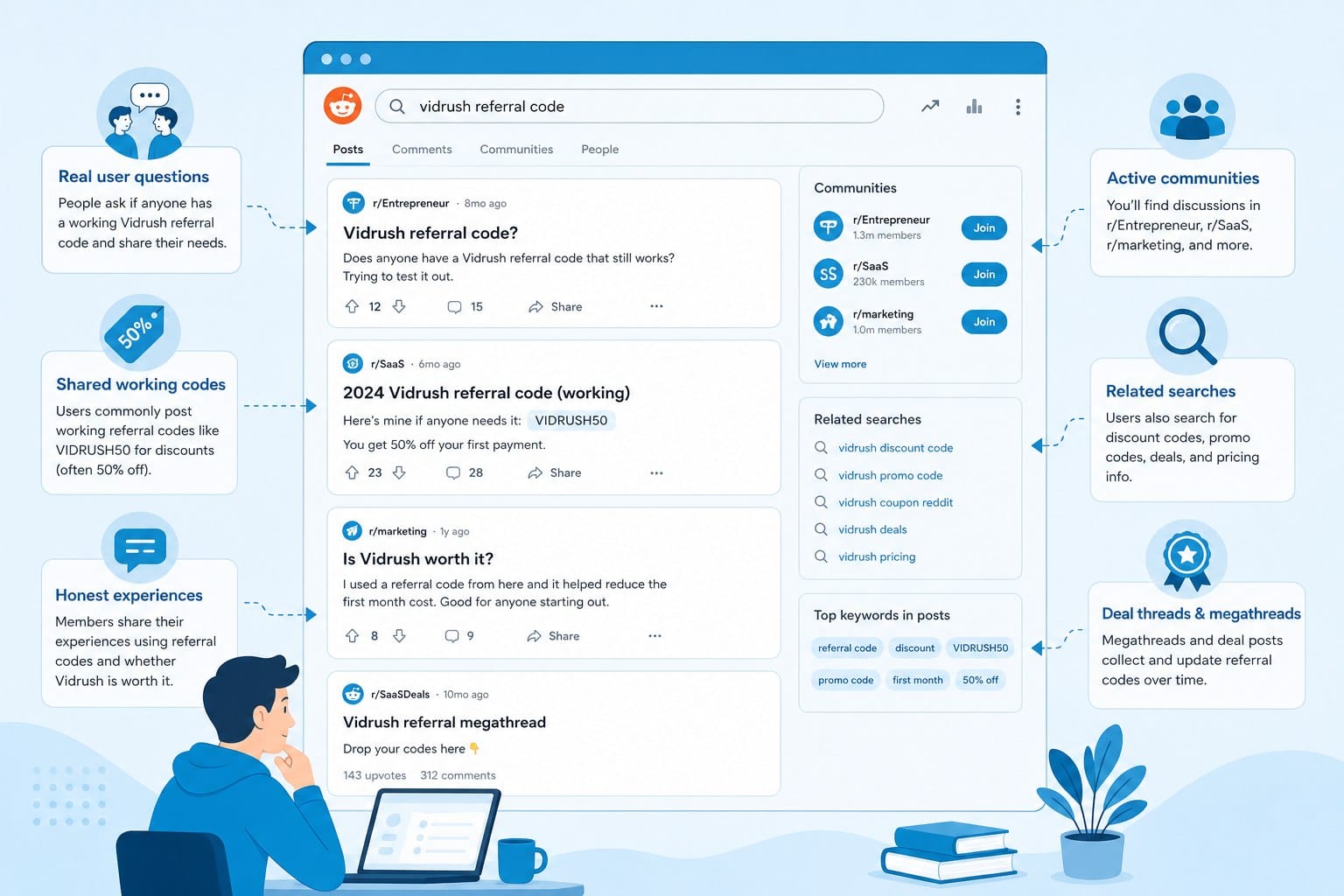
Let me be direct about what a typical Reddit search turns up. Most threads asking about a vidrush referral code reddit-style are either months old, filled with broken links, or started by accounts that posted once and disappeared. That pattern is familiar to anyone who spends time in creator communities on Reddit. Discount codes for niche video tools get shared, expire within days, and then the thread sits there indefinitely, ranking in search results and misleading anyone who stumbles across it later.
The honest reality is that Vidrush, like many AI video tools, does not appear to run a consistent public referral program that generates working codes for general audiences. Some users report seeing affiliate-style links tied to specific influencers or YouTube reviewers, but those are usually tied to a partner's commission structure rather than genuine savings for the end user. In other words, the link benefits the person sharing it more than it benefits you. The discount framing is a sales mechanism dressed up as community generosity.
Reddit communities like r/juststart, r/youtubecreators, and r/passive_income do sometimes surface genuine tool discounts. But the signal-to-noise ratio is low. For every thread with a real working code, there are ten threads with outdated information, speculation, or links to sites you would rather not visit. Creators who rely on Reddit as their primary source for software deals often waste more time than they save, and they frequently end up with tools that were not the right fit to begin with.
Here is what I did find in those Reddit threads, though, and it is actually more useful than a coupon code. Real users sharing real experiences with the platform. Comments about render quality, turnaround times, customer support responsiveness, and whether the output actually looks polished enough to publish. One user noted that the footage quality felt inconsistent across different topics. Another mentioned that scripts required heavy editing before they were ready to use. A third pointed out that customer support response times were longer than expected during high-volume periods. That kind of unfiltered feedback tells you far more about a platform than any referral link ever could.
Those qualitative impressions matter when you are making a decision about where to put your production workflow. A tool that scores well on a review site but frustrates actual users in practice is not a tool worth discounting your way into. And a tool that users rave about in comment sections, even when they are also frustrated by the pricing, is worth taking seriously on its merits.
If you want a deeper look at what creators are actually saying about Vidrush beyond the referral code hunt, this breakdown of Vidrush Reddit reviews: what creators are actually saying pulls together real sentiment from creator communities and gives you a clearer picture of what to expect before you commit to the platform.
The other thing worth naming is that referral codes as a discovery strategy often push creators toward platforms they would not have chosen on merit alone. You find a code, you feel like you are getting a deal, and you sign up without doing the research you normally would. That works fine for trying a new restaurant. It is a risky way to choose the tool you are going to depend on for your content business.
Think about what happens six months later. You have built a workflow around a platform you chose because of a discount. You have uploaded scripts, learned the interface, and integrated it with your publishing process. Then the tool changes its pricing, drops a feature you relied on, or simply does not keep up with competitors who were solving the same problem more effectively. Starting over is expensive in time and momentum, and it is more likely to happen when the initial selection was discount-driven rather than capability-driven.
The Reddit search also has a structural problem that is worth understanding. Reddit's ranking algorithm surfaces threads based on engagement and recency, but old threads with a lot of comments can stay near the top of search results for years. A thread from eighteen months ago about a Vidrush promo code that worked during a launch promotion will still appear in search results today, even though that code expired long ago and the promotion no longer exists. There is no mechanism that automatically removes outdated deal threads from visibility, so the search experience is perpetually cluttered with information that used to be accurate.
Some creators have started using Reddit's search filters to look only at posts from the past month, which cuts down on outdated results. But even that strategy only works if the right threads exist. For a tool like Vidrush that does not run a public referral program with widely distributed codes, there simply may not be anything useful in the recent window either.
The bottom line on the Reddit search: the time you spend chasing a code that probably does not exist is time you could have spent reading actual user reviews, watching demo videos, or running a free trial to evaluate the tool yourself. That kind of firsthand research takes longer upfront but pays off much more reliably than hoping someone on Reddit posted a working promo link recently.
Why chasing referral codes distracts creators from decisions that actually matter
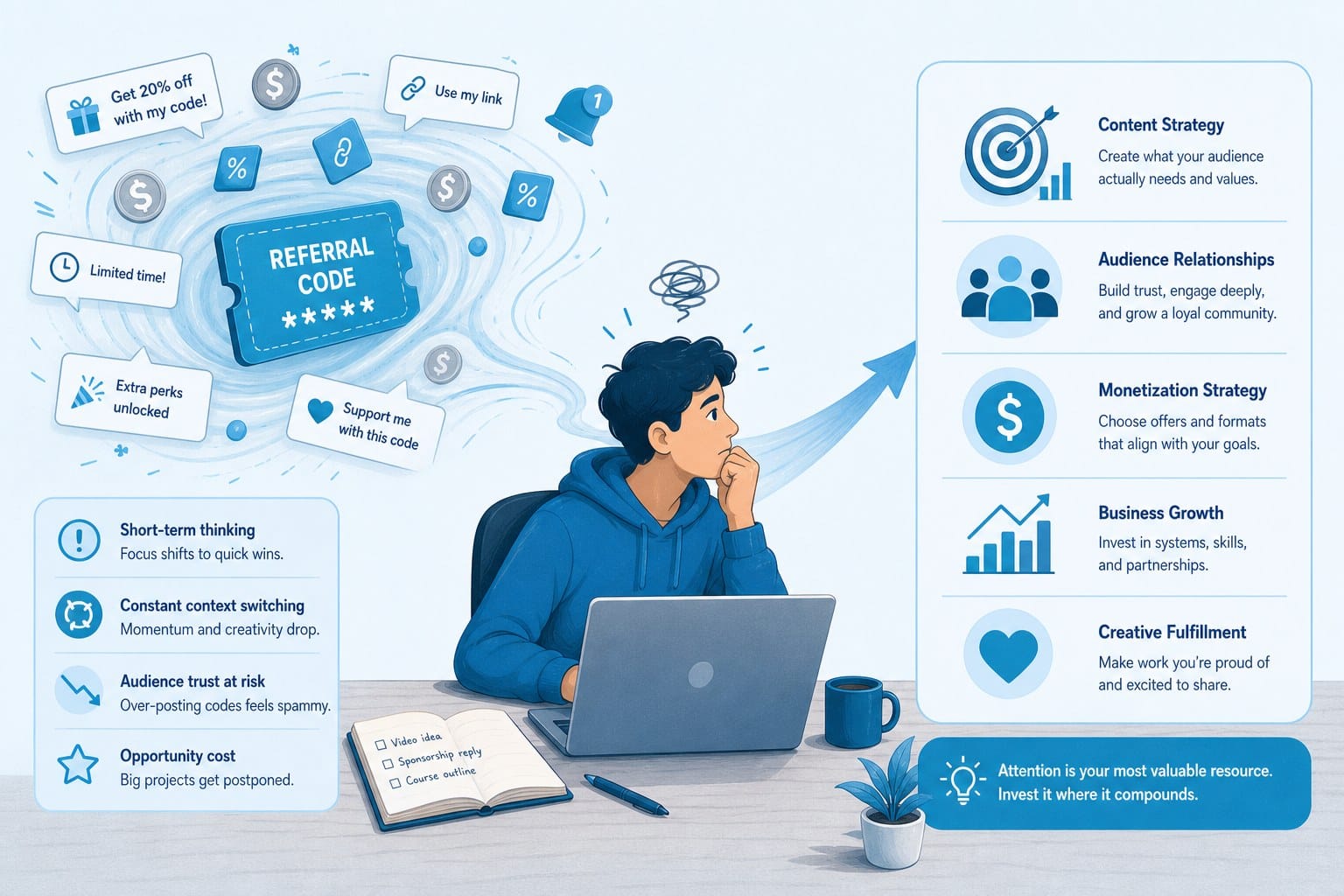
I understand why creators chase referral codes and discount links. Video production tools are not cheap, and when you are building a faceless YouTube channel or scaling a content operation as a solo creator, every dollar saved feels like a meaningful win. The instinct to look for a better deal before committing to a purchase is rational. But the referral code hunt has a real opportunity cost that most creators underestimate, and it quietly pulls focus away from the decisions that actually move a channel forward.
Consider the time cost first. An hour spent digging through Reddit threads, testing dead links, signing up for newsletters hoping to unlock a promo code, and then comparing four different discount aggregator sites is an hour you did not spend scripting your next video, researching your niche, or analyzing what your audience actually responds to. For creators who are already stretched thin, that trade is almost never worth it. Time is the one resource you cannot buy more of, and spending it on a search that yields nothing is a pure loss.
There is a subtler problem, too. When tool selection is driven by discounts rather than fit, you often end up with a platform that does not match your actual workflow. Maybe you needed something that handles long-form documentary-style content but you signed up for a tool optimized for short clips because that was what had a Reddit promo code circulating that week. Now you are either forcing your content into a format that does not suit your niche or you are paying for a second tool on top of the first one to cover the gaps. The ten percent you saved on signup costs you far more in friction and wasted subscription fees down the road.
The creators who build durable channels talk about tools in terms of output quality, workflow speed, and commercial rights. They ask whether a platform can research a topic and produce a complete script, or whether they have to write everything themselves. They ask whether the footage it sources looks current and relevant or whether it feels like generic stock content from a decade ago. They ask whether the final output is commercially cleared so they can monetize without worrying about licensing disputes. These are the questions that determine whether a tool earns its place in your production stack. A ten percent discount on a platform that fails those tests is still a bad deal.
Pricing transparency matters here in a specific way. Some AI video platforms offer a free tier that is genuinely functional and lets you produce real content before committing to a paid plan. Others offer free access that is so limited it functions more like a teaser than a working product, and the limitations only become clear after you have already invested time learning the interface. Knowing which category a tool falls into before you start hunting for discount codes is more valuable than finding the codes themselves.
For anyone unsure about Vidrush's cost structure specifically, this article on Is Vid Rush free to use gives you a clear breakdown of what the platform actually offers at each access level so you know what you are working with before you go looking for ways to reduce the price.
Understanding a real pricing model matters more than finding a referral code because it tells you whether a platform is financially sustainable for the way you actually create. Creators whose output varies significantly from month to month need flexibility. Someone producing thirty videos during a launch push and then dropping to five during a slow month should not be paying the same flat rate in both scenarios. A usage-based model serves that creator better than a fixed subscription, regardless of whether either option has a discount available.
There is also a mental bandwidth cost to the referral code search that does not get discussed enough. When you are actively hunting for a deal, part of your attention stays on the hunt even when you are doing other things. You check back on a thread to see if anyone responded. You open a bookmark to see if a coupon site updated its Vidrush listings. You spend five minutes on a Discord server asking if anyone has a current code. None of those individual actions takes long, but they add up and they keep you in a reactive, searching mode rather than a building mode. The creators I have watched scale successfully tend to make a decision, commit to it, and move on. The perpetual deal-seekers tend to stay stuck in the evaluation phase far longer than necessary.
For creators producing educational content, explainer videos, or documentary-style listicles, the platform's capabilities around research, scripting, and footage sourcing are far more relevant than whether someone on Reddit posted a discount code recently. Those capabilities determine your output quality and your ability to publish consistently at scale. They are worth evaluating rigorously and on their own terms, separate from any conversation about pricing or discounts.
One practical approach that sidesteps the referral code problem entirely: use free trials deliberately. Many AI video platforms offer some form of trial access, and if you treat that window as a genuine evaluation rather than a casual browse, you can learn most of what you need to know about fit before you ever have to make a purchasing decision. Set a specific benchmark, produce two or three test videos on topics similar to your real content, and evaluate the output honestly against what you would need to publish it. That process tells you more than any Reddit thread ever will, and it costs you nothing but focused time.
What creators found instead, and why Cliptude is worth a serious look
Here is what the more thoughtful creators I have followed actually discovered when they stopped chasing the vidrush referral code reddit spiral and started evaluating tools based on what they actually needed. They found that the platforms worth paying attention to are the ones solving the hardest parts of video production, not just one piece of the puzzle.
For faceless YouTube creators specifically, the hardest parts are usually research, scripting, and editing. Research takes time because good educational content requires accuracy, and pulling together reliable sources on a complex topic is not fast work. Scripting takes skill because a script that reads well on the page does not always translate into engaging narration. Editing takes either money, time, or both, especially when you factor in sourcing footage, timing cuts to a voiceover, and adding graphics or motion elements that make the video visually interesting enough to hold attention past the thirty-second mark.
Finding relevant footage that looks current and professional is its own challenge. The free stock footage that saturates AI video tools often has a dated, generic quality that immediately signals to viewers that they are watching templated content. The moment a viewer recognizes that a video was assembled from the same footage pool they have seen in a hundred other videos, the trust and attention you need them to give you starts to erode. Generating motion graphics and animations that do not require a design background is another barrier, particularly for creators in niches like finance, history, and science where visual explanation is a significant part of the value you provide.
Putting all of those pieces together into a finished video that looks professional enough to compete in a crowded niche is genuinely difficult, and most tools only address one or two pieces of that problem. Some platforms are strong on scripting but produce mediocre footage results. Others have good footage libraries but require you to bring your own fully written script. A few handle production well but have licensing terms that make commercial monetization complicated or risky. The tool that handles the full pipeline, from topic to finished video, is the one that actually changes what a solo creator or small team can produce.
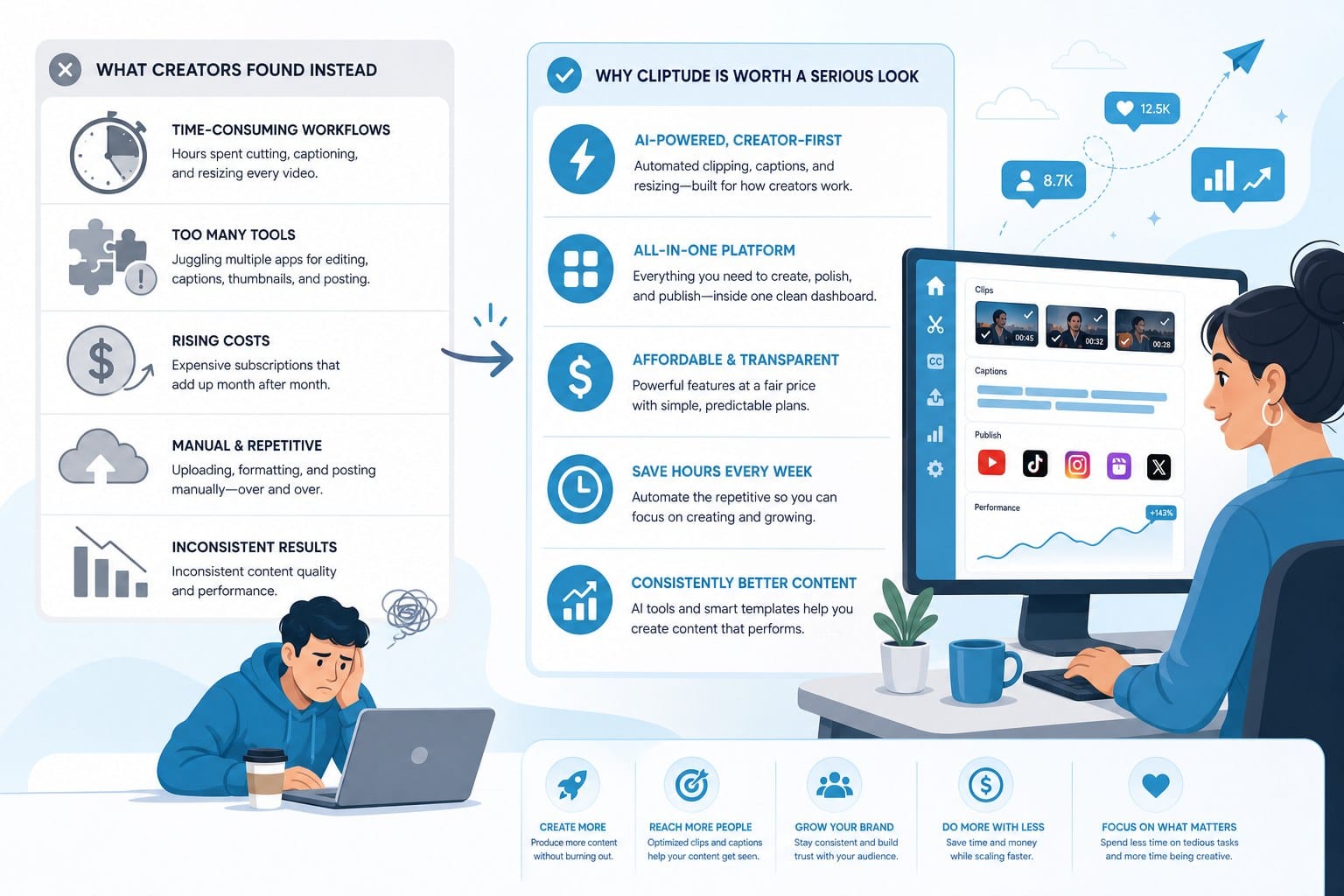
That is where Cliptude stands out in a way worth explaining concretely. Cliptude is an AI-powered text-to-video platform that handles the full production pipeline from a single prompt or script. You give it a topic or a brief, and it handles the research, writes the script, sources footage, generates motion graphics, and edits the final video. The output covers YouTube long-form content, documentaries, YouTube Shorts, TikTok videos, Instagram Reels, animations including whiteboard and stickman formats, and music videos.
For a solo creator or a small media team without a videographer, a dedicated editor, or a motion graphics artist on staff, that is a meaningful practical difference from tools that only handle one piece of the job. You are not coordinating five different platforms, transferring files between them, and hoping the output from one integrates cleanly with the input requirements of the next. You are working from a single prompt to a polished output, and the production decisions that used to require specialized knowledge are handled inside one workflow.
The pricing model is usage-based with credits, which matters specifically for creators whose production volume varies week to week. If you are ramping up for a launch, testing a new niche with high output volume, or going through a slower creative period, you are not locked into a flat monthly subscription that charges you the same rate regardless of how much you actually produce. You use what you need. That flexibility is genuinely useful for the way most independent creators actually work, which is rarely consistent or perfectly predictable across a full year.
Cliptude also includes full commercial rights on the content you produce. That is a non-negotiable requirement for any creator monetizing through YouTube AdSense, brand partnerships, or content licensing. A lot of creators overlook licensing terms when they are evaluating AI video tools, and it becomes a problem the moment a video gets flagged, a brand asks for usage rights documentation, or a music track creates a Content ID claim. Knowing upfront that your output is commercially cleared is one less operational risk to manage.
For creators focused on educational content or explainer videos, the animation formats are especially practical. Whiteboard and stickman animation styles have a demonstrated track record on YouTube for making complex topics accessible to general audiences. Educational channels in niches like personal finance, history, science, medicine, and self-development use these formats constantly because they work. The visual language of animation signals to viewers that they are going to get a clear, structured explanation, and the format holds attention in a way that talking-head videos or pure narration often cannot. Being able to generate those formats directly from a prompt, without hiring an animator or learning motion graphics software, removes a significant barrier for creators who want to operate in those niches but do not have a production background.
One aspect of content production that creators often underestimate until they are deep into a channel is thumbnail strategy. Thumbnails are frequently the last thing on the to-do list and one of the first things a potential viewer actually sees. A video with a weak thumbnail will underperform regardless of how strong the content inside it is, because the thumbnail is the primary signal that tells a viewer whether to click. At scale, generating thumbnail text that actually drives clicks becomes its own repeatable skill. This guide on thumbnail text generator: how to create click-worthy titles fast covers the mechanics of what makes thumbnail text work and how to generate strong options efficiently, which is a useful companion to any AI video production workflow.
The creators who build sustainable channels do not build them by finding the best referral code. They build them by identifying tools that let them produce good content consistently and cost-effectively over a long period of time. Consistency is the variable that matters most in algorithm-driven platforms like YouTube and TikTok. Publishing once a week for two years beats publishing daily for three months and burning out. The tools that enable consistency are the ones that reduce friction at every stage of production, not the ones that were cheapest to sign up for.
Cliptude is built for the creator who is serious about volume and quality at the same time. Whether you are running a documentary-style channel about history or true crime, a listicle channel covering personal finance topics, an educational series about science or technology, or a Shorts operation that publishes multiple videos per day, the platform is designed to absorb the production load that would otherwise require a full team. The research that used to take hours happens inside the prompt. The scripting that used to require a dedicated writer happens before you ever open an editing timeline. The footage sourcing and graphics generation that used to require a separate creative pass happen in the same pipeline.
If the vidrush referral code reddit search is what brought you here, I hope this gave you something more useful than a dead discount link. The real opportunity for AI video creators right now is not in finding slightly cheaper access to tools that already exist. It is in finding the right platform that handles enough of the production process that you can actually scale without burning out, hiring a full team, or spending more time managing production logistics than creating content. That is the search worth spending your time on, and Cliptude is the answer worth evaluating seriously when you get there.
Ready to take the next step?
Ready to stop hunting for discount codes and start producing polished videos from a single prompt? Visit Cliptude to see what AI-powered video production looks like when research, scripting, footage, motion graphics, and editing all happen in one place.