How AI Writes High-Converting Scripts for Ads and Product Videos

Writing a good ad script is harder than it looks. You've got maybe five seconds to grab someone's attention before they skip, scroll, or close the tab. That's not a lot of time to make your pitch, build trust, and push someone toward buying something. Most people underestimate just how much craft goes into those short, punchy scripts that actually work. And when you get it wrong, you're not just wasting creative effort. You're burning ad budget on content that nobody finishes watching.
Here's what's changed though. AI tools have gotten really good at writing scripts that convert. Not just scripts that sound nice or fill a word count, but actual, structured, persuasion-driven copy that moves people to act. Brands big and small are using AI to write ad copy and product video scripts faster than ever, and a lot of them are seeing better results than what they were getting from traditional copywriting workflows. A solo e-commerce founder in her apartment can now produce ad scripts at the same quality level as a creative agency that charges ten thousand dollars a month. That gap has closed dramatically, and AI is the reason why.
This post is going to break down exactly how AI does it, why it works, and what you need to know if you want to start using AI to write your own high-converting ad scripts. Whether you're running paid ads, making product explainer videos, or just trying to get people to click on something, there's a lot here worth paying attention to. We're going to go deep on the structure behind high-converting scripts, walk through the actual process AI uses to build one from nothing, and then talk about how to take that script and turn it into a finished video ad without blowing your budget or your schedule.
What makes a script actually convert
Before we talk about AI, we should talk about what actually makes an ad script work. Because AI doesn't just randomly generate words and hope for the best. It's trained on patterns, and those patterns come from scripts that have actually performed well over time. So understanding the structure helps you understand why AI is so effective at this, and it also helps you give AI the right direction when you're prompting it to write for you.
Every high-converting script follows some version of the same basic flow. It grabs attention fast, usually with a hook that speaks directly to a pain point or curiosity. Then it holds attention by building a little tension or telling a short story. Then it presents a solution, and finally it tells the viewer what to do next. That's it. Hook, problem, solution, call to action. Sounds simple, right? But getting that rhythm right in under 60 seconds is genuinely difficult to do well. Each of those four pieces has to earn its place. You can't rush the problem setup or the viewer won't feel the relief when you present the solution. You can't bury the call to action or nobody knows what to do next. The pacing between all four parts is what separates a script that converts from one that just sits there and sounds fine.
The hook is where most scripts fall apart. Generic openers like 'Are you tired of...' used to work, but audiences have seen them a thousand times. What works now is specificity. 'You're losing money every time someone visits your store and leaves without buying' hits harder than 'Want to grow your business?' because it's concrete, it creates a small moment of recognition, and it implies that there's a number attached to the problem. Specificity creates credibility before you've even introduced your product. AI tools are good at generating specific, emotionally loaded hooks because they've been trained on millions of examples of copy that performed well across different industries and audiences. They know that 'your competitors are already doing this' hits differently than 'this tool might help you compete.' The word choice, the implied urgency, the angle of the fear or the desire, all of it matters at the level of individual sentences.
Let's talk about the problem section for a second because this is where a lot of DIY scripts get weak. People rush through it. They say something vague like 'running a business is hard' and then jump straight to selling. But the problem section is what makes the viewer feel seen. If you're selling accounting software to freelancers, don't just say 'managing finances is complicated.' Paint the actual picture. 'You spent last Sunday night sorting through six months of transactions because tax season crept up on you again, and you're not even sure if you missed anything.' That version does something the vague version doesn't. It puts the viewer inside a specific, uncomfortable moment they recognize from their own life. That recognition is what creates emotional buy-in, and emotional buy-in is what makes people click. AI, when prompted well, writes problem sections that go to this level of detail because that's the level at which effective copy actually works.
I personally think the reason most small business owners struggle with ad scripts isn't a lack of creativity. It's that they're too close to their own product. They lead with features instead of feelings, with specs instead of stories. AI doesn't have that emotional attachment, so it naturally leans toward the customer's perspective, which is almost always the right angle for conversion-focused writing. That outside-the-product view is one of the quiet advantages AI brings to the table that people don't talk about enough.
There's also the pacing question. Scripts for video aren't just about the words. They're about how those words land in time. A sentence that reads fine on paper can feel rushed or flat when spoken out loud. AI tools trained on video scripts account for this by varying sentence lengths, building in natural pauses, and writing in a spoken voice rather than a written one. Think about how different 'Our software offers comprehensive financial management solutions for independent contractors' sounds versus 'It handles your books so you don't have to.' One is written. One is spoken. AI script tools default toward the spoken version because that's the style that actually works when a human voice delivers it on screen. That distinction matters more than most people realize when they're watching the final video and wondering why it doesn't feel quite right.
The call to action is another place where the craft shows. Weak calls to action say things like 'click the link below to learn more.' Strong ones give people a reason to act right now and tell them exactly what happens next. 'Start your free trial today, no credit card required, and have your books sorted by Friday.' That version removes a friction point, sets a time expectation, and makes the outcome concrete. AI tools are trained on enough high-performing ad copy to know that specificity in the call to action almost always outperforms vague encouragement. When you get a script from a good AI tool, the call to action is usually one of the strongest parts of it, because that's the part that has the clearest data trail showing what language actually drives people to click.
How AI actually builds a script from scratch
A lot of you have asked about this, specifically how AI goes from a basic product description to a full, ready-to-use ad script. It's a fair question because the output can feel almost like magic if you've never seen the process up close. But it's not magic. It's structured input, pattern recognition, and smart output formatting. Once you understand how the machine is thinking, you can work with it a lot more effectively.
When you use an AI script writing tool, the quality of what you get out depends almost entirely on what you put in. Garbage in, garbage out, as they say. The best results come when you give the AI clear information about your product, your audience, the tone you want, the platform the video will run on, and the goal of the ad. Are you driving clicks? Building brand awareness? Getting people to start a free trial? Each of those goals changes how the script should be written, and a well-prompted AI will adjust accordingly. A brand awareness script for a new skincare line lives in a totally different world from a direct-response script meant to get someone to add a supplement to their cart in the next 30 seconds. The emotional register is different, the pacing is different, and the call to action is entirely different. AI can handle both, but only if you're clear about which one you need.
Let's walk through what a real prompting process looks like. Say you're selling a meal prep subscription box aimed at busy parents who want to feed their families better food without spending two hours in the kitchen every night. A solid prompt would include the product name, that core audience description, the tone you want (let's say warm but efficient, not preachy), the platform the ad will run on (Instagram Reels, 30 seconds max), and the one action you want people to take (click the link to see this week's menu). That's five pieces of information, and each one shapes the output in a meaningful way. The platform tells the AI how long the script can be and how quickly the hook needs to hit. The audience tells it what emotional angle to lead with, probably something about feeling like you're winning at a hard job rather than just saving time. The tone keeps it from sounding like a lecture about nutrition. The goal tells it how to write the call to action. Feed an AI all five of those inputs and you're going to get a much sharper first draft than if you just typed 'write me an ad script for my meal prep box.'
Once you feed it that context, the AI uses its training data to identify which script structure fits best. For a short-form social ad, it might write a three-act structure compressed into 30 seconds. For a product explainer video that runs two or three minutes, it'll build in more room for storytelling, maybe a brief comparison with the problem the product solves, a moment where a relatable character experiences the pain point, and then a longer, more detailed payoff showing the transformation. It's not guessing. It's matching your inputs to known-working formats that have performed well in similar contexts. The AI has essentially read more ad scripts than any human ever could, and it's using that pattern library to give you something structurally sound from the start.
One thing that surprises a lot of people is how good AI has gotten at tone matching. If you tell it your brand voice is casual and direct, it writes differently than if you say your brand is professional and authoritative. If your audience is young first-time buyers, it'll use simpler language and more relatable scenarios. If you're selling B2B software to procurement managers, it'll shift the vocabulary and the emotional appeals entirely. A script for procurement managers might lean on language around risk reduction, compliance, and measurable ROI. A script for college students buying their first laptop might lean on freedom, simplicity, and not having to ask their parents for help when something breaks. This kind of audience-aware writing used to take an experienced copywriter hours to do well. Now a solid AI tool can get you a strong first draft in under a minute.
I remember the first time I tried generating an ad script with an AI tool. I was skeptical, honestly. I gave it a rough description of a product I was helping a friend promote, a small-batch hot sauce with an unusually loyal following, hit generate, and got back something that was genuinely better than my first draft would have been. Not perfect. The middle section went a bit long and the brand voice wasn't quite right. But the hook was sharper than what I would have written, it led with a scenario about ruining a boring meal that hit the right note, and the call to action was cleaner than my version. I tweaked a few lines, adjusted the tone in one spot, and we had a usable script in about fifteen minutes total. That was the moment I stopped treating AI as a novelty and started treating it as a real part of the workflow.
The revision process matters here too, and it's worth being honest about it. AI gives you a strong first draft, not a finished product. You should read every line out loud before you commit to recording anything. Does it sound like a real person talking? Are there any sentences that feel a little formal or stiff? Is the hook specific enough to your actual audience, or is it a little generic? Most of the time you'll make a handful of small edits, tighten a line or two, adjust a word that doesn't match your brand voice, and then you're done. That's a completely different workflow from starting with a blank page and grinding through every word yourself. The AI handles the structural heavy lifting and the first pass at language. You bring the brand knowledge and the human ear. Together, those two things produce better copy faster than either one alone.
If you want to see what some of the best AI tools look like for this, the free AI script writer roundup we published earlier covers more than 17 options with a real breakdown of what each one does best. That list is a great starting point if you're not sure which tool to try first. Some are built specifically for short-form ads. Others are better for longer explainer content. Some give you more control over tone and structure, while others are built for speed and simplicity. Knowing the difference before you commit to a tool saves you a lot of time and a fair amount of frustration.
Turning your AI script into a finished video ad
Writing the script is only half the job. Once you've got something you're happy with, you need to actually turn it into a video. And that's where a lot of people hit a wall. Video production has traditionally been expensive and time-consuming, which is part of why so many small brands just skip it entirely and stick to static image ads. Hiring a videographer, a voice actor, an editor, and then waiting through rounds of revisions could easily eat two weeks and several thousand dollars before you had a single ad ready to run. But that's changing fast, and the change is bigger than most people in the industry have fully processed yet.
AI tools don't just write scripts anymore. They can help you take that script and turn it into a complete video, with voiceover, visuals, and even basic editing handled automatically. The workflow has gotten so streamlined that what used to take a full production day can now happen in an afternoon. You write or generate the script, drop it into a video creation tool, choose a visual style, and the AI handles a huge portion of the rest. Think about what that means for a small brand that's been avoiding video because the cost and the time made it feel out of reach. The barrier isn't gone entirely, but it's low enough now that there's almost no reason to keep running static-only campaigns if you have a product that benefits from being shown in motion.
Let's talk about voiceover specifically because it's the piece people are most uncertain about. A script is only as good as how it sounds when someone hears it. If your voiceover is flat, too fast, or sounds robotic, it undermines everything the script was trying to do. AI voice generators have gotten good enough that most viewers can't tell they're listening to a synthetic voice if it's been configured right. The range of voice styles, accents, pacing options, and emotional tones available now is wide enough that you can match almost any brand personality without hiring a voice actor. A wellness brand can have a calm, warm, unhurried voice. A tech startup can have something crisp and confident. A direct-response e-commerce ad can use a voice with more energy and urgency. You're not locked into one option anymore. If you want a deep dive on how that piece of the puzzle works, the guide on AI voice generators covers the mechanics in detail and explains why so many creators have made the switch from traditional voiceover workflows.
Visuals are the other key piece of the production puzzle, and this is where AI has made some of its most impressive gains. AI video tools can pull relevant stock footage, generate images that match your script's scenes, and even time visual cuts to the rhythm of your voiceover automatically. The best tools will actually read your script section by section and suggest visual treatments for each one, so you're not manually hunting through a stock library trying to find footage that fits what you're saying at the 18-second mark. You end up with a video that feels cohesive and purposeful rather than slapped together from whatever you could find. For a step-by-step walkthrough of how to take an AI-written script all the way to a finished video, the script to video guide walks through the whole process clearly and covers the specific decisions you'll need to make at each stage.
One thing worth understanding is how this changes your testing strategy. Old-school ad production was so slow and expensive that most brands would produce one or two versions of an ad and run them until they either worked or got stale. That was the bottleneck. You couldn't afford to test five different hooks, three different calls to action, and two different visual styles across the same campaign because production would take weeks and cost a fortune. With AI handling most of the production, that equation flips. You can write three different versions of your opening hook, generate three versions of the voiceover, and have three distinct video ads ready to test against each other in the same afternoon you started. The one that performs best tells you something real about your audience that you can carry into the next campaign. That kind of iterative speed changes everything about how you should think about running paid video ads.
There's also the consistency angle. When you're producing ad creative manually, quality varies depending on who's available, what the budget allows on a given month, and how inspired the creative team is feeling that week. AI brings a baseline of consistency that's genuinely useful for brands that need to produce content regularly. Your tenth video is going to be just as structurally sound as your first, even if you're producing ten times the volume you were before. That doesn't mean every video will be a hit. Creative still requires judgment, testing, and iteration. But you're starting from a more reliable baseline every single time, which means fewer total misses and a faster path to finding what works.
The production side used to be the bottleneck that everything else waited on. You could have the perfect script and still be stuck waiting on a video editor, waiting on voiceover files, waiting on a revision because the client didn't like the background music. Now those delays are mostly gone. AI has compressed the production timeline so dramatically that you can test multiple versions of an ad script quickly, see which one performs better in the first 48 hours of a campaign, and iterate in real time based on actual data rather than guesswork. That kind of speed changes the whole strategy for how you run paid campaigns, and it especially changes what's possible for smaller brands that don't have a production team on staff.
Ready to take the next step?
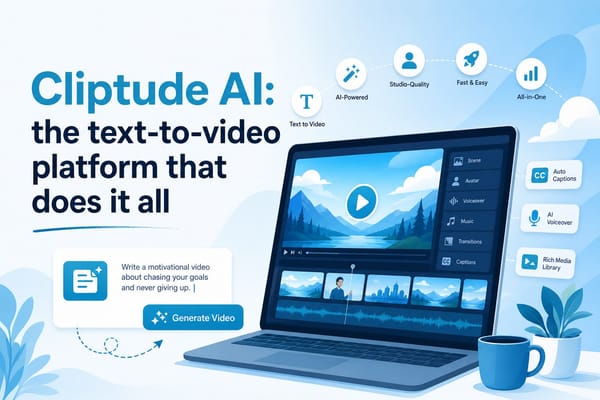
If you've made it this far, you already know AI can do a lot more for your ad scripts than just save you time. It changes the quality of what you're putting out there, the speed at which you can test ideas, and the cost of producing video content at scale. Those three things together represent a real shift in what's possible for brands that aren't working with massive budgets or big production teams. The only thing left is to actually start. If you want a tool that brings the script writing, voiceover, and video production all into one place without having to juggle five different platforms and three separate subscriptions, check out Cliptude. It's built exactly for this kind of workflow, from the first line of your script to the finished video ad ready to upload and run. The whole process is a lot less painful than what most people are dealing with right now when they try to piece it together themselves. Give it a try and let us know in the comments how it goes. What kind of ads are you planning to create first?