
How influencers and content creators can scale video output with AI

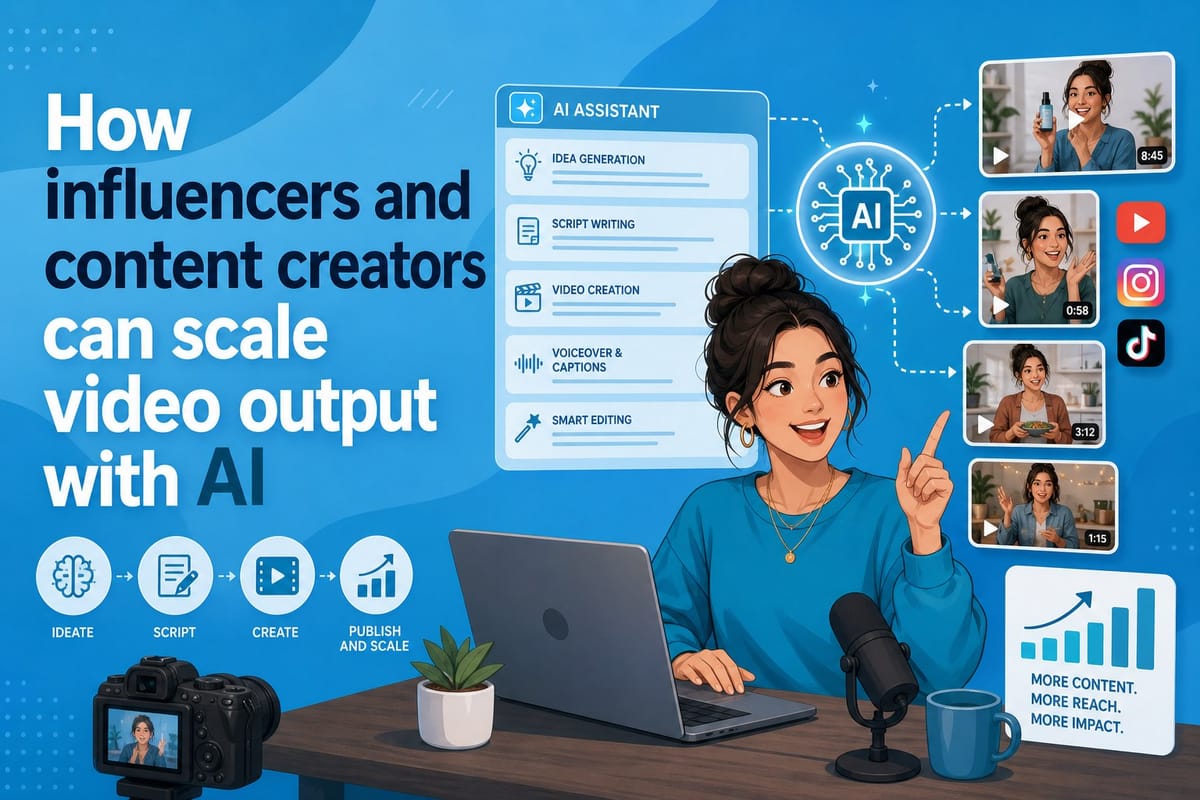
Table of contents
1. Why scaling video output is so hard for most creators
2. How AI handles the entire video production pipeline
3. Practical strategies for using AI to grow your channel faster
Keeping up with audience demand is one of the hardest parts of being a content creator today. Viewers on YouTube, TikTok, Instagram Reels, and Shorts expect fresh videos almost every day. Filming, scripting, sourcing footage, editing, and adding motion graphics can easily eat up an entire week for a single video. AI video tools are changing that equation fast. Platforms like Cliptude let creators go from a simple text prompt to a polished, publish-ready video in a fraction of the time it used to take. This article breaks down exactly how AI helps you scale video output without burning out, cutting corners on quality, or hiring a team you cannot afford. We will look at why the production process is so grueling for solo creators, how modern AI platforms handle every stage of that process, and which practical strategies actually move the needle for channel growth.
Why scaling video output is so hard for most creators
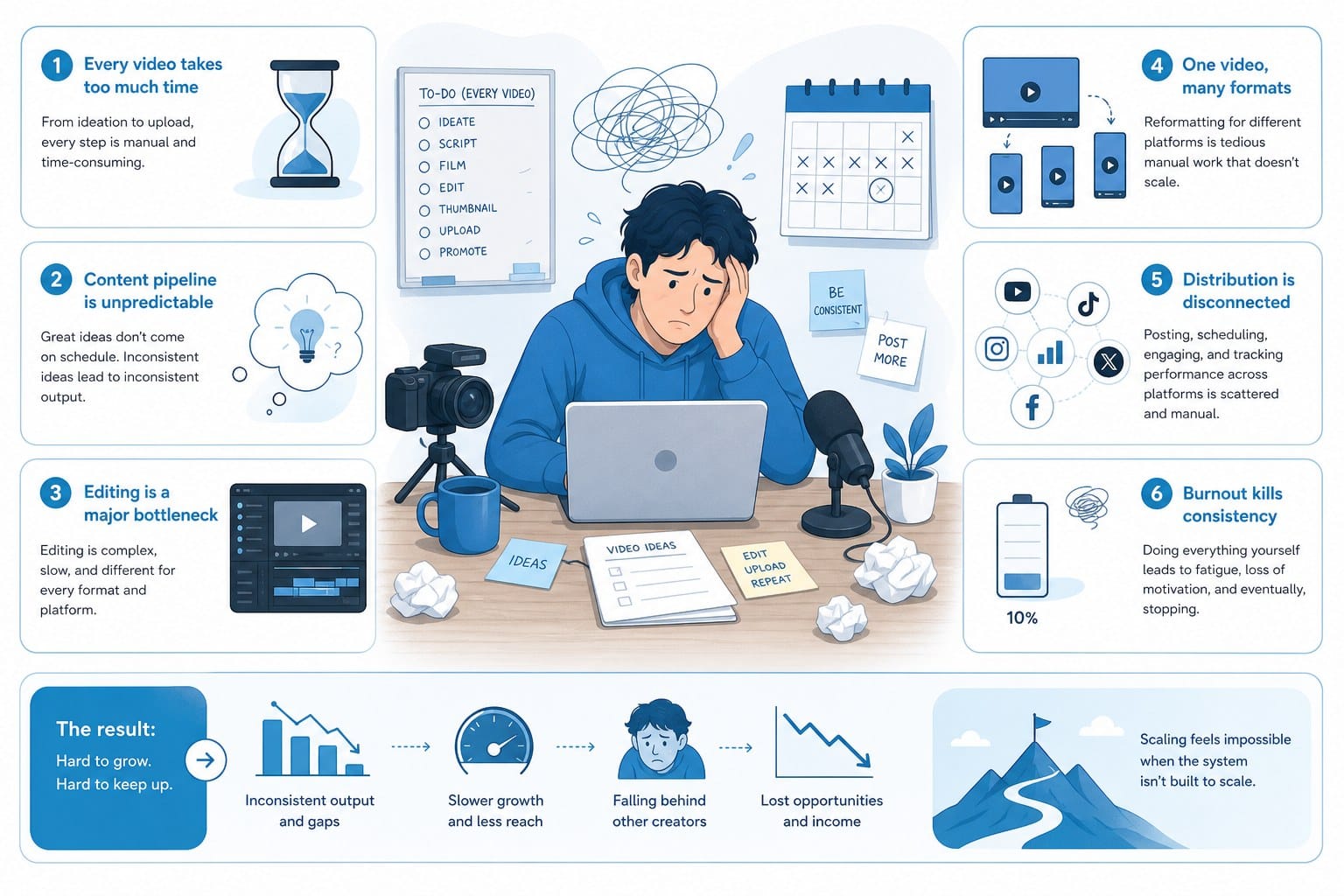
Most influencers and content creators start out doing everything themselves. You write the script, record the voiceover, hunt for B-roll footage, drop everything into an editing timeline, add text overlays, export, and upload. Then you do it again the next week. And the week after that.
The problem is that the workload does not stay manageable as your channel grows. When you have 500 subscribers, posting once a week feels fine. When you have 50,000 subscribers and your analytics show that posting three or four times per week dramatically increases watch hours and ad revenue, your production schedule becomes a second full-time job almost overnight.
Here is a realistic breakdown of the time involved in producing one standard ten-minute YouTube video without any AI assistance.
Researching the topic and gathering sources takes two to four hours on its own, especially for documentary-style or educational content where accuracy matters. Writing a tight, engaging script that hits the right word count for your target video length takes another two to three hours. Finding licensed footage, images, and audio that actually match what the script is describing adds another hour or two of searching through stock libraries. Editing everything together in software like Premiere Pro or DaVinci Resolve, adding motion graphics, syncing audio, and color grading can take anywhere from four to eight hours depending on your experience level. Uploading the finished file, writing a description, adding tags, creating a thumbnail, and scheduling the post takes another thirty minutes at minimum.
Add that up and you are looking at ten to seventeen hours per video. For a solo creator trying to post three times a week, that math simply does not work. There are not enough hours in the week, and that is before you account for responding to comments, managing social media, or doing anything else related to running a channel.
Faceless YouTube channel creators face an extra layer of difficulty. Because they are never on camera, they rely entirely on voiceovers, stock footage, motion graphics, and text animations to carry the viewer through each video. That production pipeline is even more time-intensive than a talking-head format where you just press record and start speaking. Every single visual element has to be deliberately sourced or created, because there is no presenter to fill the screen when the footage does not quite fit.
Creators who work in niches like true crime, history, science, finance, or business explainers know this well. A fifteen-minute documentary-style video about the collapse of a historical empire might require dozens of different footage clips, a carefully paced voiceover, on-screen text for names and dates, and background music that shifts to match the emotional tone of the narration. Building all of that manually is a skilled job that takes real time even when you are fast at it.
Small media teams and solo entrepreneurs who want professional-looking videos but do not have editing skills face a different version of the same wall. Hiring a freelance video editor solves the skill gap, but rates for quality work start around fifty dollars per video on the low end and climb past one hundred and fifty dollars quickly once you want anything beyond a basic cut. For a creator who is just starting to monetize, that cost is hard to justify before the ad revenue or brand deals are reliable enough to cover it.
The algorithm itself adds pressure on top of all of this. YouTube, TikTok, and Instagram all reward consistency. A channel that posts on a predictable schedule tends to get better distribution than a channel that uploads sporadically, even if the sporadic videos are individually stronger. The platforms want to keep users coming back daily, and they favor creators who give them a reason to. That means the creator who figures out how to post three quality videos a week has a structural advantage over the creator who posts one exceptional video every two weeks, regardless of raw talent.
The desire to scale is real for almost every creator at a certain point in their growth. The bottleneck is not motivation or ideas. It is the production process itself, specifically the sheer number of hours required to move from a topic idea to a finished, uploaded video. That is exactly the problem AI steps in to solve.
It is worth being specific about what solving that problem actually means in practice. The goal is not to remove human judgment from the process. A creator still needs to choose topics their audience cares about, review outputs for accuracy, and maintain a consistent voice and brand. What AI removes is the time-consuming mechanical work: the footage searches, the timeline editing, the script formatting, the motion graphics setup. When those tasks take fifteen minutes instead of eight hours, the creator can spend their actual working time on the parts of content creation that require a human perspective.
How AI handles the entire video production pipeline
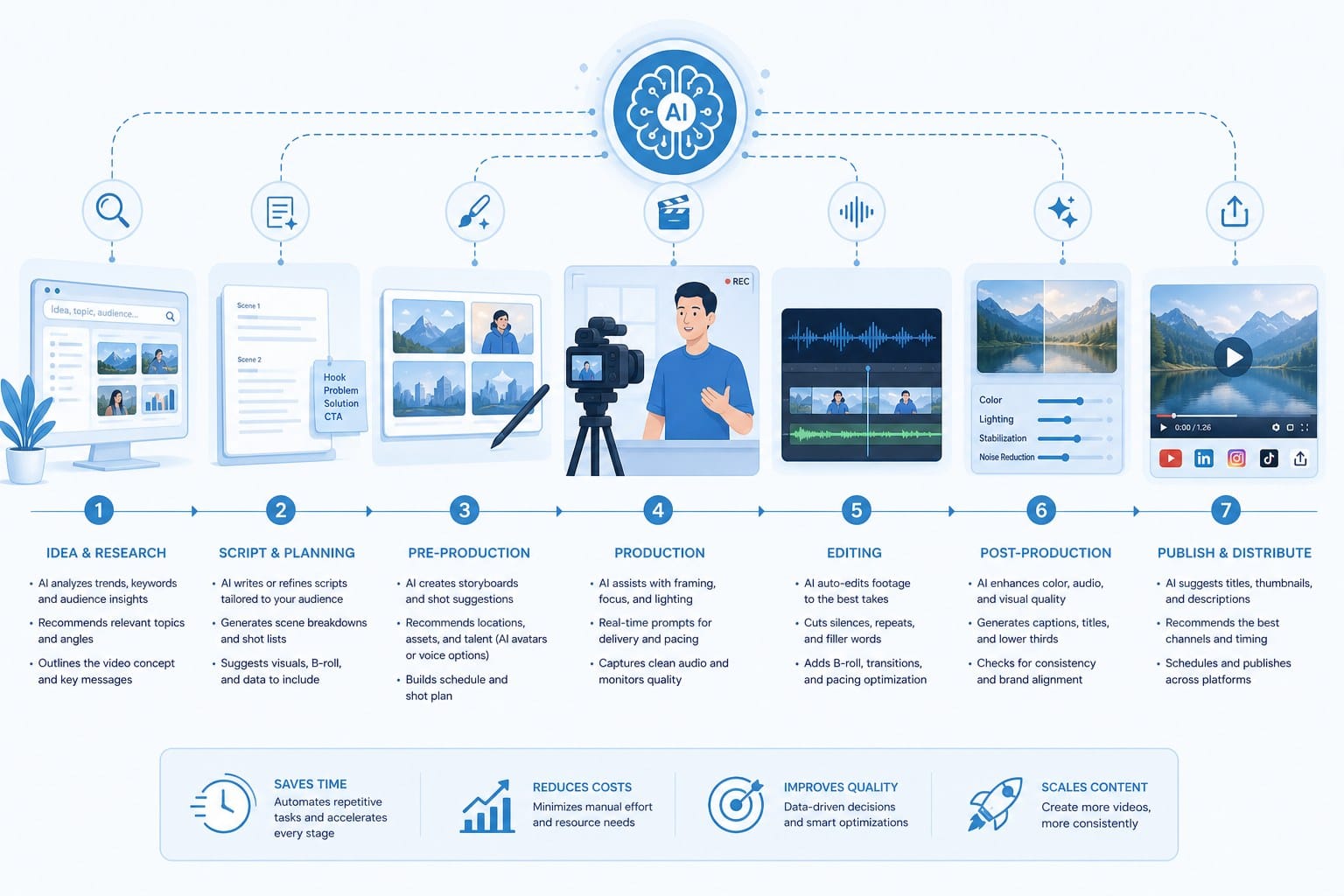
When most people think about AI and video, they imagine a tool that helps with one specific step, maybe generating a script or auto-captioning a clip after the fact. What makes modern AI video platforms genuinely powerful for influencers and content creators is that the best ones handle the entire pipeline from idea to finished video. That end-to-end capability is what changes the economics of solo content creation.
Let me walk through what that actually looks like in practice, step by step.
You start with a prompt or a script. That could be as simple as typing: 'Create a twelve-minute documentary about the history of the Silk Road, targeting a general audience interested in ancient history and trade.' The AI takes that input and works across several production stages, many of them simultaneously.
First, the platform researches the topic. It pulls together relevant context, key facts, and narrative structure so the resulting script is grounded and specific rather than vague and generic. For educational and explainer content especially, this step alone saves multiple hours of manual research. Instead of opening fifteen browser tabs and taking notes, you describe the topic and the platform builds the knowledge foundation for the video.
Next, the AI writes the script. It structures the video with a hook designed to capture attention in the first thirty seconds, a clear narrative arc through the middle, and an outro that wraps up the argument or story. The script is calibrated to match your target video length, so a request for a ten-minute video produces a script with roughly the right word count for a ten-minute voiceover at a natural speaking pace. The script also includes cues for footage placement, text overlays, and transitions so each element of the production has a logical anchor point.
After the script is written, the platform sources footage. Rather than you spending an hour on a stock video site searching for clips that sort of fit your narration, the AI automatically pulls relevant footage and still images that correspond to each segment of the video. If the script is describing ancient trading routes across Central Asia, the platform finds footage of deserts, caravans, historical maps, and period-appropriate visual references. For documentary-style and listicle content where you need a lot of variety across a long runtime, this automated sourcing is one of the biggest time savings in the entire workflow.
Once footage is sourced, the platform generates motion graphics. This includes animated text, lower thirds that identify locations or historical figures, data visualizations for statistics, and other visual elements that make the video feel produced and professional. For creators making whiteboard or stickman animation content, the AI builds those animated sequences directly from the script without you needing to open any animation software or design a single frame manually. The system translates the narration into visual storytelling at the frame level.
Finally, the AI edits everything together. It syncs the voiceover to the footage, places graphics at the right timestamps based on the script cues, selects and adds background music from a licensed library that matches the tone of the content, and exports a finished video file ready to upload.
Cliptude handles this complete workflow. The platform is built specifically for creators who want to produce long-form YouTube videos, documentaries, Shorts, Reels, whiteboard animations, stickman animations, and music videos starting from a prompt or an existing script. You do not need a production team, editing expertise, or a library of footage licenses. The platform uses usage-based credit pricing, which means you pay for what you actually produce rather than committing to a flat monthly subscription that may not match your real output in a given month.
For faceless YouTube channel creators, this model is especially well suited to how they work. A creator running a history channel, a true crime channel, or a business explainer channel can input a batch of topics and generate multiple videos in the time it used to take to produce one. Because the platform sources footage and generates motion graphics automatically, the finished videos look like they required a full production team even when a single person is running the entire operation from a laptop.
For TikTok and Instagram Reels creators, the ability to produce polished Shorts quickly is a meaningful competitive advantage. Short-form content rewards volume and consistency. The creators who post five Reels per week tend to build audiences faster than those who post one carefully crafted video per month, all else being equal. When AI reduces the production time for a sixty-second Reel from two hours to fifteen minutes, you can maintain that posting frequency without it taking over your entire schedule.
The commercial rights question matters too, and it is worth addressing directly. Creators and marketers who want to monetize AI-generated content need to know they own what they produce. Platforms that include full commercial rights with generated videos let you upload to YouTube Partner Program channels, run ads against your content, and license it to brands without legal ambiguity. That clarity is important if video production is central to how you earn.
Animation formats deserve specific attention here because they represent a capability that was genuinely out of reach for most solo creators before AI tools made it accessible. Whiteboard and stickman animation videos consistently perform well for educational content because they make complex information visually engaging without requiring a human presenter on screen and without requiring expensive custom animation. A well-produced whiteboard video about how compound interest works or why a historical empire collapsed can hold viewer attention in a way that a static voiceover over stock footage sometimes cannot.
Traditionally, producing even a three-minute whiteboard video required specialized animation software, a designer who knew how to use it, and hours of frame-by-frame work coordinating the drawing animations with the narration. The cost for a professionally produced whiteboard animation from a studio starts in the hundreds of dollars for a short video and scales up quickly. AI-generated animation brings that capability to solo creators who have zero animation background. You describe the content, and the platform produces the animated sequence.
The broader point is that AI video platforms collapse what used to be a multi-person production workflow into something a single creator can execute in a fraction of the time. That does not mean the output requires no human input. It means the human input shifts from low-skill, time-consuming tasks like manually assembling a timeline or searching stock libraries to higher-value tasks like choosing topics strategically, reviewing outputs for quality, and making the editorial decisions that keep the channel consistent and authentic. The creator stays in control of what matters most while the platform handles the mechanical production work.
Practical strategies for using AI to grow your channel faster
Understanding how the technology works is only half the picture. The more useful question is how to actually build an AI-assisted production workflow that drives consistent channel growth. The strategies below work across different channel types and monetization models, from YouTube ad revenue to brand deals to selling your own products or services.
Batch your video production by topic cluster.
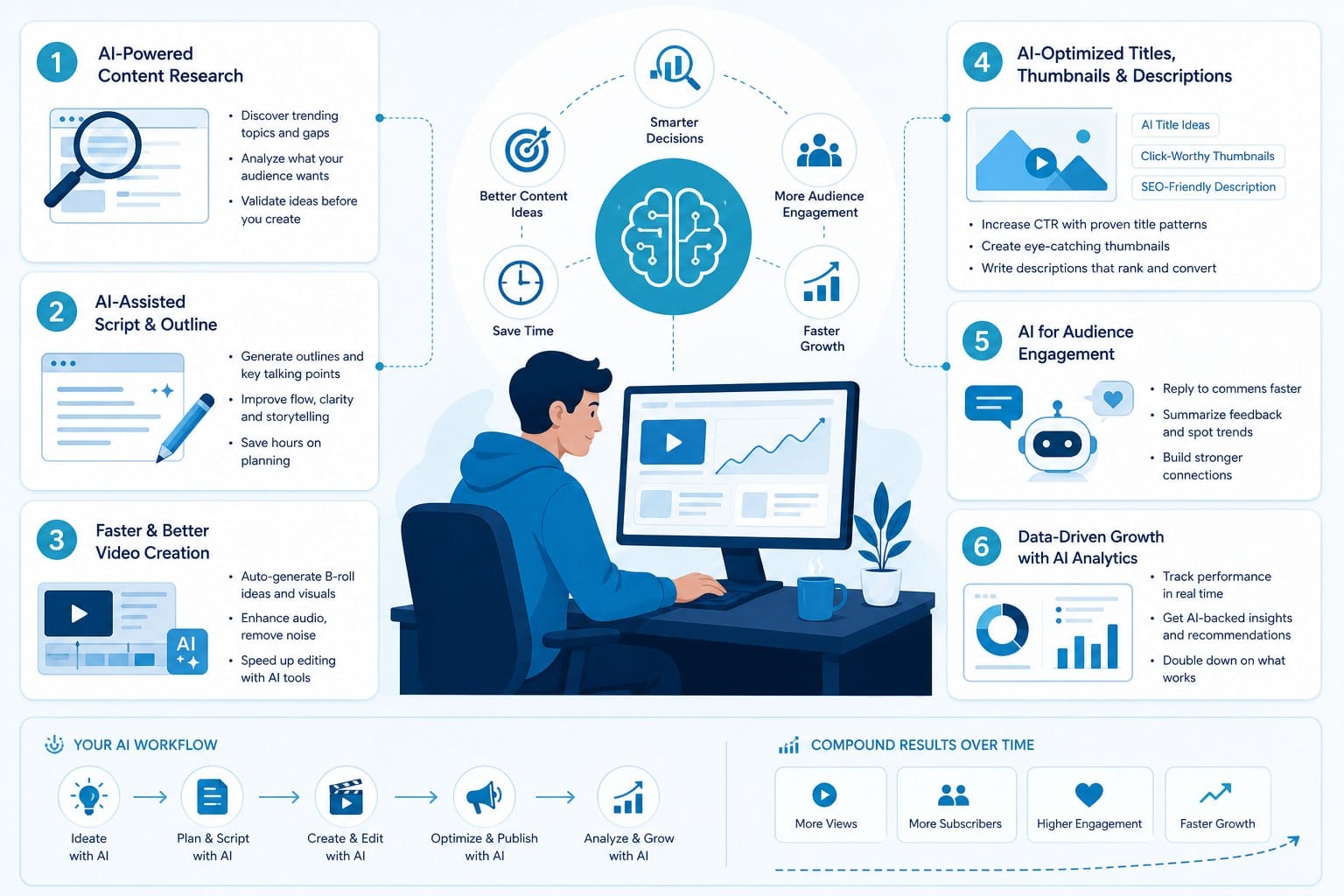
Instead of producing one video at a time and then figuring out what to make next, pick a theme and generate five to ten videos around that theme in a single working session. If you run a personal finance channel, for example, you might create videos on budgeting basics, the debt snowball method, how to build an emergency fund, beginner investing, and understanding your credit score all in one batch. Because an AI platform handles research and scripting for each one, you can move through that entire list in a day instead of spreading it across a month of individual production sessions.
This approach does more than just save time. It builds topical authority in a subject area faster. When your channel has ten well-optimized videos all related to personal finance fundamentals, YouTube's recommendation system starts to understand what your channel is about and surfaces it to viewers who are already watching similar content. Channels that establish clear topical authority tend to see stronger organic growth than channels that jump between unrelated subjects.
Schedule your batch-produced videos to release over two to four weeks rather than uploading them all at once. That keeps your feed consistently active and gives each video time to find its audience before the next one arrives.
Use long-form content to feed short-form content.
One of the most efficient content strategies available to creators right now is producing a single long-form YouTube video and then pulling multiple Shorts or Reels from the same material. With AI handling the long-form production, you start with a twelve-minute video and then use the platform's Shorts generation capability to extract three to five punchy sixty-second clips from the same content. Each clip can highlight a different moment, statistic, or story beat from the full video.
You get more total posts from the same creative effort, and you are feeding content across multiple platforms without building each piece from scratch. A viewer who discovers your channel through a Reel has a path to the full video. A viewer who watches the full video on YouTube might follow you on Instagram where they keep seeing your Shorts. The same core content is doing work across multiple surfaces at once.
This multi-platform approach also reduces the pressure of coming up with fresh ideas constantly. You are not creating separate content for YouTube, TikTok, and Instagram. You are creating once and distributing strategically.
Lean into formats your audience already trusts.
Documentary-style videos and listicle videos consistently perform well on YouTube because viewers arrive with clear expectations about what they will get. If someone clicks on 'The Ten Ancient Civilizations That Disappeared Without Explanation,' they know the format and are prepared to watch through to the end. That familiarity helps with watch time, which is one of the signals YouTube uses to decide how widely to distribute a video.
AI platforms are particularly well suited to these repeatable formats because the script structure is predictable. A listicle video follows a clear pattern: introduction, item one, item two, and so on through to a conclusion. A documentary video follows a narrative arc with a beginning, middle, and end. Once you identify which format works best for your niche and audience, you can replicate that structure across dozens of topics without reinventing the production approach each time. The topics change. The format stays consistent.
Test topics before committing to deep production.
One of the underused advantages of fast AI video generation is the ability to test whether a topic actually resonates with your audience before putting significant effort into a deep-dive production. Generate a shorter, lighter version of a topic first, publish it, and watch the analytics. If the click-through rate is strong and watch time is above average for your channel, that is a signal worth producing a full long-form treatment. If the video lands flat despite a strong thumbnail and title, you have found out inexpensively.
This testing loop is something most solo creators cannot afford to run when each video costs them ten or more hours of work. When production time drops to an hour or two per video, you can afford to be more experimental. You try more things, learn faster what your specific audience responds to, and spend your deeper production energy on topics that have already proven they have demand.
Build a content calendar that matches your monetization goals.
Creators who earn through YouTube ad revenue benefit directly from posting frequently, because the algorithm rewards channels that upload on a consistent schedule and because a larger video library means more entry points for new viewers. Creators who earn through brand deals or affiliate marketing need to stay visible enough between campaigns that their audience does not drift away. Creators selling their own products or services need a steady stream of content that builds trust and demonstrates expertise before asking for a purchase.
Each of these monetization models has a different optimal posting frequency and content mix, but all of them benefit from consistency. With AI handling the production pipeline, building a thirty-day content calendar and actually executing it is realistic for a solo creator in a way it simply was not before. You plan the topics, feed them into the platform in batches, do a review pass on each output, and schedule your uploads. The calendar becomes something you can actually stick to rather than an aspirational document that falls apart by week two.
Do not skip the review step.
AI-generated videos are a starting point, not a finished product you publish without watching. Block fifteen to twenty minutes to review each video before it goes live. Check that the footage matches the script accurately, that any facts, dates, or statistics cited are correct, and that the pacing feels right for your audience. Listen to the voiceover and make sure the tone matches your channel's voice.
Small edits at this stage make a meaningful difference in viewer satisfaction and retention. A viewer who notices a piece of stock footage that makes no sense in context, or a factual error they happen to know is wrong, will leave a comment about it. That kind of feedback hurts trust over time. Spending twenty minutes on a quality review catches most of those issues before they become public.
The goal is not to remove yourself from the process entirely. It is to shift your time from low-skill mechanical tasks to the higher-value judgment calls that actually require your knowledge of your audience and your niche. You are the editor and the strategist. The platform is the production crew.
Use animation formats to stand out in crowded niches.
If you are entering a niche that is already saturated with talking-head videos or basic stock-footage productions, whiteboard or stickman animation formats can make your channel visually distinctive from the start. Educational content about science, history, technology, business strategy, and economics works especially well in animation because the visuals can illustrate abstract concepts that are difficult to convey with footage alone. You can show how a supply chain works, how a historical battle unfolded across a map, or how compound interest grows over decades in a way that a voiceover over generic stock footage cannot.
AI-generated animation removes the technical and financial barrier to producing this kind of content at scale. A solo creator with no design or animation experience can produce a library of polished animated explainers in the same time it would previously have taken to produce one.
Build visual and audio consistency across your entire library.
Even when AI is generating your footage, motion graphics, and editing, you can build a recognizable visual identity by using consistent color palettes, font choices, intro sequences, and background music styles across all your videos. Consistency matters for subscriber retention. A viewer who watches one of your videos and then clicks over to your channel page should immediately recognize that all the videos belong to the same creator. That visual coherence builds trust and makes your channel feel established rather than piecemeal.
Set these preferences at the start of your production workflow and apply them across every video you generate. Over time, your channel develops a look and feel that is associated with your brand, which makes it easier for new viewers to decide to subscribe.
Think about the long-term compounding effect of consistent output.
A YouTube channel that publishes three quality videos per week grows its content library by more than 150 videos per year. Each of those videos can rank in search results, appear in the recommendation sidebar, and bring in new subscribers for years after it was uploaded. Evergreen content about history, science, personal finance, health, or business does not expire. A video you upload today about how the Roman economy worked might still be getting steady views three years from now.
Channels that build large back-catalogs of well-optimized content consistently outperform channels that post sporadically, regardless of the quality of individual videos, because they have more surface area for discovery. AI makes it possible to build that back-catalog without it consuming every available hour of your working life. The compounding begins the moment you start posting consistently, and it accelerates over time as each new video adds to the library rather than just replacing the last one.
For solo entrepreneurs and small media teams producing video content for marketing rather than content creation as a primary career, the calculation is equally straightforward. A polished explainer video can move a product or service from abstract to concrete for a potential customer faster than any written description. If producing that video previously required hiring a production company for several thousand dollars and waiting weeks for delivery, AI reduces both the cost and the timeline dramatically. You can build a library of product explainers, customer education videos, and thought leadership content without a dedicated video budget.
If you want to see what AI-assisted video production looks like in practice, Cliptude covers the full pipeline from prompt to finished video across formats including long-form documentaries, Shorts, Reels, whiteboard animations, stickman animations, and music videos. The usage-based pricing scales with your actual output rather than locking you into a flat fee regardless of how much you produce in a given month.
Ready to take the next step?
If you are ready to stop trading hours for videos and start building a content library that actually grows your channel, Cliptude is built for exactly that. Whether you run a faceless documentary channel, post daily Shorts, or need animated explainers for your business, the platform handles research, scripting, footage sourcing, motion graphics, and editing from a single prompt. Visit Cliptude today and see how fast your next video can go from idea to finished production.



