
How to create Urdu YouTube videos with AI

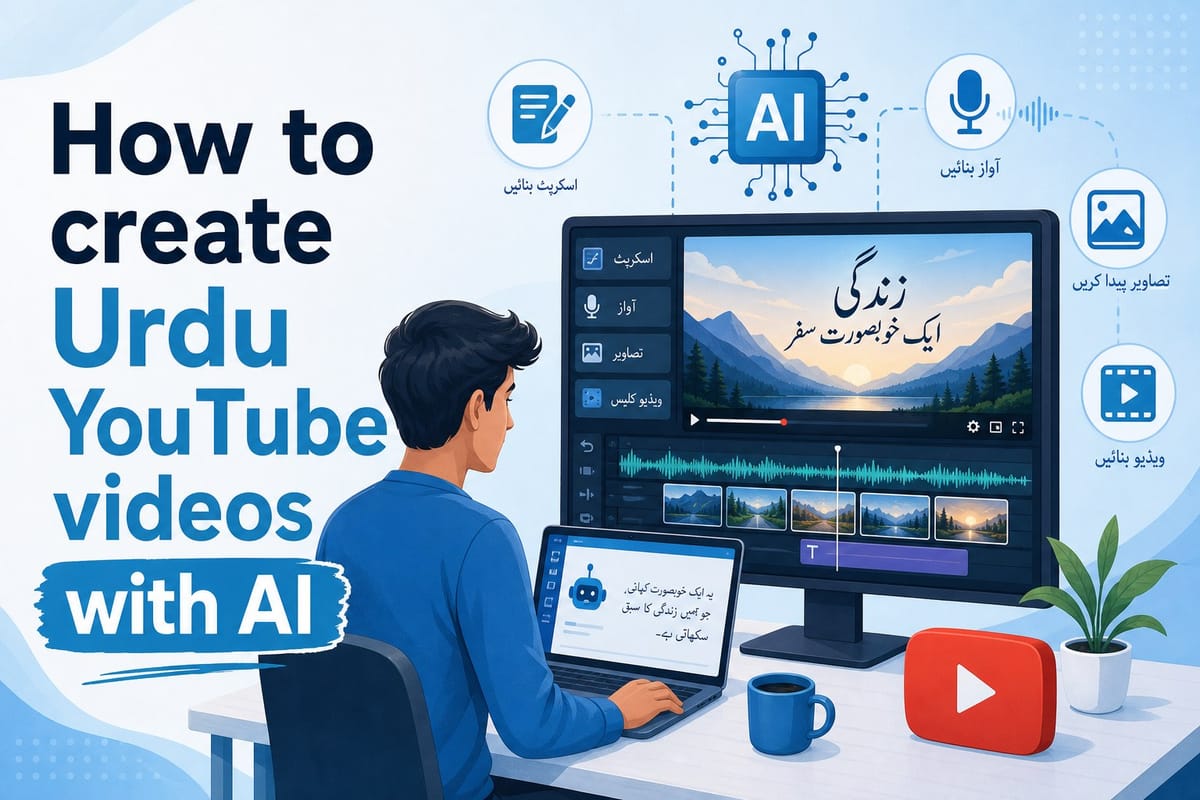
Table of contents
1. Why Urdu YouTube content is a real opportunity right now
2. How AI handles the hardest parts of video production for Urdu creators
3. Step-by-step guide to making your first Urdu YouTube video with AI
Urdu is spoken by hundreds of millions of people across Pakistan, India, and South Asian diaspora communities around the world. That is a massive audience, and YouTube is one of the best places to reach them. The problem is that making quality videos takes time, equipment, editing skills, and often a willingness to appear on camera. Most creators do not have all four of those things lined up at once. That is where AI video tools come in. I want to walk you through exactly how to create Urdu YouTube videos using AI, from choosing your topic all the way to publishing a polished final cut, without needing a camera, a studio, or years of editing experience.
Why Urdu YouTube content is a real opportunity right now
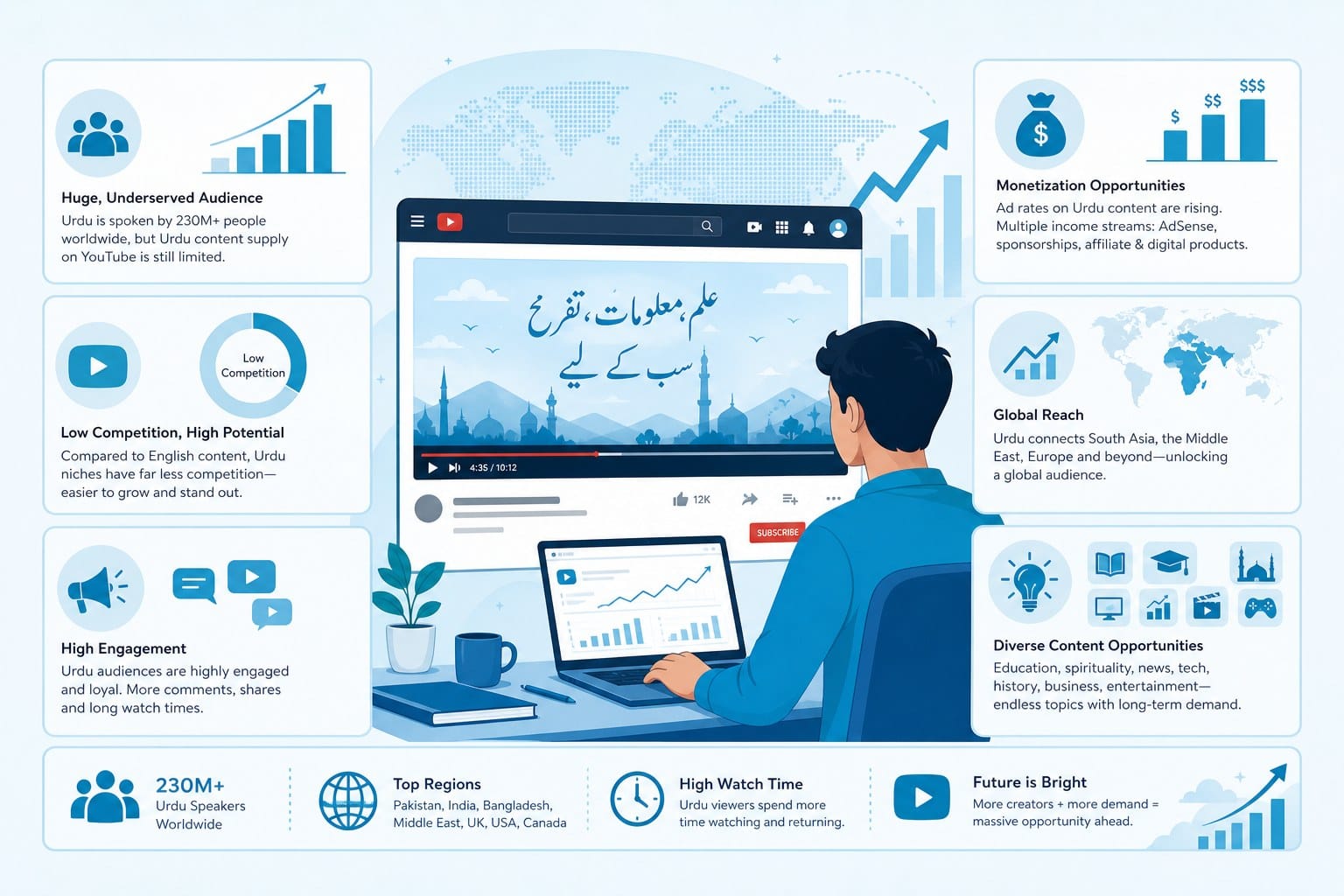
Let me give you some context before we dive into the how-to part. Urdu is the national language of Pakistan and one of the scheduled official languages of India. According to government census data, over 62 million people in India alone identified Urdu as their language in 2011, and that number does not account for the tens of millions more in Pakistan, the Gulf, the United Kingdom, Canada, and the United States. When you add up the global Urdu-speaking population, you are looking at well over 200 million potential viewers.
Despite that, Urdu YouTube content is still relatively underserved compared to English, Spanish, or even Hindi content. Many creators focus on Hindi because it shares vocabulary and grammar roots with Urdu through the common Hindustani base both languages share. But Urdu-specific content, content that uses the Persianised vocabulary, the distinct cultural references, and the literary tradition that makes Urdu unique, still has a lot of room to grow.
This matters for creators because less competition in a large market means it is easier to rank videos, build a loyal subscriber base, and eventually monetize. YouTube pays out based on watch time and ad revenue, and niche audiences that are underserved tend to watch longer and engage more because they are genuinely glad someone is making content for them.
So what kinds of Urdu YouTube videos actually do well? Based on what consistently performs on the platform, a few formats stand out. Documentary-style videos covering Pakistani or South Asian history attract strong viewership. Listicle videos like top ten facts about famous Urdu poets or the most important battles in Mughal history get shared widely. Educational explainers about science, health, personal finance, or current events in Urdu are also genuinely popular because formal education in Urdu is not always widely available online. And then there are entertainment formats like Urdu storytelling, mythology, and cultural commentary.
All of these formats can be made without you ever appearing on camera. That is the key insight I want you to hold onto as we go through this guide. Faceless YouTube channels are a legitimate and growing part of the creator economy, and Urdu is a language where faceless, narrated, visually driven content fits naturally because so much of the Urdu literary and storytelling tradition is oral and textual rather than visual.
One more thing worth noting: Urdu and Hindi share a lot of spoken vocabulary at the conversational level, which means an Urdu channel can sometimes attract Hindi-speaking viewers as well, especially if your topics are broadly South Asian in focus. That dual-audience potential is something creators in other languages simply do not have, and it is a real advantage if you use it strategically.
How AI handles the hardest parts of video production for Urdu creators
Most people who want to start a YouTube channel in Urdu face the same set of problems. They know the language. They have ideas for content. But they do not know how to edit video, they cannot afford professional production, and they do not want to be on camera. AI video platforms are built specifically to remove those barriers.
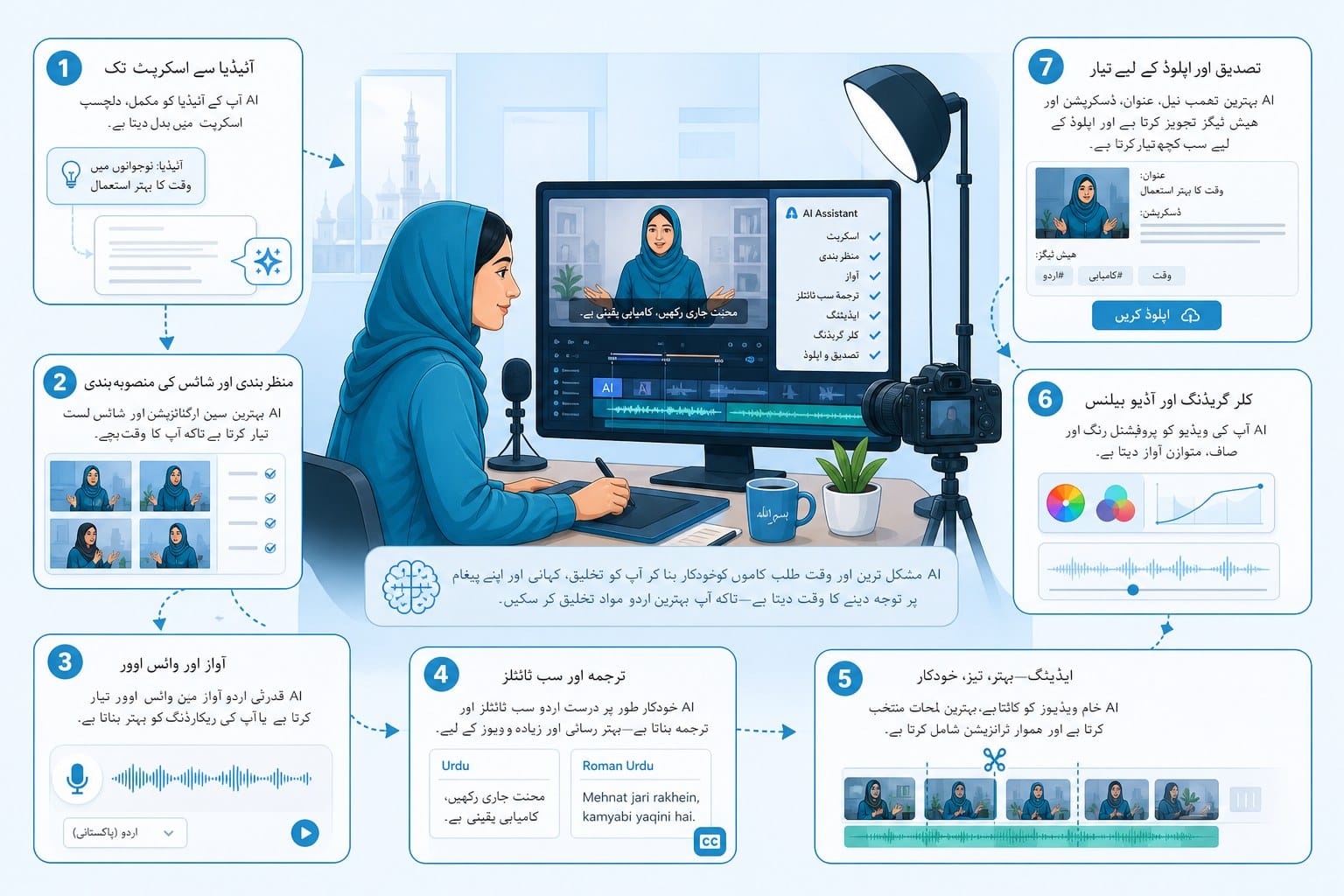
Here is how the production process actually works when you use an AI-powered tool like Cliptude.
You start with a prompt or a script. That is it. You might type something like: produce a ten-minute documentary in Urdu about the history of the Mughal Empire's influence on language and culture. Or you might write out a script yourself if you want full control over the narration. The AI takes that input and handles everything downstream.
The first thing it does is research. Good AI video platforms pull together factual context around your topic automatically. For historical or educational Urdu content, this matters a lot because accuracy builds trust with your audience and keeps people watching. If you are covering Urdu poetry, for example, the research layer helps make sure you are not misattributing verses or getting historical dates wrong.
Next comes scripting. The AI generates a structured script with a logical flow, an engaging opening, developed body sections, and a clear close. If you already wrote a script, the AI works from that instead. Either way, you end up with a document that drives everything else in the production.
Then comes the part that used to require expensive software and skills: footage sourcing, motion graphics, and editing. The AI sources stock footage or generates visuals that match your script. It adds motion graphics, titles, lower thirds, and transitions. It times everything to match the narration. For Urdu content specifically, you can use AI voiceover in Urdu if you do not want to record your own voice, or you can record your own Urdu narration and drop it in. The platform assembles the full video from all of these components.
What you get at the end is a finished, polished video ready to upload. Not a rough cut that needs another three hours of work. A finished product.
This changes the math completely for Urdu creators. Traditionally, making a ten-minute documentary-style video might take fifteen to twenty hours of work across research, scripting, recording, editing, and adding graphics. With an AI platform, that same video might take two to three hours total, most of which is you reviewing the output, making small adjustments, and adding anything personal you want to include.
For creators who want to publish consistently, which is the single most important factor in growing a YouTube channel, this is a game changer. Posting one video per week is much more achievable when each video takes a few hours instead of a few days.
Let me walk through a specific example. Say you want to create an Urdu YouTube channel focused on South Asian history. Your first video is about the role of Persian in shaping the Urdu language. This is a genuinely interesting topic: Persian was the lingua franca of the Indian subcontinent before British colonisation, and it had a profound influence on Urdu vocabulary, poetry, and formal writing. An AI tool can research this topic, pull together the key historical facts, script a compelling ten-minute narration, source relevant historical footage and imagery, and build the full video. You review it, adjust any details you want to change, record or upload your own Urdu voiceover if you prefer, and publish.
Your second video might be about the Mughal emperors who promoted Urdu literature. Your third might be a listicle of the ten most famous Urdu poets and their most beloved verses. Your fourth might be an explainer on why Urdu and Hindi are mutually intelligible in conversation but diverge in formal writing. Each of these videos could be produced in a fraction of the time traditional production would require.
For creators who are scaling a channel or running multiple channels at once, AI production also makes it possible to batch content. You could produce four or five videos in a single week and schedule them to publish over the following month. That kind of output consistency is what separates growing channels from stagnant ones.
One thing I want to be clear about: AI video tools work best when you bring your own knowledge and perspective to the content. The AI handles production. You handle the editorial judgment. You decide which topics are worth covering, what angle to take, which facts are most important for your specific Urdu-speaking audience. That human layer is what makes the content feel genuine rather than generic. Think of the AI as a very capable production team that does not know your audience as well as you do. Your job is to direct the work, not to do all the work yourself.
Step-by-step guide to making your first Urdu YouTube video with AI
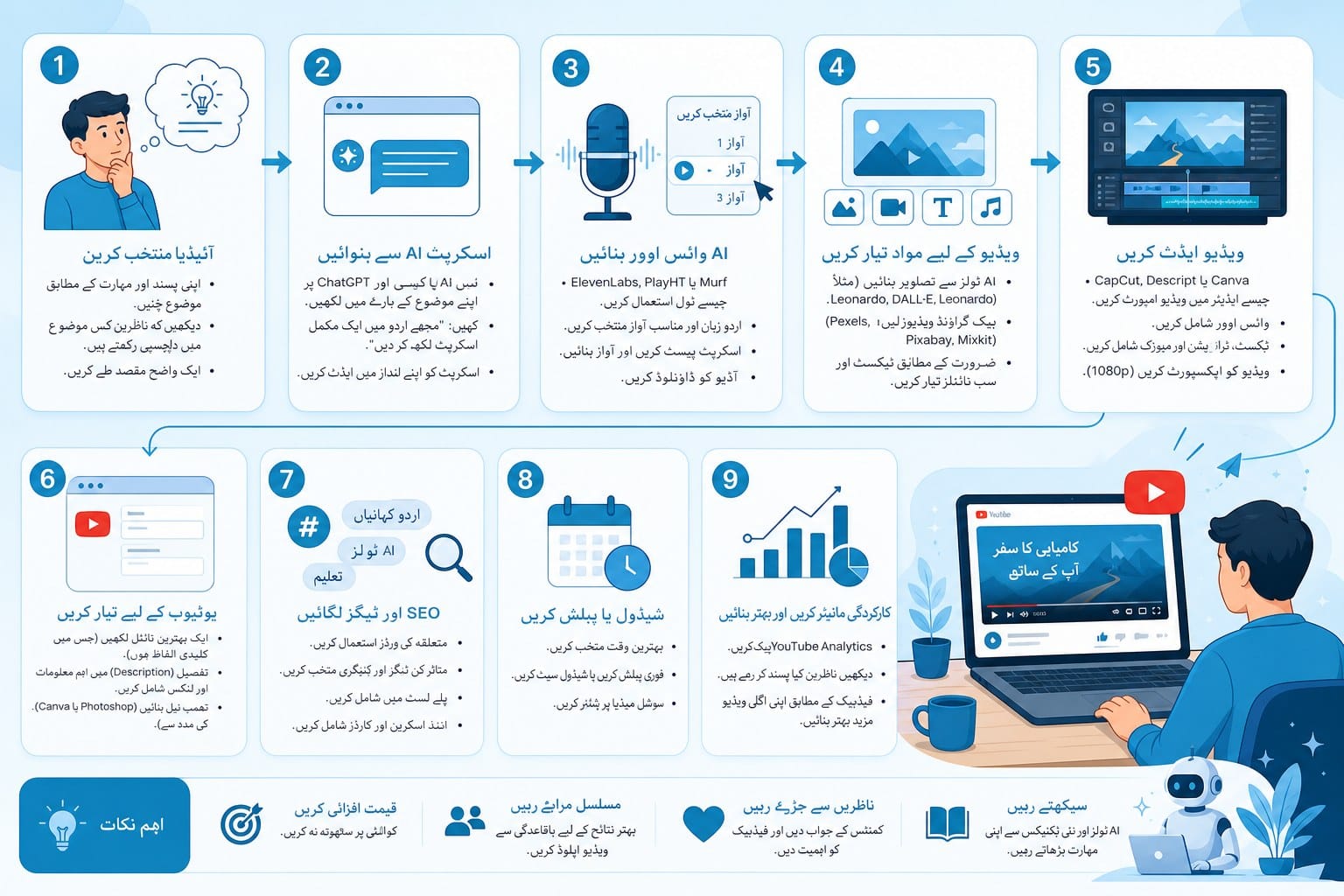
Let me make this practical. Here is a clear process you can follow to create your first AI-powered Urdu YouTube video from scratch.
Step one: Choose a specific topic with a clear audience in mind.
Broad topics make weak videos. Instead of making a video about Urdu poetry in general, make one about why Mirza Ghalib's poetry still matters today. Instead of covering Pakistani history broadly, cover the specific story of how the Urdu language became Pakistan's national language after partition. Specific topics are easier to script well, easier for viewers to find through search, and easier to hook an audience with in the first thirty seconds.
Think about who you are making this for. Are you targeting Urdu speakers in Pakistan? The South Asian diaspora in the UK or Canada? Students learning about South Asian history? Knowing your audience shapes everything from vocabulary level to cultural references to the tone of the narration.
Step two: Write a prompt or a script.
If you are using an AI platform like Cliptude, you have two options. You can write a detailed prompt describing what you want the video to cover, how long it should be, and what tone it should take. Or you can write your own full script in Urdu or English and let the AI build the video from that.
For a prompt, be specific. Instead of saying make a video about Urdu history, say something like: create a twelve-minute documentary-style YouTube video about how Persian vocabulary became central to formal Urdu writing. Cover the historical context of Persian as the administrative language of Mughal India, explain how this influenced Urdu literature and poetry, and end with examples of common Urdu words that come directly from Persian. The tone should be educational but engaging, suitable for adult viewers interested in South Asian culture and language.
That level of detail gives the AI clear direction and produces a much better result than a vague prompt.
If you want to write your own script, do it in whatever language feels natural to you. If you are more comfortable scripting in Urdu, write in Urdu. If you prefer to draft in English and then adjust the narration later, that works too. The AI platform can build the visual side of the video from an English script while you add Urdu voiceover separately.
Step three: Generate the video and review the output.
Once you input your prompt or script, the AI platform takes over. It researches, scripts if needed, sources or generates visuals, adds motion graphics and transitions, and assembles the full video. Depending on the platform and the length of the video, this process usually takes a few minutes.
When the draft comes back, watch it all the way through. Look for a few specific things. First, check the factual accuracy of anything the AI included. For Urdu content covering history, literature, or cultural topics, accuracy matters enormously because your audience knows this material and will notice errors. Second, check the visual choices. Do the images and footage actually match the narration? Third, check the pacing. Does the video move too fast or too slow through certain sections? Note anything you want to change.
Step four: Add your own Urdu voiceover or adjust the AI narration.
This is where you add your personal touch. If you are using an AI voice in Urdu, listen carefully to the pronunciation and tone. Urdu has specific phonemes that do not exist in English, and AI voices vary in quality across languages. If the AI voice is not quite right, recording your own Urdu narration and syncing it to the video will always give you a more authentic result and help you stand out.
Recording Urdu voiceover does not require fancy equipment. A decent USB microphone, a quiet room, and free recording software like Audacity are enough to produce clean audio. Practice reading the script a couple of times before recording so the narration flows naturally. Urdu is a language with a rich oral tradition, and a good narrator can make even simple content feel compelling.
If you choose to use an AI Urdu voice, take the time to review and approve it rather than just publishing whatever the platform produces. Your audience will thank you for it.
Step five: Add Urdu text and subtitles.
This step is especially important for Urdu content. Many Urdu-speaking viewers watch YouTube with subtitles on, either because they are in a noisy environment, because they are in a diaspora community and want to reinforce their reading of the script, or because they are learners improving their Urdu literacy.
Adding Urdu subtitles also helps with accessibility and can improve your video's watch time, which is a key metric YouTube uses to determine how widely to recommend a video. YouTube's auto-caption feature does not handle Urdu as reliably as it handles English, so adding your own subtitles manually or through a dedicated tool gives you better results.
For title cards, thumbnails, and any on-screen text, use a clean Nastaliq or Naskh font that renders the Urdu script clearly. Urdu is written right-to-left, which means your graphic design choices need to account for text direction. Most professional design tools support right-to-left text, but check your specific platform to make sure.
Step six: Optimize for YouTube search.
Urdu YouTube SEO follows the same basic principles as English YouTube SEO, with a few extra considerations. Your video title, description, and tags should all include relevant Urdu keywords. You can write your title in Urdu script, in transliterated Urdu using Roman letters, or in both. Many Urdu-speaking viewers search using Roman Urdu transliteration because it is faster to type on standard keyboards, so including that in your metadata helps.
Your thumbnail should be visually clear at small sizes because many viewers browse on mobile. Use high-contrast colors, readable text, and an image that communicates the topic immediately. Urdu text on a thumbnail can be a strong visual signal to your target audience that this video is made for them.
For your video description, write a genuine summary of what the video covers. Include the main topics, any notable figures or events mentioned, and a clear call to action asking viewers to subscribe if they want more Urdu content. Link to related videos on your channel to keep viewers watching.
Step seven: Publish and engage with your audience.
Once the video is live, respond to comments. Urdu-speaking YouTube communities are often close-knit, and creators who engage with their audience build loyalty faster than those who post and disappear. Thank viewers for feedback, answer questions, and take note of which topics generate the most comments and discussion. That tells you what to make next.
Consistency matters more than perfection when you are starting out. Publishing one well-made video per week will grow your channel faster than publishing three videos one month and nothing the next. AI tools make it realistic to maintain that consistency without burning out, which is exactly the point.
As your channel grows, pay attention to your YouTube Analytics data. Watch time, audience retention curves, click-through rates on thumbnails, and subscriber growth rates all give you information about what is working. Use that data to improve your next video rather than guessing. The creators who grow fastest are the ones who treat each video as a learning opportunity and adjust their approach based on real feedback from their audience.
Ready to take the next step?
If you are ready to start making Urdu YouTube videos without a camera, a studio, or years of editing experience, Cliptude is built for exactly that. You bring the topic and the vision. The AI handles research, scripting, footage, motion graphics, and editing. The result is a polished, publish-ready video in a fraction of the time traditional production takes. Visit Cliptude to create your first video today.



