How To Start a Faceless YouTube Automation Channel Using VidRush in 2026

Faceless YouTube channels are everywhere right now, and honestly, it makes a lot of sense. You don't need a camera. You don't need to fix your hair or worry about lighting. You just need a good idea, a reliable workflow, and the right tools to bring it all together. That's exactly why so many creators in 2026 are turning to platforms like VidRush to build channels that run almost on autopilot. The barrier to entry has dropped so much in the last few years that a person with a laptop, a decent internet connection, and a few hours a week can genuinely compete with channels that have been around for years.
But here's the thing most people don't tell you: starting a faceless channel isn't as simple as pressing a button and watching the views roll in. There's a process. There's research, scripting, visuals, voiceover, and editing involved. Each of those steps can go wrong in ways that quietly kill your channel before it ever gets going. The good news is that VidRush and tools like it have made that process way faster than it used to be. And if you set things up correctly from the start, you can build a real channel that grows without you being on camera at all. The trick is understanding what the tools can do for you and what still requires your own judgment and taste.
In this post, we're going to walk through exactly how to do that in 2026. Whether you're brand new to YouTube or you've been posting for a while and just want to go faceless, this guide has got you covered. We'll talk about picking your niche, building your content system, using automation tools the right way so your channel actually sounds human, and then keeping the momentum going long enough to turn it into something real. There's a lot to cover, so let's get into it.
Picking your niche and setting up your channel the right way
A lot of you have asked about this, and it's usually the first place people get stuck. Choosing a niche for a faceless channel feels different than choosing one for a personal brand channel. You're not banking on your personality to carry the content. You're banking on the topic itself being interesting enough to keep people clicking, watching, and coming back. That means you want a niche with strong search demand, decent watch time potential, and content that can be made without you ever showing your face on screen.
Some of the best-performing faceless niches right now include history, true crime, personal finance and money management, science explainers, self-improvement, tech breakdowns, and unsolved mysteries. These topics work well for a few specific reasons. People search for them constantly, which means the traffic is already out there waiting. They lend themselves naturally to narration over visuals, so you can pair a strong voice track with stock footage, archival images, or animations without anything feeling forced. And there's always fresh material to cover, which means you're not going to run out of video ideas after three months. If you've been thinking about starting a faceless documentary-style channel specifically, there's a solid breakdown of how that format works in this guide to starting a faceless documentary channel that's worth reading before you commit to a direction.
When you're narrowing down your niche, it helps to think about depth. A broad topic like "history" is technically a niche, but it's so wide that you'll struggle to build a loyal audience early on. Something like "forgotten empires of ancient Asia" or "the real history behind famous heists" is specific enough that a particular kind of viewer will find you and immediately feel like your channel was made for them. That specificity is what builds subscribers who actually stick around instead of watching one video and bouncing. You can always expand your topic range once your channel has some traction. Starting narrow and going deep is almost always the smarter move in the beginning.
Once you've got your niche locked in, you want to set up your channel with a clear identity. That means a name that fits the topic without being too clever or too generic, a simple but professional banner that signals what kind of content lives here, and an about section that tells viewers exactly what they're going to get when they subscribe. Don't overthink any of this. You can update your branding later. What matters early on is getting your content pipeline moving so the algorithm has something to work with and your potential audience has a reason to hit subscribe.
Your channel description and keywords matter more than most people realize, and it's one of the most overlooked setup steps. YouTube is a search engine before it's anything else. Every word in your channel description is a signal to the algorithm about who should see your content. Write your description like you're explaining your channel to someone who has never heard of your topic before. Use natural language. Mention the specific kind of videos you'll post, how often you plan to upload, and what the viewer will get out of watching. Include a few of the words your ideal viewers would actually type into the search bar, but don't stuff keywords in awkwardly. Just write naturally and the right terms will show up on their own. This one small step can make a real difference in whether your early videos get discovered or just sit there collecting dust while you wonder why nothing is moving.
Building a content system using VidRush and automation tools
Here's where things get interesting. VidRush is an AI-powered video creation platform built specifically for faceless YouTube content. You give it a topic or a full script, and it handles a big chunk of the production work for you. That includes sourcing visuals from stock footage libraries, generating a voiceover from text, syncing your narration to the visuals, and assembling the whole thing into a rough cut that's ready to review, tweak, and upload. For creators who want to post consistently without spending 20 or 30 hours on every single video, it genuinely changes what's possible.
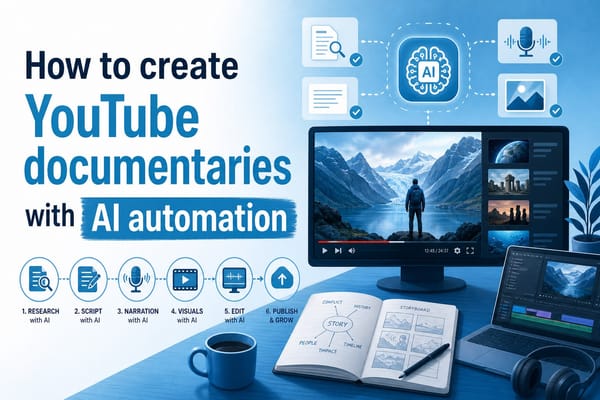
The basic workflow goes like this. You start with a topic and do a quick round of keyword research to make sure people are actually searching for it. Tools like TubeBuddy, VidIQ, or even YouTube's own search suggest feature can show you what's getting traction in your niche. Then you write your script, or you use VidRush's AI to generate a first draft. From there, the platform pulls together stock footage, images, or animations to match your narration scene by scene. You review the visual choices, swap out anything that doesn't fit, add a voiceover using either an AI voice or your own recorded narration, and then make any final edits before uploading. That whole process, which used to take days of sourcing clips, recording, and editing, can now be done in a few hours once you've run through it a couple of times and know where the bottlenecks are.
I personally think the scripting step is where most automation channels fall apart, and it happens quietly. People rush it, let the AI write something generic, post the video, and then wonder why their retention rate drops off a cliff after the first minute. Your script is what keeps people watching. It needs a strong hook in the first 30 seconds that gives the viewer a reason to stay. It needs a clear structure so the viewer always knows where they are in the story. And it needs enough personality and specificity to feel like a real person with a genuine point of view wrote it, not a language model filling in a template. If you want to sharpen your scripting skills before you hand anything over to an AI, this article on how to write YouTube scripts that hook viewers in 30 seconds is one of the most practical resources I've read on the subject. Go through it before you let any automation tool touch your scripts unsupervised.
One thing I learned the hard way when I first started experimenting with automation tools is that you can't just accept the first output and call it done. I remember running a history topic through an AI script generator and posting the video with almost no edits. It got views for about a week and then completely flatlined. When I went back and watched it critically, it sounded exactly like what it was: a robot summarizing Wikipedia. The AI gives you a starting point, not a finished product. Your job is to make it sound like a real channel with a real voice. Read every script out loud before you finalize it. Fix anything that sounds robotic, overly formal, or weirdly structured. Add a line or two that feels specific to your channel's tone, whether that's a dry observation, an interesting aside, or a question that keeps the viewer thinking. That little bit of human polish is what separates channels that grow from channels that stall out at a few hundred views per video and never break through.
VidRush also gives you meaningful control over the visual style of your videos, which is worth thinking about early because your visual identity is part of what makes your channel recognizable. Different styles work better for different niches, and picking the wrong one can make your content feel off even if the script and narration are great. An infographics-heavy approach works really well for finance, data-driven content, and anything where you're explaining numbers or systems to your audience. If that style interests you, there's a detailed walkthrough of how to pull it off effectively in this guide to making infographic-style YouTube videos. History and documentary channels tend to do better with cinematic footage, dramatic music, and strong narration that carries the emotional weight of the story. Science channels often use animation to explain concepts that would be hard to show with real footage. Pick a visual style that genuinely fits your niche, commit to it for at least your first ten videos, and let it become part of how viewers recognize your channel before they even read the title.
Batching your content is another piece of the system that most people overlook when they're just starting out. Instead of making one video at a time from idea to upload, try working on three or four videos simultaneously at the same stage. Do all your keyword research in one sitting. Write all your scripts in another session. Run all your videos through VidRush in a block of time you set aside specifically for production. This approach reduces the mental switching cost of jumping between creative tasks and means you're always a few videos ahead instead of scrambling to post something at the last minute. Once you get into a batching rhythm, the whole operation starts to feel like a real content machine instead of a constant hustle.
Growing your faceless channel and making it sustainable
Getting your first few videos out is one thing. Building a channel that actually grows over time is a completely different challenge, and it's the one that trips up most people who start with a lot of energy and then quietly disappear after a couple of months. The creators who see real results with faceless automation channels are the ones who treat it like a system with moving parts they're constantly learning from, not a side project they check in on whenever they feel like it. That means posting consistently, studying your analytics, testing what's working, and slowly improving your process with every video you make. Growth rarely comes all at once. It usually shows up gradually, and then suddenly.
Consistency is the single biggest factor that separates channels that grow from channels that flatline, and the reason comes down to how the YouTube algorithm actually works. The algorithm rewards channels that publish regularly because it gives the system more content to recommend, more data to learn from, and more opportunities to surface your videos to new viewers. You don't need to post every day to see this effect. For most faceless channels, two to four videos per month is a realistic and sustainable pace that keeps the algorithm engaged without grinding you down to the point where the quality starts slipping. If you're thinking about building longer-form content as part of your strategy, this post on how to make a 30-minute YouTube video without burning out has some really practical frameworks for batching and planning that will help you stay consistent without sacrificing quality.
Your thumbnails and titles matter just as much as your content, and in some ways they matter even more in the early days because they determine whether anyone clicks on your video in the first place. A genuinely great video with a weak title and a boring thumbnail will always underperform a good video with a compelling title and a strong visual hook. Spend real time on these. Look at what's already ranking well in your niche and pay attention to what makes those thumbnails eye-catching. Is it the color contrast? A close-up face even on a faceless channel, borrowed from stock imagery? Bold text with a clear emotional hook? Figure out the visual language your niche responds to and use it. Test different title formats over time. Some niches respond better to question-based titles like "Why Did This Empire Disappear Overnight?" Others do better with list formats, bold statements, or a sense of urgency. Pay close attention to your click-through rate in YouTube Studio because that number is one of the clearest signals you have about whether your titles and thumbnails are doing their job.
Monetization is the reason most people start these channels in the first place, and it's completely realistic with a well-run faceless channel. YouTube's Partner Program in 2026 requires 1,000 subscribers and either 4,000 watch hours or 10 million Shorts views in the past 12 months. Once you hit those thresholds, ad revenue starts coming in. For channels in high-value niches like finance or tech, the CPM rates can be surprisingly good even with a modest audience. From there, you can layer in additional income streams like affiliate marketing, where you recommend tools or products related to your niche and earn a commission on sales. You can pursue sponsorships once your channel has some credibility and a real audience. You can even create and sell digital products like guides, templates, or mini-courses if your niche has an audience that wants to go deeper than what a free YouTube video can cover. The key is not to chase money so aggressively at the start that you lose focus on making content that people actually want to watch. Build the audience first with genuine consistency and quality. The monetization follows naturally when the numbers are there and the trust is established.
A note on staying on the right side of YouTube's content guidelines is worth adding here because it's something a lot of new automation channel creators run into. Automation tools make it easy to crank out a large volume of content quickly, but that speed can get you into trouble if you're not being thoughtful about what you're publishing. YouTube has gotten significantly better at identifying low-effort mass-produced content, and channels that rely entirely on AI-generated templates without adding any original value tend to get hit with limited monetization flags or reduced distribution. The fix is simpler than it sounds. Make sure every video you put out adds something real. Cover a topic that hasn't been done to death, or go so much deeper than what's already out there that your video becomes the definitive resource on the subject. Put your own angle on the story. Add a perspective, a comparison, or a piece of context that other channels in your niche aren't providing. The channels that grow in 2026 aren't the ones that automate everything down to zero human input. They're the ones that use automation to handle the time-consuming production tasks while still bringing genuine curiosity and editorial judgment to every single video they make.
Analytics are your best friend once your channel starts producing data, and most new creators either ignore them entirely or only look at the vanity metrics like total views and subscribers. The numbers that actually tell you something useful are average view duration, audience retention curves, click-through rate, and traffic sources. Average view duration tells you whether your content is holding people's attention or losing them somewhere in the middle. Retention curves show you the exact moment viewers start dropping off, which usually points to a specific problem in your script or pacing. Click-through rate tells you whether your thumbnails and titles are compelling enough to earn the click. Traffic sources tell you whether you're building search traffic, browse traffic, or relying heavily on one source that could dry up. Spend time with these numbers every month. They'll tell you more about what your channel needs than any generic advice ever will.
Ready to take the next step?
Starting a faceless YouTube automation channel in 2026 is one of the most accessible ways to build a real online income stream without putting yourself in front of a camera. But the tools you use matter, and so does the effort you put into making your content feel worth watching. If you've been experimenting with VidRush or other automation platforms and want to take your visuals to a level that actually stands out in a crowded niche, check out Cliptude as your go-to solution for creating high-quality faceless videos with a wide range of styles and formats. Whether you want animated explainers, cinematic documentary-style content, or a more creative visual approach that doesn't look like every other automation channel out there, Cliptude gives you the control and flexibility that most automation tools simply don't offer. Drop a comment below and tell me what niche you're building your channel in. I read every single one and I'd genuinely love to see what you're working on.