How to Use AI Voiceover to Grow a Faceless YouTube Channel Faster in 2026

Faceless YouTube channels are blowing up right now, and a huge reason for that is AI voiceover. You don't need a fancy microphone. You don't need to sit in front of a camera. You don't even need to love the sound of your own voice. With the right AI voice tool and a solid workflow, you can put out videos that sound polished, feel engaging, and actually get watched. That's a big deal if you're building a channel from scratch in 2026, when competition on the platform is steeper than it's ever been and viewers have shorter patience than ever for content that feels half-finished.
But here's the thing a lot of creators miss: slapping an AI voice onto a mediocre script and some stock footage isn't enough. The channels that grow fast are doing more than just automating the narration. They're picking the right voice style for their niche, writing scripts that match how that voice delivers lines, syncing their audio carefully with visuals, and thinking about the whole viewer experience from the first second to the last. Growth doesn't come from shortcuts alone. It comes from using these tools the right way, in the right order, with a real understanding of why each step matters.
This post is going to walk you through exactly how to do that. Whether you're brand new to the faceless channel world or you've already got a few videos up and want to move faster and more efficiently, there's something here for you. A lot of you have asked about how AI voiceover actually fits into a real content workflow without turning your videos into something that sounds like a robot reading a Wikipedia article, so let's get into it.
Why AI voiceover is the engine behind faceless channel growth
If you've looked into how to start a faceless YouTube channel, you already know that speed is one of the biggest advantages this format offers. You're not booking studio time. You're not waiting on a voice actor to deliver files. You're not sitting in a closet surrounded by blankets trying to get a clean recording. You fire up your AI voice tool, paste in your script, and you've got a full narration ready in minutes. That kind of turnaround changes everything when it comes to how often you can actually publish.
Consistency is one of the biggest factors in channel growth, and AI voiceover makes consistency achievable in a way that recording your own voice simply doesn't for most people. A professional voice actor can cost anywhere from fifty to several hundred dollars per video depending on length and usage rights. Your own voice requires energy, a quiet recording environment, decent gear, and a good day where you don't sound stuffed up or tired. AI removes all of those variables at once. You can produce three or four videos a week without burning out, and that upload frequency tells the YouTube algorithm that your channel is active, consistent, and worth recommending to new viewers. The algorithm rewards channels that show up regularly, and AI voiceover makes showing up regularly a realistic goal instead of an exhausting grind.
But speed isn't the only reason AI voiceover helps channels grow faster. The quality has genuinely gotten impressive. In 2026, the best AI voices don't sound like a robot reading off a teleprompter in a flat monotone. They have natural pacing, they have tone variation between sentences, and some of them can shift emotional register in a way that actually holds a viewer's attention through a ten or fifteen minute video. This matters more than most new creators realize. Watch time is the metric YouTube cares about most. If your narration sounds dull or mechanical, viewers click off fast. Your average view duration drops. Your click-through rate suffers. And the algorithm starts showing your video to fewer and fewer people. A great AI voice keeps people watching longer, and longer watch time means YouTube treats your content as valuable and pushes it to bigger audiences. That's the growth loop you're trying to build.
Consider a channel in the personal finance space as a concrete example. Two creators post the same topic, something like how to build an emergency fund. One uses a flat, robotic AI voice with no pacing variation and clips that don't match the narration. The other uses a warm, confident AI voice with natural pauses, a script written in conversational language, and visuals that change every few seconds to keep the eye busy. The second creator's watch time is probably double or triple the first one's, even if the actual information in both videos is identical. That difference in watch time determines which video YouTube recommends. I personally think the biggest underrated benefit of AI voiceover is that it lets you focus all your creative energy on the script and the visuals instead of splitting your attention between content quality and recording quality. When you're not worried about whether your room sounds echoey or whether you stumbled over a line, you can put that mental energy into making the content itself genuinely better. That trade-off is worth it every single time. If you want to understand how voice style choices affect audience retention before you commit to a single voice for your whole channel, check out this breakdown of the best voiceover styles for faceless YouTube channels before you go any further.
How to pick the right AI voice and match it to your content
Not every AI voice works for every channel, and this is a mistake that costs creators real audience trust if they get it wrong. A calm, slow, documentary-style narration that works beautifully on a history channel would feel completely off on a true crime video where tension is the whole point. A dramatic, suspenseful delivery that works on a mystery channel would feel condescending on a channel teaching people how to code or manage their finances. The voice you pick sets the entire emotional tone for your channel brand, and switching it after you've built an audience creates a jarring experience for your viewers that can actually hurt your subscriber retention. So getting this right early matters a lot, and it's worth spending more time on than most new creators give it.
Start by thinking seriously about your niche and your target audience. Finance channels tend to perform well with a confident, measured voice that sounds authoritative without being stiff or distant. Something that makes viewers feel like they're getting advice from someone who knows what they're talking about, not someone reading from a textbook. True crime and mystery content works better with a voice that sits in a lower pitch range and has a slightly more dramatic, slower delivery that builds tension between sentences. Educational content aimed at younger audiences needs something warmer, faster, and more conversational, something that feels like a friend explaining a concept rather than a professor lecturing. Most AI voice platforms like ElevenLabs, Murf, or PlayHT let you preview dozens of voices before committing, so spend real time testing them against actual lines from your script. Don't just listen to the generic demo phrases the platform provides. Paste in a real paragraph from your actual content and hear how it sounds in context. That's the only way to know if a voice actually fits your material.
Once you've picked a voice, your script has to be written specifically for that voice. This is where a lot of creators drop the ball in a big way. They write the script the way they'd write a school essay or a formal article, full of long compound sentences and dense paragraphs, and then wonder why the AI voice sounds awkward or monotonous when it reads it back. Short sentences work dramatically better for AI narration. Conversational phrasing helps the voice sound natural. Punctuation controls how the voice pauses and breathes between ideas, and that rhythm is what separates narration that feels alive from narration that feels like a wall of words. A comma tells the voice to pause briefly. A period tells it to pause longer and drop slightly in pitch. A question mark changes the inflection entirely. When you write with those patterns in mind, the voice starts to sound like a real person talking through ideas rather than reading them aloud. If you've ever listened to your AI narration and thought something sounded stiff or robotic even though you picked a good voice, the answer is almost always buried in the writing itself. The post on why your AI voiceover sounds robotic and how to make it human goes deep on exactly this problem and is worth reading before you generate another line of audio.
One more thing worth understanding clearly: the pacing of your voice matters as much as its tone, and possibly more. A voice that rushes through complex information, skipping over explanations before a viewer has had time to absorb them, loses people fast. A voice that drags on simple points or leaves too much dead air between ideas loses them just as fast but for the opposite reason. Most AI voice tools let you adjust the overall playback speed, and some give you manual control over pause length between sentences or paragraph breaks. Use those controls deliberately. A good rule of thumb is to slow the voice down slightly when you're walking through something technical or detailed, and let it move at a more natural pace during storytelling or narrative sections. I spent about a week on my first channel just testing different pace settings on the exact same script before I landed on something that felt genuinely natural, and it made a noticeable difference in how long people stayed watching. Getting pacing right is one of those small technical details that has an outsized impact on your retention numbers, and it costs you nothing but a little time to get right.
Building a workflow that actually scales your channel output
Having a great AI voice is only one piece of the puzzle, and treating it like the whole solution is one of the most common mistakes faceless channel creators make when they're starting out. The creators who grow their channels fastest aren't just using one good tool in isolation. They've built a complete workflow where each step feeds naturally into the next without a lot of friction or decision fatigue. Script to voiceover to visuals to editing to upload. When that pipeline runs smoothly and consistently, you can go from a raw idea to a published video in a single day, and that changes the game entirely in terms of how quickly your channel can build momentum.
The script is where everything starts, and it's where everything can fall apart if you don't treat it seriously. A weak script makes every other part of the process harder and more expensive in terms of time. Your AI voice can't make a boring script interesting, no matter how good the voice sounds. Your visuals can't save a video that doesn't have a clear point, a logical structure, and a reason for the viewer to keep watching past the first sixty seconds. We talked about this in an earlier post on why your documentary and listicle videos feel generic, and the same principles apply here in full force. Your script needs a strong hook in the first thirty seconds that creates a clear reason for the viewer to stay. It needs a structure that builds on itself rather than just listing information in a random order. And it needs to end with something that either satisfies the viewer or leaves them wanting more, both of which drive rewatches and shares. Once the script is genuinely solid, the voiceover almost generates itself because the writing already has rhythm and purpose built into it. For a detailed breakdown of how to nail that opening hook, the guide on how to write YouTube scripts that hook viewers in 30 seconds is one of the best starting points you'll find.
After the voiceover is generated, you need visuals that actually match what the voice is saying moment to moment, not just vaguely related footage that you throw over the audio and hope for the best. This is where a lot of faceless channels get lazy and it shows in their numbers. Stock footage that has no clear connection to what the narration is describing breaks the viewing experience in a subtle but powerful way. Viewers notice something is off, even if they can't consciously explain why they clicked away. Matching your visuals closely to your audio, using text overlays to reinforce the key point being made at any given moment, and thinking about how the whole thing flows together visually are all things that separate channels with strong retention from channels that bleed viewers at the two-minute mark. The practical challenge is finding enough relevant B-roll footage quickly enough that it doesn't slow down your whole production timeline. Knowing how to find B-roll for long-form YouTube videos efficiently can save you several hours per video, which adds up to dozens of hours a month if you're publishing consistently.
The editing step used to be the single biggest time sink for faceless creators, the place where production always slowed to a crawl and where a lot of channels gave up because it just took too long to make everything fit together. AI video editors have changed that in a meaningful way. If you're still editing manually using traditional software for every single cut and sync point, you're spending time you don't need to spend. Modern AI editing tools can auto-sync your voiceover to scene changes, suggest cut points based on the audio, handle caption generation automatically, and take care of a lot of the repetitive frame-by-frame work that used to eat up hours of a creator's day. We covered this in detail in our post on what is an AI video editor and how faceless YouTubers are using it in 2026. The key principle behind a truly scalable workflow is that you should not be making the same creative decisions over and over again from scratch for every video. Build templates for your intro and outro. Save your preset voice settings so you're not adjusting them each time. Establish a consistent visual style so you know exactly what kind of footage you're looking for without having to rethink your aesthetic every time you open a new project. Every repeatable decision you lock in upfront is time you get back on every future video. That compounding efficiency is how faceless channels go from posting once a week to posting four or five times a week without the creator losing their mind, and it's what separates the channels that plateau at a few thousand subscribers from the ones that break through to real audience growth.
Ready to take the next step?
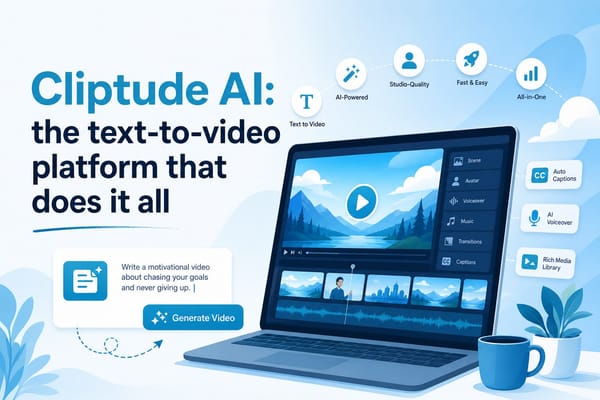
If you're ready to stop piecing together five different tools that don't talk to each other and start building your faceless channel with a workflow that actually holds together from one end to the other, check out Cliptude. Cliptude brings your script, AI voiceover, visuals, and editing into one place so you can move fast without sacrificing the quality that keeps viewers watching. It's built specifically for the kind of channel and workflow we talked about in this post, and it removes the friction points that slow most creators down before they ever get real traction. Drop a comment below and let me know what part of your AI voiceover workflow you're still struggling with. Whether it's finding the right voice, writing scripts that don't sound stiff, or just getting your production time down to something manageable, I read everything and I'd love to help you figure it out.