
What is Foley vs. SFX (Sound Effects)?

Sound is half the movie. You've probably heard that said before, and it's true. But most people watch a film or video without ever thinking about where those sounds actually come from. The footsteps on a gravel road, the creak of a door, the crunch of someone biting into an apple — none of that is usually recorded on set. It all gets built in post-production, and that's where the terms Foley and SFX come in.
These two things get mixed up all the time, even by people who work in video production. A lot of you have asked about this after reading about audio layering and mixing, so I figured it was time to break it down clearly. Foley and SFX are not the same thing. They serve different purposes, they're created in different ways, and knowing the difference can actually change how you approach sound design in your own projects.
Whether you're editing YouTube videos, short films, or social content, understanding sound design basics gives your work a more polished, professional feel. So let's get into it.
What Foley actually is
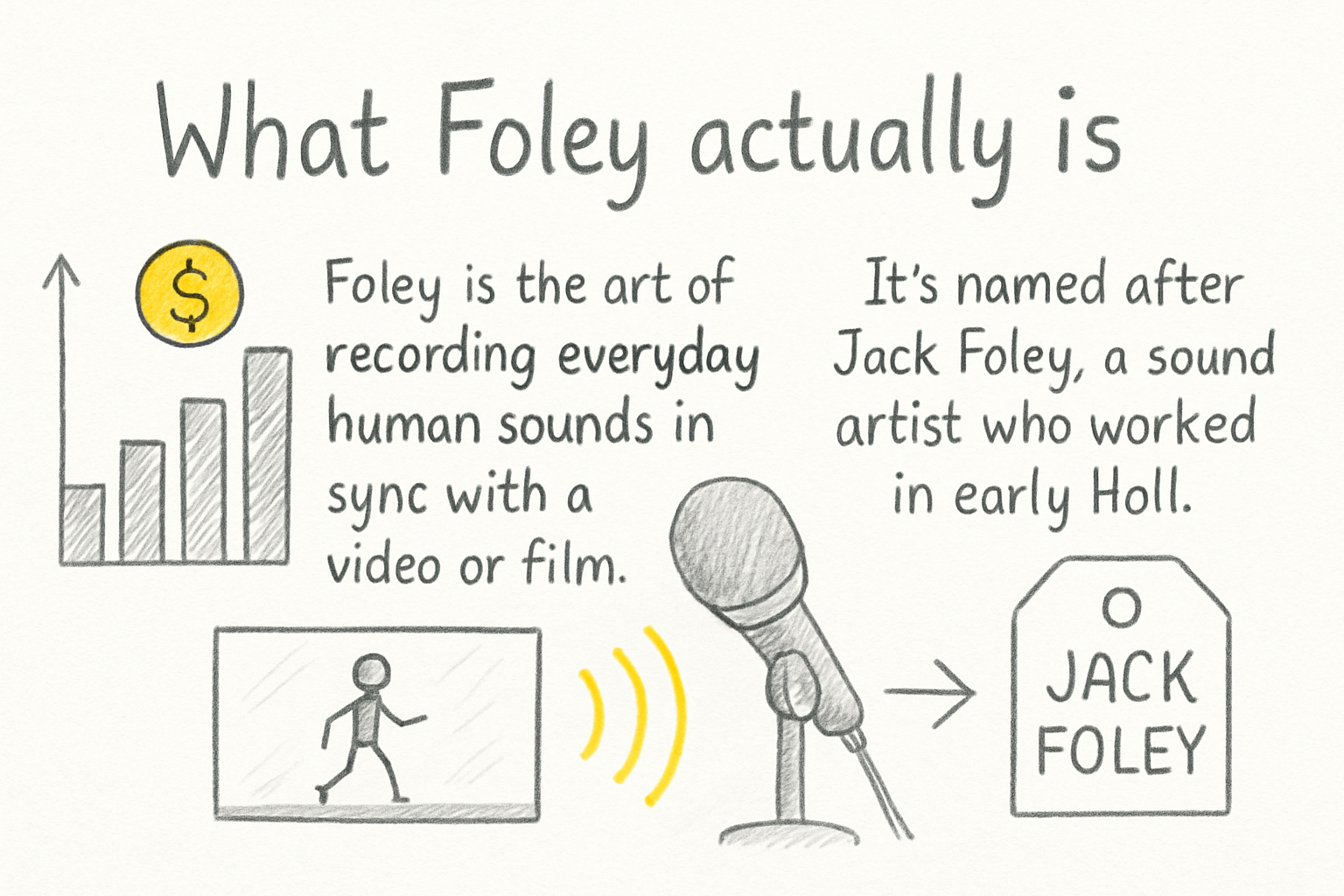
Foley is the art of recording everyday human sounds in sync with a video or film. It's named after Jack Foley, a sound artist who worked in early Hollywood and basically invented the technique. The idea is simple: you watch the footage and perform sounds in real time that match what's happening on screen. A Foley artist might walk in place on different surfaces to match an actor's footsteps, rustle a leather jacket to match movement, or tap their fingers on a desk to match a character's nervous habit.
What makes Foley special is that it's performed live and recorded fresh, not pulled from a library. A skilled Foley artist watches the picture and creates sounds that feel organic to that specific moment. The timing has to be tight. If the footsteps are even a frame off, the whole thing feels wrong, and your brain will notice even if you can't explain why.
I personally think Foley is one of the most underrated crafts in all of filmmaking. There's something almost theatrical about it — a person standing in a studio with a pile of props, recreating the physical world of a movie in real time. It's oddly satisfying to watch. I remember the first time I saw a behind-the-scenes video of a Foley stage and just sat there thinking, 'So that's how they make footsteps sound that crisp.' It changed how I listened to movies from that point on.
Foley typically covers three main categories: footsteps, movement (cloth and body sounds), and specific prop sounds tied to an actor's performance. These are sounds that feel personal and human. They follow the actor everywhere they go on screen.
What SFX means and how it's different
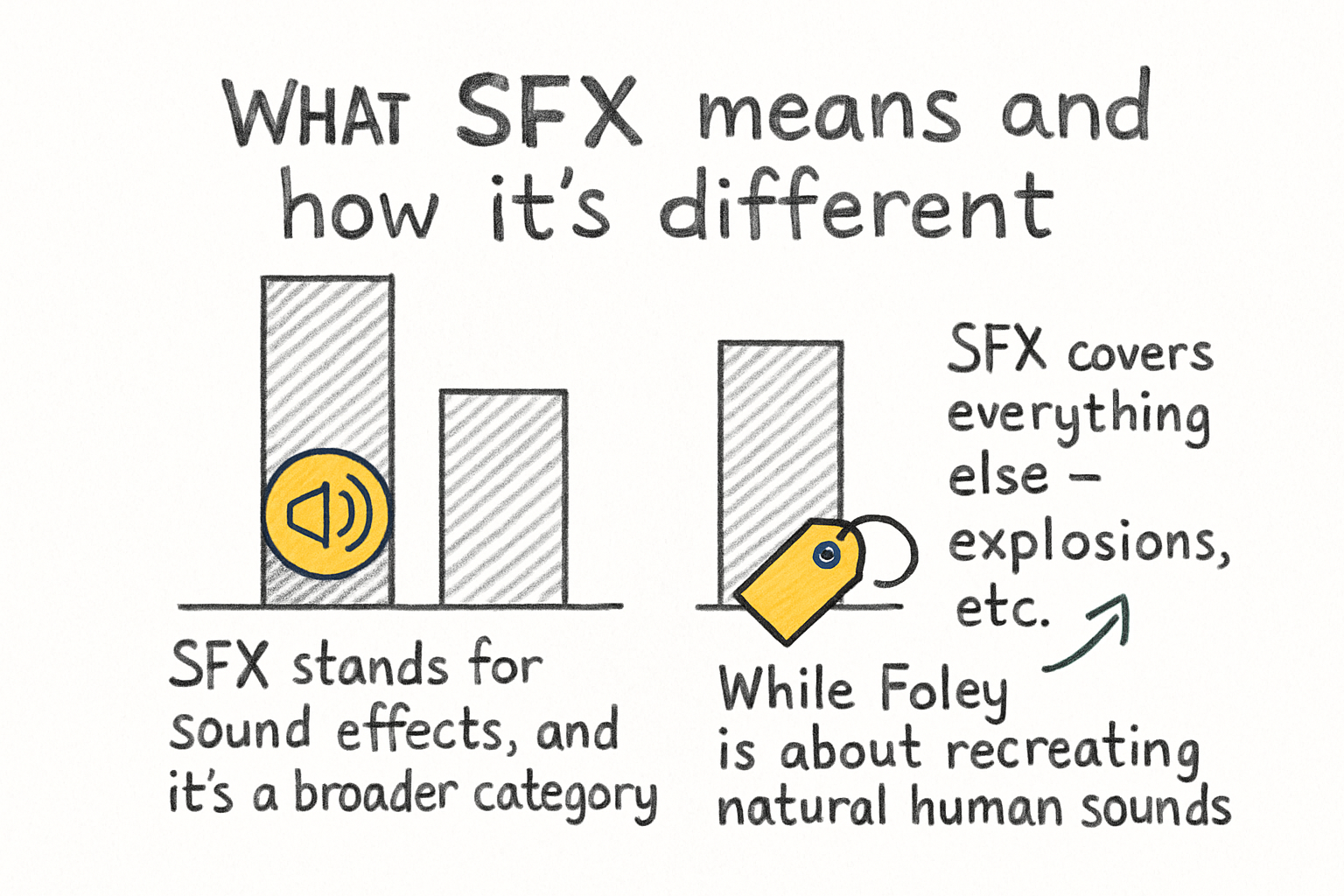
SFX stands for sound effects, and it's a broader category. While Foley is about recreating natural human sounds, SFX covers everything else — explosions, car engines, weather, animals, sci-fi sounds, crowd noise, and anything that sets the scene or adds impact. SFX can come from a library, they can be recorded on location, or they can be designed from scratch using software and layered audio.
Think about a thunderstorm in a movie. The crack of lightning, the rumble that follows, the rain hitting a window — none of that is Foley. That's all SFX, either recorded from real weather or built from stock sounds and processed to fit the scene. Or think about a car chase. The engine revving, the tires squealing, the crash — all SFX. These sounds are usually tied to the environment or event, not to a specific actor's physical performance.
Here's an easy way to remember it: Foley follows the person, SFX set the world. If a character punches someone, the hit sound is often a Foley effect (performed and recorded to match that exact swing). But if a grenade goes off two blocks away during that same fight, that's an SFX element dropped into the mix. Both matter, but they do different jobs.
When you're editing video content and thinking about how sound layers together, it helps to think about this split. Good sound design uses audio ducking explained here to balance all these elements — Foley, SFX, dialogue, and music — without any one layer drowning the others out. Knowing what type of sound you're working with helps you make better decisions about how to treat it in the mix.
Why this matters for video creators
You might be thinking, 'Okay, this is interesting, but I'm making YouTube videos, not Hollywood films.' Fair point. But understanding Foley and SFX is still useful, even at a smaller scale. The difference between a flat video and one that feels alive often comes down to sound. When your video has the right sounds layered in — even subtle ones — it pulls the viewer deeper into what's happening.
For creators doing talking-head content, interviews, or tutorials, Foley isn't usually something you need to worry about much. But if you're doing any kind of storytelling, product videos, scripted content, or short films, adding even basic Foley-style sounds can make a big difference. A simple keyboard click, a coffee mug setting down, or a chair scraping back — these tiny sounds ground the viewer in a real space. Without them, a scene can feel hollow.
SFX, on the other hand, is something almost every creator uses at some point. Transition sounds, notification pings, background ambience, music stingers — these all fall under the SFX umbrella. If you're using a stock sound library or downloading sound packs, you're already working with SFX. The key is using them with intention, not just filling silence with random noise.
Sound design also connects directly to pacing and editing. The way sound cuts between scenes can be just as powerful as the picture cut itself. If you want to see how that works in practice, our post on J-cuts and L-cuts in video editing shows exactly how audio and video can be staggered to create smoother, more cinematic transitions. Once you start hearing those techniques in finished videos, you'll spot them everywhere.
Ready to take the next step?
Sound design is one of those things that separates videos people scroll past from videos people actually watch all the way through. Now that you know the difference between Foley and SFX, you've got a better foundation to think about how sound works in your own projects. If you have questions, drop them in the comments — I read every one and love hearing what you're working on. And if you're looking for a faster, smarter way to produce video content without getting buried in the technical side, check out Cliptude. It's built to help creators move from idea to finished video without the usual friction, so you can focus more on storytelling and less on the technical pile-up.



