Why Making One Faceless YouTube Video Takes 10+ Hours (And How to Cut It to 1)

If you've ever tried making a faceless YouTube video from scratch, you already know the pain. What looks like a simple ten-minute video on screen can eat up an entire day behind the scenes. You sit down thinking you'll knock it out in a couple of hours, and then suddenly it's midnight and you're still hunting for the right stock footage clip to match line forty-seven of your script. You haven't eaten dinner. Your coffee went cold two hours ago. And the video isn't even close to done. Sound familiar?
A lot of you have asked about this exact problem. Why does it take so long? Where does all the time actually go? And more importantly, is there a way to make it hurt less without sacrificing quality? The answer is yes, but first you have to understand where the hours are disappearing. Because if you don't know what's eating your time, you can't fix it. Guessing at the solution without diagnosing the real problem is how people end up buying a new microphone when what they actually needed was a better research system.
The good news is that most of the time you lose making a faceless video isn't lost to unavoidable work. It's lost to inefficiency, bad tools, unclear processes, and doing things in the wrong order. Most creators don't realize that the ten-plus hours they're spending isn't the cost of making a good video. It's the cost of making a video without a repeatable system. Once you see the breakdown clearly, you can start cutting that grind down to something that actually fits into a real life with a job, a family, and maybe the occasional night of sleep. Let's walk through it step by step.
Where all those hours actually go
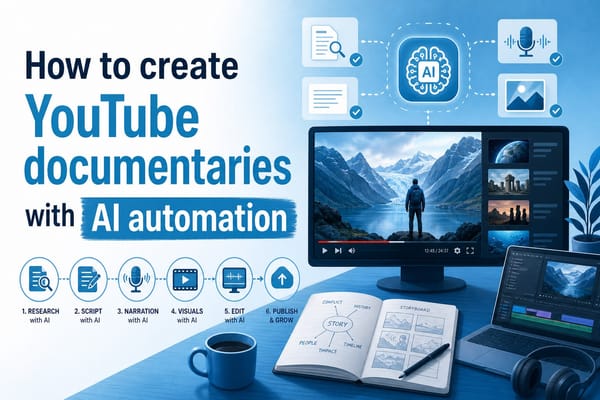
The first big time-eater is research, and it hits harder than most creators expect. Before you write a single word of your script, you need to know what you're talking about well enough to explain it clearly and keep someone watching for ten minutes. For a standard ten-minute video, most creators spend anywhere from one to three hours just reading, watching, bookmarking, and cross-checking information. This is especially true for documentary-style channels covering history, science, true crime, or geopolitics, where accuracy actually matters and you can't just wing it. The research phase feels productive because you're learning things, but it can spiral fast if you don't have a system in place to contain it. You click one Wikipedia article about the fall of the Roman Empire, that leads to a YouTube documentary, that leads to a Reddit thread with a source you've never heard of, and two hours later you've got forty-two browser tabs open, three conflicting timelines, and no clear sense of what your actual video is supposed to argue. If you want to tighten this step up, check out this guide on how to research a YouTube documentary faster that breaks the process into something actually manageable and repeatable.
Then comes scripting, and this is where creators who aren't professional writers really start to feel the drag. Writing a full script for a ten-minute video means producing roughly 1,400 to 1,600 words, depending on your pacing and whether you speak quickly or slowly. For most people, that takes one to two hours on its own just to get a rough draft down. And that's not counting the revision rounds that always follow. You write a draft, read it out loud, realize the third section doesn't connect logically to the second, move things around, rewrite the intro because the hook isn't landing, and then do it all again. Scripting can easily stretch to three hours when revisions are factored in. A lot of creators underestimate this step because they assume that since talking is easy, writing must be too. It's not the same skill at all. Talking is improvised and context-dependent. Writing a script that sounds natural when read aloud, flows logically from point to point, and holds a stranger's attention for ten straight minutes is a real craft that takes real time to develop.
After scripting comes voiceover, and this is where things get genuinely messy if you're recording yourself. First you have to set up your recording space, check for ambient noise, position your mic, and do a test recording to make sure levels are right. Then you record the whole script, which for a ten-minute video means about fifteen to twenty minutes of actual speaking time. Then you listen back and cringe at the flubs, the mouth clicks, the weird inhale before a sentence, the moment your neighbor started their lawnmower on minute six. Then you record it again. Maybe a third time for certain sections. Then you pull everything into an audio editor, remove the mistakes, strip the long silences, equalize the levels, and apply noise reduction so it sounds clean. For a ten-minute finished product, recording and editing your own voiceover realistically takes two to three hours. And that's before you've touched a single frame of footage. A lot of creators have started switching to AI voiceover tools to skip this entire process, and if you're curious how that works, the best AI voice over generator for YouTube videos guide covers the top options in real detail without the fluff.
Video editing is the final monster, and it's the step that tends to swallow the most unpredictable chunks of time. Sourcing stock footage or B-roll that actually matches your script is its own job. You need clips that are visually relevant, high enough quality for YouTube, properly licensed, and varied enough that your video doesn't feel like a slideshow of the same five shots. Then you sync each clip to the right moment in your voiceover, add lower-third text overlays, drop in background music at the right volume level so it doesn't drown out the narration, apply transitions between scenes, do basic color grading so everything looks cohesive, add captions or subtitles, and then wait for the whole thing to render and export, which depending on your computer can take anywhere from ten minutes to forty-five. All of that, for a creator with moderate editing experience, takes two to five hours. And that's assuming you already have a stock footage library you trust. If you're searching Pexels, Pixabay, or a paid platform from scratch every single video, you're easily adding another hour just to the clip-hunting phase. Add it all up and the math lands you between eight and twelve hours for one video, every single time, week after week.
The real culprits slowing you down
Here's what most YouTube advice skips over entirely. It's not that making videos is inherently slow. It's that most creators are doing it in a way that creates friction at every single transition between tasks, and that friction compounds. I personally think the biggest hidden time-waster isn't any one task in the production process. It's the constant context-switching between tasks with no clear workflow holding everything together. You're trying to write your script while also looking up footage options. You're recording your voiceover while also trying to decide what background music fits the mood. You're editing the timeline while also still undecided about what your thumbnail should say. Your brain never fully settles into any one mode because you're always doing three jobs at the same time, and the mental cost of switching is higher than most people realize. Cognitive scientists call it task-switching cost. Creative professionals just call it exhausting.
I remember my first few months trying to build a faceless channel as a side project. I didn't have a set process. I'd start the script on Monday night, get distracted, abandon it halfway through, come back to it Thursday when I had an hour free, forget where I was going with the argument, decide to start a different video instead, end up with three half-finished scripts and no finished video by Sunday. Then I'd panic and rush something together, skimp on the research, use whatever footage came up first in the search results, and publish something I wasn't proud of. The video would get low views and I'd tell myself the niche was too competitive. The problem wasn't the niche. It was chaos dressed up as productivity.
Another major culprit is what I'd call tool-hopping, and it's an issue that hits newer creators especially hard. The faceless YouTube workflow touches a lot of different media types: written scripts, audio recordings, video clips, graphics, captions, thumbnails. Most creators patch together a different tool for each one. A Google Doc for scripting. A separate app for AI voices. A stock footage site or two. An audio editor for cleanup. A video editor for the timeline. Another tool for captions. Another for the thumbnail. Each tool has its own interface, its own file formats, its own export quirks, and its own learning curve. Every time you switch from one to another, you lose five to ten minutes just getting reoriented, finding the right project file, remembering where you left off, and exporting in the right format for the next step. Multiply that across a dozen transitions per video and you've quietly burned over an hour on nothing but opening apps, locating folders, and waiting for files to load. That's an hour you could have spent making the script sharper.
There's also the perfectionism trap, and it hits faceless channels especially hard for a specific reason. When you're on camera, your personality and presence humanize the small imperfections. Viewers forgive a slightly awkward cut because they're invested in you as a person. But in a faceless video, there's no face to create that warmth, so creators instinctively try to compensate by making every visual decision perfect. You spend forty-five minutes searching for the exact right aerial drone shot of ancient Rome when a decent one you found in the first five minutes would have worked completely fine. You redo the color grade three times because the shadows feel slightly too warm. You obsess over whether the background music should be strings or piano. Your audience isn't watching your video under a microscope. They're watching it on their phone while half-paying attention, and what they're going to respond to is whether the story you're telling is actually interesting. That's a script-level problem, not a clip-selection problem. If you want to fix the real quality issue at its source, take a look at why your documentary and listicle videos feel generic because that's consistently where the gap between mediocre and genuinely good faceless content lives. Fix the script first, then worry about the footage.
How to actually cut it down to one hour
Okay, so one hour is the goal. Is it realistic for a polished ten-minute video? Genuinely one hour is very tight and requires a lot of pre-built templates and a tool setup that removes most of the manual work. But two to three hours is very achievable once you've built the right system and stuck with it long enough that the process feels automatic. Here's how the math changes when you stop doing things the hard way at every step.
Start with a research template rather than free-form browsing. Give yourself a hard thirty-minute window and a structured set of questions you need to answer before you close any tabs. What's the main argument or central question of this video? What are the three to five supporting points that build the case? What's one fact or angle that most people don't already know about this topic? What's the emotional hook that makes someone care about this subject in the first place? That constraint forces focus in a way that open-ended browsing never does, and it kills the rabbit-hole problem by giving you a stopping condition. When you've answered those four questions, the research phase is done, even if you haven't read everything you bookmarked. Pair that structured research approach with a script outline template you reuse every single video, with clearly labeled sections for hook, context, main argument, supporting points, surprising detail, and outro call to action, and you can go from blank page to finished first draft in under an hour if you're writing a format you've practiced before. The consistency of the template is what creates the speed. If you're producing long-form content regularly and want to understand how to systemize the script-to-video pipeline beyond just the writing phase, the article on how to create a long-form YouTube video from a script lays out a repeatable process that's worth working through in full.
The voiceover step is where AI tools have genuinely changed what's possible, and the change has happened fast enough that a lot of creators haven't caught up yet. Instead of spending two to three hours recording, re-recording, editing breaths out of your audio, applying noise reduction, and normalizing levels, you paste your finished script into an AI voice tool and get a clean, natural-sounding voiceover delivered in three to five minutes. No mic setup. No soundproofing your closet with blankets. No takes. No cleanup. The quality of modern AI voices has improved enough that most viewers, watching on a phone through earbuds at 1.25 speed, genuinely cannot tell the difference between a well-chosen AI voice and a human recording, especially when the content itself is compelling enough to hold their attention. If you want to understand the full landscape of what's available and which tools are actually worth using, the guide on how to create a professional voiceover without a microphone using AI breaks it down clearly. And for creators who want to maintain the personal feel of their own voice without the recording overhead, there's also the option of cloning your own voice so the AI produces audio that sounds exactly like you, complete with your natural pacing and tone. We went into a lot of depth on how that actually works in our AI voice cloning explained piece, and it's worth reading if you're on the fence about whether AI voice fits your brand.
Editing is the last frontier, and this is where modern AI video editing tools have started to make the most dramatic dent in total production time. The traditional editing process requires you to manually hunt through stock footage libraries for clips that match each section of your script, drag each clip into your timeline, manually sync it to the right moment in your voiceover, add captions line by line, and then go back through the whole thing to adjust pacing and transitions. That process, done carefully, takes most creators three to five hours per video. Newer AI-assisted editing tools can auto-match relevant stock footage to your script based on the actual words and topics in each sentence, auto-sync those clips to your voiceover without you dragging anything, and generate captions automatically in sync with the audio. What that means in practice is that you go from staring at a blank timeline to having a rough-cut video in fifteen to twenty minutes instead of three hours. Then you spend the remaining time reviewing, making judgment calls about clip choices the AI got wrong, adjusting music levels, and tweaking anything that feels off. That review-and-refine process is a much better use of a creative person's time than the manual mechanical work it replaces. If you're not sure what these tools actually look like in a real workflow, the breakdown of what an AI video editor is and how faceless YouTubers are using it gives a grounded picture without overselling what the technology can do. The key mental shift is moving from treating yourself as the person who does all the labor to treating yourself as the person who makes all the decisions. Use AI as your first-pass production engine. Let it handle the repetitive, mechanical, time-consuming grunt work of clip matching and caption generation and rough-cut assembly. Then bring your actual creative judgment to the parts that matter most: the script, the hook, the story structure, the moments where a specific clip choice or a specific line of narration is going to make the difference between a video someone shares and a video they click away from. Your time is the most expensive resource in your production. Spend it where only you can make the call.
Ready to take the next step?
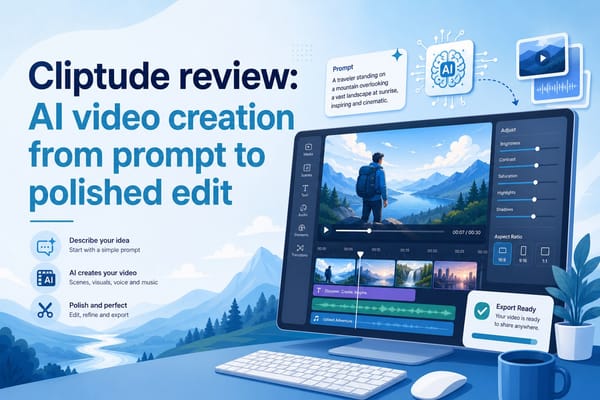
If you're serious about cutting your production time down and actually building a faceless channel that puts out consistent content without burning through every weekend to do it, the right system makes the difference between a channel that grows and one that stalls out because you can't keep up with the pace. Most creators who are stuck at ten-plus hours per video aren't stuck because they're slow or untalented. They're stuck because they're trying to run a modern content operation with a patchwork of five separate apps that don't talk to each other and a workflow they're reinventing from scratch every single time. That's why we'd love for you to check out Cliptude, which brings the entire faceless video production workflow into one place. From AI voiceover generation to auto-matched stock footage to timeline editing and caption generation, it's built specifically for creators who want to make videos they're proud of without losing every free hour they have to the process. Drop a comment below and tell us where your biggest time-waster is right now. Is it the research spiral? Is it the voiceover recording and cleanup? Is it getting lost in the editing timeline for hours? Let's figure it out together and find the specific fix that actually moves the needle for your channel.