Can You Use AI-Generated Scripts on YouTube? (2026 Policies + Monetization Tips)

A lot of you have asked about this, and honestly, it makes total sense why. AI-generated scripts are everywhere right now, and YouTube creators want to know if using them will get their channel demonetized, flagged, or buried in the algorithm. It's a fair concern, and the short answer is: no, AI-written scripts alone will not get you kicked out of the YouTube Partner Program. But the longer answer has a few important details you really need to understand before you go all-in on this approach.
YouTube's 2026 policies have shifted in ways that catch a lot of creators off guard. The platform doesn't care much about how your script was written. What it cares about is whether your content is original, valuable, and not misleading. If you slap a raw AI script onto a slideshow with a robotic voice and zero editing, you're going to have a bad time, and not just with YouTube, but with your audience too. Think about the last time you clicked on a video and immediately felt like you were watching something hollow and recycled. You probably clicked away within thirty seconds. That's exactly the experience YouTube's systems are designed to detect and punish over time. However, if you treat AI like a writing assistant and actually put your voice and perspective into the final product, your channel can absolutely grow and monetize in 2026.
I personally think AI scripts are one of the most underused tools for creators who are serious about growing fast without burning out. I started using AI to draft outlines and rough scripts a couple years back, and the time savings were almost shocking. What used to take me four hours to write was reduced to about ninety minutes of focused editing work. But I also learned pretty quickly that dumping unedited AI output into a video is a recipe for flat, forgettable content that audiences ignore and algorithms bury. This post is going to walk you through exactly what YouTube allows in 2026, where the real risks are hiding, and how to make AI-generated scripts work for your monetization strategy without cutting corners that come back to bite you.
What YouTube's 2026 policies actually say about AI content
YouTube has not banned AI-generated scripts. Let's get that out of the way first. As of 2026, the platform's content policies focus on three main things when it comes to AI: disclosure, originality, and deception. If your AI-generated content checks those boxes honestly and consistently, you're in good shape. But each of those three areas has some nuance worth understanding, because misreading them is how creators accidentally put their channels at risk.
The disclosure rule is the one most creators miss, and it's also the one that has expanded the most over the past couple of years. YouTube now requires creators to label videos that contain realistic AI-generated content that could be mistaken for real events or real people. This mostly applies to AI-generated faces, voices that sound like specific real public figures, or footage that appears to have been filmed but was actually generated by software. A script written by AI and then read aloud by a human on camera does not trigger this requirement. A deepfake-style video of a politician or celebrity saying something they never actually said absolutely does, and YouTube has been taking that seriously with account-level enforcement actions. So if you're writing scripts with AI and recording yourself reading them, you don't need to slap a disclosure label on every video. But if you're generating synthetic media that mimics real people or real events, that label is not optional anymore.
Originality is where things get more interesting, and more complicated. YouTube's spam and repetitive content policy has always targeted what the platform calls mass-produced videos, meaning channels that pump out hundreds of near-identical videos with little to no human creative effort behind them. Picture a channel that publishes fifty videos a week, all with the same structure, the same tone, barely different topics, and clearly no human thought between them. YouTube's systems have gotten much better at identifying that pattern, and channels running that playbook are getting suppressed in search and recommendations. The key thing to understand is that this policy is not specifically about AI authorship. It's about the final video feeling like filler. A human could produce filler content just as easily as an AI could. What matters is whether your video brings something to the topic that wasn't already sitting in the top ten results.
Deception is the third pillar, and it's the one with the most serious consequences. YouTube doesn't want creators using AI to spread medical misinformation, fabricated news stories, or misleading financial advice just because a chatbot wrote it. You can't claim ignorance because the AI drafted the script. You're still the publisher, and YouTube treats you like one. This matters a lot in niches like personal finance, health, legal advice, or any topic where a viewer might actually make a real-world decision based on what they hear in your video. AI tools make confident-sounding mistakes constantly. They'll cite statistics that don't exist, attribute quotes to the wrong people, or describe how a medication works in a way that sounds authoritative but is subtly wrong. Before any AI-drafted script goes live, every fact in it needs to be verified against a reliable source. That's not just good practice for your channel's safety. It's the basic responsibility that comes with having an audience.
How AI scripts affect YouTube monetization and the algorithm
Here's something a lot of creators get wrong: they assume the YouTube algorithm can somehow detect whether a script was written by AI and actively penalize it. That's not how it works. The algorithm is not reading your script and running it through a detector. It's measuring performance signals after your video goes live. Things like watch time, click-through rate, average view duration, comments, likes, and shares. A well-crafted AI script that keeps viewers genuinely engaged will actually perform better than a sloppy human script that meanders and loses people halfway through. The algorithm doesn't care about authorship. It cares about behavior. Specifically, it cares about whether real viewers are choosing to watch your video all the way through or bouncing after twenty seconds.
That said, AI scripts do carry an indirect risk to your monetization that's worth taking seriously. If your AI draft produces content that feels generic or could have been written for any channel on any day, viewers will drop off early. Low average view duration sends a negative signal to the algorithm, and over time that suppresses your impressions, which reduces ad revenue, which slows your path to and through the YouTube Partner Program. This is especially true for faceless YouTube channels, where the script and voiceover carry almost the entire viewing experience. There's no on-camera personality to save a flat script. There's no visual storytelling or facial expression to compensate for writing that doesn't move. The words have to do all the work, which means they have to be good.
Monetization through the YouTube Partner Program in 2026 still requires at least 1,000 subscribers and 4,000 watch hours for long-form content, or 10 million Shorts views for the Shorts-focused path. AI scripts can actually help you hit those thresholds faster if you use them to increase your publishing consistency without sacrificing quality. We've talked before about why making one faceless video can take 10 or more hours, and AI scripting is one of the biggest time-savers in that production pipeline. If going from one video a month to four videos a month means you hit 4,000 watch hours in three months instead of a year, that's the difference between a hobby and a monetized channel. The math on consistency is brutal in the early stages, and anything that helps you show up more often without burning out is worth understanding.
The channels that are making real money with AI scripts in 2026 aren't just copying ChatGPT outputs and hitting upload. They're using AI to handle the structural and formulaic parts of scriptwriting, things like intros that establish the hook, transitions between sections, and conclusions that drive viewer action, while putting human insight, storytelling, and specific examples into the parts of the video that actually build trust. Think of it like having an assistant rough out the framework of a house while you handle all the interior design and finishing work. The frame gets the structure up fast, but the details are what make people want to live there. That combination of speed and quality is what creates videos people actually finish watching, and finished videos mean more watch hours, better ad rates, and faster channel growth. If you want to go deeper on building a revenue strategy around longer content, the guide on monetizing long-form YouTube videos lays out the approach in a lot more detail.
One more thing worth mentioning here is advertiser sensitivity. Some advertisers have brand safety settings that restrict their ads from appearing on certain types of content. Channels that produce a high volume of AI-heavy content with low human editing sometimes get flagged as lower-quality inventory by programmatic ad buyers, which can result in lower CPMs even if the videos are technically monetized. This isn't an official YouTube policy, it's just how the advertising market works. The more your content feels like it came from a real, knowledgeable human with a perspective, the better it tends to perform not just with viewers but with the advertisers competing to reach them.
How to make AI-generated scripts work without getting penalized
The number one rule is simple: treat the AI draft like a first draft, not a finished product. When I first started using AI for scripts, I'd read through the output and think it was solid. Then I'd watch the video back and realize it sounded weirdly formal, almost like a textbook trying to be friendly. Technically correct sentences, organized structure, but no personality. No real human in there. The AI had written in a way that was competent but lifeless, and that comes through on camera in a way that's hard to ignore once you notice it. Your job is to make the script sound like you actually said it, not like you ran something through a content generator and called it a day.
Start by giving the AI a very specific prompt, because the quality of what you get out is directly tied to the quality of what you put in. The more context you give it, the more useful the output. Tell it your channel's tone, your target audience's age range, the exact format and length of your video, the specific point of view you want to argue, and even what you don't want it to do. A vague prompt like 'write a script about personal finance' will give you something indistinguishable from the ten thousand other personal finance videos already on the platform. A prompt like 'write an 1,800-word YouTube script for an audience of 22-to-32-year-olds about why budgeting apps make most people worse with money, using a direct and slightly contrarian tone, with a strong hook in the first thirty seconds and three specific examples' will give you something you can actually build on. Specificity is the difference between getting a raw material and getting something close to a usable draft.
Once you have the draft, the first thing you should rewrite completely is the intro. The first thirty seconds of your video determine whether people stay or leave, and AI consistently writes intros that are too slow, too formal, or too generic. They tend to start with context-setting when they should be starting with a hook, a tension, a surprising statement, or a question that makes the viewer feel like they need the answer. Write that opening section yourself, in your own voice, with your own instincts about what your specific audience wants to hear first. Then go through the rest of the script and read it out loud. Every sentence that makes you stumble, every phrase that sounds stiff, every moment where you think 'I'd never actually say it like that,' those are the spots you rewrite. Add a personal story where the AI put a generic example. Add a specific statistic you actually looked up where the AI put a vague claim. Add a reference to something current or culturally specific to your audience where the AI defaulted to something timeless and therefore boring. Those details are what AI genuinely cannot generate with authenticity, and they're exactly what makes viewers trust that a real person is talking to them.
For creators doing voiceover-only videos, the script quality becomes even more important because there's nothing visual or interpersonal to compensate for weak writing. If you're layering an AI voice generator on top of an AI script, you need to be especially careful that the final product feels like it came from somewhere real. The combination of a synthetic voice reading an unedited AI script is the fastest way to produce the exact kind of content YouTube's systems are built to stop recommending. Check out how course creators and coaches use AI to write educational scripts if you want to see how professionals in high-trust niches handle this balance, because the bar for credibility in those spaces is higher than almost anywhere else on YouTube.
Fact-checking your final script before recording is also non-negotiable, and it deserves more than a quick skim. Pick every specific claim your script makes and ask yourself whether you actually know that to be true. If the AI wrote that a certain study found a certain result, go find that study and confirm it exists and says what the script claims. If it wrote that a particular company made a particular decision, verify it with a real source. This takes time, but it's the kind of time that protects your channel for the long run. In niches like finance, health, legal information, or anything where viewers are making real decisions based on what they watch, one confidently stated wrong fact can trigger an age restriction, a policy strike, or in serious cases, removal. Protecting your monetization starts with protecting your credibility, and your credibility starts with the script.
Finally, think about how you structure your workflow so that the human editing step never gets skipped when you're under pressure. It's easy when you're trying to hit a publishing schedule to convince yourself that a script is close enough to finished and it probably won't matter. It almost always matters. Build the editing pass into your calendar the same way you build in recording time and thumbnail creation. The creators who consistently succeed with AI-assisted scripting aren't the ones who found a better AI tool. They're the ones who built a repeatable process where the AI handles speed and structure, and the human handles quality and voice. That's the workflow worth building.
Ready to take the next step?
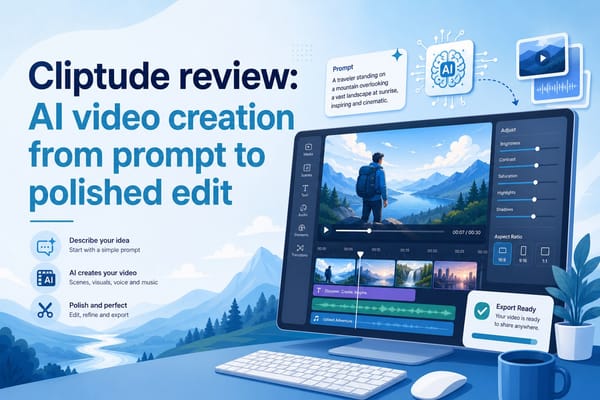
If you've been sitting on the fence about using AI to write your YouTube scripts, hopefully this clears things up. The policies in 2026 give creators real room to use AI tools, as long as you're adding genuine value, staying honest with your audience, and not just copy-pasting robot text into a video player and hoping for the best. The creators winning right now are the ones who figured out how to move faster without cutting the corners that actually matter. They're publishing more, staying consistent, and still making content that feels worth watching. If you want to put all of this into practice without juggling five different tools across your whole production process, check out Cliptude. It's built specifically for YouTube creators who want to go from script to finished video without the usual headache. Drop a comment below and let me know: are you already using AI scripts, or are you still hesitant? I'd genuinely love to hear what's holding you back.