Urdu AI video generator for professional YouTube content

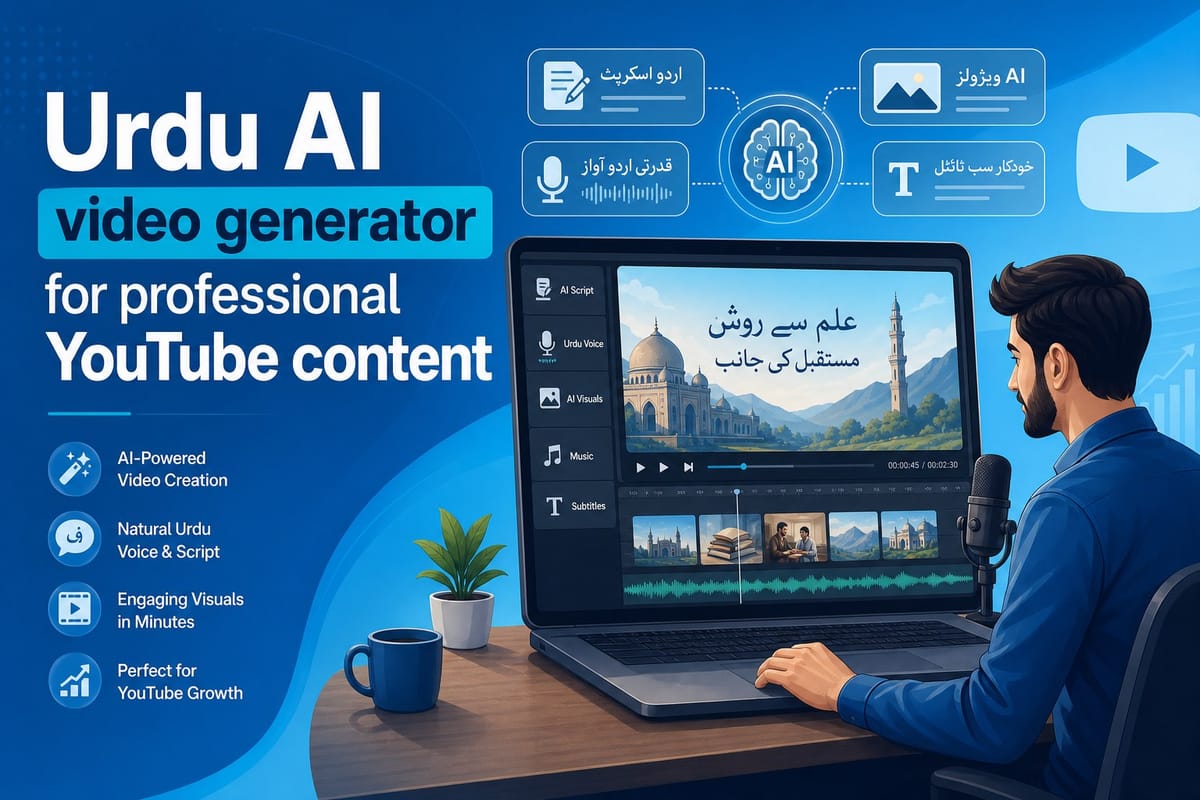
Table of contents
1. Why Urdu YouTube content is a massive untapped opportunity
2. How an urdu ai video generator actually works for professional content
3. Building a real Urdu YouTube channel with AI-generated content
Urdu-speaking creators are building some of the fastest-growing faceless YouTube channels right now. The demand for Urdu content on YouTube is real, and it is growing every year as more viewers in Pakistan, India, and the broader South Asian diaspora look for quality video content in their language. The problem is that producing polished, professional videos in Urdu takes time, skills, and money that most solo creators simply do not have. A capable urdu ai video generator changes all of that. Instead of spending days scripting, editing, and sourcing footage, you can go from a simple idea to a finished video in a fraction of the time. In this article, I will walk you through exactly why Urdu content is such a big opportunity, how AI video generation works for Urdu creators, and how platforms like Cliptude can help you produce professional YouTube content without sitting in front of a camera or hiring a full production team.
Why Urdu YouTube content is a massive untapped opportunity
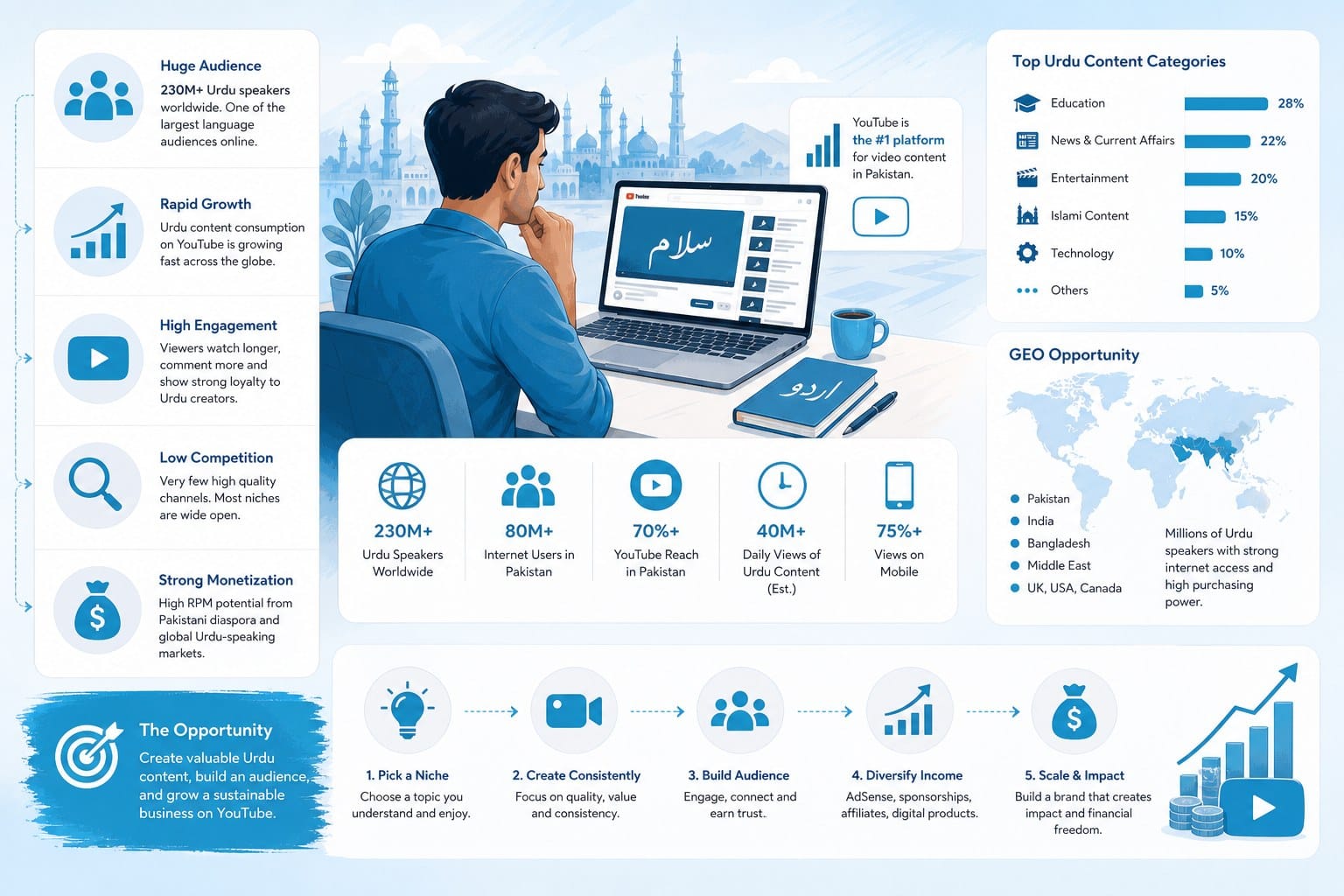
Let me start with the numbers. Urdu is spoken by over 230 million people worldwide. Pakistan alone has more than 220 million people, and YouTube is one of the most visited websites in the country. Add in the Urdu-speaking communities spread across the UK, the United States, Canada, and the Gulf states, and you are looking at a global audience that is hungry for content in a language they grew up speaking.
Despite that huge audience, the supply of high-quality Urdu video content on YouTube is still relatively thin compared to English or even Hindi. Most popular Urdu channels are either news-based, which is a crowded space, or they rely heavily on the personality of an on-camera host. That means the faceless educational, documentary, and listicle format that has exploded in English is still wide open in Urdu.
Think about what the most successful faceless English channels cover. Topics like history, science, psychology, true crime, personal finance, world geography, and motivational content all perform incredibly well. Now imagine those same topics delivered in fluent, natural Urdu. The competition is far lower, the audience is engaged, and the potential for rapid channel growth is significant.
I have seen creators in smaller language niches build channels to hundreds of thousands of subscribers in under a year simply because they were one of very few people making consistent, well-produced content in that language. Urdu is in a very similar position right now.
The challenge for most creators is not the topic ideas. It is the production. Making a professional-looking video with good narration, relevant footage, clean editing, and motion graphics is genuinely hard if you do not have a background in video production. Hiring a freelance editor and voiceover artist for every video adds up fast. That is exactly the problem a good urdu ai video generator is built to solve.
Another thing worth understanding is how YouTube's algorithm rewards consistency. Channels that post regularly tend to grow faster than channels that post sporadically. If it takes you two weeks to produce one video manually, you will struggle to stay consistent. If an AI tool can compress that production time down to a few hours per video, suddenly posting two or three times a week becomes realistic. That consistency compounds over time and is one of the biggest drivers of channel growth.
So the opportunity is clear. Large audience, low competition in the faceless content space, and a format that is proven to work in other languages. The only thing standing between most creators and a successful Urdu channel is the production barrier. That barrier is what AI video generation is built to remove.
How an urdu ai video generator actually works for professional content
Not all AI video tools are built the same way, and it is worth understanding what separates a basic text-to-video tool from one that can actually produce professional YouTube content in Urdu.
At the most basic level, a text-to-video tool takes written content and turns it into a video. But for that video to actually be watchable and competitive on YouTube, a lot more needs to happen than just slapping some stock footage behind a script. You need proper research, a well-structured script, relevant visuals, clean narration, motion graphics, and polished editing. For Urdu content specifically, you also need the tool to handle Urdu script correctly, generate natural-sounding Urdu narration, and understand the cultural context of the content.
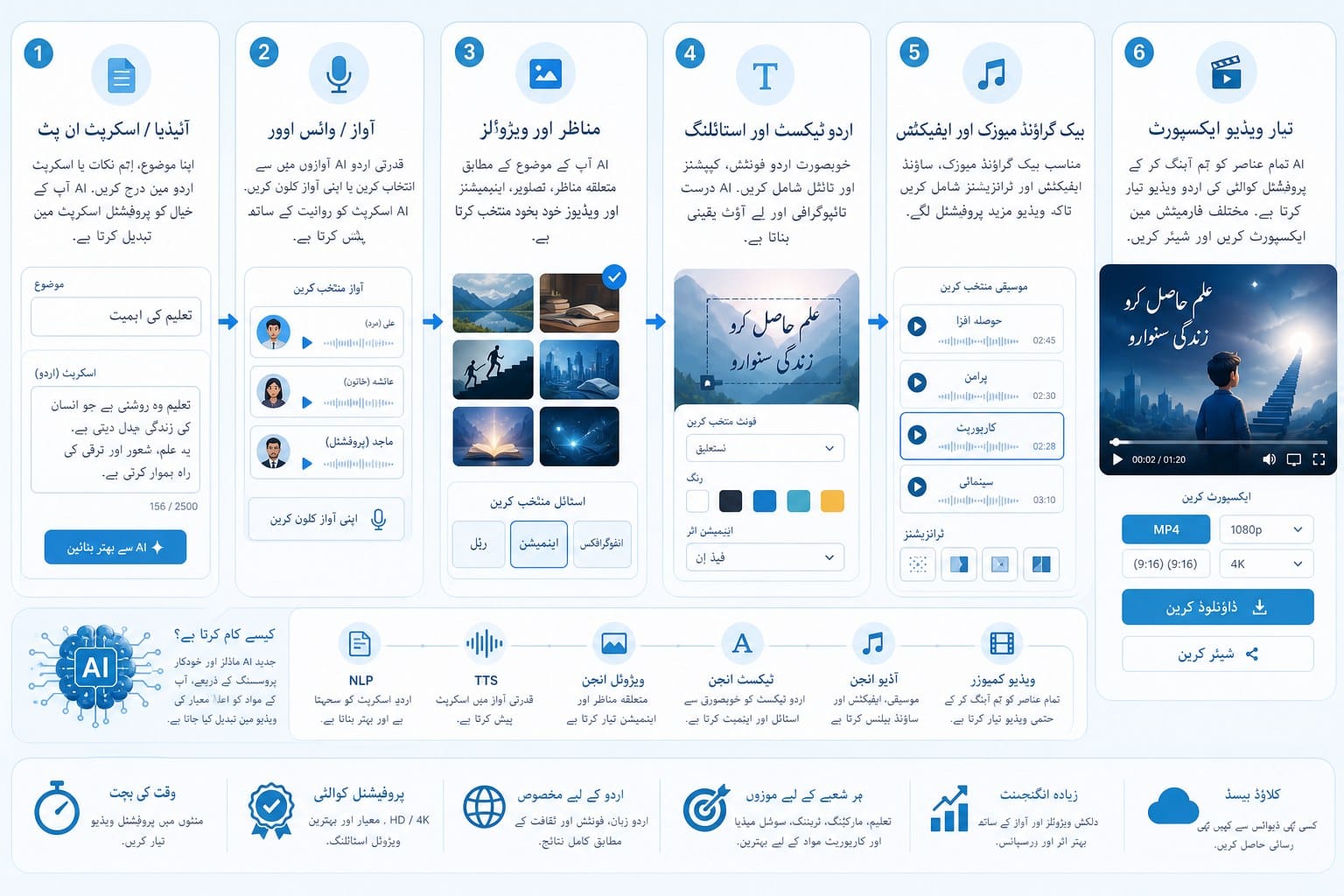
Here is what a proper workflow looks like when using an AI video platform for Urdu YouTube content.
First, you start with an idea or a prompt. It could be something like "a documentary about the history of the Mughal Empire" or "a listicle about the seven most dangerous animals in Pakistan." The AI takes that prompt and does the research work for you. It pulls together the relevant information, organizes it into a logical structure, and writes a script that flows well.
Second, the script gets turned into narration. For Urdu content, this means generating a voiceover in Urdu that sounds natural and clear. The quality of the Urdu voice matters a lot here. A robotic or heavily accented voice will kill viewer retention no matter how good your visuals are. The best tools offer multiple voice options so you can find one that fits the style of your channel.
Third, the platform sources relevant footage and images to match the script. For a documentary about the Mughal Empire, that means historical images, relevant B-roll footage, and visual elements that bring the story to life. The footage needs to be properly licensed so you are not running into copyright issues on YouTube.
Fourth, motion graphics and text elements get added. This is where a lot of basic AI tools fall short. Professional YouTube videos in almost every niche use text overlays, animated titles, and visual transitions to keep viewers engaged. Without these elements, even well-scripted content can feel flat.
Fifth, everything gets assembled and edited into a finished video. Cuts happen at the right moments, audio levels are balanced, and the pacing keeps viewers watching from start to finish.
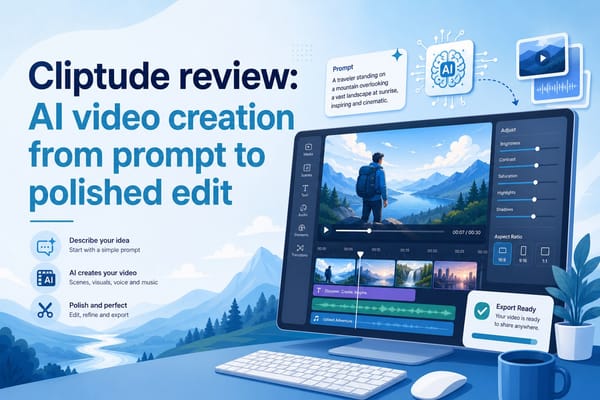
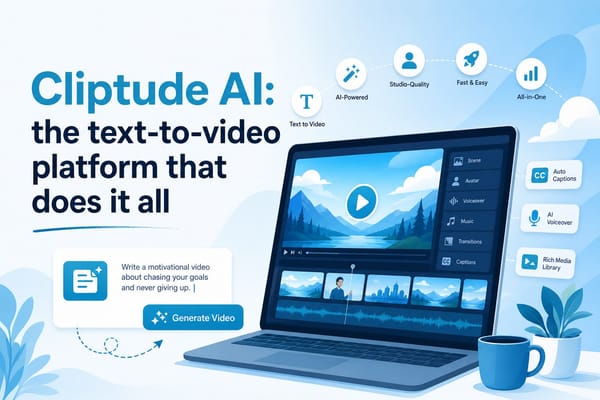
Cliptude handles all five of these stages automatically. You put in a prompt or an existing script, and the platform takes care of research, scripting, footage sourcing, motion graphics, and editing. The result is a polished video that looks like it took a professional team days to make. For Urdu creators, this is transformative because it removes every step of the production process that typically requires technical skill or a large team.
One thing I want to be clear about is the role of the creator in this process. Using an AI video generator does not mean you just press a button and walk away. The best results come from creators who bring their knowledge of their audience, their niche expertise, and their sense of what topics will resonate. The AI handles the technical production. You handle the creative direction. That combination is what produces content that actually builds a loyal audience.
For faceless channel creators in particular, this workflow is ideal. You never need to appear on camera, you never need to set up a recording studio, and you never need to spend hours in a video editing timeline. Your job is to pick great topics, review the output, and publish consistently.
There is also the question of video formats. Urdu content works across multiple formats and platforms. Long-form documentaries and listicles work well on YouTube's main feed. Short-form clips cut from those longer videos can perform well on YouTube Shorts, TikTok, and Instagram Reels. Animated formats like whiteboard or stickman videos work particularly well for educational and explainer content because the visual style itself is engaging and distinctive. Having a platform that can produce all of these formats from a single prompt gives you a huge advantage in terms of content volume and reach.
For anyone thinking seriously about building a monetized Urdu channel, understanding your thumbnail and title strategy is just as important as the video itself. A great video that nobody clicks on will not grow your channel. If you want to understand how to make your thumbnails work harder for you, I recommend reading about clickbait thumbnail generator: create high-CTR YouTube thumbnails automatically. Getting that click is the first battle, and thumbnails are often where new channels leave a lot of growth on the table.
Pricing is another practical consideration. Cliptude uses credit-based pricing, which means you only pay for what you produce. This is much more manageable than a flat subscription when you are starting out, because your production volume will likely increase over time as your channel grows and as you get more comfortable with the platform. You can start with a smaller amount of credits, see what the output looks like, and scale up your production as your channel gains momentum.
Building a real Urdu YouTube channel with AI-generated content
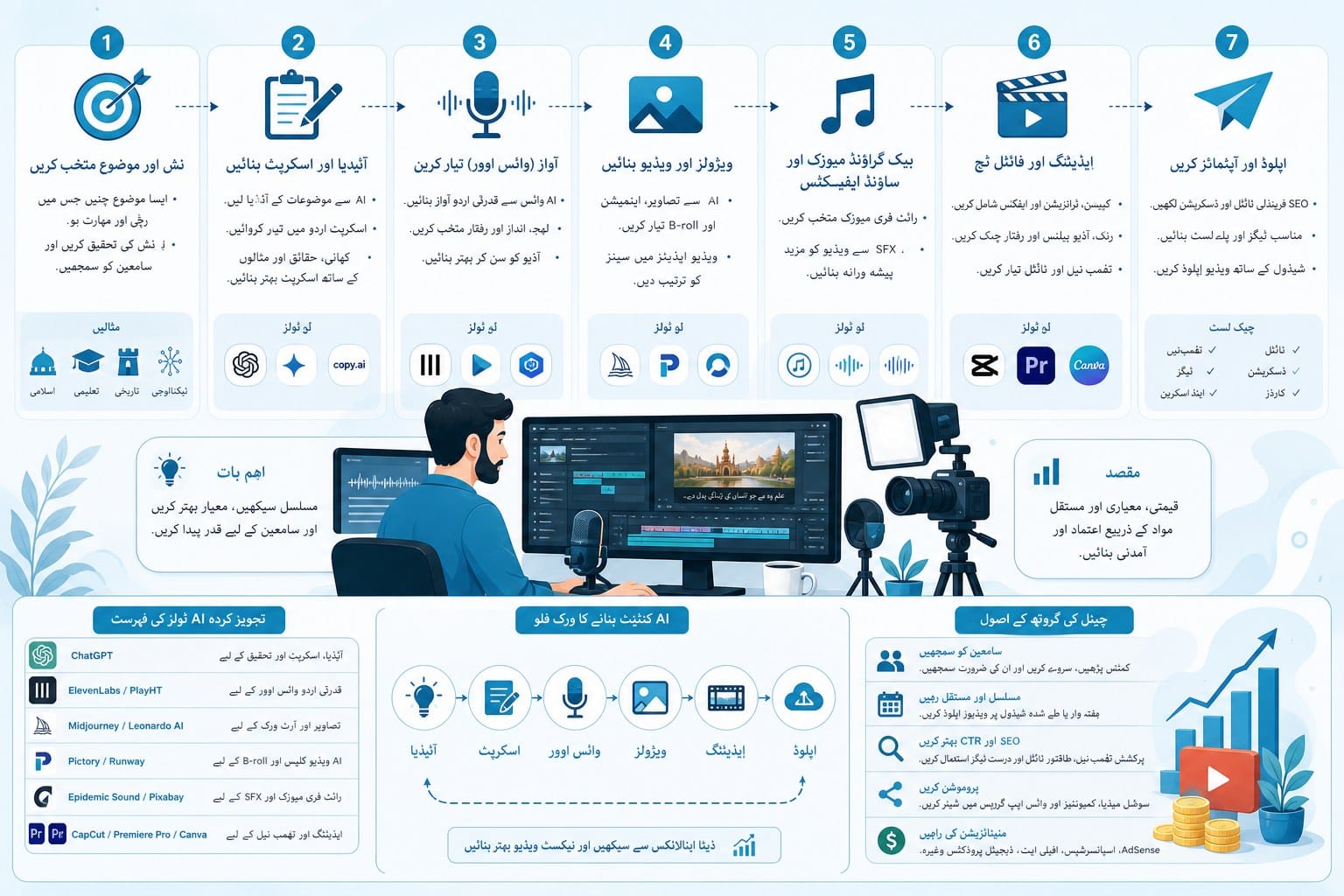
Let me get practical here. I want to walk through what actually building a faceless Urdu YouTube channel with an AI video generator looks like in practice, from choosing your niche to publishing your first batch of videos.
The niche question is where most new creators get stuck. They either pick something too broad, like "news and current events," or they pick something so narrow that they run out of topics in three months. The sweet spot for a faceless Urdu channel is a niche that has deep content possibilities, an engaged audience, and relatively low competition in Urdu specifically.
Here are a few niches that have strong potential for Urdu faceless content right now.
History and civilization. Pakistani and South Asian history is rich and complex, and there is enormous appetite for well-produced content that explores it. Videos about the Indus Valley Civilization, the Mughal era, partition history, and ancient trade routes can each sustain dozens of episodes. This format works extremely well as a documentary-style video, which is one of the formats Cliptude produces.
Science and technology. Urdu-speaking audiences are increasingly tech-savvy, and there is a real appetite for science content explained clearly in Urdu. Topics like space exploration, biology, physics, and emerging technology translated into accessible Urdu can attract a broad audience that spans students, curious adults, and professionals.
Personal finance and business. Financial literacy content in Urdu is significantly underserved. Topics like how to save money, how businesses work, investment basics explained for Pakistani audiences, and freelancing tips are all high-value content categories that audiences genuinely search for.
True crime and mysteries. This genre is one of the most reliable performers on YouTube globally. Urdu-language true crime content covering historical events, unsolved mysteries, or notable cases that are culturally relevant to South Asian audiences has very little competition and strong viewer retention.
Motivational and self-improvement. Urdu motivational content is popular but most of it is on-camera talking head style. Polished animated or documentary-style self-improvement content in Urdu stands out significantly from what most creators in this space are doing.
Once you have picked your niche, the next step is building a content calendar. I recommend planning at least 10 to 15 video topics before you publish your first video. This gives you a buffer and ensures you are not scrambling for ideas every week. It also helps you think through the narrative arc of your channel. Are you building a channel that goes deep on a few subjects, or one that covers a wide range of topics within a broad theme like history or science?
With Cliptude, you can take those 15 topic ideas and begin producing videos immediately. You enter your prompt, the platform researches and scripts the content, generates the Urdu narration, sources the footage, adds motion graphics, and produces a finished video. From there, you review it, make any adjustments you want, and publish.
Here is something I think a lot of new creators underestimate: the importance of the first 30 seconds of every video. YouTube's algorithm pays close attention to viewer retention, and the biggest drop-off point for most videos is in the first 30 seconds. If you are not immediately giving the viewer a reason to keep watching, they leave. When you are reviewing the AI-generated output, pay particular attention to the opening hook. Make sure it is engaging, specific, and gives the viewer a clear sense of what they are going to learn or experience by watching the full video.
Consistency in visual style also matters more than most new creators realize. When your thumbnails, title cards, and color scheme are consistent across your videos, viewers start to recognize your channel. That recognition builds trust, and trust drives subscriptions. Even with AI-generated content, you can develop a consistent visual identity by choosing a color palette and thumbnail style and sticking to it across all your videos.
For YouTube Shorts and short-form content, the approach is slightly different. Shorts work best when they are punchy, fast-moving, and deliver a single interesting fact or idea in under 60 seconds. You can take a long-form documentary video and cut it into three or four Shorts that each highlight a particularly interesting segment. This gives you significantly more content from a single production, and Shorts can drive subscribers back to your main channel.
Monetization is a topic worth addressing directly. Urdu channels can earn through YouTube's Partner Program once they meet the subscriber and watch hour thresholds. With consistent posting of high-quality content, reaching those thresholds is achievable within a reasonable timeframe. Beyond AdSense, Urdu channels can also pursue sponsorships from brands targeting Pakistani and South Asian audiences, affiliate marketing, and digital products like courses or ebooks.
Because Cliptude gives creators full commercial rights to their AI-generated videos, you can monetize the content however you choose. There are no restrictions on how you earn from the videos you produce on the platform. That is an important distinction from some other tools that limit commercial use.
I also want to touch on the topic of video titles and metadata, because even great content does not grow if it cannot be found. Your video title and description need to include the keywords your audience is actually searching for in Urdu. YouTube is a search engine, and optimizing for it matters. Pay attention to what search terms appear in YouTube's autocomplete when you type in Urdu queries related to your niche. Those autocomplete suggestions tell you exactly what people are looking for.
Thumbnail text is another area that Urdu creators often overlook. If you are adding text to your thumbnails, that text needs to be readable at small sizes because most viewers will see your thumbnail as a small rectangle on their phone screen. Understanding how to use thumbnail text effectively is a skill that pays off in higher click-through rates. If you want to go deeper on this, the article on how to use a YouTube thumbnail text generator effectively covers the core principles well.
One more practical note: do not neglect the publishing schedule. Decide on a consistent posting frequency before you launch and stick to it. Three times a week is ideal if your production capacity allows it. Once a week is absolutely fine when you are starting out. What matters is that viewers and the algorithm can rely on you to post on a predictable schedule. Random or sporadic posting makes it much harder to build momentum.
The combination of a large underserved audience, proven content formats, and powerful AI tools means that an Urdu faceless YouTube channel is genuinely achievable for a solo creator today. The production barrier that used to require a team and a significant budget is now something a single person can overcome with the right platform.
For creators who have looked at other tools and felt underwhelmed by the output quality or frustrated by complicated workflows, it is worth looking at how alternatives stack up. There are some helpful comparisons in the wider Cliptude blog content, including a piece on Vidrush referral codes explained and a better alternative that gives a sense of how different platforms approach AI video production and what to look for when choosing the right one for your needs.
Ready to take the next step?
If you are ready to start building a professional Urdu YouTube channel without a camera, an editing suite, or a production team, Cliptude is built for exactly that. You bring the ideas and the knowledge of your audience. Cliptude handles the research, scripting, footage, motion graphics, and editing. Head over to https://cliptude.com to explore the platform and start producing your first Urdu video today.