
AI video generator for faceless YouTube channels

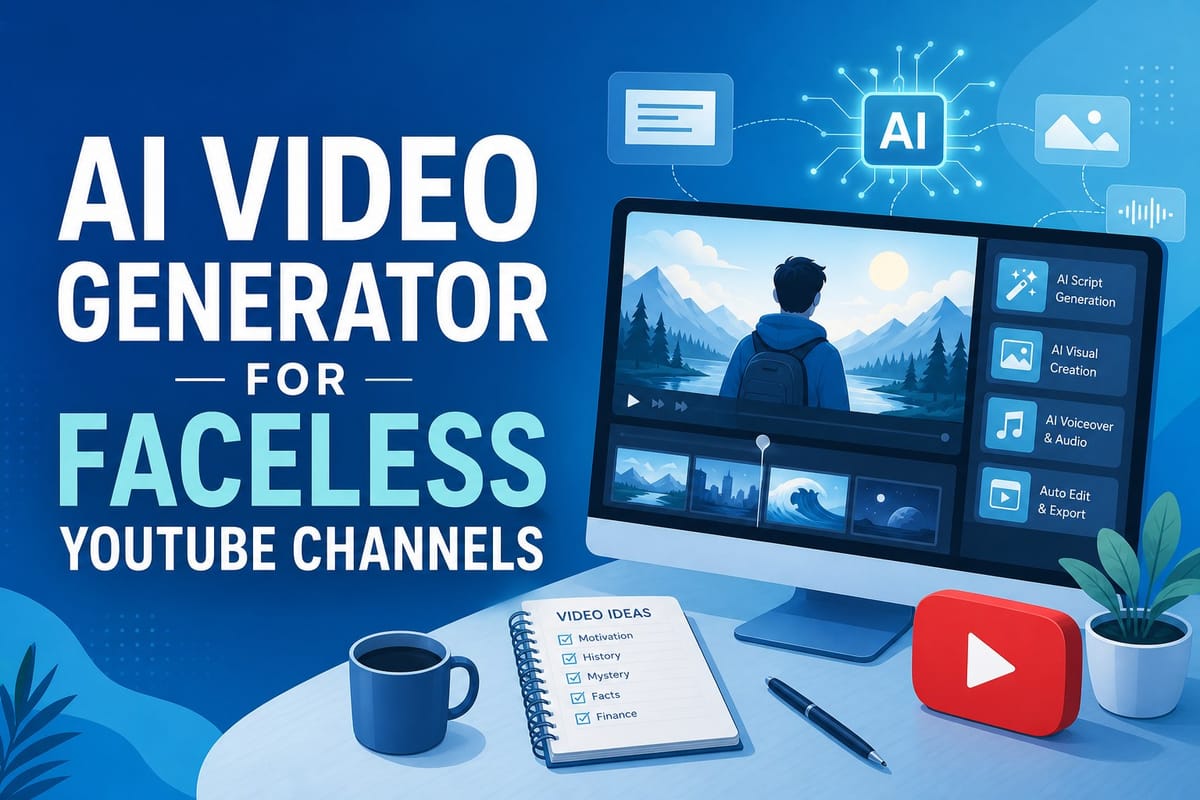
Table of contents
1. Why faceless YouTube channels are a serious business model
2. What an AI video generator actually does for faceless content
3. How to build a sustainable faceless channel with AI video tools
Running a YouTube channel without ever appearing on camera is more popular than most people realize. Channels covering history, true crime, finance, science, and self-improvement rack up millions of views every month, and the people behind them never show their faces. The catch has always been production. Writing a solid script, finding the right footage, editing everything together, and adding motion graphics takes serious time, even when you know what you are doing. That is where an AI video generator for a faceless YouTube channel changes the game. Instead of spending 20 or 30 hours on a single video, you can go from a prompt or a rough script to a polished, publish-ready file in a fraction of the time. In this article, I want to walk you through what these tools actually do, why faceless channels are such a strong business model right now, and how to use AI video generation in a way that keeps your content quality high and your audience growing.
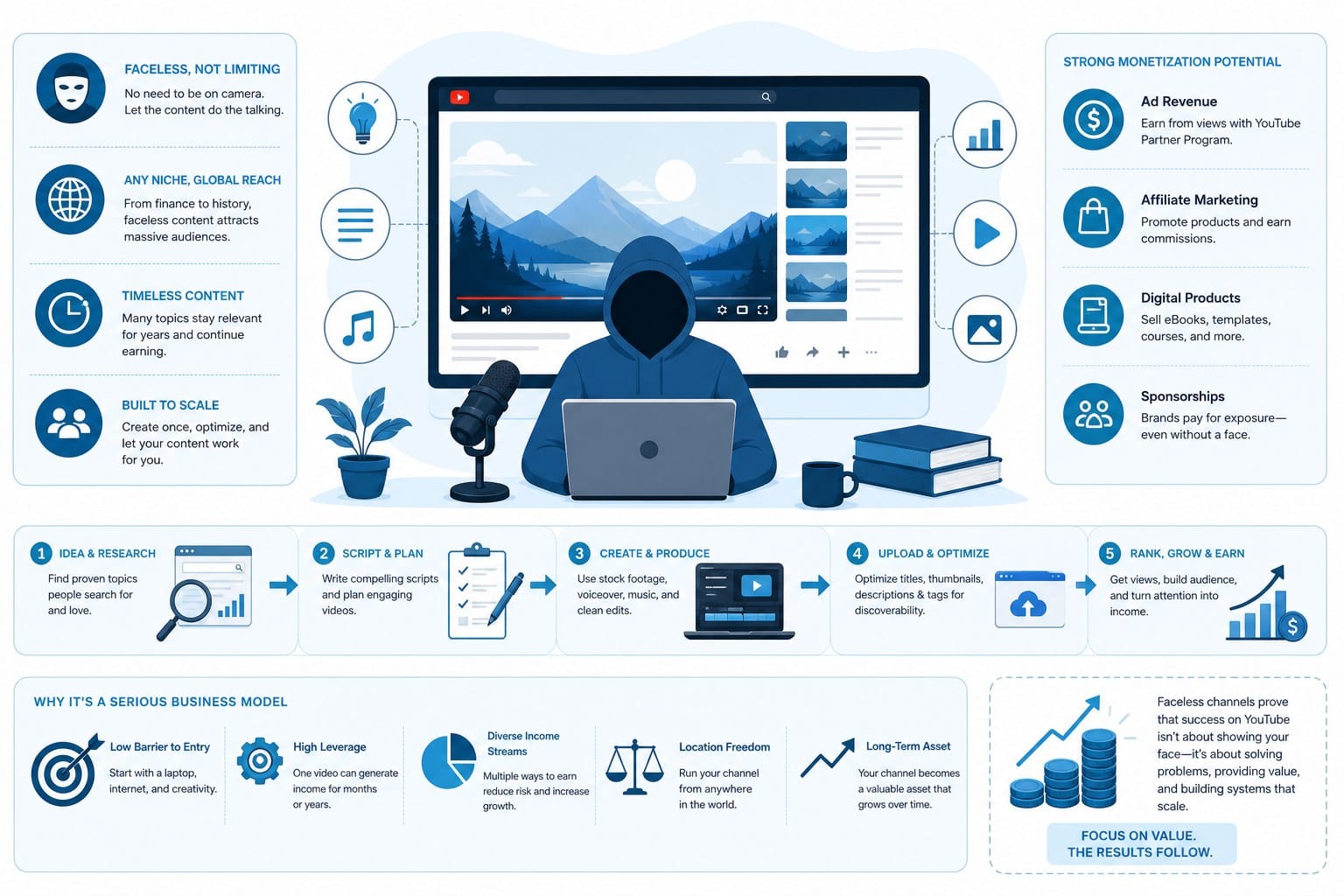
Why faceless YouTube channels are a serious business model
Let me start with the obvious question: why would anyone build a channel without showing their face? The short answer is that audiences do not watch faces, they watch value. If your video teaches someone something interesting, tells a compelling story, or keeps them entertained for ten minutes, they will watch it again and again without ever needing to see who made it.
Faceless channels have a few specific advantages that make them worth building.
First, they scale better than personal brand channels. When your channel is built around your face, your voice, and your personality, you can only grow as fast as you can personally produce content. Faceless channels are not tied to one person in the same way. You can bring in writers, use AI tools, or batch-produce content without anyone asking why the host looked different last week.
Second, they are lower risk from a privacy standpoint. Many creators, especially those covering sensitive topics like finance, politics, or personal development, prefer not to have their face attached to every opinion they publish. A faceless format gives you creative freedom without the personal exposure.
Third, they tend to hold their value on the platform. A well-researched documentary-style video about, say, the history of a famous brand or the science behind a popular trend does not get stale the way vlog content does. It keeps pulling in views and ad revenue long after it was published, which is exactly the kind of passive income most creators are chasing.
The challenge has always been production cost and time. Documentary-style videos need voiceovers, footage, graphics, and editing. Listicle videos need a script, pacing, and visual variety. Animation videos need design skills that most people simply do not have. Even if you outsource everything, you are looking at hundreds of dollars per video and days of back-and-forth with freelancers.
That is the gap that AI video generation tools are now filling. A good ai video generator faceless youtube channel workflow lets you handle the entire pipeline, from research and scripting to footage sourcing and final export, without a production team and without being on camera yourself.
I want to be honest about what these tools are and what they are not. They are not magic buttons that turn a bad idea into a great video. The best results still come from creators who understand their niche, know their audience, and have a clear sense of what they want to say. What AI tools do is remove the technical barriers so that your creative energy goes into ideas and strategy, not into wrestling with video editing software at midnight.
Channels in niches like world history, personal finance, motivational content, science explainers, and true crime have been running this playbook for years. The creators who built those channels early had to either learn video production themselves or pay someone else to do it. Now, with AI video generators, anyone with a good idea and a willingness to learn the tools can build the same kind of channel without the same barriers.
What an AI video generator actually does for faceless content
When most people hear "AI video generator," they picture a tool that maybe converts a script into a slideshow with stock footage slapped on top. That describes some tools, but it is not the full picture of what the better platforms do today.
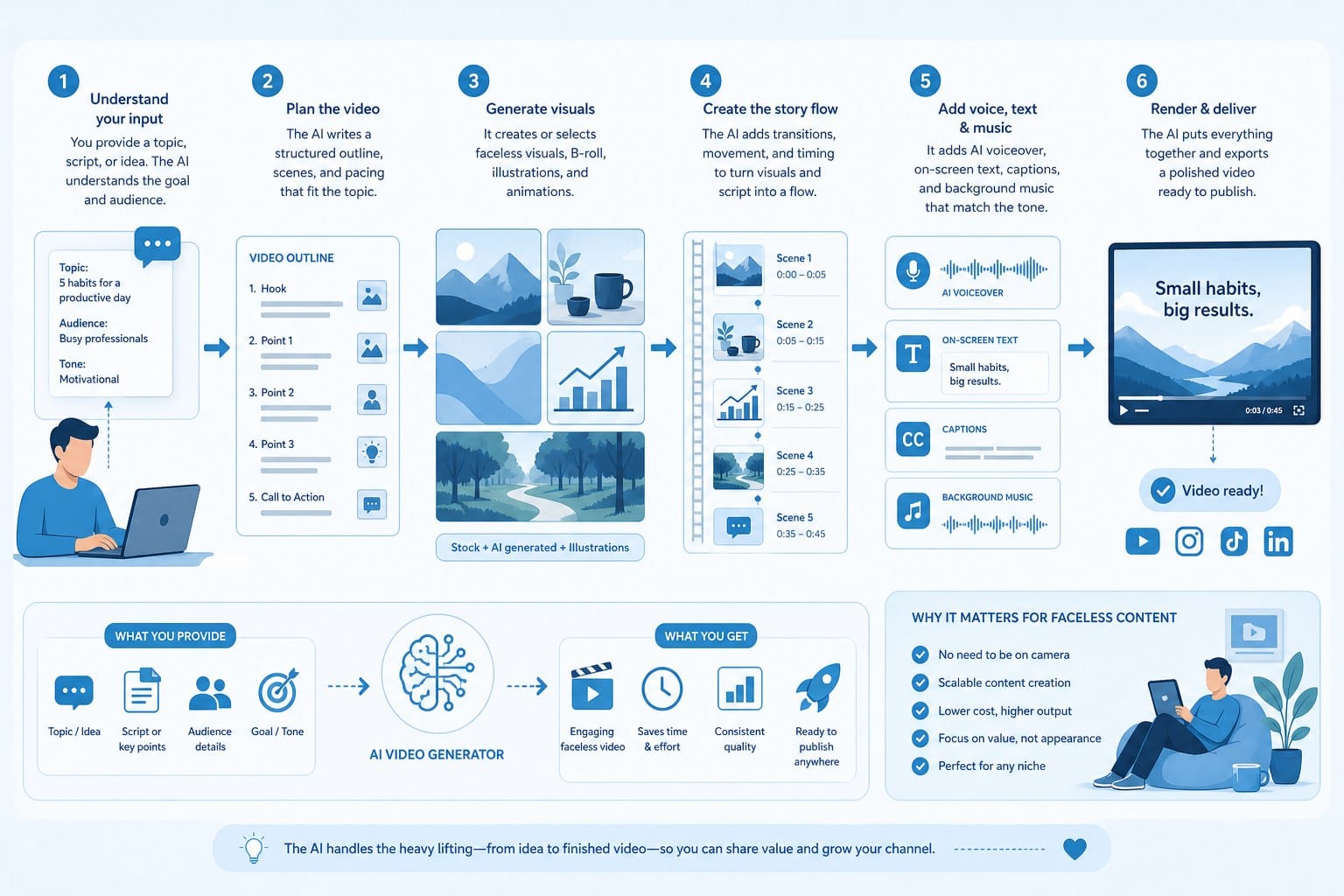
A more capable ai video generator for a faceless YouTube channel handles multiple steps in the production pipeline, not just one. Here is what that actually looks like in practice.
Research and scripting are the foundation of any good video. For a history documentary or a finance explainer, getting the facts right matters a lot. A solid AI platform will either take a prompt you provide or let you paste in your own script and build from there. If you give it a topic, it can pull together research, organize it into a logical narrative, and write a script that sounds like something a real person would say, not a Wikipedia article read out loud. I have found that the best results come when I treat the AI output as a strong first draft and then spend fifteen or twenty minutes refining the tone, adding specific examples, and cutting anything that sounds generic.
Voiceover is another critical piece. Faceless channels live and die by their voiceover quality. A monotone, robotic voice kills engagement faster than almost anything else. Modern AI voiceover has come a long way, and the best generators offer multiple voices with natural pacing, emphasis, and tone variation. Some platforms let you fine-tune the voice style to match your channel's personality.
Footage sourcing is where a lot of creators get stuck when they try to do this themselves. Finding high-quality, copyright-safe video clips that actually match your script takes hours of searching across multiple stock libraries. A capable AI platform automates this by pulling footage that matches the content of each section of your script. For a video about space exploration, it finds space footage. For a video about ancient Rome, it finds relevant historical visuals. You still want to review the selections and swap anything that feels off, but the heavy lifting is done for you.
Motion graphics and text overlays add the polish that separates professional-looking content from amateur content. Lower thirds, title cards, data visualizations, and animated transitions all signal to the viewer that this is a serious channel worth subscribing to. Platforms that generate these automatically, matched to your topic and style, save an enormous amount of time.
Animation formats are worth mentioning separately because they open up a whole category of content. Whiteboard-style videos and stickman animations work extremely well for educational and explainer content. They are visually distinctive, they keep viewers engaged, and they do not require any real footage at all, which makes them ideal for topics that are hard to illustrate otherwise.
Final editing and export round out the pipeline. A good platform takes everything it has generated and puts it together into a cohesive video with proper pacing, audio levels, and format options for different platforms. Whether you are publishing a 20-minute YouTube documentary, a 60-second Short, or a vertical Reel, you should be able to export in the right format without doing manual editing work afterward.
Cliptude handles all of these steps. You start with a prompt or a script, and the platform automatically researches the topic, writes or refines the script, sources footage from its library, generates motion graphics, adds voiceover, and delivers a finished video. It covers long-form documentaries, listicle videos, Shorts, animations, and music videos, which makes it genuinely useful across different content formats and niches.
If you are building a documentary-style channel specifically, I recommend reading how to make a YouTube documentary without showing your face for a deeper look at the format and what makes it work on YouTube.
One thing I want to address directly is commercial rights. If you are planning to monetize your channel through YouTube's Partner Program or through brand deals, you need to know that the content you produce is yours to use commercially. Some AI tools have murky licensing terms that create problems down the line. Before you build a channel on any AI video platform, check that you have full commercial rights to the output. Cliptude's model includes this, which matters a lot when your goal is building a real business.
Pricing is another practical consideration. Cliptude uses usage-based credit pricing, which means you pay for what you produce rather than a flat monthly fee regardless of output. For creators who are still figuring out their posting schedule or who produce in batches rather than weekly, this kind of model is much more efficient than paying the same amount every month whether you publish two videos or twenty.
The honest truth is that no AI tool produces perfect results every single time. You will occasionally get a piece of footage that does not quite fit, a script line that needs rewriting, or a graphic that looks slightly off. The workflow that works best is to use the AI to do 80 to 90 percent of the work, then spend your time reviewing, refining, and adding the creative judgment that turns a good video into a great one. That balance is where the real efficiency gains are.
How to build a sustainable faceless channel with AI video tools
Having the right tool is only part of the equation. The other part is having a clear strategy for how you are going to use it. I want to walk through what a sustainable faceless channel workflow actually looks like when you are using an AI video generator.
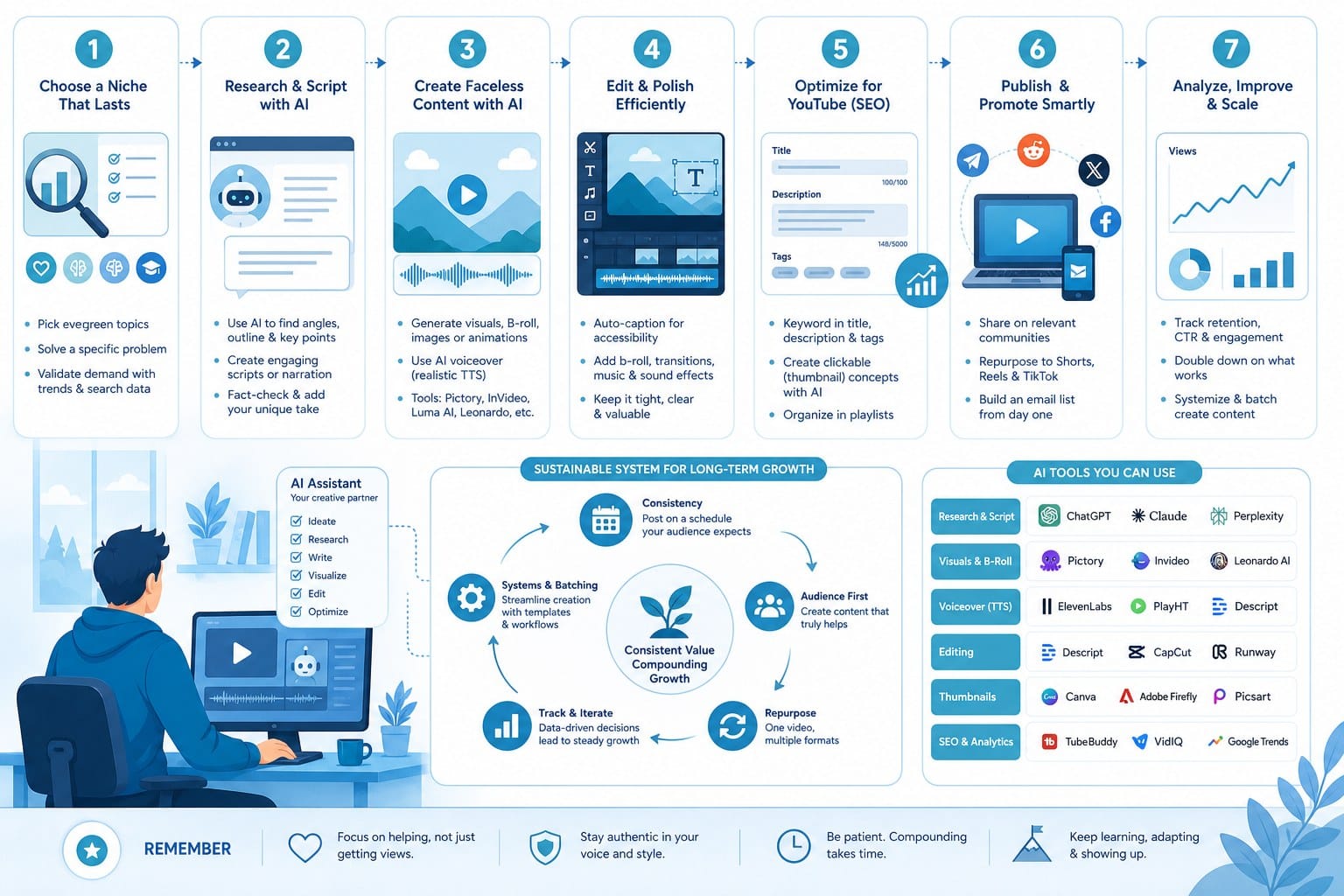
Start with niche selection and stick to it. One of the biggest mistakes new faceless channel creators make is picking a topic that is too broad. "Interesting facts" is not a niche. "The history of abandoned places" is a niche. "How personal finance works for people in their 20s" is a niche. The more specific your niche, the easier it is to build an audience that expects a particular kind of content from you and keeps coming back for it. It also makes scripting easier because you develop a repeating format that your AI generator can execute reliably.
Batch your content production. One of the biggest advantages of using an AI video generator is that you are not limited to producing one video at a time. If you set aside a full day for content production, you can generate drafts for four or five videos, review and refine them, and come out the other side with a publishing schedule that is set for the next month. This consistency is enormously important for YouTube's algorithm. Channels that publish regularly tend to grow faster than channels that publish sporadically, even if the sporadic videos are individually better.
Develop a review process that you actually follow. I mentioned earlier that AI tools handle 80 to 90 percent of the work, but that remaining percentage matters a lot for quality. Build a simple checklist for every video you review. Does the script flow naturally? Are the footage selections relevant and visually interesting? Does the voiceover pacing feel right? Are the graphics clean and readable? Catching problems at the review stage takes much less time than fixing a video after you have already published it and gotten negative comments.
Think about your titles and thumbnails from the very beginning. A great video with a weak title and a boring thumbnail will underperform. YouTube's algorithm cares enormously about click-through rate, and click-through rate is almost entirely determined by your title and thumbnail. I spend more time on these two things than most creators expect. If you want to speed up the thumbnail creation process, this guide on clickbait thumbnail generation covers how to create high-CTR thumbnails automatically, which pairs well with an AI video workflow.
Diversify your formats as you grow. Long-form documentary videos are the backbone of most successful faceless channels, but they are not the only format that works. Shorts and Reels give you a way to reach new audiences and drive traffic back to your longer content. Animation formats like whiteboard or stickman videos work especially well for educational topics where you want to explain something step by step without relying on stock footage. Mixing formats keeps your channel interesting and gives you multiple ways to connect with different parts of your audience.
Track what works and double down on it. After you have published 10 or 15 videos, you will start to see patterns. Certain topics get more views. Certain formats get more watch time. Certain titles drive more clicks. Pay attention to these signals and let them shape your content calendar. The AI generator makes it easy to produce more of what is working because you are not constrained by the time it takes to manually produce each video.
If you are expanding into multilingual content, which is a smart way to grow a faceless channel because you can reach audiences that most English-language creators ignore, AI video generation handles this better than most people expect. You can produce content in languages you do not personally speak, which dramatically expands your potential audience. For creators looking at Urdu-language content specifically, this resource on using an AI video generator for Urdu YouTube content is worth reading.
Monetization strategy matters more than most creators realize when they are starting out. YouTube ad revenue is the obvious starting point, but it is not the only option and for many niches it is not even the best one. Affiliate marketing works well for finance, tech, and product review channels. Digital products like courses and guides work well for educational channels. Brand sponsorships become available once you have meaningful watch time and subscriber numbers. An AI video generator gives you the production capacity to build toward all of these monetization paths faster because you are not bottlenecked by how long each video takes to make.
Finally, think about your channel as a portfolio of assets, not a content treadmill. Every video you publish is a piece of content that can keep earning for months or years. A well-researched documentary about a historical event or a detailed explainer about how a financial concept works does not become less relevant the day after you publish it. Evergreen content is the foundation of sustainable passive income on YouTube, and AI video generation makes it possible to build that library of evergreen content without burning yourself out in the process.
The faceless channel model is genuinely accessible now in a way it was not a few years ago. The production barriers that used to require either significant skill or significant money are coming down fast. What remains is the creative and strategic work of choosing the right niche, understanding your audience, and producing content that gives people a reason to watch and subscribe. That part is still on you, but the AI handles enough of the rest that it is worth taking seriously as a path to building something real.
Ready to take the next step?
If you are ready to start building your faceless YouTube channel without the usual production headaches, Cliptude is worth trying. You can go from a prompt or a script to a finished, publish-ready video covering documentaries, listicles, Shorts, animations, and more, all with full commercial rights and usage-based pricing that scales with what you actually produce. Head to Cliptude and start creating.



