The Best Eleven Labs Alternatives

ElevenLabs is genuinely impressive. If you've spent any time with it, you already know it can produce voices that sound eerily human, full of emotion and natural rhythm. For a lot of creators and developers, it became the go-to tool almost overnight. But it's not perfect for everyone, and the cracks start to show fast when you run into its credit limits, its pricing tiers, or the fact that it just hands you an audio file and walks away.
A lot of you have asked about this exact problem. You want ElevenLabs-level quality but without the friction, the cost, or the missing features that slow your workflow down. The good news is the market has grown a lot in the past year. There are now several strong options depending on what you're actually trying to build. Whether you're making YouTube videos, corporate training content, audiobooks, or running voice agents in production, there's likely a better fit for your specific situation.
This post breaks down six of the best ElevenLabs alternatives right now. We'll cover who each one is built for, what makes it stand out, and where it falls short. By the end, you should have a clear idea of which tool deserves a spot in your workflow.
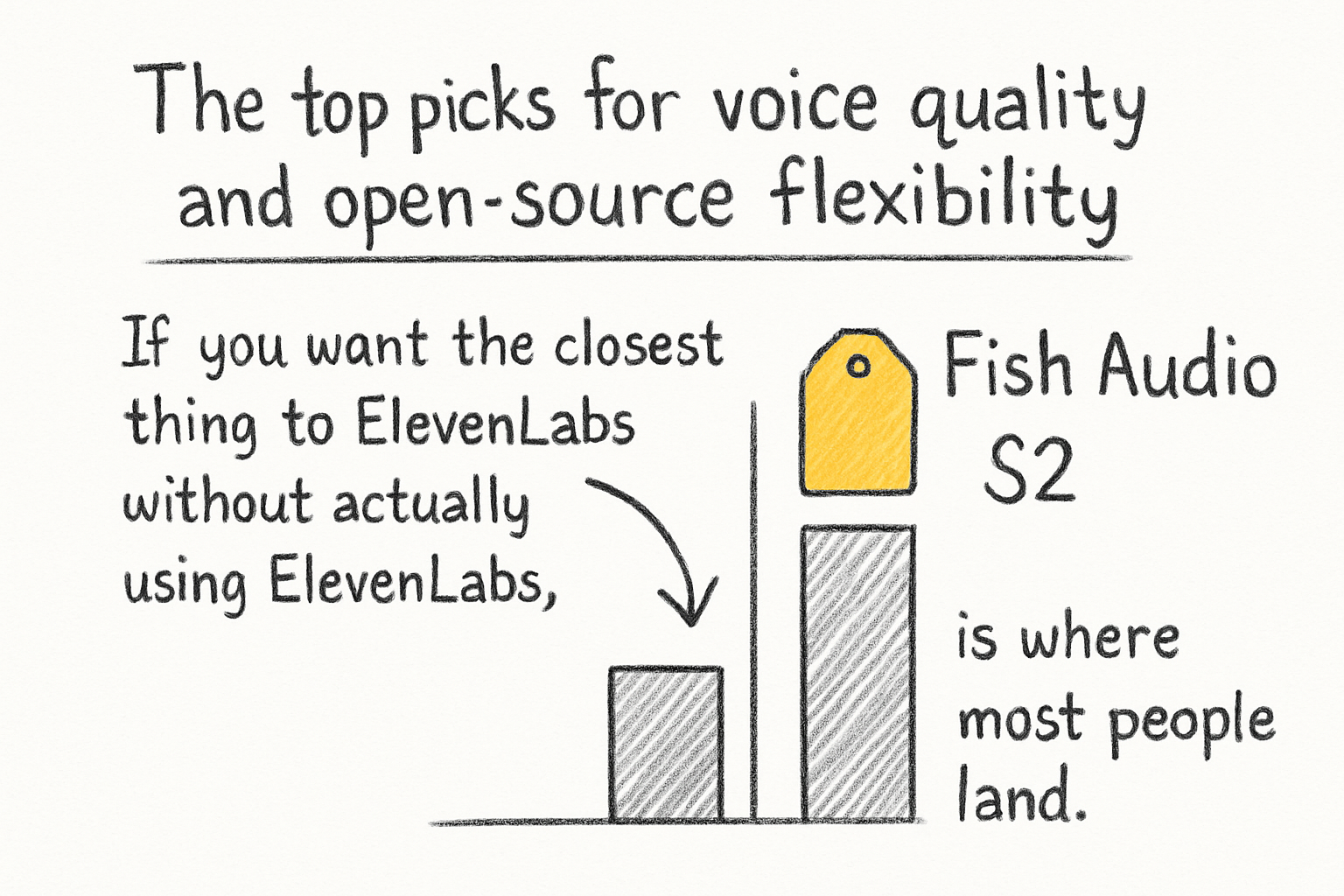
The top picks for voice quality and open-source flexibility
If you want the closest thing to ElevenLabs without actually using ElevenLabs, Fish Audio is where most people land. Specifically, the Fish Audio S2 Pro model has been turning heads across the creator and developer communities. It delivers natural prosody and expressive inflections that rival the best in the industry, and it doesn't lock you into a punishing credit system. For creators who want top-tier voice quality and for developers who need open-source flexibility, it's hard to argue against it.
PlayHT is another strong contender, especially if you work in podcasting or audiobook production. Its voices are realistic and warm, and the interface makes it genuinely easy to tweak pacing, adjust tone, and fix pronunciation without needing a technical background. The dubbing and voice cloning features are some of the most user-friendly you'll find anywhere. It won't give you the same cinematic range as ElevenLabs at its best, but for clean spoken-word content, it more than holds its own.
For developers who want to go even deeper, Coqui and its XTTS model are worth serious attention. It's open-source, it can clone a voice from just a three-second audio clip, and it works across multiple languages. If you're building real-time voice agents and need low latency without paying API costs every month, self-hosting XTTS is one of the smartest moves you can make. I personally think this is the most underrated option on this whole list, mainly because most non-technical creators sleep on it entirely.
I remember trying to clone my own voice for a side project last year and being shocked at how well XTTS performed with barely any source audio. It wasn't flawless, but it was good enough to make me rethink how much I was spending on other tools.
The best options for video creators and enterprise teams
Here's where things get interesting for video-focused workflows. ElevenLabs gives you great audio, but then you're on your own. You download the file, import it into your editor, and spend the next twenty minutes syncing it to your timeline. That friction adds up fast, especially if you're producing content at scale.
GenAI Pro was built with that exact problem in mind. It integrates voice generation directly into a video timeline, so you're not bouncing between apps. For YouTubers, TikTokers, and agencies pushing out a high volume of content, this kind of end-to-end workflow is genuinely useful. It's one of the few tools that treats voice as part of the video rather than an afterthought you bolt on at the end. If you want to see how this fits into a broader AI video stack, our roundup of AI video creation tools covers the landscape well.
On the enterprise side, WellSaid Labs sits in a category of its own. The voice quality is immaculate. Mispronunciations are rare to the point of being almost nonexistent, and the overall output sounds polished and professional in a way that's hard to match. It's built for high-end e-learning, corporate training, and commercial use where you need something that sounds boardroom-ready. The catch is the price. WellSaid Labs is expensive, and its content moderation is strict. It's not built for creative storytelling or raw emotional range. Think of it as the premium business suit of AI voice tools. It does exactly what it's designed to do, and nothing outside of that lane.
Murf.ai fills a similar space but leans more toward e-learning specifically. It has a massive library of pre-built voices sorted by use case, and the output is clean and studio-quality. It won't blow you away with dramatic emotion, but if you're building a course or a training module and you need something that sounds clear and professional, Murf.ai gets the job done without a steep learning curve.
How to actually pick the right tool for your workflow
With six solid options on the table, the real question becomes which one fits what you're actually doing day to day. If voice quality is your top priority and you want something open and accessible, Fish Audio S2 Pro is your first stop. If you're a developer building production voice agents and want to cut API costs, XTTS is worth the setup time. If you're producing spoken-word content like podcasts or audiobooks and you want an easy interface, PlayHT is probably your best bet.
For video creators, GenAI Pro removes the most painful part of the process, which is the manual sync. And if you're in enterprise or e-learning, WellSaid Labs and Murf.ai both deliver the professional quality those audiences expect. None of these tools are a perfect one-size-fits-all solution, but that's actually fine. The best setup usually involves knowing what your primary output is and choosing the tool built for that specific job.
The bigger pattern worth noticing here is that the AI voice space has matured to the point where ElevenLabs no longer has a monopoly on quality. A year ago that wasn't really true. Now there are genuine alternatives that hold up under real-world conditions. That's good for everyone building in this space.
If you're curious about how AI-generated content fits into broader creative workflows, the piece on AI generated video content is worth a read for more context on how these tools connect.
Ready to take the next step?
Here's the thing nobody talks about enough. Even if you find the perfect voice tool, whether that's Fish Audio, PlayHT, or ElevenLabs itself, you're still left doing a lot of manual work. You download the MP3, import it into your editor, drag it onto the timeline, zoom in to sync it to your visuals, and repeat. That process eats time. If you're making documentary-style or narrated video content regularly, it gets old fast. That's exactly why Cliptude exists. It's an end-to-end AI documentary platform that handles the whole chain automatically. It generates the script, creates hyper-realistic voiceovers, sources the B-roll, and syncs everything together in a timeline for you. No juggling five subscriptions. No manual audio imports. Just a finished video. If that sounds like the workflow you've been looking for, go try Cliptude and see how much time you get back. Drop a comment below if you've tried any of the tools on this list. I'd love to know which one is working best for you.