
AI text to video for YouTube creators: a complete guide

Table of contents
1. What AI text to video for YouTube actually does
2. How to get good results from AI-generated YouTube videos
3. Building a scalable YouTube channel with AI video production
If you want to grow a YouTube channel but hate being on camera, or you simply do not have time to film, script, and edit every video yourself, AI text to video for YouTube is worth understanding. The technology has moved fast. What used to take a full production team several days can now happen in a fraction of the time, starting from nothing more than a topic or a rough script. This guide walks through how the process works, what kinds of content it suits best, and how to use it to build a real channel without burning out.
What AI text to video for YouTube actually does
A lot of people picture something much simpler than what modern tools can do, so it helps to start with the basics.
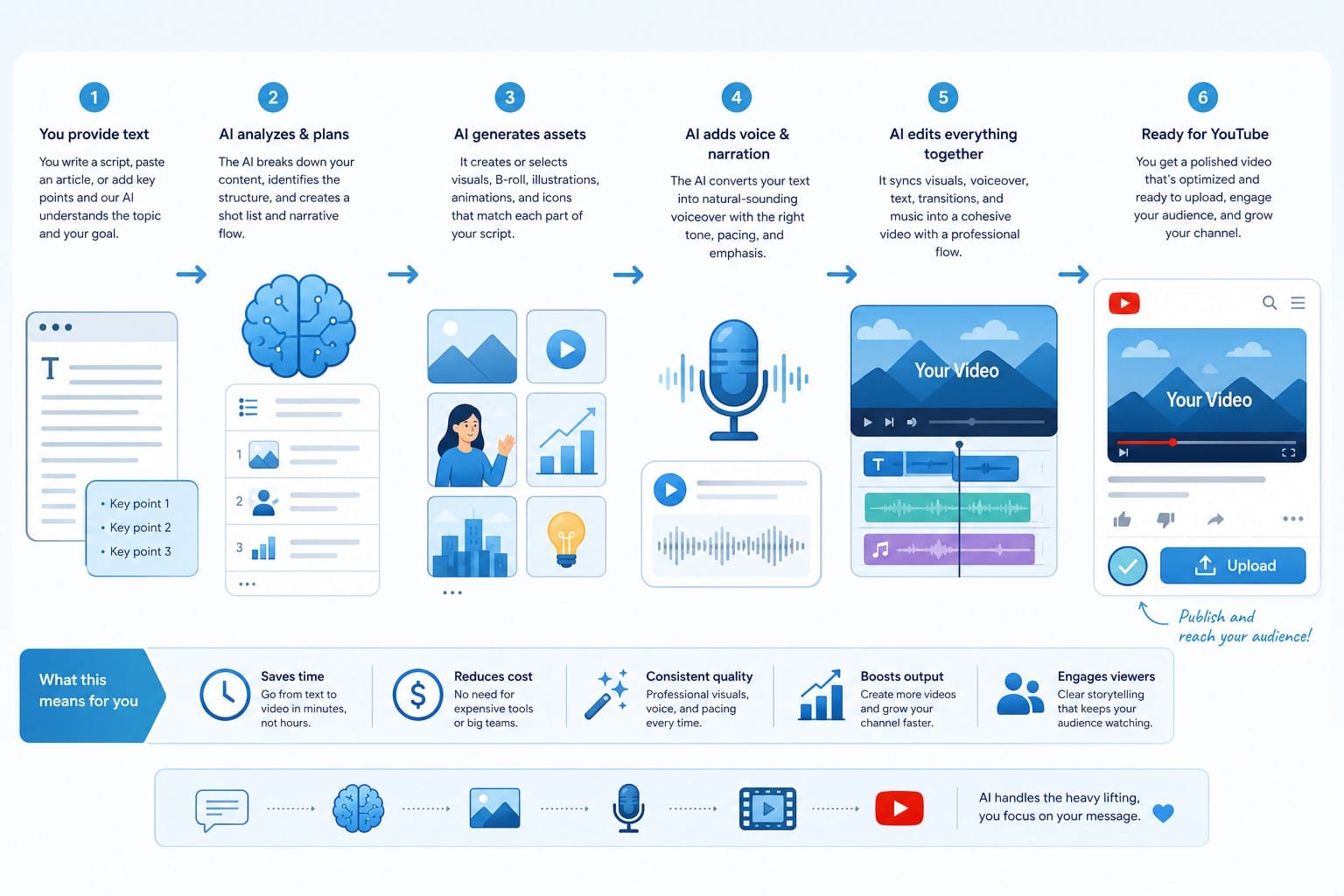
At its core, an AI text-to-video system takes written input — whether that is a single-line prompt, a detailed outline, or a full script — and turns it into a finished video. The better platforms handle every layer of that process automatically. That includes researching the topic, writing or refining the script, sourcing relevant footage, generating motion graphics or animations, adding voiceover, and stitching everything together into an edited cut.
That is a significant departure from older tools that just dropped stock clips behind a text overlay. Modern AI text to video for YouTube actually assembles something that looks like a professionally produced video, not a slideshow with narration.
Here is a concrete example of how the workflow plays out. Say you want to make a 10-minute documentary about the history of the space race. You type that topic into the platform. The AI researches key events, figures, and timelines. It writes a narrative script. It pulls archival-style footage and matches clips to the script beats. It generates graphics to support data points. It layers in a voiceover and background music. You end up with a video that is ready to review and upload, without you ever opening a video editor.
For faceless YouTube channels, this changes the math entirely. You do not need a camera, a studio, or video editing skills. If you can describe what you want to make, you can make it.
The types of videos this approach works well for include several distinct formats, each with its own audience and production style.
Documentary-style content covers long-form videos about history, science, true crime, biography, and current events. These tend to perform well on YouTube because they hold viewer attention and attract subscribers who want depth rather than quick takes. A well-made 15-minute documentary about a forgotten historical figure can collect views for years because people keep searching for that topic.
Listicle videos — top 10 lists, ranked breakdowns, best-of compilations — are high-click-through formats that AI can structure and produce quickly. The format works because viewers already know what they are getting. They clicked for a ranked list, and the video delivers exactly that.
Educational and explainer videos cover step-by-step tutorials, concept explanations, and how-things-work breakdowns. Animation formats like whiteboard or stickman styles work especially well here because they simplify complex ideas visually. A whiteboard animation explaining compound interest does more work than a talking head saying the same words.
YouTube Shorts and vertical content represent the short-form side of the same production process. AI can adapt long-form content into short clips or produce them from scratch for Shorts, TikTok, or Instagram Reels. A 12-minute documentary can yield three or four compelling 60-second clips, each covering a surprising fact or pivotal moment from the longer video.
One thing worth clarifying: AI text to video does not mean lower quality by default. The output depends on the platform you use, the quality of your input, and how much you refine the result. A well-prompted AI video can look polished and professional. A vague prompt will produce something generic, because the AI has no real direction to work with.
The people getting the most out of this technology treat it as a production assistant, not a magic button. They put thought into their topic, review the script before the video generates, and make small adjustments to improve the final cut. That combination of AI speed and human judgment consistently produces better results than either one alone.
Not every niche benefits equally from AI-generated video. History, science, personal finance, and true crime are natural fits because the content is research-driven, works well with voiceover narration, and does not require a presenter on screen. A cooking channel or a fitness channel where the physical demonstration matters would be a harder fit, though even those niches can use AI for supplementary content like ingredient breakdowns or exercise science explainers.
Understanding what the technology does well is the first step. The second step is learning to get good results from it, which is less about the tool and more about the decisions you make before and during production.
For a deeper look at building a channel this way, how to start a faceless YouTube channel with AI covers the channel strategy side alongside the production side and is worth reading before you pick your niche.
How to get good results from AI-generated YouTube videos
Getting solid output from AI text to video for YouTube is a skill, not a given. The people who complain that AI videos look generic are usually skipping steps that matter. The steps are not complicated, but they require actual thought, which is what separates channels that grow from channels that stall.
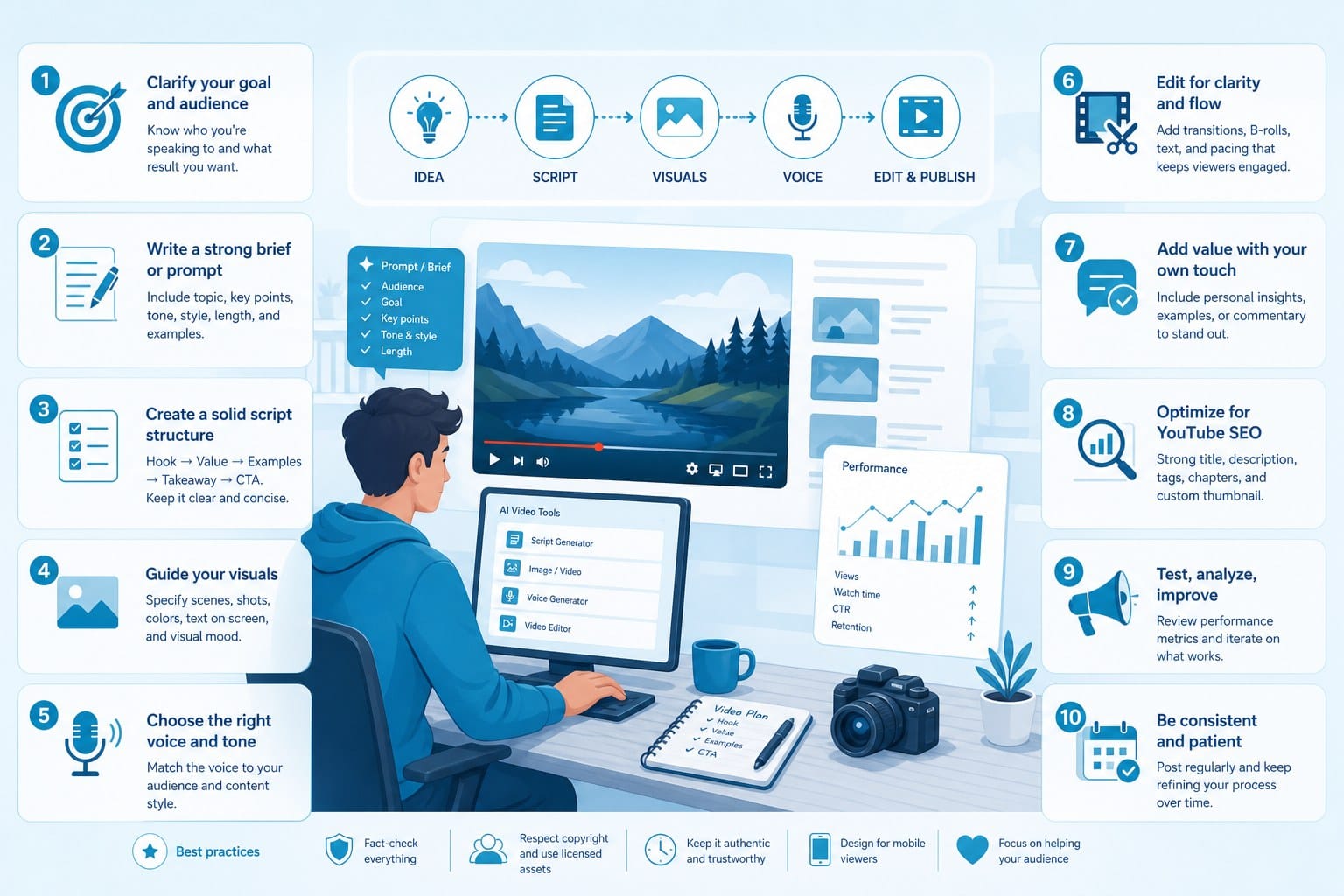
Start with a specific prompt or script. The more specific your input, the better your output. Compare these two prompts side by side.
Weak: 'Make a video about dogs.'
Strong: 'Make a 10-minute documentary-style YouTube video about the history of dog domestication, starting with wolves approximately 15,000 years ago and ending with modern breed development in the 20th century. Use a calm, authoritative narrator tone. Include on-screen text for key dates and locations. Open with a hook about how dogs became the most widespread large predator on Earth.'
The second prompt gives the AI enough information to make real decisions. It knows the length, the format, the narrative arc, the tone, the visual style, and the opening hook you want. That specificity flows through every layer of the production. The script will be more focused, the footage selection will be more targeted, and the final cut will need fewer adjustments.
If you already have a rough script, even better. Paste it in and let the AI handle footage sourcing, graphics, and editing. This is especially useful if you are repurposing existing blog posts or written guides into video content. The structure is already there — the AI just builds the visual layer on top of it.
Pick the right video format for your niche. Not every format works for every topic, and choosing the wrong one creates friction between the content and the viewer's expectations.
Documentary style suits history, biography, true crime, and science. It uses footage-based visuals, a steady narrator voice, and a narrative structure that moves through events chronologically or thematically. Whiteboard or stickman animation works better for abstract concepts like economics, psychology, or technical how-to content, because the animation can illustrate relationships and processes that footage cannot show directly. Listicle format works for pop culture, rankings, and anything that benefits from a countdown structure where each item is self-contained.
Think about what your target audience is already watching. If your niche is personal finance, an explainer animation probably feels more appropriate than a news-style documentary. If your niche is historical battles, footage-based documentary style tends to hold viewers longer because the visuals match the content.
Review the script before the video generates. This is the single most important habit to develop when using AI text-to-video tools. Most platforms give you a window to review or edit the script before proceeding to video generation. Use it every time.
Check for factual accuracy. AI research is generally solid but not perfect. A video about a historical event might get a date slightly wrong, attribute a quote to the wrong person, or oversimplify a complex cause-and-effect relationship. If your video makes a claim that is wrong, your credibility takes the hit, not the AI's. Viewers who know the topic will leave comments, and those comments affect how other viewers perceive your channel.
Check the tone. Does it match your channel's voice? Does it sound like something a real person would say out loud, or does it sound like a term paper being read aloud? Adjust any sentences that feel stiff or unnatural before the video generates, because fixing narration after the fact usually means regenerating sections.
Check the structure. Does it have a clear intro that hooks the viewer, a middle section that builds logically from point to point, and a conclusion that wraps things up rather than just stopping? Good YouTube videos follow a structure that keeps viewers watching, and that structure starts at the script level.
Spending five minutes reviewing the script can save you from having to regenerate the entire video, which is always worth it.
Think about retention from the start. YouTube's algorithm favors videos that keep viewers watching. The metric is called average view duration, and it matters more than raw view count for channel growth. A video with 10,000 views and 70% average view duration will get recommended more than a video with 50,000 views and 20% average view duration, because YouTube's system reads long watch time as a signal that the content is worth promoting.
AI-generated videos can have retention problems if the opening is too slow, the middle too repetitive, or the overall length too long relative to the topic's depth. A few practical ways to counter this:
Keep the intro tight. Get to the point within the first 30 to 60 seconds. Do not spend two minutes explaining what the video will cover before actually covering it. Open with a compelling fact, a surprising question, or a vivid scene that pulls the viewer into the topic immediately.
Use pattern interrupts. Changes in visual style, cuts to b-roll, text callouts, and animated graphics break up visual monotony and give viewers a reason to keep watching. AI platforms typically handle this automatically, but you can check the preview and request adjustments if one section feels too flat.
Match video length to topic complexity. A simple topic does not need a 20-minute video. A genuinely complex topic should not be rushed into five minutes. Viewers can tell when a video is padded or rushed, and either one hurts retention for different reasons. Padded videos lose people in the middle. Rushed videos leave people unsatisfied at the end and less likely to subscribe.
Use commercial rights correctly. If you plan to monetize your channel through YouTube AdSense, brand sponsorships, or content licensing deals, make sure the platform you use grants full commercial rights to the videos you generate. Some tools restrict commercial use, which creates legal risk if your channel grows to a size where it attracts attention. Platforms like Cliptude are built with monetization in mind, so creators have the rights they need to run their channels as actual businesses from day one.
For a broader look at what AI production platforms can do for faceless channel creators, this overview of AI video generators for faceless YouTube channels covers the landscape and helps you understand what to look for before choosing a tool.
Building a scalable YouTube channel with AI video production
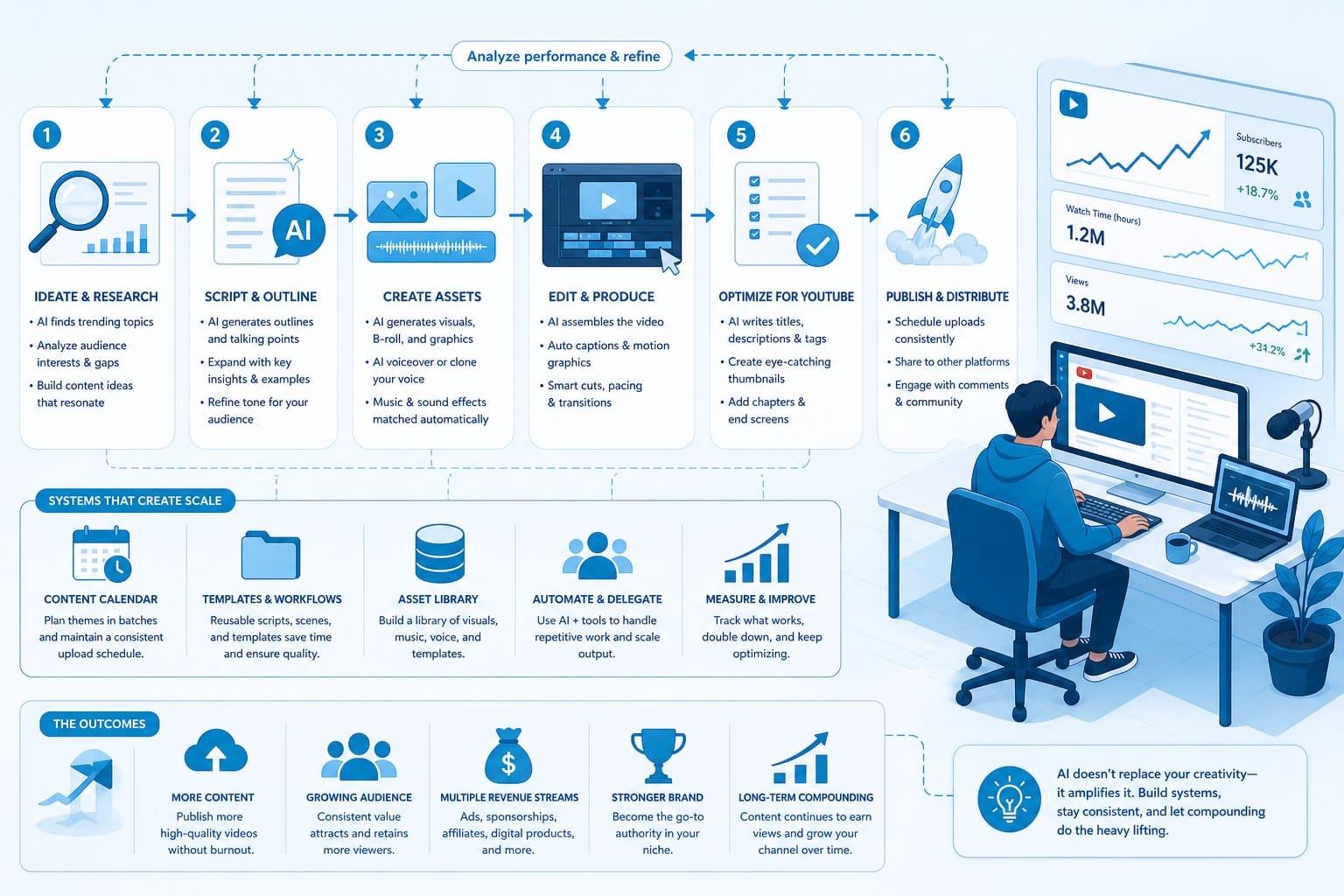
The real advantage of AI text to video for YouTube is not just producing one video faster. It is the ability to build a consistent publishing schedule without burning yourself out or hiring a full production team. Consistency is what drives algorithmic growth on YouTube, and AI makes consistency achievable for a single creator working part-time.
Let me walk through what a sustainable AI-powered YouTube channel actually looks like in practice, from production habits to niche selection to analytics.
Batch production beats one-at-a-time publishing. One of the most common mistakes new creators make is producing videos one at a time and publishing as soon as each one is done. This creates an unpredictable schedule that is hard to maintain and hard to grow. When you miss a week because life gets busy, your channel goes quiet, and quiet channels get fewer recommendations.
With AI, batch production becomes realistic. You can spend a few hours generating five to ten videos, reviewing scripts, and queuing them for upload throughout the week or the month. YouTube's native scheduling tool lets you set exact publish times in advance, so your channel stays active even when you are not actively working on it.
This is especially valuable for faceless channels because there is no filming schedule to coordinate around. You are not waiting for good lighting, a quiet room, or a day when you feel like being on camera. Your production calendar is completely flexible, which means you can work ahead and maintain a buffer of finished content.
Niche selection matters more than most new creators expect. AI makes it easier to produce content, but it does not automatically tell you what content to produce. Niche selection is still one of the highest-leverage decisions you make as a creator, and a poor niche choice will limit your growth regardless of how good your production quality is.
The best niches for AI-generated video content tend to share a few characteristics. They have consistent search demand, meaning people are searching for this type of content regularly, not just during news cycles or trending moments. They work well with the formats AI does best, like documentary, explainer, or listicle. And they are not so saturated that a new channel has no realistic path to gaining traction.
History and biography work particularly well. People search for historical content constantly, and documentary-style AI video fits the format perfectly. You can cover well-known historical events in more depth than existing videos, spotlight forgotten figures, or explore cultural moments that have clear search demand but limited quality content already on YouTube.
Personal finance and economics benefit from explainer animations and whiteboard-style visuals. The audience is motivated and tends to watch full videos because the information directly affects their financial decisions. Search volume is high, and educational content in this space gets shared across social media and financial communities.
Science and nature attract engaged viewers who watch full videos rather than skimming. Topics like space exploration, marine biology, evolutionary biology, and climate science have consistent search demand and suit long-form documentary style well. Viewers who care about these topics tend to be loyal subscribers if the content is accurate and well-produced.
True crime and mystery reward good storytelling, and AI can structure narrative-driven scripts effectively. Search demand in this niche is consistently high, and the audience expects the kind of detailed, sequential storytelling that documentary format handles well.
Technology and AI content may feel meta, but the audience for technology explainer content is large and still growing. People want to understand tools and trends that affect their work and daily lives. Explainer animations and listicle-style breakdowns work well here, and the niche rewards channels that can make complex topics accessible without dumbing them down.
Plan your content calendar around search intent. Random content production leads to random results. Channels that grow consistently are usually publishing content that people are actively searching for, not content that the creator found interesting that week.
Free tools like YouTube's own search bar reveal a lot about what people want. Type the beginning of a question related to your niche and see what autocomplete suggests. Those suggestions are based on real search volume. Reddit communities in your niche show you what questions people are actually asking, often in the exact phrasing they would type into a search bar. Google Trends can show you whether search interest in a topic is rising, stable, or declining, which matters if you are deciding between two similar ideas.
For example, if you run a history channel, you might notice that searches for the causes of specific wars, the lives of rulers who are less well-known, or the history of everyday objects all have search volume but limited quality coverage on YouTube. Those are video ideas with an audience already waiting. When you combine AI production speed with intentional search-driven content planning, growth becomes much more predictable than publishing whatever you feel like making.
Repurpose long-form videos into Shorts. YouTube Shorts are a meaningful growth tool, and AI makes repurposing straightforward. A 12-minute documentary can yield three or four compelling 60-second clips that each tell a self-contained story or highlight a surprising fact from the longer video. Publishing Shorts alongside long-form content gives your channel exposure to two different recommendation systems simultaneously. Shorts sometimes introduce new viewers to your channel who then find and watch your longer videos, boosting your overall watch time metrics.
If you are also posting on TikTok or Instagram Reels, the same vertical clips can go there. The same production effort reaches multiple platforms without additional work, which matters when you are running a channel as a solo creator.
Track what is working and adjust accordingly. YouTube Studio gives you detailed analytics on every video you post, and looking at those numbers regularly is what separates channels that improve from channels that plateau.
Click-through rate tells you whether your thumbnail and title are compelling enough to get people to click when your video appears in recommendations or search results. If your click-through rate is consistently low, your thumbnails or titles need work, regardless of how good the video itself is. People have to click before they can watch.
Average view duration tells you whether people are actually watching once they click, or leaving quickly. If your average view duration drops at a specific point in every video, something about your structure is losing people at that moment. A slow middle section, a topic that runs out of interesting content before the video ends, or a jarring transition can all cause consistent drop-off at a predictable timestamp.
Subscriber conversion tells you whether the people who watch your videos are finding your channel distinct enough to want to come back. A video can be informative and still not generate subscribers if it does not give viewers a strong sense of what your channel is about and why they should follow it.
AI tools make it easier to experiment because the cost of producing a video is low. You can try different approaches to the same topic, different thumbnail styles, different title formats, and different video lengths, and see what the data tells you. Then produce more content using the approaches that are working.
Long-form documentary content is a strong foundation for YouTube specifically. Channels focused on building a long-term subscriber base tend to do better with long-form content than with short-form over time. Long-form videos attract subscribers who are genuinely interested in your niche, generate more watch time per video, and tend to stay in YouTube's recommendation system longer. A good 15-minute video about a historical event can keep collecting views for two or three years because people keep searching for that topic.
If you are building a serious faceless YouTube channel, start with one format — documentary or explainer — and get good at it before expanding. Consistency in format helps viewers know what to expect from your channel, which makes them more likely to subscribe and return. You can read more about the production side of this in how to make a YouTube documentary without showing your face.
Cliptude is built specifically for the kind of work described in this guide. It is not a general-purpose video editor with an AI feature added on. It is an end-to-end AI production system that handles research, scripting, footage sourcing, motion graphics, and editing from a single prompt or script. For faceless channel creators, this means going from topic idea to finished video without touching editing software. For creators scaling their output, the credit-based model means you pay for what you actually produce rather than a flat subscription that charges you whether you publish or not.
The platform supports long-form documentaries, listicle videos, animated explainers, YouTube Shorts, and music videos. That range matters because your channel's needs will evolve as it grows, and staying on one platform is simpler than stitching together multiple tools with different interfaces, rights terms, and output quality standards.
If you are ready to start producing content, Cliptude is worth exploring as your production foundation.
Ready to take the next step?
If you are serious about building a YouTube channel without being on camera or spending weeks on each video, AI text to video for YouTube is the most practical path available right now. The technology handles the heavy lifting of research, scripting, footage, and editing so you can focus on strategy, topic selection, and growing your audience. Start with a niche you understand, write a specific prompt, review the script before it generates, and track your results after you publish. That process, repeated consistently, is how faceless channels grow. Visit Cliptude to see how the platform works and start producing your first AI-generated YouTube video.



