
How to start a faceless YouTube channel with AI


Table of contents
1. Choosing your niche and planning your content strategy
2. Using AI tools to research, script, and produce your videos
3. Growing your channel, hitting monetization, and scaling output
I want to show you exactly how to start a faceless YouTube channel with AI, from picking a niche to publishing your first video. You do not need a camera, a studio, or video editing experience. What you do need is a clear plan and the right tools to execute it. Faceless channels have grown into one of the most popular formats on YouTube because they let creators focus entirely on content quality instead of on-camera performance. Topics like true crime, history, finance, science, and listicles pull in millions of views every month, and almost none of those videos show a human face. AI has made this format even more accessible. Platforms that handle scripting, voiceover, footage sourcing, and editing automatically have removed the last major barrier for new creators. This guide walks through the whole process step by step so you can go from zero to a published, professional-looking video without hiring a production team.
Choosing your niche and planning your content strategy
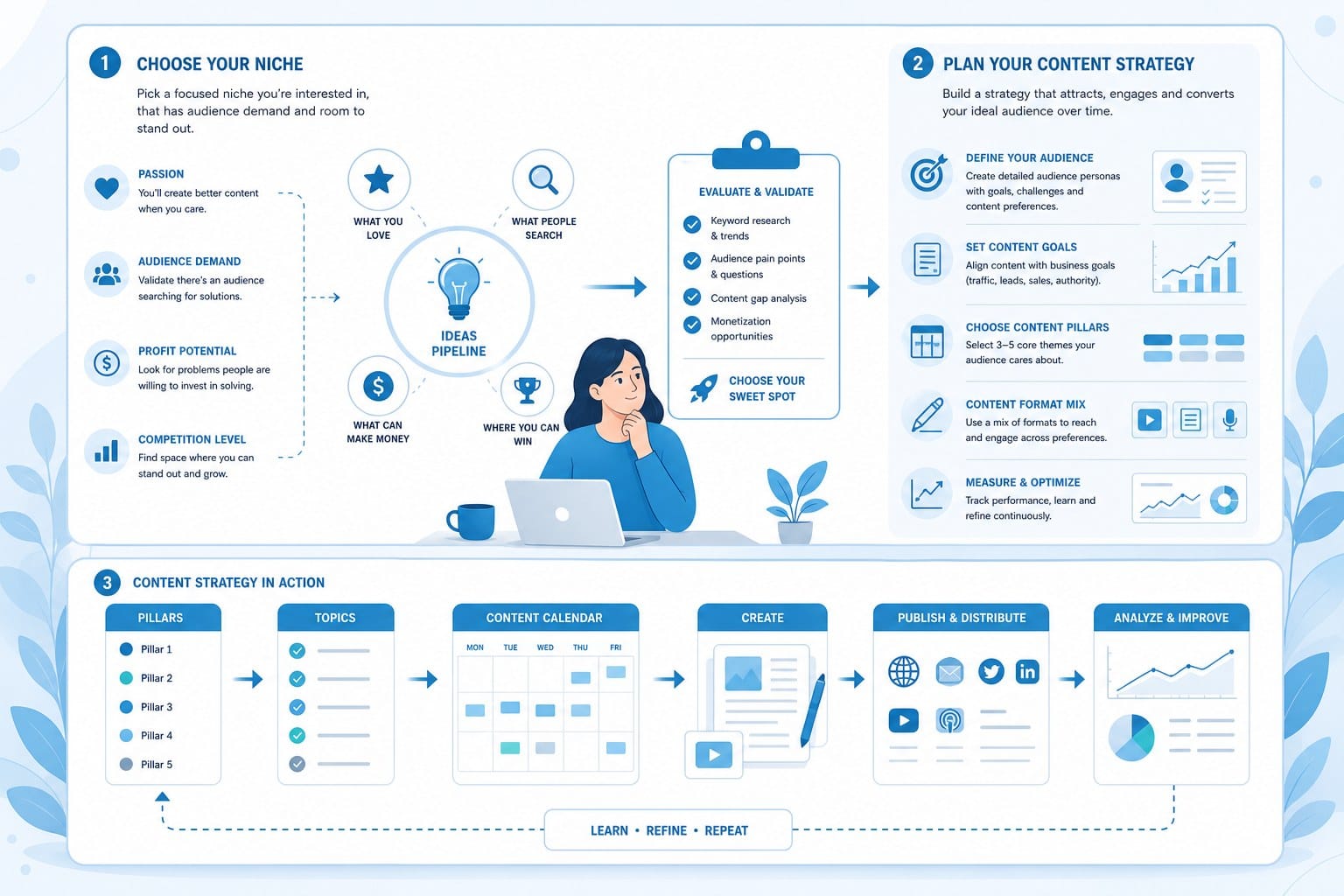
The single most important decision you make before you record or generate a single frame is your niche. A niche is the specific topic area your channel covers. It shapes your audience, your monetization path, and how quickly the YouTube algorithm recommends your videos to new viewers.
Start by listing topics you find genuinely interesting or already know something about. You do not need to be a professional expert, but you do need to care enough about a subject to research it consistently. Channels that start strong and then slow down usually do so because the creator picked a topic for money reasons alone, burned out on the research, and ran out of ideas.
After you have a list of five to ten topics, look at each one through three filters.
The first filter is search volume. People need to be actively searching for content in that space. Tools like Google Trends and YouTube's own search bar suggestions can give you a quick read on whether a topic has consistent interest. A topic like "ancient history mysteries" or "personal finance for beginners" gets searched every single day. A very narrow niche like "the history of one specific 1970s board game" might not have enough search demand to build a channel on.
The second filter is monetization potential. YouTube's Partner Program requires 1,000 subscribers and 4,000 watch hours before you can earn ad revenue. But the ad rates, called CPM, vary wildly by topic. Finance, business, technology, and education channels earn much higher CPMs than entertainment or gaming channels. A channel covering "how to invest in index funds" will earn more per 1,000 views than a channel covering celebrity gossip, even if both have the same subscriber count.
The third filter is faceless-friendliness. Some topics work beautifully without showing a face. Documentaries, explainers, history videos, listicles, science breakdowns, and news analysis all fit naturally into a faceless format. Topics that depend on personal connection, like lifestyle vlogs or fitness coaching, are harder to run as faceless channels without a significant rebranding of the concept.
Once you pick a niche, build out a content calendar before you publish anything. Aim to plan at least 20 video ideas before you launch. This tells you whether the niche has enough depth to sustain a long-term channel. It also means you are never scrambling for ideas mid-week when you should be focused on production.
Think about content series within your niche. A history channel might run a multi-part series on the rise and fall of specific empires. A finance channel might do a weekly series breaking down one investment concept per video. Series keep viewers coming back because they want to see what comes next. They also train the algorithm to understand what your channel is about, which improves how YouTube recommends your videos.
Your video length also matters at this planning stage. Long-form videos, generally over eight minutes, earn more ad revenue per video because they can include multiple ad breaks. Documentary-style and educational content typically performs well at 10 to 20 minutes. Shorter explainers can work at five to eight minutes. YouTube Shorts are a separate format entirely and are better used as a discovery tool to drive people toward your long-form content.
Finally, pay attention to your channel name and branding before you publish. A faceless channel brand is built around a topic or a feeling, not around a person's name. "Curious Atlas" or "Deep Dive Docs" signals immediately what kind of content a viewer will find. Choose something simple, memorable, and relevant to your niche. Get a consistent logo and banner created using a free design tool, and set up your channel description with your target keyword included naturally.
Spending one to two weeks on this planning phase will save you months of wasted effort later. The creators who grow fastest are not the ones who publish first. They are the ones who publish with a clear strategy from day one.
Using AI tools to research, script, and produce your videos
Once you have a niche and a content plan, the production process begins. This is where AI changes everything for faceless creators. A workflow that used to require a writer, a researcher, a voiceover artist, a video editor, and a motion graphics designer can now be handled by one person using AI tools.
Let me walk through the production workflow from start to finish.
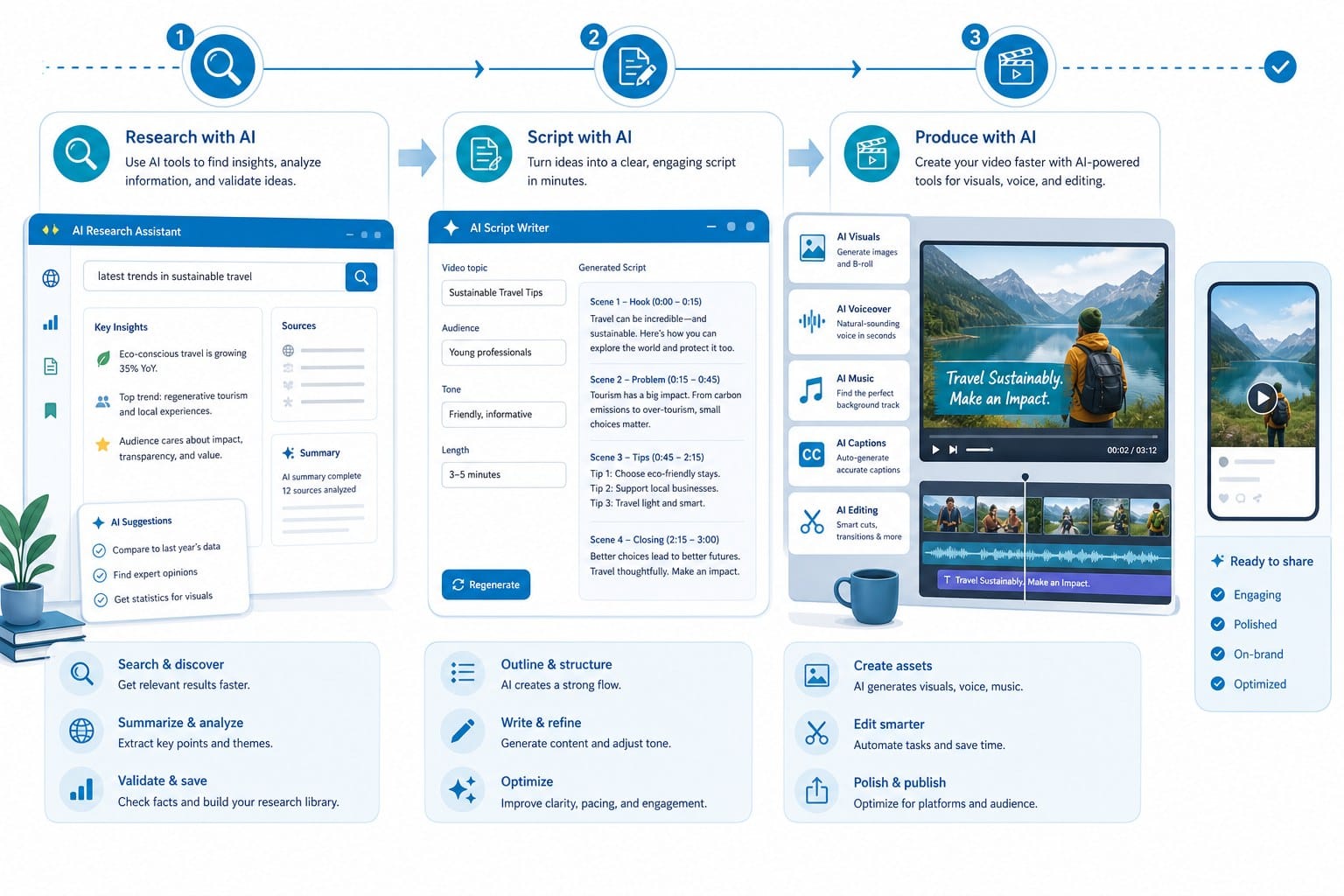
The first step is research and scripting. A strong YouTube video starts with a strong script. The script determines the pacing, the information quality, and whether a viewer stays until the end. You can use a general-purpose AI writing tool to generate a first draft based on a topic and a specific angle. For example, instead of asking for "a video about World War One," ask for "a 12-minute YouTube script about the one week in 1914 that caused World War One, written for a general audience with no prior history knowledge, structured with a hook, three main acts, and a strong closing." The more specific your prompt, the better the output.
Read the draft carefully and edit it. AI writing tools make factual errors. They sometimes get dates wrong, misattribute quotes, or oversimplify complex events. You are the editor and the fact-checker. Your job is to take the AI draft and shape it into something accurate, engaging, and written in your channel's voice. This editing step is where human judgment still matters enormously.
The second step is voiceover. A faceless channel still needs a compelling voice. AI voiceover tools have improved dramatically. Many now produce voices that sound natural, with appropriate pacing and emotional tone. You can choose from dozens of voice styles to find one that fits your channel's personality. A documentary channel might use a deep, measured voice. An explainer channel aimed at students might use something faster and more energetic.
The third step is video production, and this is where an AI video generator for faceless YouTube channels saves the most time. Instead of manually sourcing footage, timing clips to a voiceover track, adding lower thirds and text overlays, and color grading the final edit, you can feed your script into a platform that handles all of that automatically.
Cliptude is built specifically for this workflow. You paste in a prompt or a finished script, and the platform researches the topic, sources relevant footage, generates motion graphics, and delivers a polished video. It supports documentary formats, listicle formats, animated explainers including whiteboard and stickman styles, YouTube Shorts, and music videos. The output looks like something a small production team spent days on.
For creators building documentary-style content, I recommend reading more about how to make a YouTube documentary without showing your face to understand the specific techniques that make that format work well on YouTube.
The pricing model Cliptude uses is credit-based, which means you pay for what you actually produce rather than committing to a flat monthly fee that costs money whether you publish or not. For solo creators testing a new channel, this structure reduces financial risk significantly.
Fourth, think about thumbnails. YouTube thumbnails are the single most important factor in click-through rate. A video with great content but a weak thumbnail will be ignored. AI image generation tools can help you create eye-catching thumbnail concepts, but you still need to think carefully about the design principles that work on YouTube. High contrast, a single clear focal point, bold readable text at small sizes, and an image that creates curiosity or emotional tension all contribute to a higher click rate. Test different thumbnail styles in your early videos and see which ones drive more clicks.
Fifth, your video titles and descriptions need to be written with both the viewer and search in mind. A title like "The Day That Triggered World War One" is more compelling than "World War One Causes Explained." It creates curiosity without being misleading. Your description should include your main keyword naturally in the first two sentences, provide a brief summary of the video, and include timestamps for longer videos. Timestamps help viewers navigate and signal to YouTube that your video is well-organized.
If you are creating content for international audiences, AI tools also open up multilingual production. The process for creating content in languages like Urdu is now much more accessible, and resources like this guide on Urdu AI video generator for professional YouTube content show how creators are reaching entirely new viewer bases with AI-assisted production.
One production tip I want to emphasize: consistency beats perfection at the start. Your first ten videos will not be your best. The goal is to learn how the platform's algorithm responds to your content, improve your scripting skills, and build the production habits that let you publish reliably. Channels that publish one well-researched video per week grow faster than channels that spend three weeks on one video and then go quiet for a month.
Set a production schedule you can actually keep. If you can realistically produce one video per week, plan for one per week. If two weeks is more realistic given your other commitments, build your calendar around that. The algorithm rewards consistent activity. Irregular posting patterns confuse the algorithm and reduce how often your existing subscribers see your new uploads.
Growing your channel, hitting monetization, and scaling output
Publishing your first video is a milestone, but the real work of building a faceless YouTube channel happens in the months after that first upload. Growth on YouTube is almost never linear. Most channels see slow early growth, then a period where one or two videos break out and pull in a larger audience, and then a compounding effect as the algorithm promotes more of their content.
Understanding how YouTube's algorithm works at a basic level helps you make better decisions about what to produce and how to optimize it.
YouTube's recommendation system primarily optimizes for watch time and satisfaction. Watch time is how many minutes viewers spend watching your content. Satisfaction is measured through signals like likes, comments, shares, and surveys YouTube sends to viewers. The algorithm asks: does this video keep people watching, and do people feel good after watching it? If your videos consistently score well on both, YouTube pushes them to more viewers.
This means your opening 30 seconds are critical. If viewers click your video and leave within the first half minute, YouTube reads that as a signal that your thumbnail or title over-promised what the video delivered. Write openings that immediately deliver on the promise of the title. Do not spend 60 seconds on a long intro. Get into the content fast.
Retention curves, which YouTube Analytics shows you for free, tell you exactly where viewers drop off. If you see a sharp drop at the two-minute mark on multiple videos, something in your scripting or pacing at that point is causing people to leave. Watch your own videos with fresh eyes and try to identify what a viewer is experiencing at that moment. Is there a slow section? A confusing transition? A point where the energy drops? Fix those patterns in your next video.
For faceless channels specifically, the visual pacing of your video matters a lot. Because there is no on-camera host to hold attention, the footage, graphics, and editing need to do that work. Cuts every two to four seconds, text on screen reinforcing key points, and dynamic motion graphics all help maintain viewer attention through a longer video. This is one reason AI-generated video with automatic motion graphics and editing outperforms a simple slideshow with stock photos. Movement and visual variety hold attention.
Now let me talk about monetization specifically, because this is usually the goal.
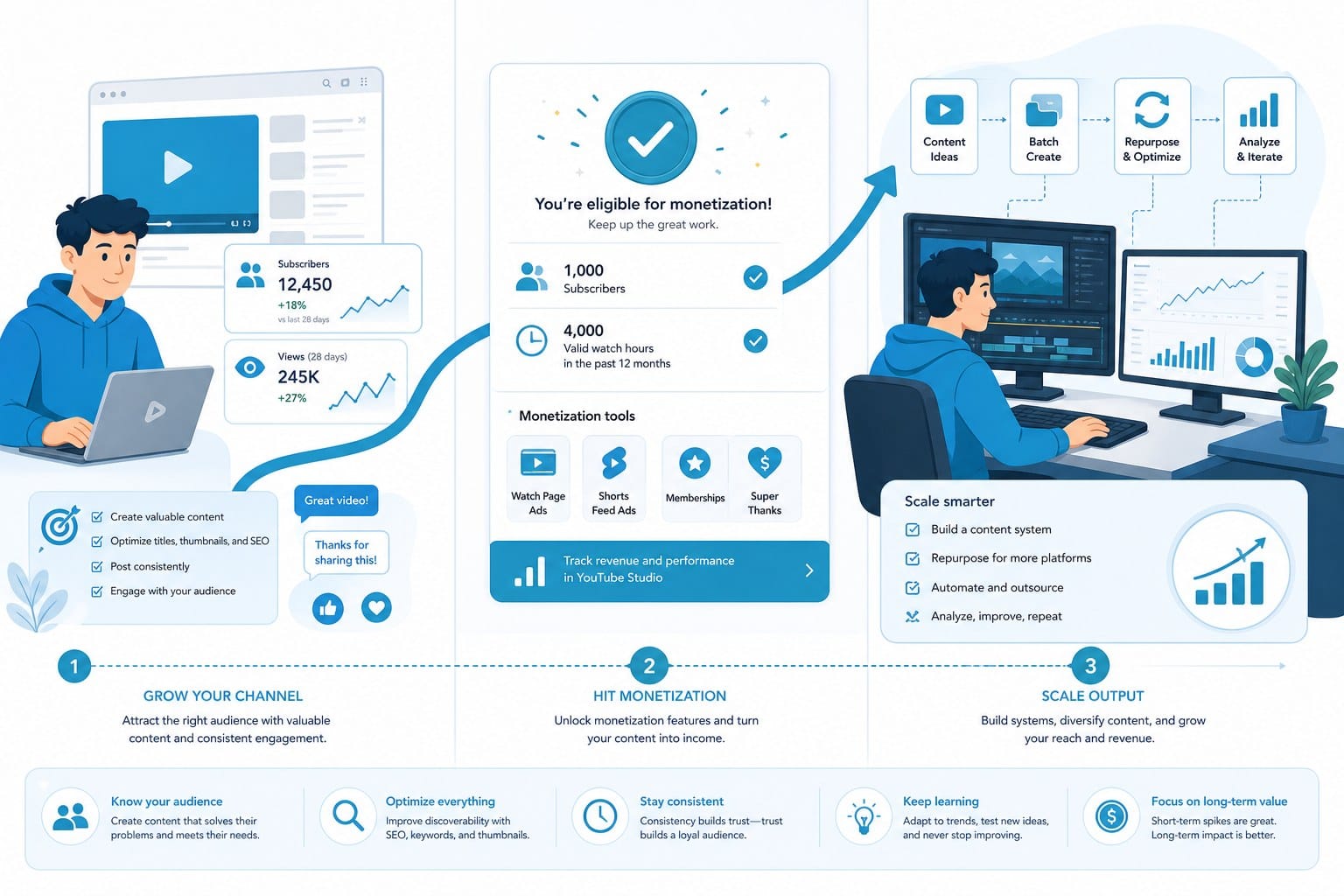
YouTube's Partner Program is the most common first monetization step. You need 500 subscribers and three public uploads in the last 90 days to access basic monetization features like channel memberships. You need 1,000 subscribers and either 4,000 watch hours in the past year or 10 million YouTube Shorts views in the past 90 days to turn on full ad revenue sharing. For most channels in good niches, hitting these thresholds takes six to twelve months of consistent publishing.
Beyond ad revenue, faceless channels can monetize in several other ways. Affiliate marketing involves recommending products in your video descriptions and earning a commission when viewers buy through your links. A finance channel can link to investment platforms or budgeting apps. A technology channel can link to software tools. A history channel can link to books on Amazon. Affiliate income often outpaces ad revenue in a channel's early days because you do not need a huge audience to earn meaningful commissions.
Sponsored content is another revenue stream that opens up once your channel reaches a few thousand subscribers. Brands in your niche will pay to have their product or service mentioned in your video. For faceless channels, sponsorships are typically read by the voiceover and accompanied by branded visual inserts. The rates vary by niche, audience size, and engagement rate, but a channel with 10,000 engaged subscribers in a high-value niche can command hundreds of dollars per integration.
Digital products, like ebooks, templates, courses, or research guides, also work well for faceless educational channels. If your channel teaches viewers how to do something, a paid deeper dive on that topic is a natural upsell.
Scaling output is where AI tools create the biggest competitive advantage. A solo creator using AI video production can realistically publish two to four long-form videos per week without burning out. That volume, combined with a strong niche and good SEO practices, can compress the timeline to monetization significantly compared to a creator doing everything manually.
When you are ready to scale, think about batching your production. Write and edit four to eight scripts in one sitting. Generate and review all of those videos in a single production session. Schedule them to publish across two to four weeks. Batching lets you stay in a creative and analytical mindset for longer blocks of time rather than switching between research, writing, and editing every single day.
Channel analytics deserve your attention every week, not just when something goes wrong. Look at which videos have the highest average view duration. Look at which videos are getting the most impressions. Look at where your subscribers are coming from. These numbers tell you which topics and formats your specific audience responds to, and that information should directly shape what you produce next.
Do not ignore your comment section. Comments are one of the most direct signals you have about what your audience wants. If viewers are repeatedly asking follow-up questions about a topic, that is your next video idea. If they are correcting a factual error, acknowledge it and get it right next time. Engaging with comments also improves your satisfaction signals in the algorithm.
Finally, cross-promotion across platforms extends your reach without requiring additional production work. A 15-minute documentary can be cut into three to four short clips for YouTube Shorts, Instagram Reels, and TikTok. These short clips introduce your content to new audiences who might then subscribe to your main channel. AI tools can help with this reformatting automatically, trimming long-form videos down to vertical short-form clips optimized for each platform.
Building a faceless YouTube channel with AI is genuinely achievable for one person with a laptop and a clear strategy. The tools exist to handle the production work that used to require an entire team. What you bring to the equation is your creative direction, your research judgment, your niche expertise, and your consistency. Those are things no tool can replace, and they are also the things that will make your channel stand out from the growing number of AI-generated channels appearing on the platform every week.
Ready to take the next step?
If you are ready to stop planning and start publishing, Cliptude is built to take you from a prompt or a script to a polished, publish-ready video in a fraction of the time it would take to do it manually. Visit Cliptude to explore the platform and see how it fits into your faceless channel workflow. The credit-based model means you only pay for what you produce, so you can test it on your first real video without committing to a large upfront cost.



