AI video generator for Marathi content creators

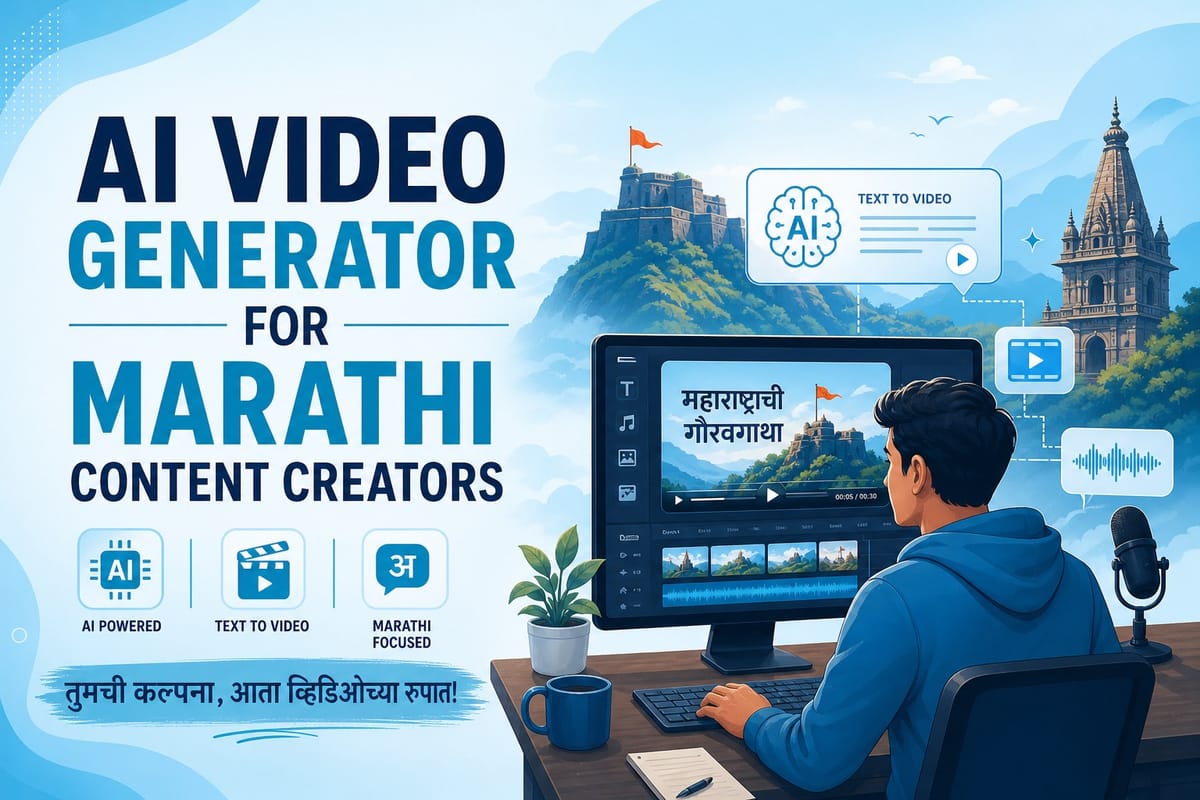
Table of contents
1. Why Marathi content creators have a real advantage right now
2. How an AI video generator actually works for Marathi content
3. Building a consistent Marathi channel with Cliptude
I want to be upfront with you: creating Marathi content on YouTube is harder than it looks. You need a script, a voiceover, footage, graphics, and editing — all before you publish a single video. Most Marathi creators I talk to spend anywhere from 10 to 20 hours on one video. That is a lot of time for a channel that is still growing.
The good news is that an AI video generator Marathi creators can actually use now exists, and it handles most of that production work automatically. In this article, I will walk you through why Marathi content is such a big opportunity right now, what the production process looks like inside an AI platform, and how Cliptude fits into that workflow. By the end, you should have a clear picture of what publishing at scale actually looks like — and whether this approach makes sense for where you are in your creator journey.
Why Marathi content creators have a real advantage right now
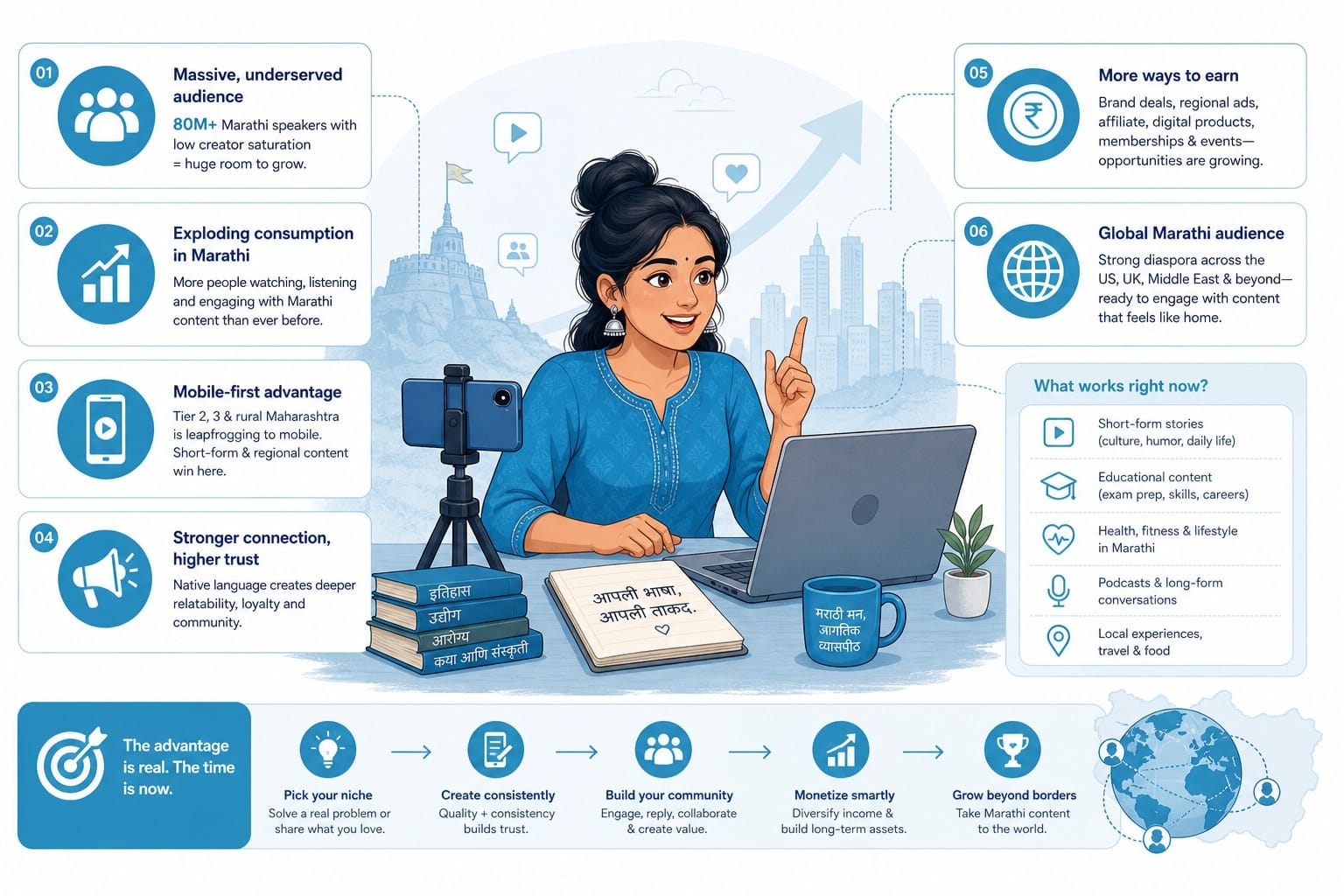
Marathi is spoken by more than 83 million people, making it one of the most widely spoken languages in India. Despite that size, Marathi content on YouTube and short-form platforms is still far less saturated than Hindi or English content. That means a focused Marathi channel can rank faster, build a loyal audience quicker, and face less competition in almost every niche.
Think about the topics Marathi audiences actively search for. Historical documentaries about Chhatrapati Shivaji Maharaj and the Maratha Empire. Explainer videos about Maharashtra's geography, food, and festivals. Personal finance content in Marathi. Motivational videos, devotional content, and local news breakdowns. Each of these categories has genuine demand and not nearly enough supply.
The gap is not because creators lack ideas. It is because video production takes too long and costs too much. A solo creator who wants to publish two or three videos per week quickly runs into a wall. Writing the script takes a few hours. Sourcing B-roll footage takes more time. Recording a voiceover, syncing it with visuals, adding motion graphics, and exporting a clean final cut can eat up an entire day. Multiply that by three videos a week and you are looking at a part-time job on top of whatever else you do.
This is where AI tools start to make real sense. When you use an AI video generator Marathi workflow, the platform handles the research, scripting, visual sourcing, and editing steps automatically. You shift from being a video editor to being a content director. You decide the topic and the angle. The platform does the production.
Faceless channels in particular benefit from this setup. You do not need to appear on camera. You do not need a studio or recording equipment beyond a decent microphone if you want to record your own voice. Many successful Marathi channels already operate this way, covering topics like history, crime stories, mythology, and listicles entirely through narration over visuals. If you want a broader look at how AI tools support this format, the guide on AI tools for faceless YouTube channels: a practical guide covers the full picture.
The timing is also favorable from an advertiser standpoint. Regional language channels in India have been attracting more ad spend as brands realize that Tier 2 and Tier 3 city audiences are growing fast. A channel that publishes consistently in Marathi, maintains quality, and builds a subscriber base of even 50,000 engaged viewers can generate meaningful revenue through ads, sponsorships, and affiliate partnerships.
To put some numbers behind that: YouTube channels in Indian regional languages have seen CPMs rise year over year as more advertisers target vernacular audiences. That trend is not reversing. If anything, it accelerates as smartphone penetration deepens in smaller cities and towns across Maharashtra and beyond. A Marathi channel you start building today will be competing for a bigger ad budget two years from now than the one that exists today.
It is also worth thinking about the audience loyalty dynamic in regional language content. When someone finds a high-quality Marathi channel covering topics they care about, they tend to stay. They share it with family. They come back for every upload. That kind of community is harder to build in a crowded space like English YouTube, where viewers have dozens of competing channels covering any given topic. In Marathi, a well-made channel can become the go-to source in its niche within a few months.
Niche selection matters enormously here. Broad channels that try to cover everything tend to grow slowly because they do not attract a specific subscriber type. Channels that pick a lane — Maratha history, Marathi true crime, personal finance for Maharashtrian families, devotional content for specific festivals — build faster because every new video is directly relevant to everyone already subscribed.
The creators who move now, while the niche is still open, will have a significant head start over anyone who waits another year or two. The window does not stay open forever. As AI tools become more widely understood and adopted, more creators will enter the Marathi space. The ones who establish authority early — consistent publishing history, subscriber count, search rankings — will be much harder to displace.
AI-powered production is the tool that makes that volume of content realistic for a solo creator or a small team. Without it, publishing two to three quality videos per week in Marathi requires either a full production team or a creator willing to work unsustainable hours. With it, one person with the right workflow and a clear content strategy can compete with channels that have far more resources.
How an AI video generator actually works for Marathi content
Let me break down what the production process looks like when you use Cliptude to create Marathi videos. It helps to see the specific steps rather than just hearing that the platform is powerful.
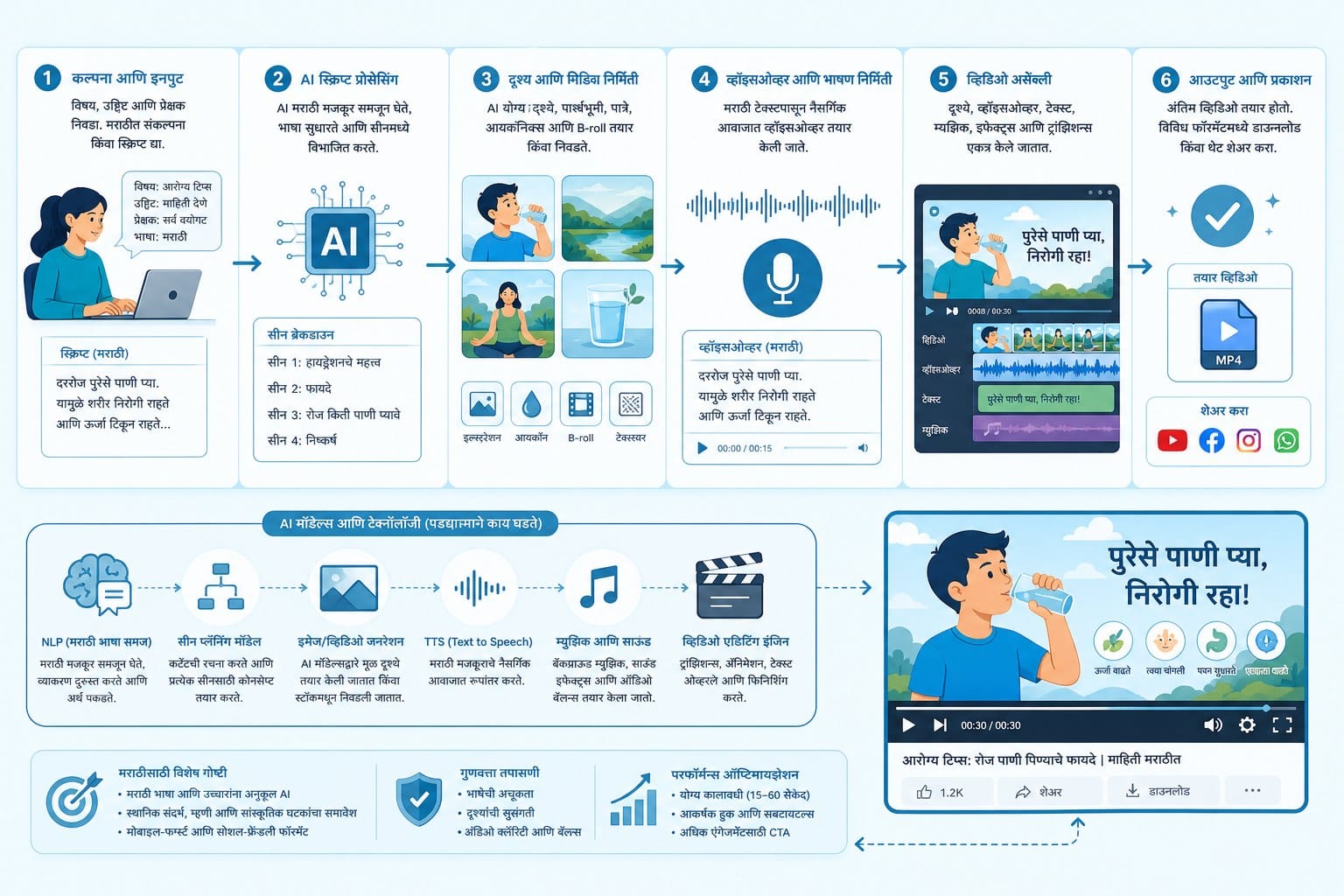
You start with a prompt or a script. If you have a topic in mind but have not written anything yet, you can describe the video in plain language. Something like: a 10-minute documentary about the history of Pune for a Marathi-speaking audience. The platform researches the topic, structures a script with an introduction, body sections, and a conclusion, and presents it for your review. If you already have a script written in Marathi or in English, you can paste it directly and the platform works from there.
That script review step is important and worth taking seriously. The AI will produce a solid structural draft, but you are the one who knows your audience. You know whether the tone is right for the kind of channel you are building. You know whether a historical reference needs more context for a younger Marathi viewer or whether a particular detail is off. This is where your role as a content director shows up. Treat the first draft as a starting point and improve it before moving forward.
From there, Cliptude sources footage automatically. This is one of the most time-consuming steps in traditional video production, and the platform handles it without you having to browse stock libraries manually. It pulls visuals that match the script content, section by section. For a historical documentary about Pune, that might mean archival photos, maps, wide shots of forts and urban landscapes, and motion graphics that bring dates and timelines to life. For a personal finance explainer, it might pull lifestyle footage alongside animated charts.
Motion graphics are generated as part of the same process. If your script references data — population numbers, battle dates, geographic distances, budget figures — the platform can create lower thirds, animated text overlays, and infographic-style graphics that make the information easier to follow. This level of polish is what separates a channel that looks professional from one that looks rushed. Viewers notice, even if they cannot articulate exactly why one video feels more credible than another.
Voiceover is another key piece of the production. You can use an AI voice in Marathi, or you can record your own narration and sync it with the visuals. Many creators I know prefer to record their own voice because it adds a personal quality that audiences respond to. There is something about hearing a real person narrate a story that builds trust in a way that a synthesized voice still has not fully matched, particularly for longer content. The platform accommodates both approaches, so you can decide based on your comfort level and your channel strategy.
Editing happens automatically once all the components are in place. Cuts are synced to the narration, transitions are added, pacing is adjusted to match the energy of the script, and the final video is exported at a resolution suitable for YouTube or short-form platforms. The whole process takes a fraction of the time that manual production would require. What might take a skilled editor six to eight hours to assemble is handled in a session that lets you review and adjust rather than build from scratch.
Cliptude supports multiple video formats, which matters a lot for Marathi creators who want to publish across platforms. You can produce a 10-minute YouTube documentary, a 60-second YouTube Short, an Instagram Reel, and a Facebook video clip all from the same core script. That kind of output would take days to produce manually, requiring separate edits with different aspect ratios, pacing adjustments, and caption treatments. With an AI workflow, it becomes manageable in a single session.
The platform uses usage-based credit pricing, which means you pay for what you produce rather than committing to a fixed monthly seat regardless of output. For a solo creator who might have a productive month followed by a slower one, that flexibility is valuable. You are not wasting money on a subscription during weeks when life gets busy and publishing slows down.
Animation formats are also available through Cliptude. If you want to create a whiteboard-style explainer about Maharashtra's water crisis, or an animated breakdown of the history of the Maratha Empire in a format that appeals to younger viewers, those styles are supported. Educational content in Marathi performs especially well when it combines clear narration with engaging visuals, and animation is one of the best formats for topics where real footage is limited or unavailable.
Commercial rights are included with the content you create on Cliptude. That matters if you plan to monetize through YouTube's Partner Program, sell videos to brands, license content to media companies, or use the videos in paid advertising campaigns for your own business. What you produce is yours.
One thing worth addressing directly: AI-generated video can sometimes trigger platform scrutiny if it looks low-effort or mass-produced without clear informational value. The way to avoid that is to make sure your content has a genuine point of view, real information that serves the viewer, and production quality that holds up on a full-screen watch. The article on how to avoid YouTube inauthentic content flags with AI video goes into this in detail and is worth reading before you start publishing at scale.
For Marathi creators specifically, I would recommend thinking carefully about how you localize the content rather than just translating it. A video about personal finance for a Marathi-speaking audience should reference local context — familiar cities, relevant financial products available in India, examples that resonate with someone living in Pune or Nashik rather than a generic global audience. That localization layer is what you bring as the creator. The AI handles the production scaffolding. You bring the cultural fluency and the audience understanding that make the content genuinely useful.
This division of labor is what makes the AI video generator Marathi workflow effective at scale. The platform does not replace your creativity or your understanding of your audience. It removes the technical and time barriers that were preventing you from publishing consistently and at the quality level your audience deserves.
Building a consistent Marathi channel with Cliptude
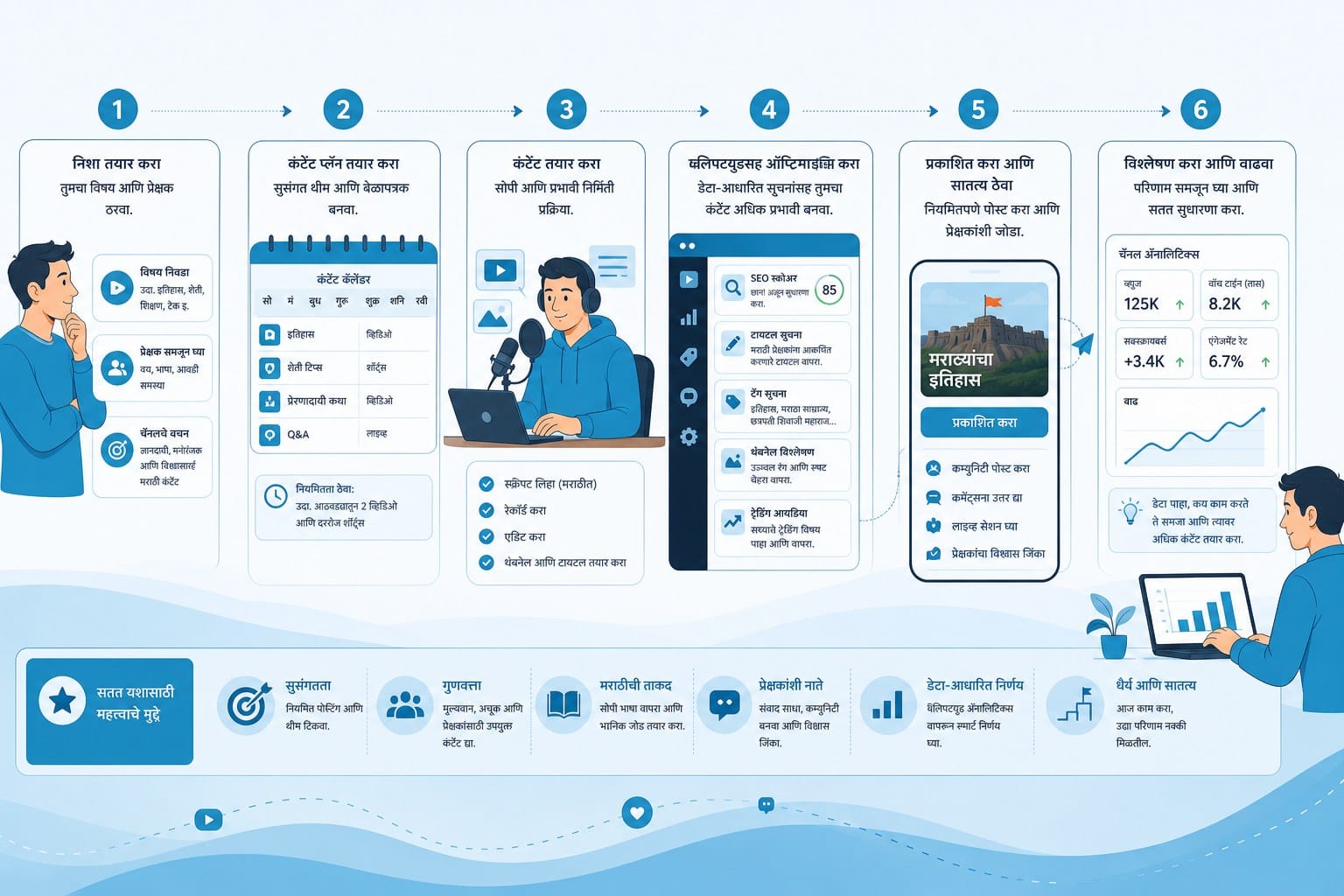
Consistency is the single most important factor in growing a YouTube channel. The algorithm rewards channels that publish regularly. Audiences subscribe and return when they know new content is coming. But consistency is exactly what breaks down when production takes too long and each video feels like starting over.
Let me give you a realistic picture of what a Marathi content schedule could look like using Cliptude.
Suppose you decide to run a faceless Marathi history channel. Your target is two long-form videos per week, each around 10 to 12 minutes, plus two or three Shorts repurposed from the same content. With traditional production, that schedule is probably not sustainable unless you have a team. With an AI-powered workflow, one person can manage it.
On Monday, you identify your two topics for the week. Maybe one is a documentary about the Peshwa period in Pune and the other is a listicle covering five underrated forts in Maharashtra. You enter both as prompts on Cliptude and review the generated scripts. You make edits where needed, adjust the tone, and add local context that the AI might not have included — a specific story you know from that region, a detail from a primary source, a reference your audience will immediately recognize.
By Tuesday, the first video is in production. The platform sources footage, generates motion graphics, and assembles the edit. You review it, request any adjustments, and approve the final version. That video is ready to upload.
By Thursday, the second video follows the same process. You publish both videos with thumbnails, titles, and descriptions optimized for search. From each video, you pull out two or three Shorts using the most engaging 60-second segments — a dramatic moment in the historical narrative, a surprising fact, a visual that works well in vertical format. Those Shorts get scheduled across the following week to maintain a steady presence on the channel.
Over the course of a month, you have published eight long-form videos and somewhere between 10 and 12 Shorts. That is the kind of output that moves a channel forward in the algorithm. And it is achievable by a single creator using AI-powered production — not as a one-week sprint, but as a sustainable weekly rhythm.
Content categories that work particularly well for Marathi channels in this format include historical documentaries, mythology and devotional content, crime and mystery stories, travel and geography of Maharashtra, educational explainers on science and economics, and motivational or self-improvement content. Each of these niches has an established Marathi-speaking audience with clear search intent. They are not watching these videos by accident. They are looking for them.
I also want to mention something that applies broadly to creators working in regional languages. The strategies that work for one language often translate to others. If you are curious about how this same workflow applies to another South Asian language context, the article on AI video generator in Urdu: how to create videos in your language covers the same principles from a different angle and might give you ideas you can adapt directly for Marathi.
One practical point about thumbnails and titles: even though Cliptude handles the video production, you still want to invest time in creating compelling Marathi-language thumbnails and titles that drive clicks. Bright colors, clear text in Devanagari script, and a visual that creates genuine curiosity tend to perform well. The thumbnail is the first thing a viewer sees before they decide whether to watch. A strong video with a weak thumbnail will underperform. You can use separate design tools for thumbnails or work with a freelance designer if that is not your strength. The video itself is the hard and time-consuming part — that is what Cliptude takes care of.
If you plan to monetize beyond YouTube ad revenue, an AI production workflow also opens up other income streams that would otherwise require a production team. You can create sponsored content for Marathi-language brands. You can produce educational video series and sell them directly to viewers as a course. You can offer video production services to local businesses in Maharashtra who want Marathi-language promotional content but do not have the capacity to produce it themselves. The commercial rights you hold on Cliptude-produced content make all of these options available.
Scaling beyond a single channel is also possible once you have the production process figured out. Some creators run two or three niche channels simultaneously. One might focus on Marathi history, another on Marathi business and finance, and a third on devotional content. With an AI-powered workflow, managing multiple channels becomes realistic in a way that it simply was not before. You are not multiplying the editing workload when you add a channel — you are multiplying the topic selection and script review work, which is far more manageable.
My honest advice is to start with one channel, one niche, and a consistent publishing schedule. Get the workflow dialed in. Understand what your audience responds to. Build your first 1,000 subscribers. Then think about expanding. The creators who try to do too much too fast often end up doing nothing well. The ones who pick a lane and stay in it consistently are the ones I see growing month over month.
If you are a solo entrepreneur using video content to market a product or service to Marathi-speaking customers, the same logic applies. You can produce explainer videos, product walkthroughs, testimonial-style content, and educational series at a volume that would otherwise require a production team. Full commercial rights mean you can use the content anywhere — your website, social ads, email campaigns, presentations — without any licensing concerns.
Cliptude gives you the production capacity to publish at a professional level even if you have never edited a video before. The AI video generator Marathi workflow removes the technical barrier that stops so many talented creators from getting started or scaling up. What you bring to the table is your knowledge of Marathi culture, your audience, and your point of view on the topics you cover. That combination — AI production capacity plus genuine cultural knowledge — is what builds a real channel with real loyalty and an audience that keeps coming back.
The opportunity for Marathi content creators right now is genuine. The audience is large, the competition is manageable, and the tools to produce high-quality video efficiently are available today. The only question is whether you are going to act on it before the window narrows.
Ready to take the next step?
Ready to start building your Marathi channel without spending weeks on production? Visit Cliptude and create your first AI-generated video from a simple prompt. No editing experience required.