How to avoid YouTube inauthentic content flags with AI video

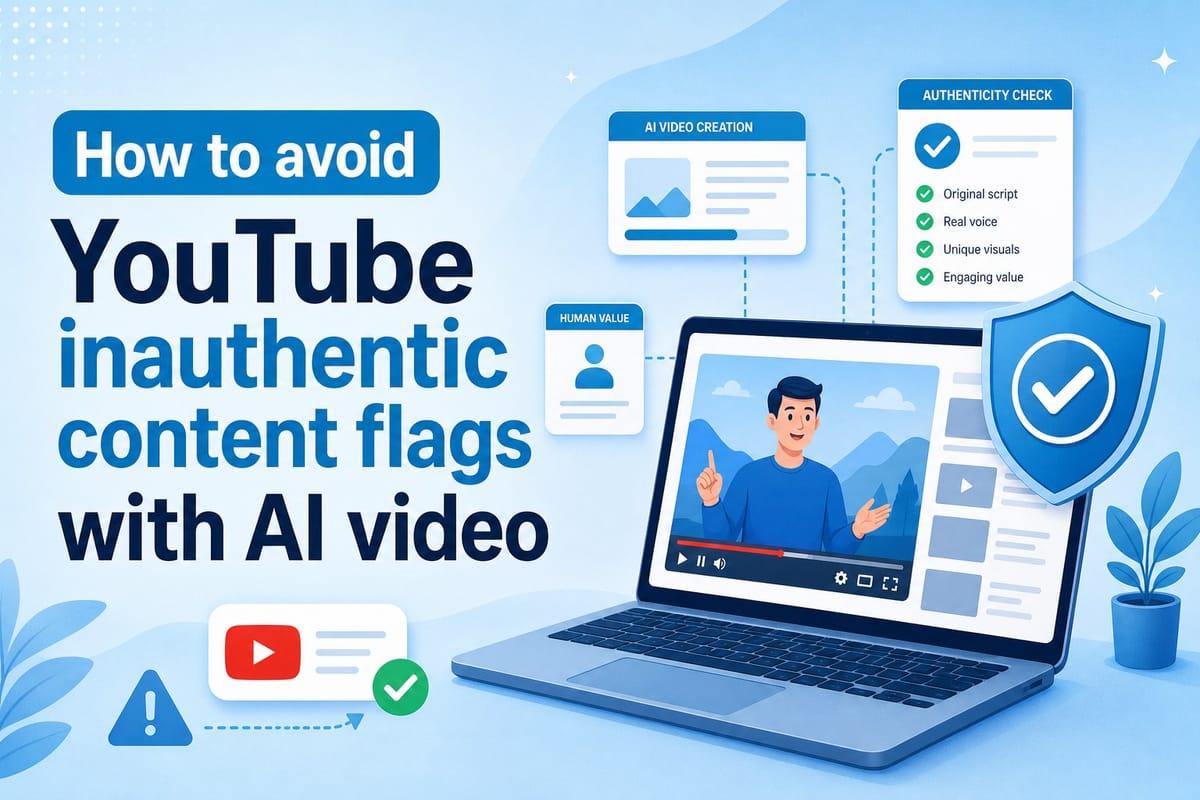
Table of contents
1. What youtube inauthentic content actually means
2. The specific mistakes that trigger inauthentic content flags
3. How to build an AI video workflow that stays safe and scales
If you create AI-generated videos for YouTube, you have probably heard about the platform's policies around what it calls "youtube inauthentic content." Getting flagged can mean losing monetization, having videos removed, or earning a channel strike. The good news is that these outcomes are avoidable. This guide walks you through exactly what triggers these flags, what YouTube actually looks for, and how to build an AI video workflow that stays well inside the rules.
What youtube inauthentic content actually means
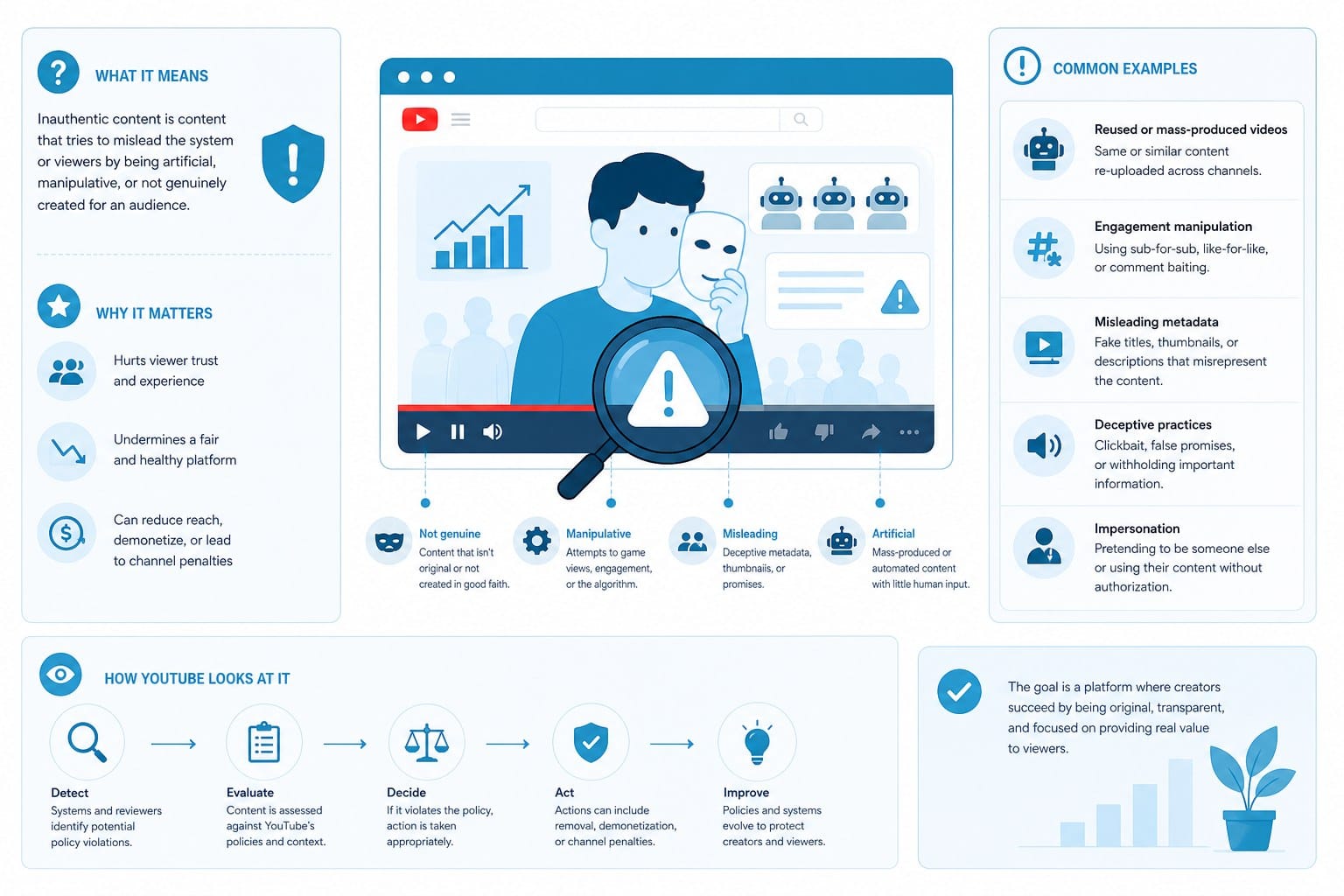
YouTube does not ban AI video. That distinction gets lost in a lot of creator conversations, so it is worth stating plainly before anything else. What YouTube does prohibit is content designed to deceive viewers about its nature or origin, content that looks mass-produced without meaningful creative input, and content that feels like it exists only to game the algorithm rather than genuinely serve an audience.
The term "youtube inauthentic content" comes from YouTube's broader spam and deceptive practices policies. These rules target a specific behavior pattern: uploading large volumes of nearly identical, low-effort videos that flood the platform without adding real value. Think of channels that post hundreds of auto-generated slideshow videos with robotic voiceovers, all covering the same topic with barely any variation between them. That is the behavior YouTube is working to stop, and that is the behavior you need to actively distance your channel from.
YouTube has also introduced specific AI disclosure requirements that sit alongside the inauthentic content policy but operate independently. If your video uses AI to realistically depict a real person saying something they never actually said, or shows a realistic-looking event that never happened, you are required to disclose that in the video's settings. Failing to do so is a separate policy issue from the inauthentic content policy, but both violations can get your content actioned, and repeat violations can escalate quickly.
So what does YouTube consider authentic? A video is authentic when it reflects real creative decisions, presents a genuine perspective or useful information, and does not try to mislead the viewer. Authenticity is about intent and execution, not about whether a human hand touched every frame or whether an AI tool assisted in production.
This matters enormously for faceless channel creators. Running a faceless channel is completely legitimate. Thousands of successful channels post documentary-style content, explainer videos, and listicles without ever showing a host on camera. The format itself is not the problem. The problem arises when the content is hollow, repetitive, or deceptive. If your faceless channel delivers real research, real insights, and real production quality, you are not making inauthentic content, even if AI tools helped you get there.
AI voiceovers are another area where creators often carry unnecessary anxiety. Using an AI-generated voice is not automatically a flag risk. YouTube does not require all narration to come from a human. The issue is whether that voiceover is paired with meaningful, original content. A well-researched documentary with an AI narrator is not inauthentic. A thin, copy-pasted script read by a robotic voice over stock images with no editing, no original insight, and no production care is a much harder case to defend, especially at volume.
There is also a broader context worth understanding. YouTube's content policies exist because the platform's recommendation engine is built on trust. When viewers click on a video and feel deceived or disappointed, they signal that to YouTube through behavior: they skip, they leave early, they do not click again. Those engagement signals feed directly into how the algorithm treats your channel. So the policies and the algorithm are pulling in the same direction. Creating content that genuinely serves viewers is not just the ethical path; it is also the path that produces sustainable channel growth.
One more thing worth clarifying: the inauthentic content policy does not require you to disclose that AI helped you write your script, choose your footage, or generate a voiceover any more than a human creator needs to disclose that they used editing software or a teleprompter. The disclosure requirement is specifically about realistic synthetic media that could mislead viewers about real people or real events. Knowing that boundary removes a lot of the ambiguity that causes creators to either over-disclose things that do not need disclosure or, more dangerously, under-disclose things that do.
Understanding this distinction is the foundation of everything else covered in this guide. The policies are written to protect viewers and the broader platform ecosystem, not to punish creators who use helpful technology. Work with that intent in mind and you will avoid most of the common pitfalls before they become problems.
The specific mistakes that trigger inauthentic content flags
Knowing what to avoid is more useful than vague warnings about quality. Here are the actual behaviors and production patterns that put AI video creators at real risk, described as specifically as possible so you can audit your own workflow against them.
Mass duplication at the channel level
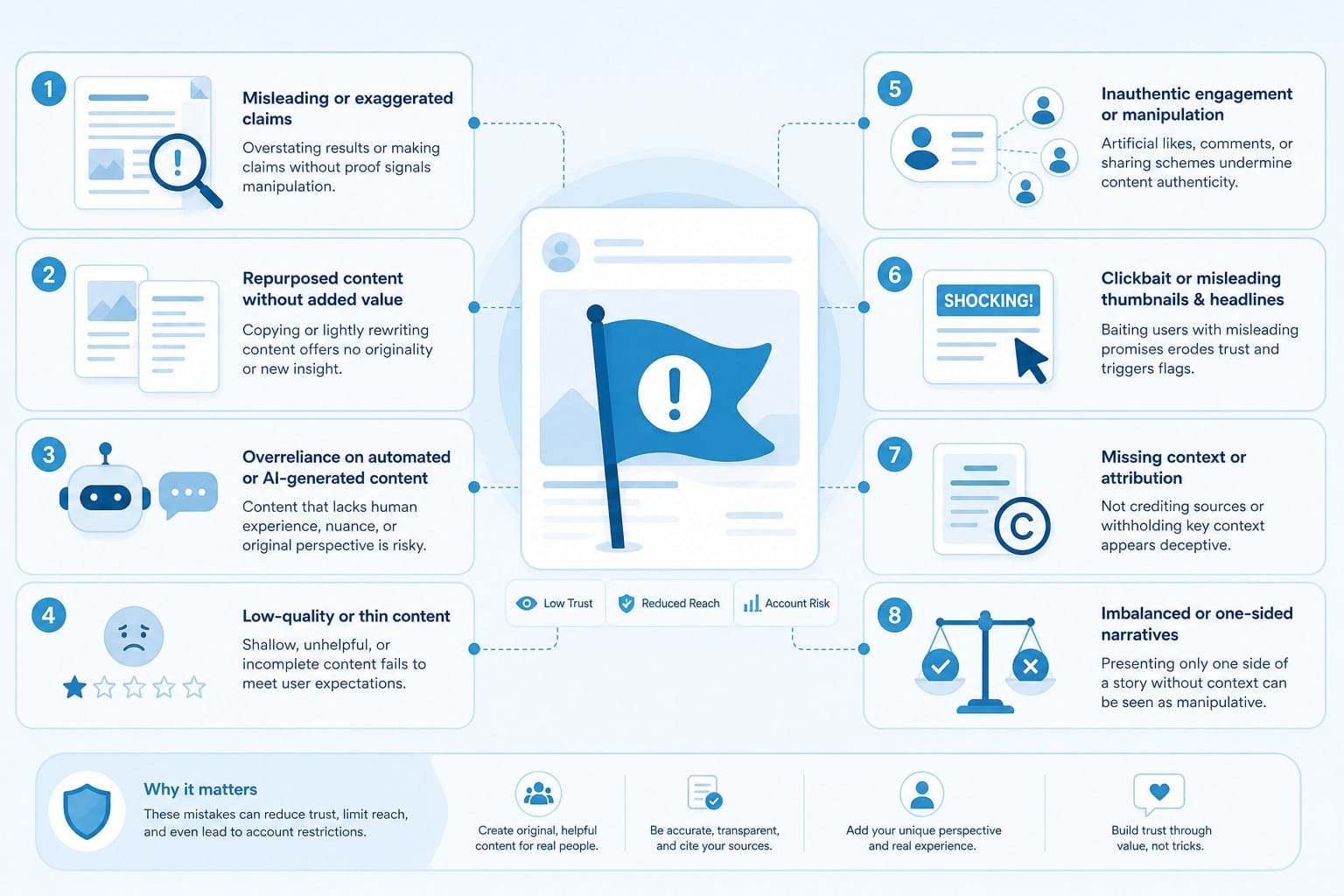
The first and most common mistake is mass duplication. This means uploading the same video or near-identical videos across multiple channels, or releasing dozens of videos on the same topic with only superficial differences between them. If you are using an AI tool to spin out twenty videos on "best budget laptops" that all use the same script structure, the same footage clips, and the same voiceover pacing, YouTube's systems are likely to notice the pattern. The platform looks for repetition that suggests a channel exists to manipulate recommendations rather than to serve viewers. Scale by itself is not the issue. Scale combined with uniformity is.
Hollow scripting with no original analysis
A script that is scraped or lightly paraphrased from existing articles without any original analysis, examples, or editorial voice is a risk factor. This is especially true when that script is paired with generic stock footage that has no meaningful connection to the specific claims being made. Viewers notice when the visuals and the narration feel disconnected, and so does YouTube's engagement data. Low watch time, high skip rates, and low click-through retention all send signals that viewers found the content unsatisfying. At scale, those signals get attention from YouTube's policy enforcement systems.
The scripting problem runs deeper than just plagiarism risk. When every sentence in a script exists to fill time rather than to deliver information, the video has no reason to be watched. AI tools can produce fluent prose very quickly, but fluency is not the same as usefulness. A script with ten minutes of content that teaches the viewer something specific is worth more to your channel than twenty minutes of well-voiced nothing. The former earns watch time. The latter burns it.
Skipping the AI disclosure requirement
As of March 2024, YouTube requires creators to label videos that use AI to generate realistic depictions of real people or events. If you are making a documentary-style video that uses AI to show what a historical event might have looked like, or that generates a realistic-sounding quote attributed to a real living figure, you are required to disclose this in the video settings. The disclosure appears as a label that YouTube surfaces to viewers, similar to how news organizations label opinion content.
Skipping this step is not just a policy violation. It is the kind of deception that YouTube's inauthentic content rules are specifically designed to prevent. And because YouTube has built the disclosure toggle directly into the upload flow, failing to use it when it is warranted is increasingly hard to explain as an oversight. Channels that earn disclosure violations are more likely to have their other content reviewed more closely as well.
Misleading metadata
Using misleading titles, descriptions, or tags to attract clicks on content that does not deliver what it promises is a form of inauthenticity that is easy to slide into accidentally, especially when creators are optimizing titles for search volume without thinking carefully about what the video actually covers. If your title promises a deep investigation and your video is a three-minute slideshow, the gap between expectation and delivery creates frustration. That frustration shows up in engagement metrics, and those metrics can flag content for review.
Good metadata practice is straightforward: your title should accurately describe the experience the video delivers, your description should give viewers real context about what they are about to watch, and your tags should reflect the actual topic rather than aspirational search terms that have nothing to do with your content. This alignment between metadata and content is a trust signal that YouTube's systems value.
Uniform production at scale
AI tools make it easy to produce a lot of videos quickly, but speed becomes a liability when every video looks and sounds identical. Same background music, same transitions, same graphic templates, same voiceover style, same script structure, same runtime. At volume, this uniformity looks like automated spam even if each individual video has some genuine content in it. The pattern itself is a signal.
Varing your format, structure, visual style, and tone is not just good creative practice. It is a visible sign that a real creative mind is involved in production decisions rather than a tool executing the same template repeatedly. This does not mean you need a different visual language for every video. It means that your production library should show real variation in how ideas are organized, presented, and illustrated.
Recycled footage without customization
Buying or recycling footage in bulk without any customization is another pattern that gets channels flagged. If you are pulling the same stock clips that every other creator uses and placing them under a generated voiceover without any motion graphics, text overlays, or editing that connects the visuals to the specific content, your video looks like a template output. The footage is decorative rather than informative, and experienced viewers notice that immediately.
The fix is not necessarily expensive. Pairing licensed footage with custom graphics, relevant on-screen text, and thoughtful pacing makes an enormous difference in how professional and authentic the final product looks and performs. When the visuals do real explanatory work rather than just filling the frame, viewers stay longer and engage more meaningfully.
A concrete example of both approaches
Imagine you are making a listicle documentary about ancient civilizations for a faceless history channel. A risky approach looks like this: generate a script with a basic AI prompt, paste it into a text-to-speech tool, layer it over public domain images with no editing, and upload it five times a week with minimal variation between videos. That approach is exactly what YouTube's inauthentic content policies target.
A much stronger approach works like this: build a genuinely researched script that includes specific details not found in the first page of search results, pair it with a voiceover that has natural pacing and appropriate emphasis on key points, use motion graphics to highlight specific facts and timelines, and include custom visual elements that make the video feel produced rather than assembled. The second approach is not necessarily more expensive or dramatically more time-consuming with the right tools, but it produces something that viewers actually want to watch and that YouTube's systems recognize as legitimate, valuable content.
For creators building that kind of visual identity and production standard, understanding frameworks like the Vox animation style explained for video creators can sharpen your thinking about how production choices contribute to perceived authenticity and channel brand consistency. The specific techniques behind that visual approach give you a concrete reference point for what high-quality AI-assisted production can look like.
How to build an AI video workflow that stays safe and scales
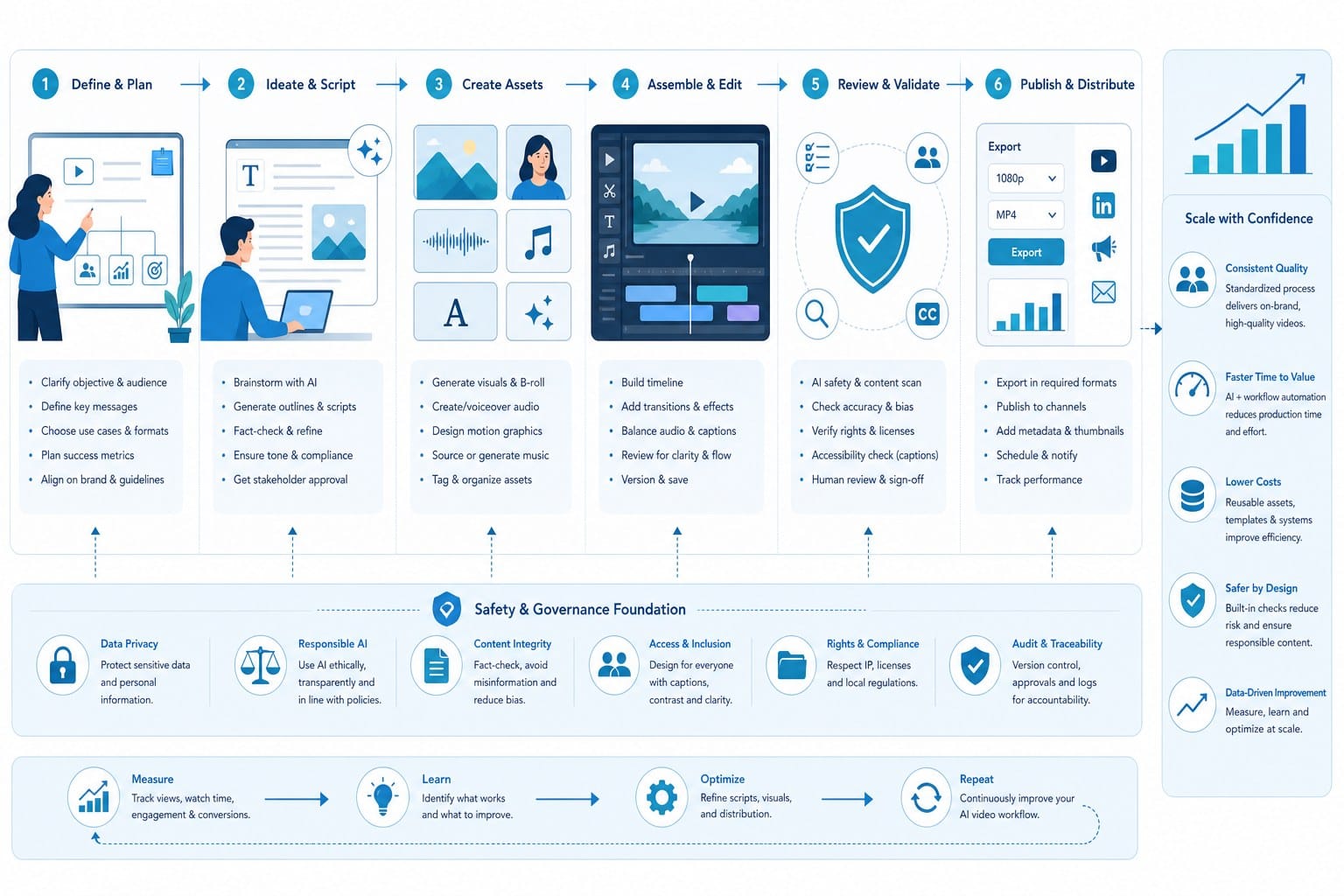
Here is a practical workflow that lets you produce AI-assisted videos at volume without tripping the youtube inauthentic content filters. This covers research, scripting, visual production, voiceover, upload practices, and the editorial layer that holds everything together.
Start with real research, even if AI organizes it
Even if you use AI to help draft your script, the research foundation should be real. That means pulling from credible sources, finding angles that are not covered in the top five search results for your keyword, and injecting specific examples, statistics, or case studies that give the script a distinct point of view. AI is excellent at organizing information and drafting prose. But the editorial decisions, the selection of what to include and what to leave out, should reflect genuine judgment about what serves your specific audience.
This is where many AI video creators underinvest. They treat the script as an afterthought and focus energy on the visual production. But the script determines whether your content is hollow or substantive. A strong script built on solid research is the most important factor in whether a video gets watched, re-watched, and shared. It is also the clearest signal to YouTube that someone with real knowledge and real intent created this video. Time spent making the script genuinely useful is not wasted on polish. It is structural investment in channel longevity.
One useful discipline: before you finalize any script, ask whether a viewer who watches the whole video will know something specific that they did not know before, or be able to do something they could not do before. If the answer is no, the script needs more work. That standard filters out hollow content before it ever reaches production.
Build a visual identity that is specific to your channel
A recognizable visual identity does not require a large design budget. It requires consistent decisions about color, typography, motion style, and graphic format that viewers can recognize across your videos. Channels that use a coherent visual language look like they have a production team behind them even when they do not. They feel like a brand rather than a content farm, and that perception matters both to viewers and to YouTube's systems.
For educational and documentary-style content, motion graphics are one of the most effective ways to add perceived value and authenticity. When a video explains a concept and the graphics on screen actually illustrate that specific concept with custom animation, the viewer experience improves dramatically. This is different from dropping a stock footage clip of a person at a computer whenever the script mentions technology. The graphics should do real explanatory work. They should make the information clearer, not just fill the frame.
Production approaches like the one described in Vox texture explained: what it is and how it works in video use layered, tactile visual elements to make information feel crafted rather than assembled. That layered quality is exactly what separates videos that feel produced from videos that feel generated. If you want to execute that look practically, how to create Vox style graphics for your videos breaks down the specific production techniques involved and gives you a concrete starting point for building your own version of that aesthetic.
The goal is not to imitate any specific channel's style. The goal is to develop a visual system that your channel owns, that viewers recognize, and that reflects active design decisions rather than default template settings.
Get the voiceover right
AI voices have improved dramatically in recent years, but they still sometimes produce flat or unnatural delivery on certain phrases, particularly on sentences with unusual punctuation or on proper nouns the model has not encountered frequently. Listen back to your audio before final production and adjust the script text, punctuation, or pacing controls to get a result that sounds like a real narrator who understands the material and cares about communicating it clearly.
A voiceover that sounds like a human being who is engaged with the topic is more engaging to listeners, retains viewers longer, and signals authenticity. Long watch time is one of the strongest positive signals you can send to YouTube's recommendation system, and the voiceover has a direct effect on whether viewers stay through the full video or leave early. Even small adjustments, adding a comma to create a natural pause, changing a word to avoid a robotic pronunciation, breaking a long sentence into two shorter ones, compound into a noticeably better listening experience across a full video.
Manage upload volume against engagement quality
Resist the temptation to maximize for upload quantity alone. YouTube's systems look at the relationship between upload frequency and engagement quality. A channel that publishes ten videos a week and earns minimal watch time, comments, and shares on each one looks very different from a channel that publishes three well-produced videos a week and earns genuine, sustained engagement. The first pattern triggers scrutiny. The second builds authority.
Scaling your output is a legitimate goal, but the right pace is one at which you can maintain quality and genuine viewer response across everything you publish. If your engagement metrics drop significantly when you increase upload frequency, that is a signal to pull back and invest more in each video rather than producing more videos at lower quality. The algorithm rewards engagement rate, not upload rate.
Use the AI disclosure tools correctly and consistently
YouTube has added a simple toggle in the upload flow for creators to disclose AI-generated or AI-altered content. If your video realistically depicts a real person, real event, or real place in a way that viewers might mistake for genuine footage or genuine statement, turn on the disclosure. This is not an admission that your content is bad or that you have done something wrong. It is responsible transparency that YouTube explicitly treats as a positive signal about your channel's trustworthiness.
Make the disclosure review part of your upload checklist rather than something you decide case by case. Ask yourself before every upload: does this video contain realistic synthetic depictions of real people or real events? If yes, disclose. Build that habit and you remove an entire category of policy risk from your workflow permanently.
Build a creative review step into every production
If you are using an AI platform to produce videos at scale, design your workflow so that each video goes through a creative review step before upload. This does not need to be a lengthy process. Even ten to fifteen minutes of active editorial decisions, what to cut, what to add, what to restructure, what visual element to change, makes a meaningful difference in the final product. This human layer is not just a policy safeguard. It is often what elevates a competent AI output into something genuinely good.
It also ensures that your content library has real diversity in structure, tone, and presentation rather than looking like it was stamped from a single mold. Reviewers, whether human or algorithmic, can tell the difference between a library of videos that reflect active creative judgment and a library that reflects a tool running on autopilot. The former builds channel credibility over time. The latter creates vulnerability.
Choose production tools that support a high baseline
The tools you use set the floor for what is possible in your workflow. If your production tool produces output that requires significant manual correction to reach acceptable quality, you will either spend more time than anticipated on each video or accept lower quality than you intended. Neither outcome serves your channel well at scale.
A platform like Cliptude is built to support this kind of intentional, quality-first workflow. It handles research, scripting, footage sourcing, motion graphics, and editing from a single prompt, but the output is designed to be a polished production rather than a rough template. That means you get the speed benefits of AI production without the uniform, low-effort look that gets channels flagged. For creators running faceless channels producing documentary or educational content at volume, starting from a high production baseline makes it much easier to maintain authenticity standards across a large library of videos without sacrificing the pace that makes the business model work.
Put it all together as a system
The creators who build durable AI video channels think in systems rather than individual videos. They define a research process that reliably produces original angles. They establish a visual identity that is consistent enough to build recognition but flexible enough to avoid uniformity. They set a production pace that their engagement metrics can sustain. They build disclosure review and metadata accuracy into their upload checklist. And they maintain an editorial review step that keeps active creative judgment in the loop on every piece of content.
That systematic approach is what separates channels that grow steadily from channels that spike and then get actioned. YouTube's systems are looking for patterns, and the pattern you want to establish is one of consistent quality, consistent engagement, and consistent transparency. Build that pattern deliberately from the beginning and it compounds over time into channel authority that is very difficult for competitors to replicate quickly.
Avoiding youtube inauthentic content flags is not about limiting your use of AI. It is about using AI as a production accelerator rather than a replacement for genuine creative and editorial judgment. Channels that succeed with AI video long-term are the ones that use the technology to do more of what good creators already do: research thoroughly, write clearly, produce with visual consistency, and serve their audience's real interests. AI tools can help you meet that standard faster and at lower cost than has ever been possible before. The standard itself has not changed.
Ready to take the next step?
If you want to build a faceless YouTube channel that produces genuine, policy-compliant content at scale, Cliptude is worth exploring. The platform handles research, scripting, footage sourcing, motion graphics, and editing from a single prompt, so you can focus your energy on the creative and editorial decisions that make your channel stand out. Visit Cliptude to see how it works and start producing videos that viewers and YouTube's systems recognize as the real thing.