AI video generator for Nepali content creators

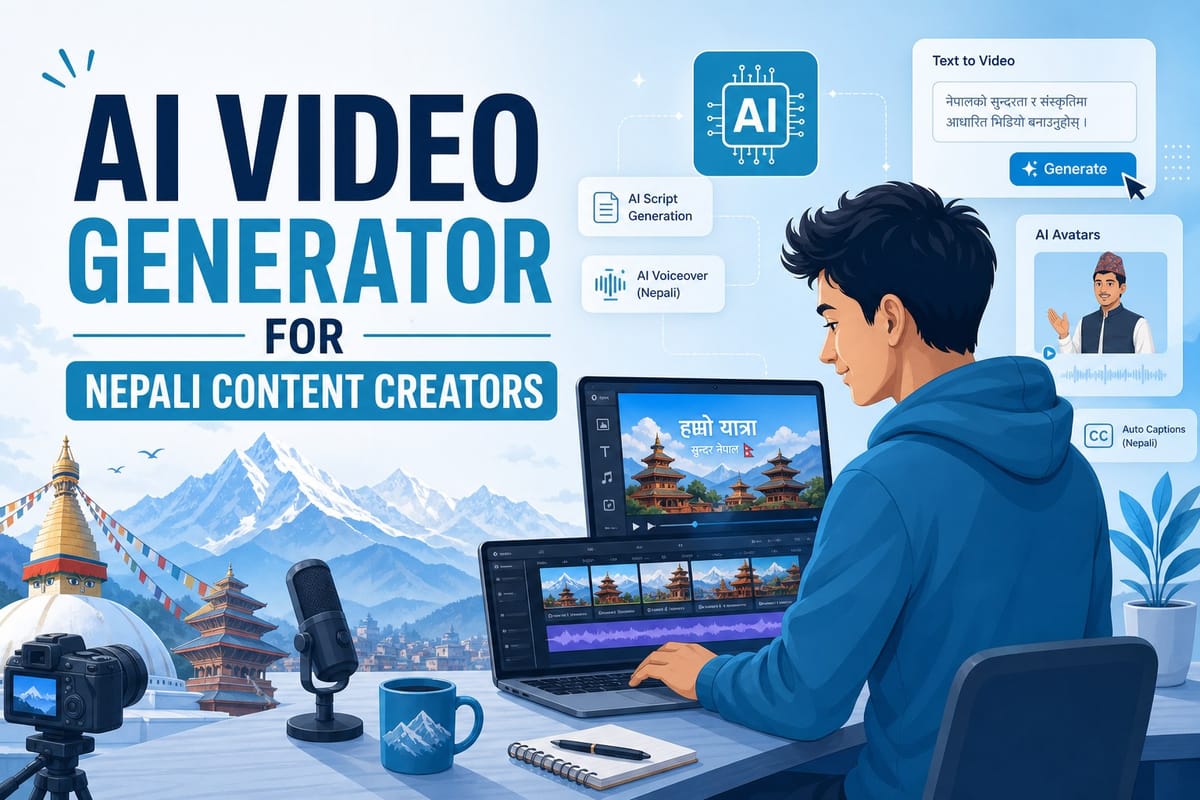
Table of contents
1. Why Nepali creators face a harder production climb than most
2. What an AI video generator actually does for Nepali content
3. How to build a Nepali content channel using Cliptude in a real workflow
Nepali content creators are building some of the fastest-growing YouTube channels in South Asia right now. From travel documentaries about the Himalayas to educational videos on Nepali history, the demand for local-language content is real and growing fast. The problem is that producing a polished video still takes hours of scripting, footage hunting, editing, and rendering. That is where an ai video generator nepali creators can actually use starts to make a serious difference. In this article, I want to walk through why Nepali creators face unique production challenges, how AI video generation solves them, and how a platform like Cliptude fits into a practical workflow for creators working in Nepali or covering Nepali topics.
Why Nepali creators face a harder production climb than most
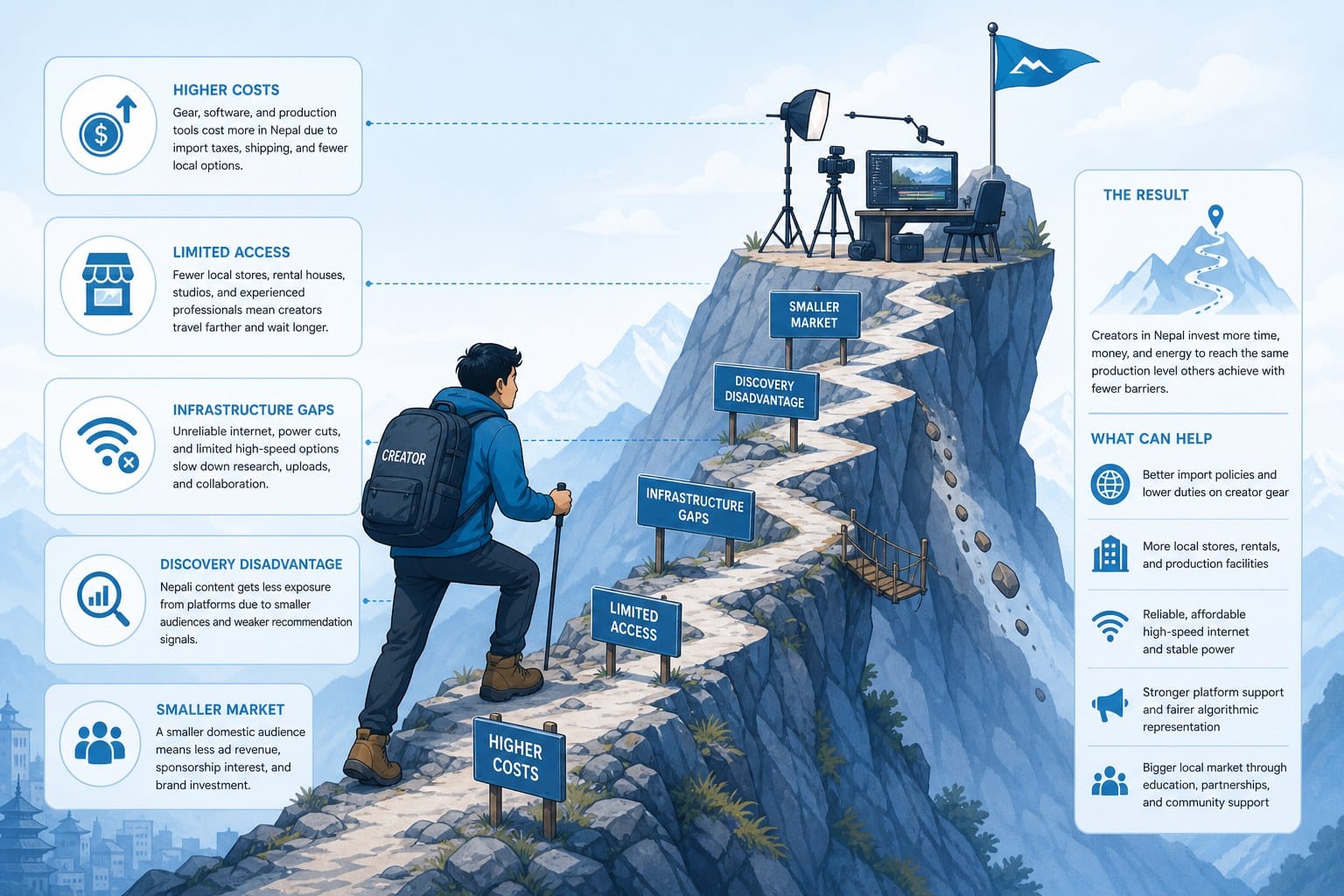
Let me be direct about something: creating video content in Nepali or about Nepal is harder than creating content in English, and the reasons are mostly structural rather than creative.
The stock footage problem is the most immediate obstacle. Search for B-roll of Kathmandu street markets, Pokhara lakeside, or rural hill districts and you will find a fraction of what you would find for New York City or London. Documentary creators covering Nepal either have to travel and shoot their own footage or stitch together clips that do not quite match the story they are telling. Both paths cost time and money that solo creators rarely have in the early stages of building a channel.
Editing talent in Nepal is growing but still uneven in the freelance market. Skilled video editors who understand Nepali aesthetics, proper Devanagari subtitling, and YouTube audience retention optimization are not as easy to source or as affordable as editors in some other regional markets. Outsourcing production to international freelancers often delivers a result that feels generic and disconnected from the subject matter. A video about the Rana regime or the 1990 democracy movement needs an editor who understands the context, not just the software.
The YouTube monetization threshold compounds all of this. Every creator on earth needs 1,000 subscribers and 4,000 watch hours to qualify for the YouTube Partner Program. Nepali channels targeting a domestic or diaspora audience often grow more slowly in the first six months because the total addressable audience in Nepali is smaller than English-language equivalents. That means a Nepali creator has to publish more content, more consistently, just to reach the same monetization milestone that an English-language creator might hit faster with a single viral video. Producing at that volume is almost impossible when every video takes two to three days to complete.
The faceless channel format is particularly relevant to Nepali creators for both cultural and practical reasons. Many creators simply do not want to appear on camera. Some work in professional or government environments where a public YouTube presence would create complications. Others prefer to focus entirely on storytelling and research rather than on-camera performance. The faceless format fits perfectly for documentary-style content, educational explainers, history listicles, and geography breakdowns. But a faceless video still requires motion graphics, voiceover integration, transitions, visual pacing, and tight editing. Without those elements, the video looks cheap and audience retention drops off fast, which tanks YouTube's algorithm ranking before the channel ever gets traction.
This structural gap is exactly what AI video generation tools are starting to close. When you look at what is happening in comparable South Asian language markets like Hindi, Urdu, and Bengali content, the pattern is clear: creators who adopt AI production tools early are scaling their output while others stay stuck at the one-video-per-week ceiling. If you want to see how this plays out in a closely parallel context, the AI video generator in Urdu: a practical guide covers many of the same structural challenges Nepali creators face, including the stock footage shortage, the limited freelance editing market, and the pressure to produce volume before monetization kicks in. The parallels are direct enough that any Nepali creator planning a content strategy should read it.
There is also a timing factor worth naming directly. The Nepali-language YouTube space is underpopulated relative to audience demand right now. Viewers who want well-produced, accurate content about Nepali history, culture, geography, or current affairs do not have many established channels to choose from. That is a genuine opportunity. But the window for building early authority in this niche will not stay open indefinitely. As production tools become more accessible, more creators will enter the space. The creators who move now and build a content library over the next twelve to eighteen months will have a structural advantage that is very hard for later entrants to overcome.
The good news is that the tools are genuinely accessible to creators with no technical video production background. The learning curve for AI video platforms is measured in hours, not months. A creator who understands their subject matter, can write or review a script, and has clear ideas about what they want to communicate can produce professional-quality video content without knowing anything about editing software, color grading, or audio mixing. That shift in what production actually requires is the practical change that makes this moment different from any previous point in the history of online video.
What an AI video generator actually does for Nepali content
There is real confusion about what AI video generation means in practice. Some creators imagine a single button that produces a finished, broadcast-ready documentary. Others assume it is a glorified slideshow tool that strings stock photos together with text overlays. The reality is considerably more useful than either of those descriptions, and understanding what the technology actually does helps you decide how to integrate it into your workflow strategically.
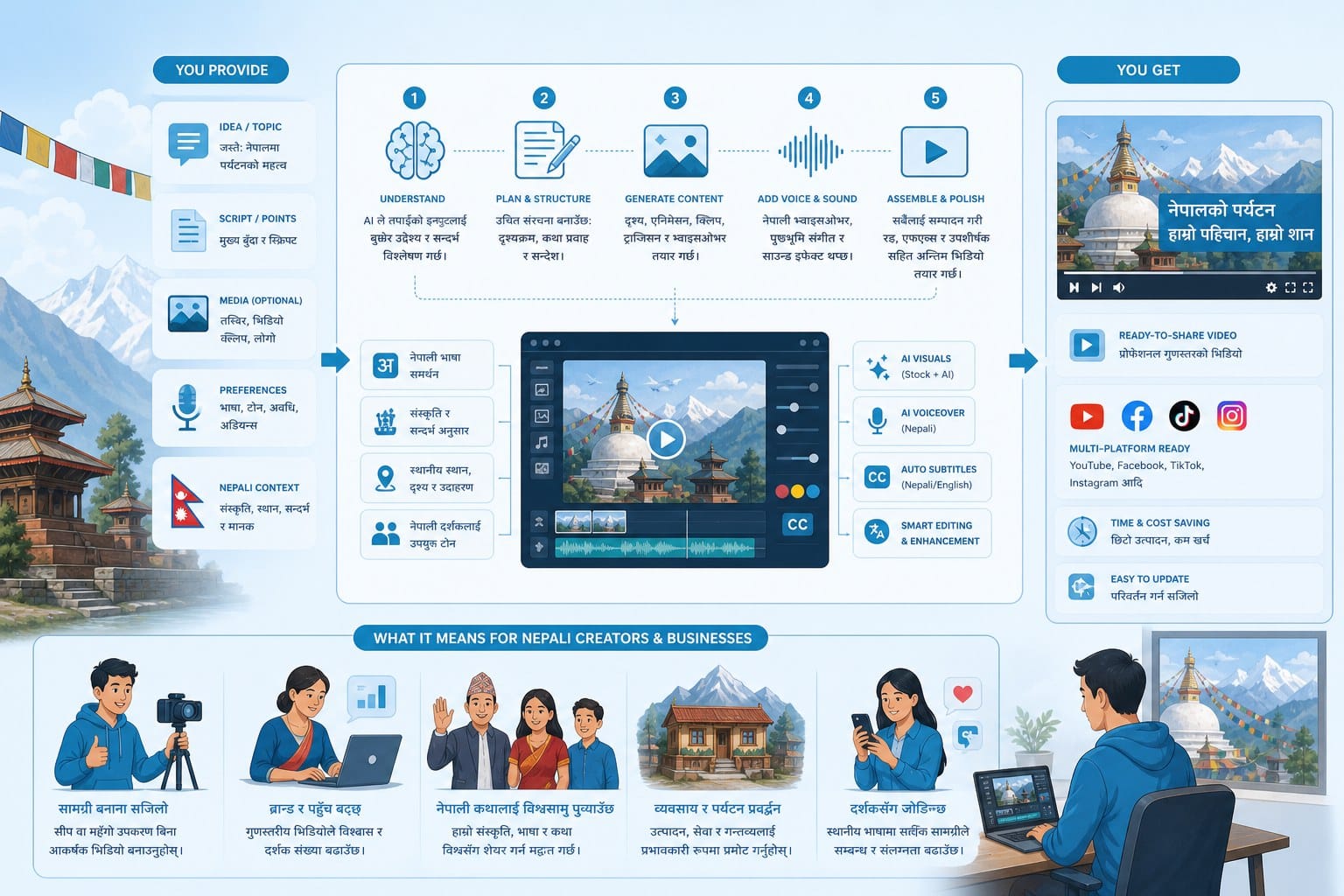
A serious AI video platform handles several steps that normally require separate tools and separate skill sets. It takes your topic or script as input, structures the content, sources or generates visuals, adds motion graphics and transitions, syncs audio elements, and exports a video draft that is ready to review and publish. The creator's job shifts from doing every technical task to directing the output. You decide what the video covers, review the draft, make targeted adjustments, and publish. You stop being the person operating the tools and start being the person making editorial decisions. That is a genuinely different and more scalable role.
For Nepali content specifically, this workflow has concrete and immediate benefits across several content categories.
Documentary content about Nepal is one of the strongest-performing formats for Nepali-language YouTube audiences. Topics like the history of the Gurkha regiments, the geography of the Annapurna range, the cultural significance of Dashain and Tihar, the economic transformation of Kathmandu valley, the history of the Newari trade networks, or the political timeline from the 1990 constitution to the 2006 peace accord all have real and measurable audience interest. They also face relatively low competition compared to English-language equivalents covering the same topics. A creator who can produce a well-researched, visually polished ten-minute documentary on any of these subjects has a legitimate shot at becoming the go-to channel in that niche. The production cost has always been the barrier. AI tools remove most of that barrier.
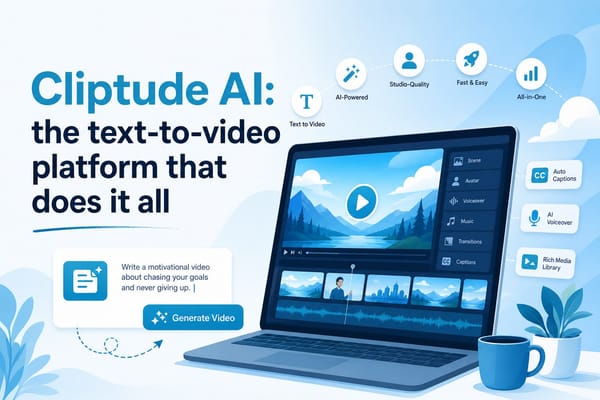
Cliptude is designed specifically for this kind of content creation. You provide a prompt or a complete script, and the platform handles research structuring, footage sourcing, motion graphics, visual pacing, and editing automatically. For a Nepali creator building a documentary about the history of the Nepal-Tibet trade route, the workflow looks like this: you describe the topic in a prompt, specify the format and length, review the script the system generates or upload your own, watch the system build the video with relevant footage and motion graphics, and end up with a polished draft in a fraction of the time that manual production would require. The platform supports long-form documentaries, YouTube Shorts, listicle videos, whiteboard animations, and stickman explainer formats. That range matters because different content types serve different strategic purposes on a growing channel.
The animation and motion graphics formats deserve specific attention in the context of Nepali content. When stock footage of Nepal is sparse or nonexistent for a particular historical period or geographic area, animation is not just a fallback option. It is often the better storytelling choice. An animated map showing the expansion of the Gorkha Kingdom under Prithvi Narayan Shah communicates information that no amount of footage could. An illustrated timeline of the Rana prime ministers is clearer and more engaging than a slideshow of old photographs. A whiteboard-style explanation of how Nepal's federal governance structure works after the 2015 constitution is easier for a viewer to follow than a talking-head segment in front of a whiteboard. Many of the most-watched educational channels on YouTube use exactly these formats regardless of their topic, not because they lack resources, but because animation communicates certain kinds of information better than live footage does.
For Nepali educational content covering topics like Buddhist philosophy at the monasteries of Lumbini and Boudhanath, the history of the Kumari tradition, Nepali language lessons for diaspora children, or civics explanations about how Nepal's parliament functions, the combination of whiteboard and stickman animation formats is particularly strong. These are content categories where the absence of live footage is irrelevant to the viewer's experience. The clarity of explanation is what matters, and animation delivers that clarity better than most live-action alternatives.
Cliptude uses usage-based credit pricing rather than a flat monthly subscription. For solo creators and small media teams, this structure matters significantly. You pay for what you produce rather than paying for a subscription that costs you money during months when you are not actively producing. A creator who makes two or three videos per month pays for two or three videos. A creator who scales up to ten or fifteen videos per month pays for that volume. The cost structure grows with your output rather than charging you a fixed amount regardless of whether you are being productive. That kind of pricing flexibility is genuinely important for creators in the early stages of building a channel when cash flow is tight and production schedules are unpredictable.
The commercial rights structure is another practical detail that matters for anyone building a channel as a business rather than a hobby. Cliptude produces content with full commercial rights included. You can monetize everything you create through YouTube ad revenue, brand sponsorships, or distribution on other platforms without legal uncertainty about the footage or graphics the system generated. For a Nepali creator building a channel that they intend to eventually monetize through brand deals with Nepali businesses, tourism brands, or diaspora-focused products, knowing that your content is commercially clean from the start removes a category of risk that catches some creators off guard.
On the language handling question, which is something every Nepali creator using an ai video generator nepali workflow will think about: Cliptude works from the script or prompt you provide. If you write your script in Nepali, the platform builds the video around that Nepali-language script. If you write in English for a video covering Nepali topics aimed at an international or diaspora audience, the system handles that directly. If you want to produce both a Nepali-language version and an English-language version of the same core content, that is a practical option that several diaspora-focused channels are already using effectively. Many Nepali YouTube channels actually target both the domestic Nepali audience and the diaspora audience in English or in bilingual formats. The flexibility to work in either language within the same production platform simplifies that dual-audience strategy considerably.
For a more detailed look at how to build the complete production-to-publication pipeline using AI tools, how to create and publish polished video content with AI tools covers the workflow from initial prompt through final upload in practical, step-by-step detail. The advice applies directly to the documentary and educational formats that Nepali creators are most likely to be building.
How to build a Nepali content channel using Cliptude in a real workflow
I want to make this concrete rather than theoretical. Here is how a Nepali creator can use Cliptude to build and grow a channel from the first video through a sustainable long-term publishing schedule.
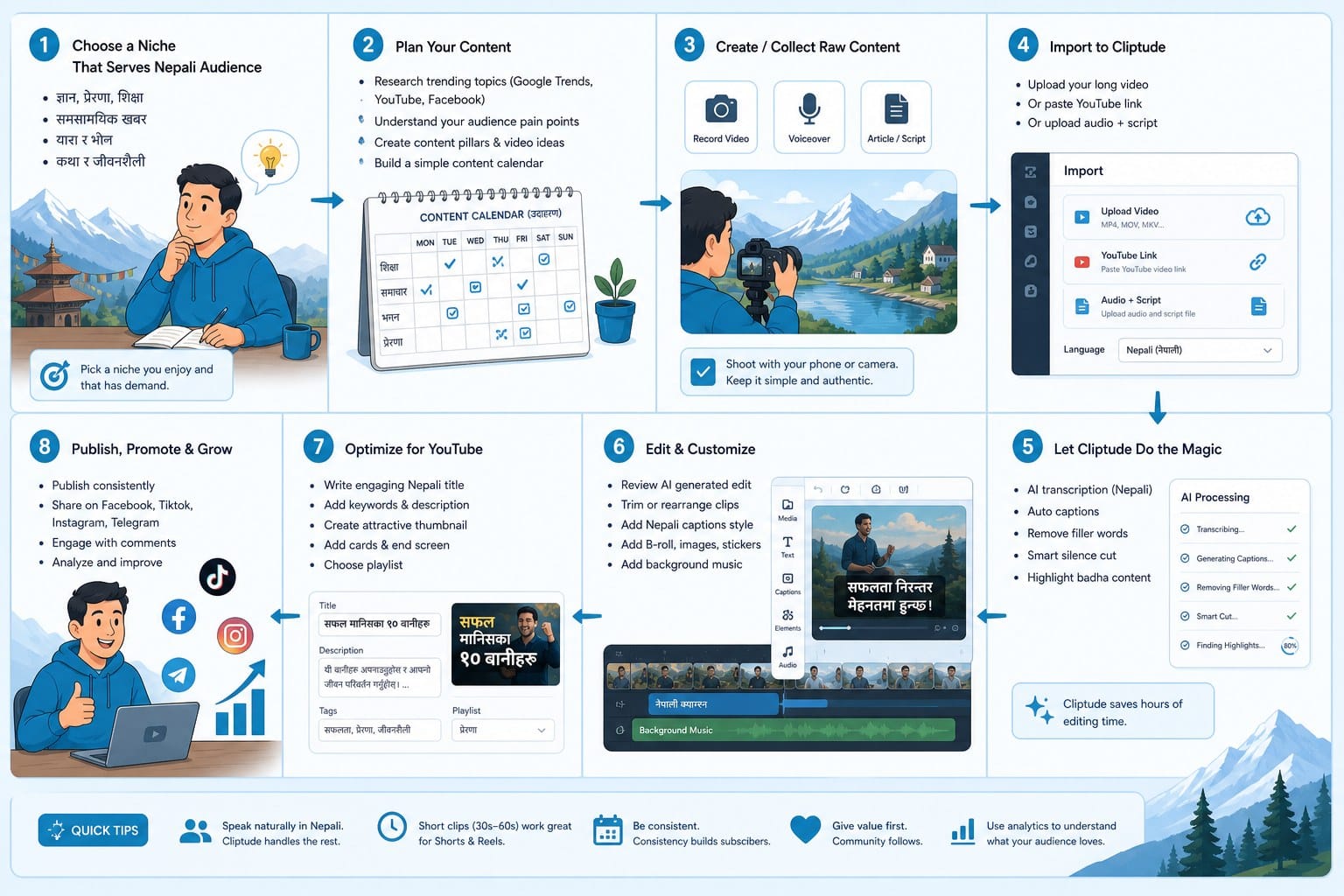
The first decision is niche and format, and these two choices should be made together. The two strongest combinations for Nepali creators right now are documentary-style content covering Nepali history, geography, and culture, and educational explainer content tackling topics with a specific Nepali angle. Both formats work extremely well as faceless channels. Both have real audience demand that existing channels are not meeting at scale. And both are formats that Cliptude's production pipeline handles effectively. Picking one of these combinations before you start producing means every subsequent decision becomes easier because you have a clear filter for what belongs on your channel and what does not.
Once you have your niche, the next step before producing a single video is to batch your content ideas. Write down fifteen to twenty video topics within your chosen niche before you start making anything. For a Nepali history channel, your list might include the Prithvi Narayan Shah unification campaign, the Anglo-Nepal War of 1814 to 1816 and its long-term consequences, the rise and fall of the Rana oligarchy, the 1990 democracy movement and the jana andolan, the decade-long Maoist conflict and the 2006 comprehensive peace accord, the 2015 earthquake and the international humanitarian response, and the political transitions that followed the adoption of the federal constitution. Each of those is a standalone ten-minute documentary topic with documented audience interest. Having a full content list before you start means you can move directly from one video to the next without losing two days per video just deciding what to make next. That decision paralysis is one of the most common reasons early-stage channels stall out before they reach monetization.
Your script approach is the next practical decision. You can write the script yourself in Nepali or English and upload it to Cliptude, or you can give Cliptude a detailed prompt and review the draft it generates. For creators who know their subject deeply, writing the script yourself and using Cliptude for the production layer tends to produce the most accurate and specific output fastest. For creators who are still building their knowledge of a niche, using the AI-generated draft as a research scaffold and then fact-checking and refining it is a reasonable and efficient approach. Either way, the script is the most important creative input you bring to the process. A strong, specific script produces a strong video. A vague or generic script produces a generic video regardless of how capable the production platform is.
Here is what a strong prompt looks like for a Nepali documentary topic. For a video on the history of Nepali cuisine and its regional variations across the hill districts, the Terai, and the high mountain communities, an effective prompt includes the main topic, the specific documentary format with a third-person narrator style, the geographic and cultural regions you want covered, whether you want the structure to be chronological or comparative, the target length, and any specific dishes, ingredients, or cultural practices that must be included. The more specific the prompt, the more targeted the output will be and the less revision time you spend after the fact.
For shorter content, the prompt approach works similarly but with tighter scope. A sixty-second YouTube Short on the cultural significance of sel roti during Tihar needs a prompt that specifies the exact duration, the specific cultural context, the single point you want to make, and the visual tone you want the animation or footage to carry.
Short-form content on YouTube Shorts and Instagram Reels is a strategic opportunity for Nepali creators that I think is significantly underused right now. Sixty-second videos covering Nepali cultural facts, geographic highlights, historical moments, or language lessons can outperform longer content in the early stages of channel growth because they reduce the viewer's commitment threshold for a first encounter with your channel. A viewer who would not commit to a twelve-minute documentary about the Rana period might watch a sixty-second Short about one specific and surprising fact from that era, subscribe because they find the channel interesting, and then watch your long-form content later. Shorts and Reels build channel discovery faster than long-form content alone. Cliptude produces both formats natively within the same workflow, so you do not need a separate tool or a separate production process for short-form content. A practical strategy is to produce one long-form documentary and two or three related Shorts per week from the same source material.
After your first batch of three to five videos is produced and published, establish a publishing schedule and hold to it. Consistency matters more than frequency on YouTube. Two well-produced videos per week maintained over six months is a significantly stronger growth strategy than five videos in week one followed by silence for three weeks. With Cliptude handling the production layer, two videos per week is achievable for a solo creator who has a full-time job and is treating the channel as a serious side project. That publishing consistency, held for six to twelve months, is what moves a Nepali channel from zero to the monetization threshold in a niche language market where individual video virality is less predictable than in larger language markets.
Monetization strategy beyond YouTube ad revenue is something Nepali creators should think about from the beginning rather than treating it as a later-stage concern. Brand partnerships with Nepali businesses, diaspora-focused product companies, Himalayan tourism operators, or cultural organizations are realistic options for a channel with even a few thousand highly engaged subscribers. A Nepali food channel with four thousand subscribers who actively comment, share, and engage is worth more to a Himalayan tea brand or a Nepali restaurant group than a generic food channel with forty thousand passive subscribers who never interact. Niche cultural authority has real commercial value that does not require massive subscriber counts to access. Because Cliptude produces content with full commercial rights, everything you publish is legally ready for brand integration from day one.
For creators building a small team rather than a solo operation, the Cliptude workflow scales without requiring you to hire dedicated video editors. A two-person team where one person handles topic research and scripting while the other handles review, thumbnail creation, and publishing coordination can produce at the volume that previously required a four or five-person production operation. The AI handles the production layer between those two human roles, which means the team's time goes entirely toward the creative and editorial decisions that actually require human judgment.
If you are actively evaluating which AI video platform makes the most practical sense for your situation, Vidrush AI alternative: what Cliptude offers instead provides a direct and straightforward comparison of features, video format support, and pricing structure. Reading it will help you make a clear-eyed decision without having to trial multiple platforms back to back.
One final practical point about the ai video generator nepali workflow that applies regardless of what platform you use: the review step is not optional. AI-generated video drafts are strong starting points, not finished products. Budget twenty to thirty minutes per video to review the script for factual accuracy, check that the visuals are contextually appropriate for the content, and adjust pacing where the rhythm feels off. That review step is what separates a video that feels like it came from a creator who knows and cares about the subject from one that feels like it came from a content mill. The AI removes ten to fifteen hours of raw production labor from the process. You contribute thirty minutes of editorial judgment. That combination of AI production efficiency and human editorial care is what builds a loyal and returning audience in any language market, and Nepali is no exception.
Ready to take the next step?
If you are a Nepali creator ready to produce consistent, polished video content without spending days on each video, Cliptude is built for exactly that workflow. Start with a detailed prompt or your own script, choose your format from long-form documentary to YouTube Shorts to whiteboard animation, and have a production-ready video draft faster than any traditional editing process allows. Visit Cliptude to explore the platform and see how the credit-based pricing fits your actual production volume.