Are content creators and influencers the same thing

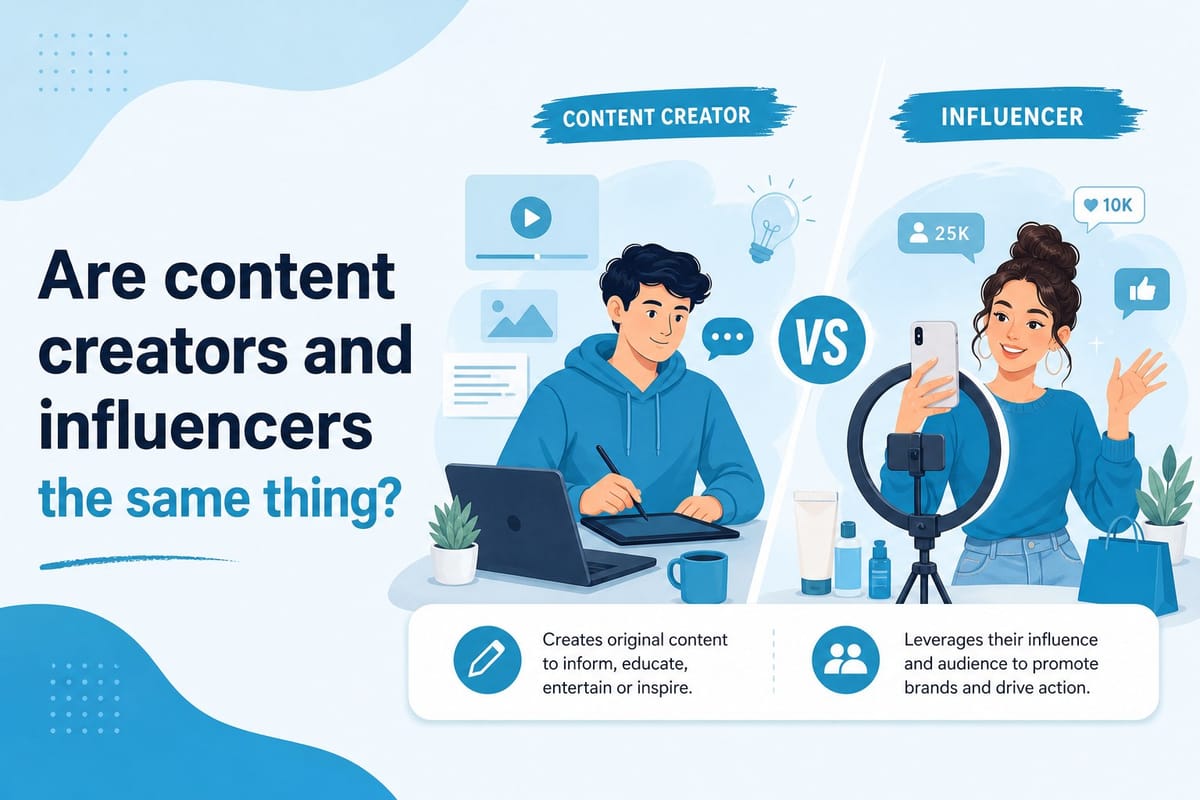
Table of contents
1. What makes a content creator different from an influencer
2. How the two roles overlap and where they split in practice
3. Why the difference matters for your strategy and income
I get asked this question a lot, and honestly, the confusion makes sense. The terms "content creator" and "influencer" show up together so often that most people treat them as the same label. But are content creators and influencers the same thing? The short answer is no, and understanding the difference can change how you build your brand, grow your audience, and make money from your work. Whether you run a faceless YouTube channel, post Reels, or manage a small media team, knowing which category you fall into helps you set the right goals and pick the right tools. This post breaks down exactly what separates the two roles, where they overlap, and why the distinction matters for your strategy and income.
What makes a content creator different from an influencer
Let's start with the definitions, because getting these right changes everything downstream.
A content creator is anyone who produces content for a digital platform. That includes YouTube videos, blog posts, podcasts, TikToks, Instagram Reels, animations, newsletters, and more. The word "creator" is about the act of making something. You can be a content creator with zero followers and still fit the label perfectly. The output is what defines you.
An influencer, on the other hand, is someone who has already built a large enough audience that their opinions, recommendations, and actions shape what other people think, buy, or do. The word "influencer" is about impact on an audience. You need a real, engaged following to hold that title. Without that audience relationship, the label does not apply.
Here is the clearest way to put it: all influencers are content creators, but not all content creators are influencers.
Think of it like this. A filmmaker who posts short documentaries on YouTube is a content creator. If that filmmaker has 2 million loyal subscribers who buy every book they recommend, they are also an influencer. But a new channel posting well-researched explainer videos with 400 subscribers is still a content creator — just not yet an influencer. The distinction has nothing to do with quality or effort. It has everything to do with audience size, trust, and demonstrated impact on behavior.
The distinction matters in practical, day-to-day ways.
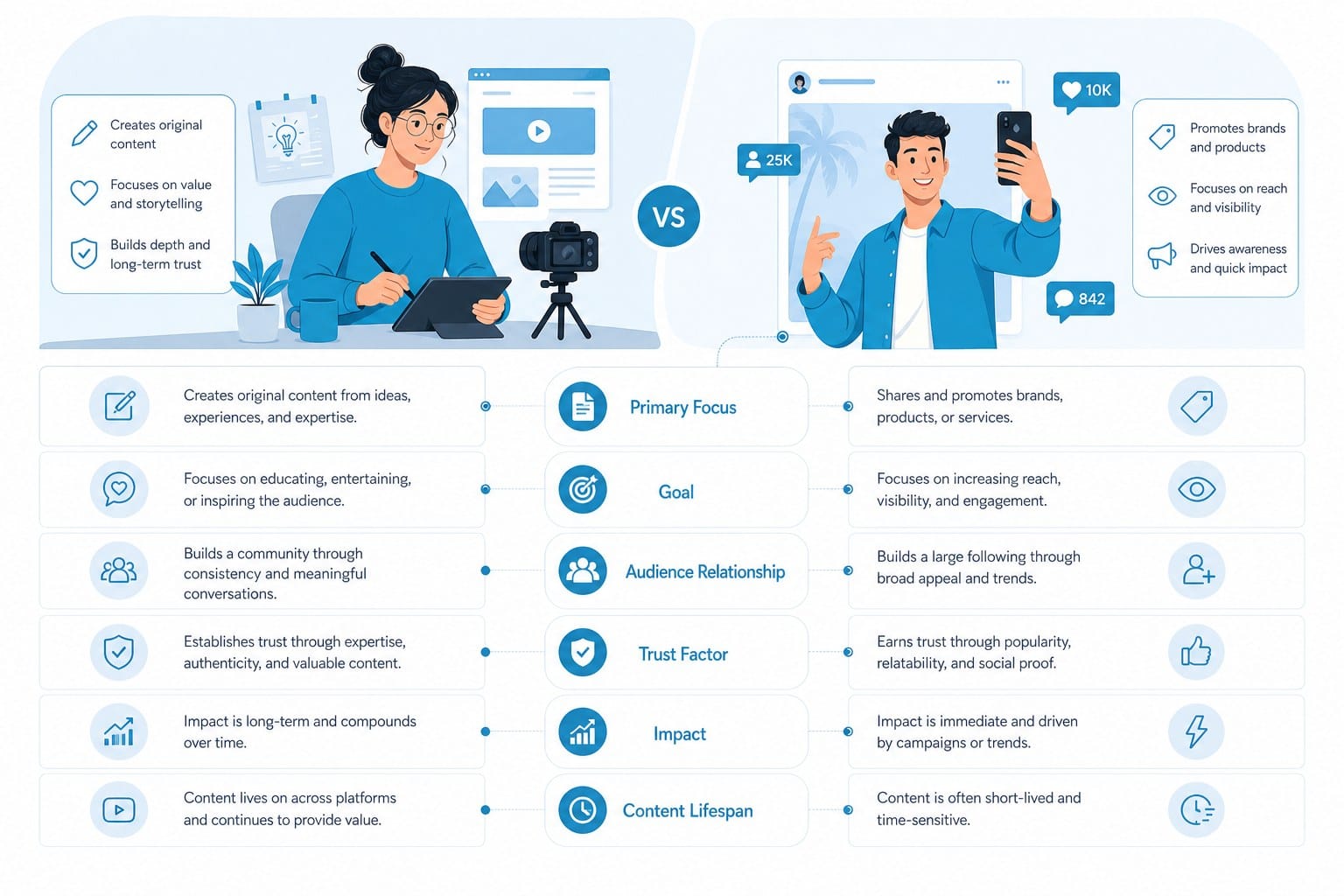
Content creators are usually judged on the quality of what they make. Good editing, strong scripting, accurate research, and consistent publishing schedules matter most. The output is the product. Brands and platforms look at what the creator produces and how well it holds an audience's attention over time.
Influencers are judged on their reach, engagement rate, and perceived authority within their niche. Brands pay influencers to push products because followers trust their recommendations in a personal, almost friend-like way. The personality and the relationship with the audience is the product. If an influencer recommends a skincare product, their audience buys it because they trust that specific person, not because the video was beautifully edited.
That does not mean one path is better than the other. They are just different roles with different skill sets and different monetization paths. The mistake most new creators make is assuming they need to become an influencer to make money, when in reality, a well-run content creation business can generate strong income without any personal brand at all.
Some people build a content creation business quietly. They produce faceless YouTube videos, anonymous explainer channels, or documentary-style content where the creator's face and personality never appear on screen. That person can grow a profitable channel with hundreds of thousands of views and still not be an influencer in the traditional sense. Their audience is not following a person. They are following the content. The videos earn ad revenue, attract licensing deals, and drive affiliate commissions based entirely on the quality and discoverability of what gets published.
Other people build a personal brand so strong that their name alone sells out product drops and fills webinar seats. That is the influencer model. The content they post is often secondary to the emotional connection their audience feels with them as a person. The video quality can be mediocre as long as the personality shines through and the trust stays intact.
Knowing which path you are on shapes every decision you make — from the format you choose to the way you approach brand partnerships, from how you title your videos to what metrics you track week over week.
There is also a hybrid reality that most experienced creators land in eventually. Someone starts out as a pure content creator, posting consistently, focusing on quality and topic research. Over time, their audience grows. People start to recognize the voice, the editing style, the perspective. Without deliberately trying to become a personality, that creator starts to carry some influencer weight. Brands notice. The audience begins to trust not just the content but the person behind it. That transition is gradual and organic, and it happens without a formal decision most of the time.
The reverse happens too. Some influencers who built their following through personality and engagement eventually invest in the craft side. They hire editors, bring in scriptwriters, and produce videos that could stand on their own even without the personal brand behind them. When that happens, they are operating as both an influencer and a content creator simultaneously.
Understanding where you are starting from — content or connection — gives you a real foundation to build on instead of chasing two targets at once and hitting neither.
The platforms themselves reinforce this split in subtle but important ways. YouTube has historically rewarded content: watch time, click-through rate, search relevance, and consistent upload schedules. The algorithm does not particularly care whether you are a personal brand or an anonymous channel. Good content that keeps people watching gets pushed to more viewers. That is a content creator's game, and it rewards craft.
Instagram and TikTok have historically rewarded personality: comments, shares, saves, and the sense of community that forms around a specific person. They lean toward the influencer model. The platforms push accounts that make people want to come back for the relationship, not just for the information in any single post.
But those lines have blurred significantly. YouTube Shorts now push trend-based, personality-driven content. TikTok rewards detailed educational explainers. The platforms have moved toward each other, which means creators and influencers are increasingly operating on the same turf, using the same tools, competing for the same attention. That makes the internal clarity about which role you are building toward even more important, because the platform will not do that sorting for you.
How the two roles overlap and where they split in practice
Now that the definitions are clear, it is worth looking at where the lines blur in real creative careers — because they do blur, constantly and in both directions.
Many creators become influencers over time without planning for it. Someone starts a cooking channel with no intention of becoming a personality. They post consistently, the content is useful and well-shot, and after two years they have half a million followers who trust their taste in kitchen equipment, cookbooks, and cooking techniques. Brands start reaching out. That person is now functioning as both a content creator and an influencer, whether they planned for it or not.
The same thing happens in reverse. Some influencers built their following through raw social media personality and relentless engagement rather than polished content. Over time, audience expectations rise. They hire video editors, bring in scriptwriters, and invest in equipment. Their production quality improves significantly. Now they are investing in the craft side of content creation even though they started purely as influencers.
So the two roles feed each other and can evolve into each other. But the core motivation and the core measure of success stay different even when they overlap.
For a content creator, success looks like this: the video is well-researched, clearly structured, visually compelling, and earns strong watch time. Comments say things like "this was so helpful" or "I learned something I did not expect to learn." The video continues to get views from search six months after it was published. Ad revenue comes in steadily without any additional effort. That is a content asset doing its job.
For an influencer, success looks like this: the post drives measurable sales, builds buzz around a brand or product, gets reshared widely, or shapes an ongoing conversation in a niche community. Comments say things like "I bought this because of you" or "you changed my mind about this." The sponsored post delivers the click-through rate the brand was looking for. That is an influence-based business delivering on its promise.
Those are genuinely different outcomes, and they require genuinely different content strategies to achieve them.
One area where the split becomes especially clear is in how each role handles production quality. Audiences in 2024 and beyond have more content available than they could ever consume. The barrier for keeping someone's attention is higher than it has ever been. If a video looks rough, sounds bad, or feels unorganized, viewers leave. They do not wait to see if it gets better two minutes in. They scroll to the next option.
This creates a production challenge that affects creators and influencers differently.
For influencers, there is a margin for imperfection because the audience is there for the person. A slightly shaky camera or an unpolished edit does not break the trust that already exists. The authenticity can even reinforce the relationship in some niches. Audiences sometimes prefer knowing their favorite creator is a real person operating without a film crew.
For content creators, especially those running faceless channels or producing educational and documentary-style content, production quality is directly tied to credibility. If the motion graphics look amateurish or the script feels rushed, the viewer has no personal relationship to fall back on. They just see a low-quality video and move on. The content has to carry the full weight of the viewer's attention, with no personality buffer.
This is exactly why so many content creators have started using AI-powered production tools to close the gap between what audiences expect and what a solo creator or small team can realistically produce on their own. When you can take a topic or a rough script and get a fully structured, edited, motion-graphic-ready video back without spending days in post-production, you can focus on what actually matters: the idea, the research, the accuracy, and the consistency of your publishing schedule.
You can see what that kind of workflow looks like in practice in this guide on how to create and publish polished video content with AI tools. The difference in output volume and quality when production bottlenecks get removed is significant, especially for creators who are working without a full team behind them.
Whether you are building toward influencer-level reach or focusing purely on content quality and monetization through ads and licensing, the production challenge is real. You need more output than most people can reasonably produce alone, at a quality level that keeps modern audiences engaged. The tools that address that challenge matter regardless of which side of the creator-influencer divide you are on.
Another practical split worth discussing is how the two roles approach collaboration.
Content creators tend to collaborate around topics and audiences. If two educational YouTube channels cover adjacent subjects, they might collaborate on a video that introduces each creator's audience to relevant content they were not already watching. The collaboration is additive. It brings new viewers to both channels based on shared interest in a topic.
Influencers tend to collaborate around audience overlap and mutual clout. Two influencers in the same niche collaborate because each one's audience already trusts them, and a cosign from one feels like a personal recommendation to the other's community. The collaboration works because of the personal relationships involved, not just because the topics align.
This affects how you should approach outreach, partnership opportunities, and even how you think about your content calendar. A content creator plans their schedule around topics, search trends, and publishing consistency. An influencer plans their schedule around their community's mood, current trends, and their own personal bandwidth for maintaining the relationship with their audience.
Both require discipline and planning. But the inputs that drive those plans are different, and mixing them up leads to a schedule that serves neither goal well.
Why the difference matters for your strategy and income
Understanding whether you are building as a content creator or an influencer changes how you monetize, how you grow, and what you should invest your time and money in. These are not abstract distinctions. They show up in your monthly revenue, your content calendar, and the decisions you make about tools and production.
Monetization paths work differently depending on which model you are building.
Content creators typically earn money through platform ad revenue, licensing their videos to other media companies, selling courses or digital products tied to the content they produce, and affiliate marketing where the content itself drives the recommendation rather than personal trust. A faceless educational channel on YouTube can earn significant ad revenue purely from consistent, high-quality uploads on topics that get search traffic. The creator behind the channel stays completely anonymous. The content does the work, earns the money, and builds the asset. That channel can be sold, scaled, or handed off to a team without disrupting the revenue because the value lives in the content library and the channel's search authority, not in a person.
Influencers typically earn money through sponsored posts, long-term brand partnerships, affiliate deals where their personal recommendation is the driver of conversion, and product lines built directly on their personal brand. An influencer's income is tied to how much trust and reach they have with their specific audience at any given time. If their reputation takes a hit — from a controversy, a long absence, or a shift in platform algorithms — their income usually drops alongside it because the income is tied to them personally, not to a content asset.
Neither path is inherently more stable or more lucrative than the other. But they require fundamentally different strategies, and mixing them up without clarity creates real problems.
Growth strategies look different depending on which model you are pursuing.
If you are focused on content creation, your growth strategy centers on consistency, discoverability, and quality. You publish on a regular schedule. You optimize your titles, thumbnails, and descriptions for search. You pick topics with demonstrated demand. You make sure each video is better than the last in some measurable way. Audience growth comes from the content finding people who are already looking for it. The algorithm does the distribution work when the content is good enough and consistent enough to earn that distribution.
If you are focused on influence, your growth strategy centers on community, collaboration, and consistent personality. You engage with your comments section in a way that makes individual followers feel seen. You collaborate with other influencers in your space to borrow and trade audience trust. You post consistently enough that your audience feels a real ongoing relationship with you rather than just a subscription to a channel. Audience growth comes from people finding you personally compelling and wanting to stay connected to you over time.
For anyone building a faceless YouTube channel, producing documentary-style content, or managing video output for a small team, the content creation path fits better by default. You are building a media asset, not a personal brand. The channel is the brand. The videos carry the value. The growth strategy should reflect that.
This also changes how you think about using AI tools in your workflow.
If you are a content creator, AI video tools address a very specific problem: production capacity. You have ideas. You know what your audience searches for. You know what topics get traffic and what formats hold attention. The bottleneck is production — the time it takes to go from a topic idea to a finished, polished, platform-ready video. When an AI tool can handle research aggregation, script structure, footage sourcing, motion graphic generation, and editorial assembly, you get that time back. You can go from an idea to a published video in a fraction of the time it would take to do each step manually. That means more videos per week, more topics covered, more search queries answered, and more ad revenue accumulated over time.
If you are an influencer, AI tools serve a different purpose. They handle the production craft so you can stay focused on what your audience actually wants from you: your personality, your perspective, and your presence. You use AI to handle the editing and motion graphics while you put your energy into the parts of the content that no tool can replicate — the story behind the product you are reviewing, the genuine reaction to something that happened in your life, the community question you want to answer on camera. The tools handle the craft. You handle the connection.
Either way, production volume and consistency matter more than most new creators expect. The channels and accounts that publish consistently outperform the ones that post occasionally, regardless of how good the occasional posts are. Platforms reward consistency in their algorithms. Audiences form habits around creators who show up reliably. A creator who posts twice a week every week will almost always build more momentum than a creator who posts an exceptional video once a month.
The geographic and language dimension of content creation is also worth addressing directly, because it is increasingly relevant for creators who are not building in English.
Content creators around the world are building channels in their own languages for audiences that major English-language creators never reach. Regional-language educational channels, local news explainers, niche hobby content in non-English markets — all of these represent real, growing, underserved audiences. If you are building a channel in a regional language and wondering whether AI video tools can support that workflow, the answer is increasingly yes. Practical examples of this are already playing out for creators working in Urdu and Nepali specifically. The guide on AI video generator in Urdu: a practical guide and the overview of AI video generator for Nepali content creators show how these tools are being applied in practice for non-English markets, which is a significant development for creators who have historically had fewer production resources available to them.
The business model you choose also shapes the specific content you should be making — and this is the part most new creators do not think through clearly enough at the beginning.
If your goal is ad revenue and search-driven traffic, you want longer videos on topics that people actively search for. Educational content, listicles, documentary-style topic breakdowns, and how-to guides perform well under this model because they generate ongoing search traffic long after the publish date. A video on a timeless topic can earn ad revenue for years. You want high watch time, strong click-through rates on search results, and viewers who return to your channel because the content is reliably useful.
If your goal is brand partnerships and sponsored content income, you want content that showcases your taste, your personality, and your audience's active engagement with your recommendations. Short-form content with high comment and share rates works well here because brands look at engagement ratios, not just raw view counts. You want brands to see a community that listens to you and acts on what you say.
If your goal is selling your own products or courses, you want content that demonstrates your expertise over time and builds trust with a specific audience around a specific problem you help solve. Both long-form educational content and short, punchy clips can work here depending on your niche, but the through-line is authority and demonstrated knowledge rather than broad reach.
None of these paths require you to be an influencer in the traditional sense. You can build a profitable media business as a pure content creator with no personal brand involved. But you need to be clear about which model you are building toward, because the content format, the publishing frequency, the SEO strategy, and the tools you invest in all follow from that decision. Making that decision late — or not making it at all — leaves you optimizing for the wrong thing.
The creators who struggle most are usually the ones trying to be both things at once without a coherent plan. They want influencer-level brand recognition and content creator-level passive ad revenue simultaneously, but they post inconsistently, their production quality varies wildly, and their audience never develops a clear expectation of what the channel is for. Picking a primary lane, especially early on, makes every subsequent decision easier and faster.
So let's come back to the original question: are content creators and influencers the same thing? No. They share overlapping skills and some overlapping goals. Many successful people in this space do both to some degree. But the core focus is different. Creators build through content. Influencers build through connection. Knowing which one you are leading with — and building your strategy around that clarity — is what separates channels that grow with purpose from channels that drift without direction.
If you are at the content creation end of the spectrum, especially if you are running a faceless channel, scaling video output across multiple topics, or producing without a full production team behind you, the single biggest bottleneck is almost always production capacity. You have the ideas. You know what your audience wants. You just cannot produce enough videos fast enough at the quality level your audience expects. That gap — between what you can conceive and what you can actually publish — is the specific problem AI video production tools are designed to close. You keep the creative direction. The tools remove the production ceiling.
Ready to take the next step?
If you are building a content creation business and production speed is the thing slowing you down, Cliptude is worth a serious look. It handles research, scripting, footage sourcing, motion graphics, and editing so you can focus on publishing consistently and building the kind of channel that compounds over time. Visit cliptude.com to see how it works and start producing the video content your audience is already searching for.