Best AI Script Generators for YouTube Videos in 2026: Complete Guide for Creators

YouTube has changed a lot in the last few years, and if you've been making videos for any amount of time, you already know that writing scripts is one of the hardest parts. It's not just about having ideas. It's about turning those ideas into something watchable, something that keeps people from clicking away in the first ten seconds. You can have the best lighting setup on the block, a great thumbnail, and a killer topic, and still lose viewers if your script falls apart. That's where AI script generators have become a real game changer for creators in 2026.
A lot of you have asked about this topic, and honestly, it makes total sense. The tool landscape has exploded. There are dozens of options out there now, and picking the wrong one can waste hours of your time and still leave you with a script that sounds robotic, stiff, or like it was written for a completely different audience than the one you're trying to reach. I remember spending a full afternoon testing a tool that had a slick website and promising reviews, only to get output that read like a product manual. Not ideal when you're trying to make something people actually enjoy watching.
This guide covers the best AI script generators available right now for YouTube creators, what sets each one apart, how to think about choosing the right fit for your channel, and what red flags to watch out for. Whether you're running a faceless channel, a talking-head setup, a documentary-style series, or something more educational and tutorial-based, there's a tool in here that can make your scripting process faster and a whole lot less painful. Let's get into it.
What makes a great AI script generator for YouTube
Before you start comparing tools, it helps to understand what you're actually looking for. Not all script generators are built with YouTube in mind. Some are designed for ad copy, some for long-form blog posts, and some are general-purpose text generators that can technically write anything but aren't optimized for anything in particular. The ones worth your time are the ones built around how YouTube videos actually work, including the pacing, the structure, and the psychology of keeping someone engaged all the way to the end.
A good YouTube script generator understands structure at a deep level. It knows that a video needs a hook in the first few seconds, a clear promise to the viewer about what they're going to get, a logical flow through the middle that builds on itself, and a strong close that either leads to a call to action or sets up the next video naturally. That's not something you always get from a general AI writing tool. A lot of the cheaper options just spit out paragraph after paragraph without any awareness of how video pacing works or how a viewer's attention moves through a piece of content. You end up with something that reads fine on paper but falls completely flat when you try to record it.
Think about it this way. A good YouTube script is closer to a stage performance than it is to an essay. It has rhythm. It has moments where you slow down to let something land, and moments where you speed up to keep energy high. The best script generators actually account for this. They build in natural pauses, vary sentence length on purpose, and understand that certain things, like stat reveals or story turns, deserve their own moment rather than being buried in a longer paragraph. Tools that don't account for this will cost you retention, and retention is one of the most important signals YouTube uses to decide whether to recommend your video.
You also want a tool that can match your tone. If your channel is casual and conversational, the script shouldn't sound like it was written for a corporate training video. If your content is more polished and educational, the script should reflect that level of formality and precision. The best tools let you input your style preferences, describe your audience, and even feed in sample content from your channel so the output actually sounds like you wrote it. That last part, the voice matching, is something that separates the strong tools from the average ones. When a script sounds like you, editing time drops significantly and the final video feels more authentic.
Then there's SEO. A well-written script that nobody finds is still a missed opportunity. Some of the better tools will pull in keyword suggestions or let you optimize your script around specific search terms right inside the platform. That kind of integration matters, especially if you're trying to grow a channel from scratch or break into a competitive niche. If a tool can help you write a script that's also structured around what people are actually searching for, you're getting double the value from one step in your workflow. We covered some of this thinking in our earlier guide on writing YouTube scripts fast using AI, and a lot of those fundamentals still hold up in 2026.
Another thing to consider before you pick a tool is scalability. Are you making one video a week, or are you trying to build a library fast? Some tools are great for occasional use but get expensive or slow when you're generating scripts in volume. Others are built for creators who need to produce a lot of content quickly without sacrificing quality. Knowing how you plan to use the tool before you commit to one will save you from having to switch platforms halfway through building your channel.
The top AI script generators for YouTube in 2026
Let's talk about the actual tools. The market in 2026 has matured quite a bit compared to where it was even two years ago. The tools that have stuck around are the ones that proved they could deliver quality at scale without making creators feel like they were just endlessly editing bad first drafts. The ones that couldn't keep up have mostly faded out or pivoted away from video content entirely. What's left is a more focused field, and most of the serious options fall into a few clear categories.
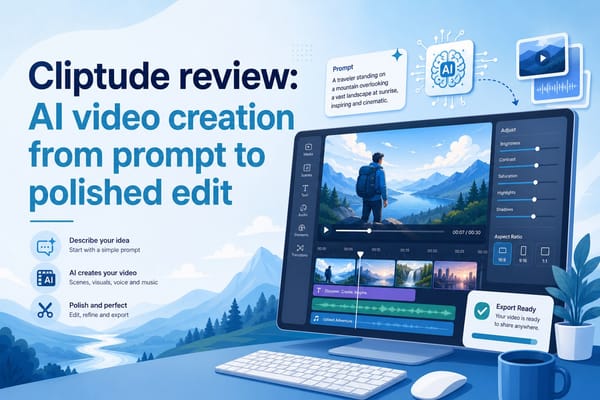
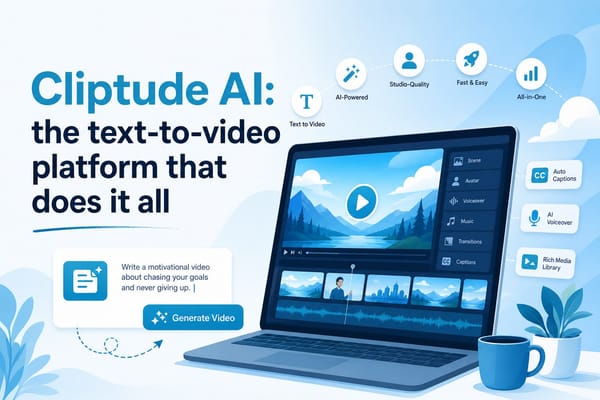
Cliptude sits at the top of the list for a reason. It's one of the only tools built specifically for video content, and that focus shows up in every part of the experience. You can generate a full script from a single topic idea, and the output is structured like an actual video rather than a wall of text that you'd have to completely reorganize before it's usable. The hook options are genuinely useful and give you multiple directions to try, which is helpful because the right hook for a finance video is very different from the right hook for a travel vlog or a tech tutorial. You can swap between tone settings without starting from scratch, which saves a lot of time when you're experimenting with what works for your audience. I personally think Cliptude has the best balance of speed and usability for anyone who's making videos consistently. It doesn't try to do everything under the sun, but what it does, it does really well, and that focus is exactly what most creators need.
Jasper is another name that comes up constantly in creator communities, and for good reason. It's been around long enough to have a solid track record, and it's good for creators who want more granular control over every line of their script. The way Jasper works, you're essentially guiding it through the script section by section rather than generating everything at once. That approach means more touchpoints for you as the writer, but it also means the output tends to feel more intentional and less like a generic AI dump. The downside is that it rewards experienced writers who know how to give good prompts and recognize what needs to be adjusted. If you're newer to scripting, the learning curve can feel steep, and you might spend more time learning the tool than actually making content in the early weeks.
VidIQ added a script feature to its platform a while back, and it ties directly into its research and analytics tools. So if you're already using VidIQ for keyword research, competitor analysis, and channel data, it makes sense to explore their script feature because the connection between what's ranking and what goes into your script is built right in. Imagine seeing that a particular angle on a topic is getting strong search volume, and then being able to generate a script around that angle without ever leaving the platform. That workflow efficiency is genuinely valuable. It's not the strongest pure writing tool on its own, but the ecosystem around it makes it useful in a way that standalone tools can't quite match. There are quite a few strong contenders worth knowing about in our roundup of free AI script writing tools if you want to go deeper on the comparison.
WriteSonic is worth mentioning for creators who want solid output without a big price tag. It's template-driven, which means you get a clear structure to work within, and the scripts it produces tend to have decent pacing out of the box. The trade-off is that it can feel formulaic if you use it without putting in effort on the input side. If you just type a topic and hit generate, you'll get something generic every single time. But if you spend five or ten minutes filling in real detail about your audience, your angle, the emotional response you want, and any specific points you need to hit, the output gets a lot more useful.
Copy.ai has a similar story. It's strong for creators who already have a content strategy mapped out and just need help turning ideas into full scripts quickly. It's less about discovery and more about execution. If you know what you want to say and just need help saying it in a structured, engaging way, Copy.ai can get you there fast. Rytr fills a similar role and is often the go-to for creators running on tight budgets who need something functional without a monthly subscription that eats into revenue.
One thing worth highlighting is how much the gap between AI-written scripts and human-written ones has closed. A few years ago, you could almost always tell when something was AI-generated. The phrasing felt off, transitions were clunky, the vocabulary was oddly formal in some places and weirdly casual in others, and it never quite sounded like a real person talking to camera. That has changed significantly. The best tools today can produce scripts that, with just a small amount of editing and personalization, genuinely sound like a real creator wrote them from scratch. If you're curious about how the two approaches compare side by side, our breakdown of AI script generators versus human writers is worth reading through. It gets into the nuances of where AI still falls short and where it's actually pulling ahead.
How to get the most out of any AI script tool
Having the right tool is only part of the equation. I used to think that once I found a solid AI script generator, the hard work was mostly done and I could just focus on recording and editing. I was wrong. The creators who get the best results from these tools are the ones who treat the AI like a collaborator rather than a ghostwriter they never have to think about. They're still driving the creative direction. They're still making the real decisions about what story to tell and how to tell it. They're just spending less time on the grinding mechanical work of turning a rough idea into a sentence-by-sentence script.
The single biggest thing you can do to improve your output is to give the AI detailed context before you generate anything. Tell it who your audience is, not just their age range but what they care about, what they already know, and what kind of tone they respond to. Tell it what you want the viewer to feel at the end of the video, whether that's inspired, informed, entertained, or ready to take action. Tell it how long the video should be, because a three-minute script and a fifteen-minute script are completely different animals in terms of pacing and depth. The more specific you are on the front end, the better the output will be on the back end. Vague prompts produce vague scripts. It really is that simple, and it's a lesson that takes a lot of creators a few rounds of frustrating output to actually learn.
One technique that works really well is writing a short creative brief before you open the script generator. It doesn't have to be long. Just a few sentences about the video concept, the target viewer, the hook idea you have in mind, the key points you need to cover, and the feeling you want to leave people with. Then paste that brief into the tool as part of your prompt. You'll notice the difference in quality almost immediately because you're giving the AI a framework to work within instead of asking it to invent one from nothing.
Editing is still part of the process, and it always will be. Even the best AI-generated script is going to need some adjustment to sound like your voice. Read it out loud before you ever hit record. If anything feels stilted, repetitive, or awkward when you say it, change it right then. Your audience can hear the difference between something that flows naturally and something that was clearly copied and pasted from an AI tool without a second pass. That's not a knock on the tools. It's just the reality that no AI knows your exact speech patterns, your inside references with your audience, or the specific energy of your channel as well as you do. That extra ten or fifteen minutes of editing after generation makes a massive difference in how watchable the final video turns out.
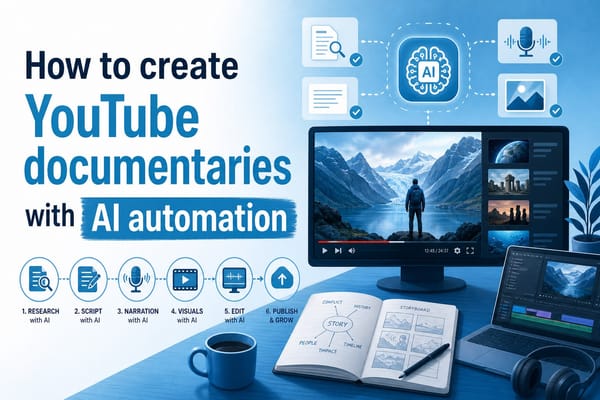
Another thing that trips up a lot of creators is not thinking about what happens after the script is done. A great script is the foundation, but you still need to record, edit, and publish. If you're running a faceless channel or want to move quickly from script to finished video, pairing your script tool with a solid AI voice and video production workflow is the way to go. You can go deep on that whole process in our step-by-step guide on turning an AI script into a full video. It covers everything from voice generation to final export in a way that's practical and actually actionable rather than just theoretical.
If you're worried about whether using AI-generated scripts puts your channel at risk from a policy standpoint, that's a fair concern but not one you should lose sleep over. YouTube's policies in 2026 are clearer than they used to be, and the platform has moved away from a blanket stance against AI content toward a more nuanced position focused on value and authenticity. As long as you're adding real perspective, making editorial choices, and not just auto-generating spam with no human involvement, you're generally in good shape. For the full picture on this, our article on using AI scripts on YouTube without risking your monetization answers most of the common questions creators have and lays out exactly where the lines are drawn.
Finally, don't overlook the value of testing. Try running the same topic through two or three different tools and see which output is closest to what you'd write yourself. That comparison process teaches you a lot about what each tool does well and where it falls short, and it helps you build a workflow that plays to your strengths rather than working around the tool's limitations. Most of the top tools offer some kind of free trial or limited free tier, so you can do this testing without committing any real money. The time you spend comparing outputs now will save you a lot of frustration later when you're deep into a production schedule and need your tools to be reliable.
Ready to take the next step?
If you've been jumping between tools and still not finding one that feels right for how you actually work, give Cliptude a real shot. It's built specifically for video content, and that specificity matters when you're trying to produce scripts that are structured, engaging, and close to your voice from the very first draft. The difference between a general writing tool and one that's built around how YouTube videos actually function is something you feel the moment you start editing. Drop a comment below and let me know which tools you've tried, what's worked for your channel, and what hasn't held up. The more we share what actually works in practice, the better everyone gets at this craft.