Can you monetize AI-generated videos on YouTube

Table of contents
1. What YouTube actually says about AI-generated content
2. How to build a monetizable AI video channel the right way
3. Common mistakes that get AI video channels demonetized or rejected
If you have been experimenting with AI video tools, you have probably asked yourself whether you can actually monetize AI-generated videos on YouTube. The short answer is yes, but there are real rules you need to follow, and ignoring them can get your channel demonetized or even removed. This guide walks you through exactly what YouTube requires, what trips creators up most often, and how to build a channel that earns sustainably using AI-generated content. None of this is guesswork — it comes from reading YouTube's actual policies and watching how real channels succeed and fail.
What YouTube actually says about AI-generated content
YouTube does not ban AI-generated videos from its monetization program. What it does require is that your content meets the same standards as any other video on the platform. That means original value, clear ownership, and no policy violations. Let's break down the parts that matter most.
The disclosure requirement is real and non-negotiable
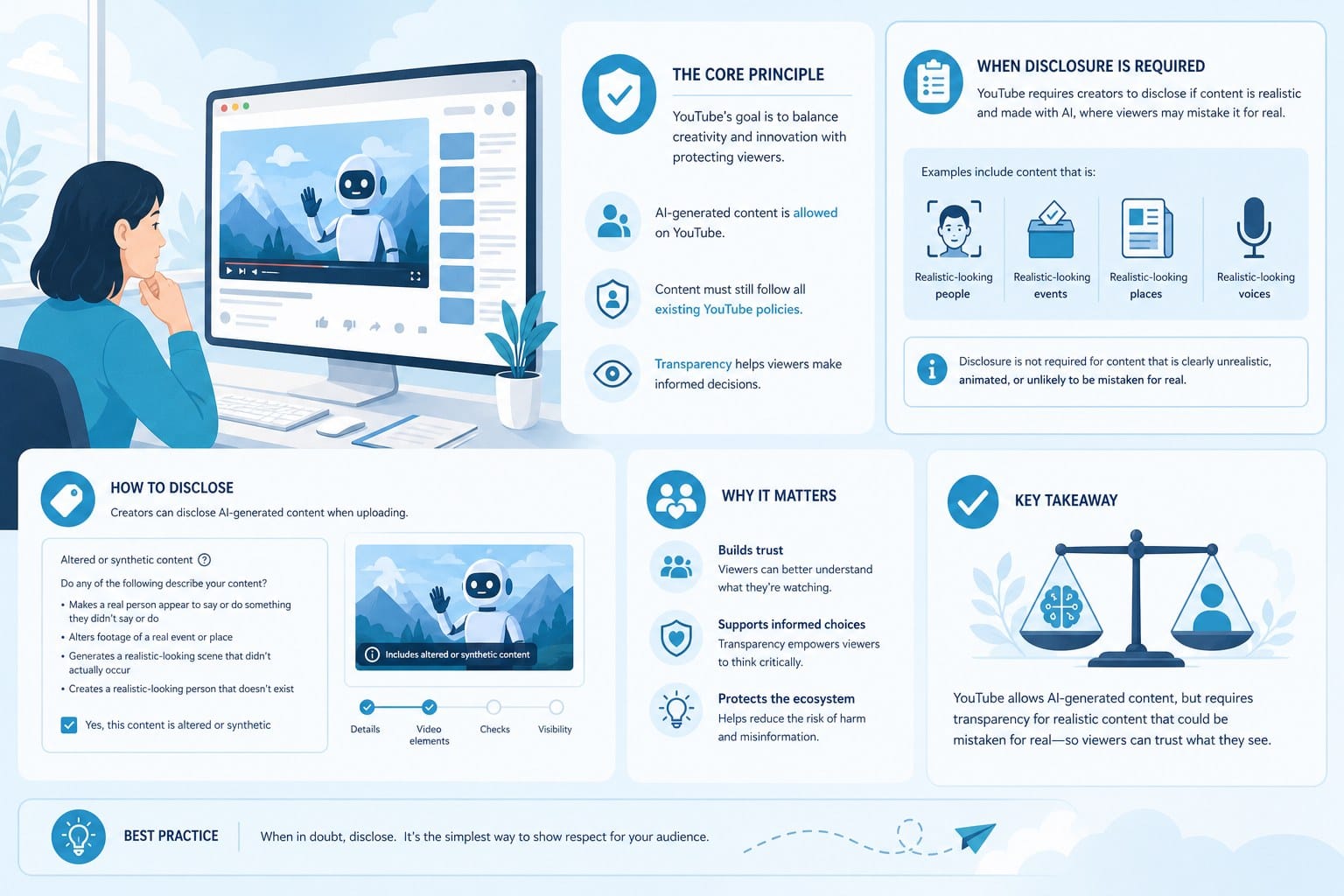
YouTube updated its policies in 2023 and 2024 to specifically address synthetic and AI-generated media. Creators are now required to disclose when realistic AI-generated content could be mistaken for real footage or real people. If your video includes a realistic AI-generated voice of a public figure, a synthetic recreation of a news event, or deepfake-style visuals, you need to flag it using YouTube's disclosure tool inside YouTube Studio. Failing to do that can lead to content removal, not just a warning.
The disclosure requirement makes a lot of creators nervous. They worry it will scare viewers away or signal that the content is lower quality. That is not what actually happens. YouTube added the disclosure feature to build trust with viewers, not to penalize creators. Audiences increasingly expect transparency about synthetic content, and channels that are upfront about it tend to build more credibility over time, not less. Think of it the same way you would think about a news outlet disclosing that a photo is an illustration rather than a photograph. It is an honesty signal, not an admission of failure.
The YouTube Partner Program looks at effort and originality, not just tool choice
YouTube's monetization program, known as the YouTube Partner Program or YPP, evaluates whether a channel demonstrates original content and consistent creative effort. YouTube has been explicit that channels made entirely of mass-produced, repetitive, or low-effort content will not qualify for monetization. That standard applies whether the videos are made by humans or AI tools. A channel that pushes out hundreds of near-identical videos with no meaningful variation, no depth of research, and no real value to the viewer will get flagged regardless of how the videos were produced.
What this means practically is that the bar is content quality, not production method. A fully AI-generated documentary that provides real research, accurate information, strong narration, and engaging visuals can pass YouTube's review process and earn ad revenue. A three-minute AI slideshow with text-to-speech reading a Wikipedia article is a much harder case because it does not demonstrate effort or originality — it demonstrates automation for its own sake.
YouTube also uses automated systems to detect repetitive or templated content. If every video on your channel follows the exact same structure with the exact same pacing, visuals, and audio style, those systems may flag your channel as spam-like even before a human reviewer looks at it. Variety in format, topic depth, and presentation style helps you avoid that problem. That does not mean you need a completely different approach for every video. It means each video should have something genuinely distinct about it.
Copyright is where most AI video creators get blindsided
AI tools often pull from large datasets to generate video elements, music, or voiceovers. If the tool you are using does not have proper licensing for the footage, audio, or images it generates, you could end up with a copyright claim on your video before you earn a single cent from it. This is not theoretical. It happens regularly to creators who do not check the commercial rights status of the assets their AI tool produces.
The question to ask before committing to any AI video platform is straightforward: does the content this tool produces carry full commercial rights for use on a monetized YouTube channel? Some tools are built with that answer clearly documented. Others are vague about it, and vague is a problem when your revenue depends on clean ownership.
This is one reason the tool you choose matters enormously. Platforms like Cliptude are designed specifically for creators who want to publish commercially. The platform researches, scripts, sources footage, and edits videos from a prompt, and it is built around giving creators clean, usable output rather than content that creates legal headaches later. That distinction — between tools built for commercial publishing and tools built for experimentation — is worth paying close attention to before you invest time building a channel around any particular platform.
AI-assisted versus fully AI-generated: YouTube does not punish either by default
Some creators assume that disclosing AI involvement will trigger automatic penalties or reduced distribution. YouTube's current policies do not support that assumption. The platform does not currently penalize AI-assisted or fully AI-generated content by default. What it penalizes is low effort, inaccuracy, repetition, and policy violations. Those standards are applied consistently regardless of production method.
That said, YouTube's policies in this space are still evolving. The safest approach is to stay current with YouTube's Creator Blog and Help Center rather than relying on what was true six months ago. The core principles — originality, accuracy, transparency, and viewer value — are unlikely to change even as the specific rules around synthetic media continue to develop.
What counts as "original" when AI is doing a lot of the work?
This is a fair question and worth addressing directly. Originality in YouTube's context does not mean every pixel or word came from your head. It means the content provides something that is not simply copied or recycled from existing material. A human editor who assembles stock footage into a coherent narrative, adds voiceover, and builds a structure around a specific argument is producing original content even though none of the raw materials are unique to them. AI production works the same way when it is used thoughtfully.
The creative decisions you make — the topic selection, the angle, the structure, the depth of research you require, the accuracy check before publishing — are what make AI-produced content genuinely yours. Channels that treat AI as a research and production assistant while applying real judgment at every decision point are the ones that build libraries of content YouTube is happy to recommend and monetize.
How to build a monetizable AI video channel the right way
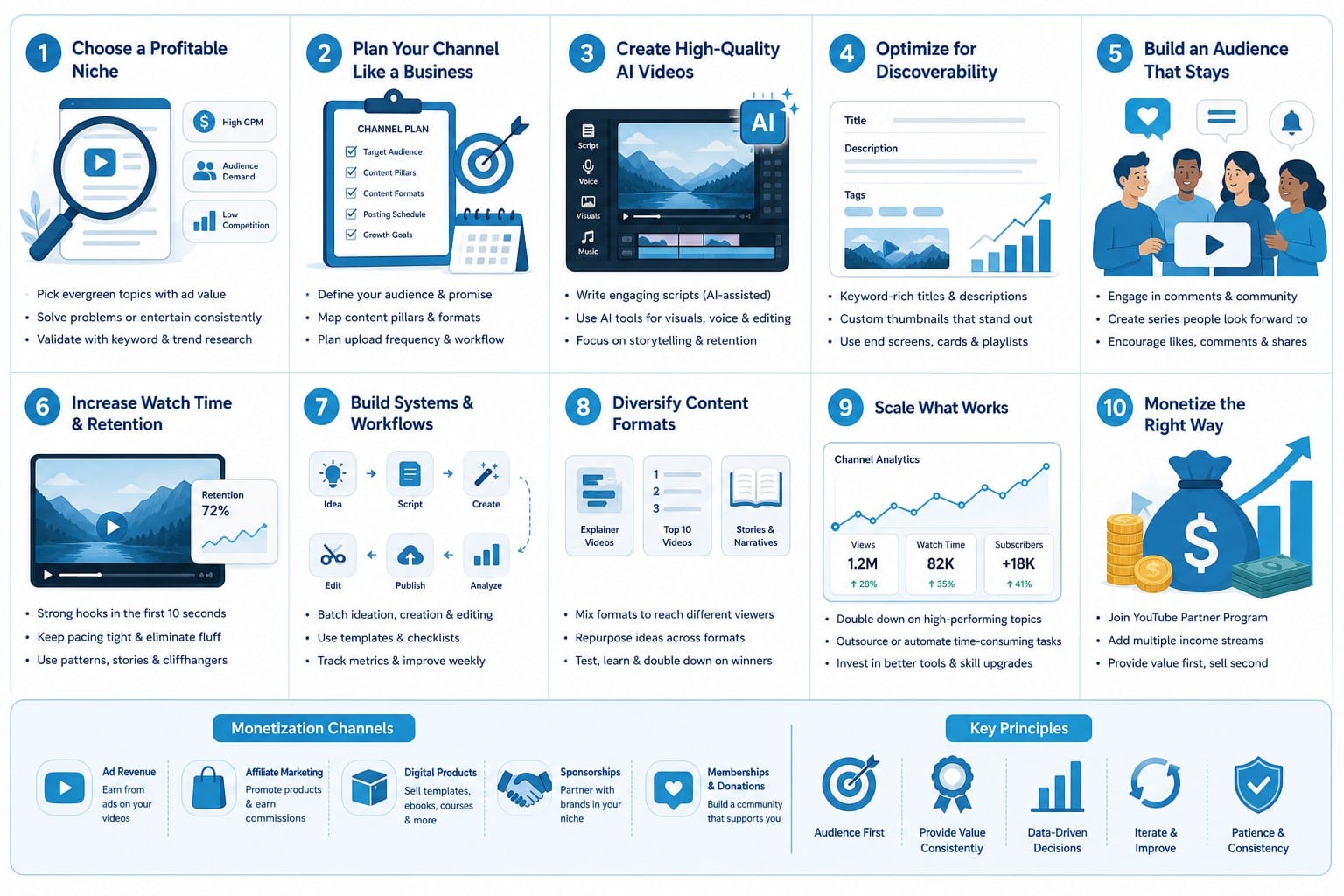
Understanding the rules is step one. Building a channel that actually earns requires a clear strategy from the beginning. Here is a realistic picture of what that looks like, from niche selection through to multiple revenue streams.
Start with niche selection backed by real data
Many creators skip the research phase and produce videos about whatever topic feels interesting in the moment. That approach rarely leads to consistent viewership, and consistent viewership is what monetization depends on. Before producing a single video, spend time identifying topics with genuine search demand.
Free tools like Google Trends and YouTube's search bar autocomplete show you what people are actively looking for. Typing a topic into YouTube's search bar and looking at the autocomplete suggestions tells you exactly how people phrase their searches, which is information you can use directly in your titles and descriptions. Free keyword planners can extend that research by showing you monthly search volumes and related terms.
Faceless channels in niches like history, science, personal finance, true crime, and educational explainers have consistently performed well because those topics carry deep, stable search interest. People search for content about historical events, scientific explanations, and financial concepts constantly, and that interest does not spike and crash the way trending topics do. Building around evergreen demand gives your older videos continued value instead of making them irrelevant after a few weeks.
Narrowing your niche further improves your chances of building a loyal audience. A channel about personal finance is competing with thousands of others. A channel about personal finance for recent college graduates in their first jobs has a clearer audience and less direct competition. Specificity helps YouTube understand who to recommend your videos to, and it helps viewers decide quickly whether your channel is relevant to them.
Choose formats that maximize watch time and ad revenue
YouTube's algorithm rewards watch time heavily. Longer videos with strong retention create more ad placements, which means higher revenue per view. They also signal to YouTube's recommendation system that your content is worth pushing to more viewers. For those reasons, long-form documentary and listicle videos are among the strongest formats for monetization.
Documentary-style videos work particularly well for faceless channels because they justify length naturally. A twelve-minute exploration of an overlooked historical event gives viewers a reason to stay because the story builds over time. The format also supports high watch time because viewers who are invested in a narrative tend not to click away mid-video.
If you are building a faceless channel and want to understand how to approach the documentary format specifically, the guide on how to start a faceless documentary YouTube channel with AI covers the core production steps and format decisions in detail.
Animated explainer videos are another strong format, especially in educational niches. Whiteboard and stickman styles have a long history on YouTube and perform well with audiences who want clear, visual explanations of complex or technical topics. If you are considering that route, it is worth reading about how to make stickman explainer videos with AI to understand what the production process looks like and what makes those videos effective over time.
Short-form content through YouTube Shorts can build subscriber count faster because Shorts are shown to non-subscribers more aggressively than long-form videos. Some creators use Shorts as a top-of-funnel strategy — producing short clips that introduce topics and direct viewers to longer videos on the same channel. This can accelerate the subscriber growth needed for YPP eligibility without requiring you to change your core content strategy.
Quality is the actual variable that determines monetization outcomes
YouTube's review team and its recommendation algorithm look at several dimensions of quality, and visuals are only one of them. The script needs to provide real information that is accurate and useful, not just plausible-sounding text. The pacing needs to hold attention rather than drag through padded sections. The audio needs to be clean and consistent because poor audio drives viewer drop-off faster than almost any other quality issue. Thumbnails and titles need to reflect what the video actually delivers, not just what sounds clickable.
When all of those elements are strong, it does not matter whether a human or an AI assembled the video. The viewer experience is what determines whether they stay, subscribe, and come back. And viewer behavior — watch time, return visits, subscriber actions — is what YouTube uses to decide whether to recommend your content.
One practical consideration when evaluating AI video platforms is whether they let you review and edit the script before the video is produced. Tools that go from prompt to finished video without a review step remove your ability to catch factual errors, adjust the angle, or improve the narrative flow. Platforms that give you a draft stage — where you can read the script, request changes, and approve before production — give you meaningful quality control without requiring you to do the production work yourself.
Build a publishing schedule you can actually maintain
Consistency in publishing matters because it trains YouTube's algorithm to recommend your channel more reliably and because it gives you more data to learn from. That does not mean you need to post every day. It means you need a schedule you can maintain without burning out or sacrificing quality to hit an arbitrary deadline.
AI production tools help here because they dramatically compress the time between concept and finished video. What used to take a small creative team days to produce can now be completed in hours with the right platform. That compression is one of the most practical advantages AI video tools offer for channel growth. It makes a weekly or twice-weekly schedule achievable for a solo creator who could not realistically produce at that pace using traditional methods.
Building toward YPP eligibility requires 1,000 subscribers and 4,000 watch hours in the past 12 months for the standard tier, or 500 subscribers and 3,000 watch hours for the lower tier that unlocks channel memberships and Super Thanks but not ads. Those numbers are reachable with consistent posting and decent content, but they take time. Creators who set unrealistic revenue expectations in the first three months tend to give up before the channel has had enough time to build momentum. The channels that earn are almost always the ones that treated the first six months as a learning and publishing phase rather than a revenue phase.
Layer in revenue streams from day one, not after you hit monetization
Ad revenue requires meeting YPP thresholds, but other income streams do not. Affiliate marketing does not require any minimum subscriber count. If your channel covers personal finance, linking to relevant tools, books, or services in your video descriptions can generate commission income from your very first video if the right viewer finds it.
Sponsorships become available once you have a small but engaged audience. Brands in niche markets often prefer smaller, highly targeted channels over massive general-interest channels because the audience match is better. A channel with two thousand engaged subscribers in a specific educational niche can attract sponsors that would ignore a channel with fifty thousand unengaged subscribers in a broad topic area.
Channel memberships unlock at the lower YPP tier. Digital product sales — courses, templates, guides, checklists — can be promoted through video descriptions and pinned comments even before you qualify for monetization. Thinking about multiple revenue streams from the beginning makes your channel less dependent on any single source and gives you real income to reinvest in the channel while you are building toward the ad revenue threshold.
Pricing structure for AI tools matters as your output scales
Some AI video platforms charge flat monthly fees regardless of how much you produce. That structure can be inefficient if your output varies month to month, as it often does for solo creators who are also managing other work. Usage-based pricing, where you pay for what you actually create, tends to work better for creators who are scaling up gradually. It lets you produce more in a productive month and spend less in a quieter one without locking you into a fixed cost you have to justify regardless of output. That flexibility matters when you are building something from scratch and managing costs carefully.
Common mistakes that get AI video channels demonetized or rejected
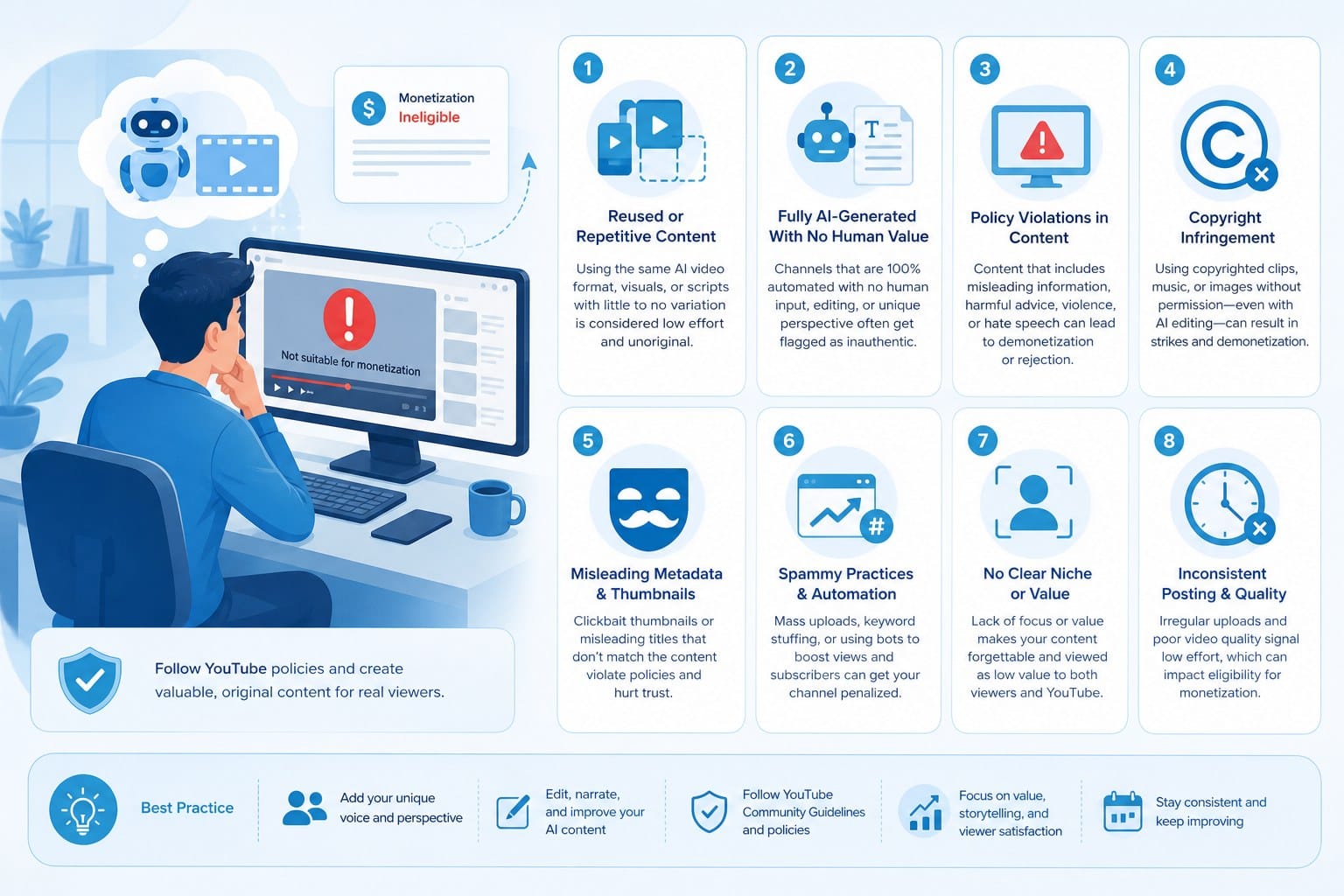
Even creators who understand the rules make mistakes that cost them monetization. Here are the most common ones, explained specifically enough that you can avoid them rather than learn them the hard way.
Repetitive and templated content is the fastest way to get flagged
The biggest mistake is what YouTube calls repetitive or reused content. This happens when a creator uses an AI tool to produce videos that are essentially the same structure with different keywords swapped in. Imagine a channel that makes videos titled "10 facts about lions," "10 facts about tigers," and "10 facts about bears" — all using the same script template, the same narration style, the same visual layout, and the same background music. YouTube's automated systems are good at detecting that pattern, and they will often deny YPP applications or remove monetization from channels that fall into it.
The fix is not complicated, but it requires real effort. Add genuine research to each video rather than relying entirely on what the AI generates from a brief prompt. Vary your structure — a listicle, then a narrative deep-dive, then a comparison format. Make sure each piece of content provides something the others do not. When every video on your channel feels like a distinct piece of work rather than a template with the variables changed, you are in a much stronger position for monetization review.
This is also where human judgment in the production process matters. AI tools can generate content efficiently, but they will repeat patterns if you let them. Reviewing your channel from the perspective of someone who has just watched three of your videos in a row is a useful exercise. If that imagined viewer would notice that everything sounds the same, your content is too templated.
Commercial licensing for AI-generated assets is not guaranteed — you have to verify it
The second major mistake is using AI tools that do not provide clear commercial licensing for their outputs. Some tools incorporate stock footage, music, or image libraries in ways that restrict commercial use. When you publish those videos on YouTube with monetization enabled, you are potentially violating both the tool's terms of service and the original rights holder's license.
Copyright claims can strip ad revenue from individual videos. In repeat cases, they can lead to channel strikes. Three strikes in a 90-day period results in channel termination. Before committing to any AI video platform, read the terms carefully or contact their support team directly to get a written confirmation that the content you produce carries full commercial rights for monetized publishing. If a platform cannot give you a clear answer to that question, that tells you something important.
AI-generated music creates specific copyright risks that catch creators off guard
AI-generated background music sounds like a safe choice compared to using commercial tracks. But not all AI music generators clear their outputs for commercial use. Some platforms generate music by training on existing licensed tracks, and the ownership situation is legally murky in ways that can still trigger Content ID matches.
If YouTube's Content ID system matches your background music to a registered track, you will get a copyright claim regardless of how the music was originally generated and regardless of whether you knew about it. That claim redirects the ad revenue from your video to the rights holder, sometimes for the entire duration the video has been live.
The safest approach is to use platforms that explicitly state their audio outputs are royalty-free for commercial use, and to look for that confirmation in writing rather than just in a marketing claim. Alternatively, build videos that do not depend on background music — strong narration over well-edited visuals can carry a video without any music at all, and it eliminates one of the most common sources of unexpected copyright issues.
Neglecting metadata leaves significant reach on the table
YouTube uses titles, descriptions, tags, and closed captions to understand what your video is about and decide who to show it to. Creators who let AI tools auto-generate all of their metadata without reviewing it often end up with descriptions that are too generic, titles that do not match high-intent search queries, or captions that are inaccurate enough to confuse the algorithm.
Spending ten to fifteen minutes improving your metadata before publishing can meaningfully change how many people your video reaches. A title that includes the specific phrase a viewer would actually search for performs better than a creative title that is harder to match. A description that summarizes the video clearly in the first two sentences helps both YouTube and viewers understand immediately whether the content is relevant to them.
Closed captions deserve specific mention because they are both an accessibility feature and an SEO signal. Auto-generated captions are often good enough, but reviewing them for accuracy before publishing ensures your video's transcript contains the right words rather than misheard alternatives.
Over-relying on AI without any human judgment in the loop produces weak channels
AI tools are production tools. They can research, script, source footage, and edit efficiently. What they cannot do is develop taste, strategic awareness, or genuine audience understanding. The channels that perform best treat AI as a production partner rather than a replacement for creative decision-making.
You still need to decide what topics to cover and why those topics matter to your specific audience. You still need to review scripts for factual accuracy before publishing, because an AI-generated error that goes unchecked can undermine your channel's credibility permanently with the viewers who catch it. You still need to evaluate whether the finished video actually delivers what it promised in the title and thumbnail. And you need to read your comments and respond to your audience, because comments tell you things about audience needs that no tool can fully anticipate.
Creators who outsource all of these decisions to AI produce channels that feel generic even when the production values are technically adequate. The human judgment layer is what gives a channel a point of view, a reason to exist, and a reason for viewers to subscribe rather than just watch a single video and move on.
Ignoring analytics means repeating mistakes instead of learning from them
If you are three months into your channel and certain videos are holding viewers for eight minutes while others see people leave in the first ninety seconds, that data is telling you something specific. The videos with strong retention are doing something right that the others are not. Identifying that pattern — whether it is topic selection, opening structure, narration pace, or something else — and adjusting your process accordingly is how you improve faster than the average creator.
YouTube Studio's analytics dashboard shows you average view duration, audience retention curves, click-through rates on impressions, and traffic sources. Each of those metrics reveals something about where your channel is working and where it is losing people. AI tools can help you produce more content, but they cannot analyze what is working for your specific audience. That part requires your attention on a regular basis.
Choosing a platform based on price without considering output quality is a hidden cost
Some creators choose AI video platforms based on price alone without thinking carefully about output quality. A tool that produces blurry visuals, awkward pacing, or robotic narration will hurt your channel even if it costs almost nothing per video. Viewers do not know or care what tool you used. They only know whether the video was worth their time. If the production quality makes it harder to follow the content, they leave — and they do not subscribe.
Choosing a platform that consistently produces professional-quality output is an investment in your channel's reputation and long-term earning potential. For creators who want to understand how different platforms approach quality and functionality before committing, the breakdown in Synthesia vs InVideo: which AI video platform is right for you gives a useful side-by-side perspective on how those tools compare.
Will YouTube eventually ban AI-generated content altogether?
This is a concern I hear regularly, and it deserves a direct answer. Based on everything YouTube has said publicly, that is not the direction they are heading. Their focus is on enforcing existing quality and policy standards, not on targeting AI as a production method. YouTube's public statements and policy updates have consistently focused on content characteristics — originality, accuracy, transparency, viewer value — rather than on the tools used to produce it.
What gets filtered out is low-effort content of any kind, however it was made. AI-generated content that meets YouTube's standards for quality, originality, and policy compliance is not under special threat. The creators who are most at risk are the ones producing high-volume, low-effort content that exploits automation without adding anything meaningful for the viewer. That risk exists whether the content is AI-generated or not.
The opportunity here is real and accessible. Building a faceless channel using AI production tools is genuinely achievable at a fraction of the cost and time it took even two or three years ago. Creators who understand the rules, choose platforms with clean commercial licensing, prioritize quality over volume, and apply consistent human judgment to their content decisions are building channels that earn reliable monthly income. It requires work, patience, and a willingness to treat the first several months as a learning phase. But it is a legitimate media business model, not a shortcut — and that distinction is what separates the channels that last from the ones that get shut down.
Ready to take the next step?
If you want to start producing professional-quality videos without a camera or an editing background, Cliptude handles the research, scripting, footage sourcing, motion graphics, and editing from a simple prompt. Whether you are building a documentary channel, an educational series, or a library of animated explainers, you can create polished content at a pace that makes monetization achievable. Try it and see how much faster your channel can grow when production is not the bottleneck.