How to start a faceless documentary YouTube channel with AI

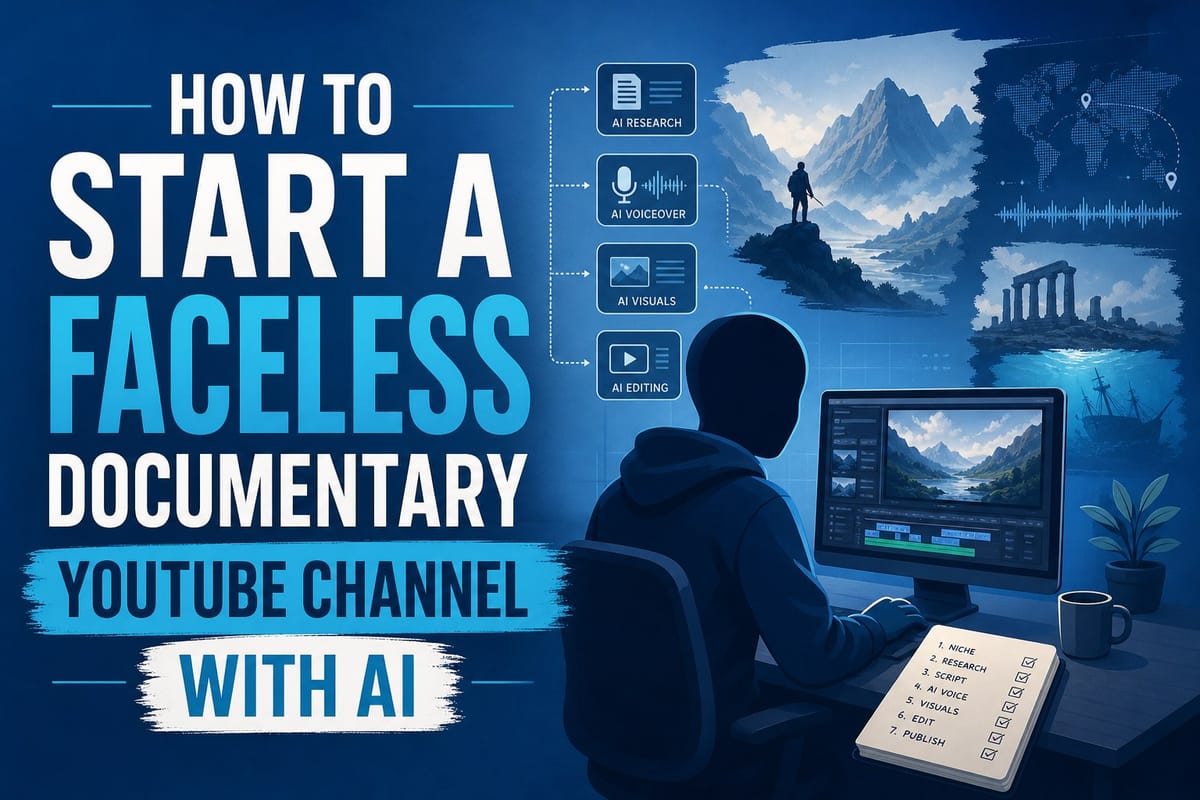
Table of contents
1. What a faceless documentary YouTube channel actually looks like
2. How to plan, research, and script your first documentary video
3. Producing your videos with AI and scaling your output
Starting a faceless documentary YouTube channel used to mean hiring a scriptwriter, a voiceover artist, a video editor, and a footage researcher — all before you uploaded a single video. That barrier kept a lot of people out. Today, AI has changed the equation completely. This guide walks you through the exact process of building a faceless documentary YouTube channel from scratch, using AI tools to handle the heavy lifting at every step. Whether you want to cover true crime, history, science, or geopolitics, the workflow here will help you produce polished, long-form documentary content without ever stepping in front of a camera. Each section covers a distinct phase: understanding the format and picking your niche, planning and scripting your first video, and producing and scaling your output with AI. By the end, you will have a clear, actionable roadmap you can follow starting today.
What a faceless documentary YouTube channel actually looks like
A faceless documentary YouTube channel is one where the creator never appears on screen. Instead, videos use narration, archival footage, motion graphics, stock video, text overlays, and music to carry the story. The creator's identity stays private, which is part of the appeal for many people who want to build an audience without building a personal brand.
This is not a new format. It has existed on YouTube for years, and several channels have used it to build audiences in the millions. What is new is how accessible the production process has become. AI tools now handle work that used to require multiple specialists, which means a single person can run a channel that would have needed a small team just five years ago.
Channels like OverSimplified and Asianometry have proven this format works at scale. OverSimplified uses animated storytelling to cover historical events and regularly pulls millions of views per video. The channel has covered topics ranging from the French Revolution to the history of Prohibition, each told through simple animation, dry humor, and tight narration. Asianometry takes a different approach, covering technology and industrial history using voiceover paired with photos, diagrams, and video clips. Neither channel requires the host to be on camera. What they share is tight research, strong scripting, and consistent visual presentation.
The documentary format specifically works well for faceless channels because the story carries the video. Viewers come for the information and the narrative, not for a personality-driven performance. Someone watching a video about the sinking of the Titanic or the rise of a tech giant is not there to see your face. They are there for the story. That means you can produce content that holds up over time and continues to attract search traffic months or even years after upload. A well-made documentary video on a stable topic is an asset that keeps working long after the upload date.
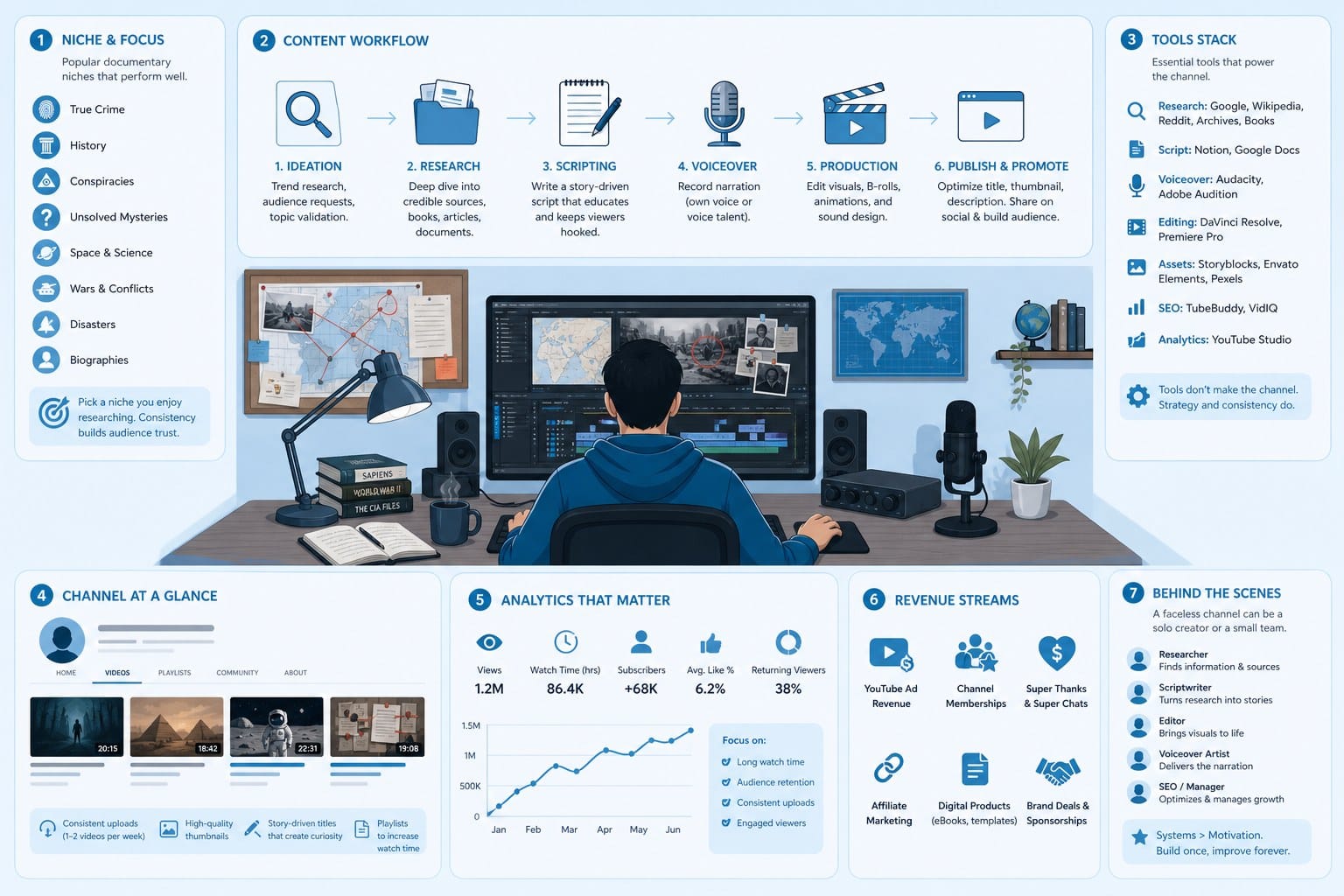
Niches that perform well for this format include history and historical events, true crime and criminal investigations, science and space exploration, geopolitics and international affairs, technology and cybersecurity, nature and wildlife, and cold cases or unsolved mysteries. Each of these niches has an existing audience on YouTube actively searching for documentary-style content every day. That built-in demand matters a lot when you are starting from zero, because you do not have to create interest from scratch. You are meeting demand that already exists.
One thing worth addressing upfront is that the faceless format does not mean low effort. The channels that grow in this space produce videos that feel researched, well-structured, and visually engaging. Viewers are not forgiving of sloppy narration, unsourced claims, or visuals that have no connection to what is being said. The good news is that AI now handles a large portion of the production work, which means you can focus your energy on choosing great topics and reviewing the output rather than grinding through every step manually.
The business model for these channels is also worth understanding before you start. Faceless documentary channels can earn through YouTube ad revenue, affiliate marketing, sponsorships, and content repurposing. The documentary format tends to attract older viewers with higher purchasing power, which means higher ad rates (called CPMs) compared to entertainment or gaming channels. History, technology, and finance niches often see CPMs between eight and twenty dollars per thousand views. That compares favorably to many other YouTube formats and makes monetization realistic even at modest view counts.
YouTube's AI disclosure policy is something you should know about before you publish your first video. As of 2024, YouTube requires creators to label videos that use AI to generate realistic content, especially synthetic voices, faces, or footage that could be mistaken for real events. For documentary channels using clearly stylized AI visuals and narration, the rule is straightforward: disclose it. YouTube gives you a checkbox in the upload settings. Use it. Transparency builds audience trust and keeps your channel in good standing with the platform. It is a small step that protects you from future policy enforcement issues.
Choosing the right niche before you start is one of the most important decisions you will make. The ideal niche sits at the intersection of three things: topics you find genuinely interesting, subjects with strong YouTube search demand, and content you can sustain for at least twenty to thirty videos without running out of ideas. Pick a niche that checks all three boxes, and you will have a much easier time building momentum in the first six months.
If you are unsure which niche fits you best, spend an hour searching YouTube for documentary-style content in categories that interest you. Look at view counts, subscriber growth rates, and comment sections. High view counts on relatively new channels signal strong demand. Active comment sections signal an engaged audience. Both are good signs for a niche you are considering entering.
Channel naming matters more than most beginners think. Your channel name is often the first thing a potential subscriber sees, and it signals what kind of content they can expect. Pick a name that feels documentary-adjacent without locking you into a single topic. Names like Archive Hour, Depth Report, The Record Room, or Signal & Noise feel serious and content-focused without being so specific that you cannot pivot if one topic underperforms. Keep it short, easy to remember, and easy to spell. Avoid names that include your personal name if you want to maintain the faceless format long-term.
How to plan, research, and script your first documentary video
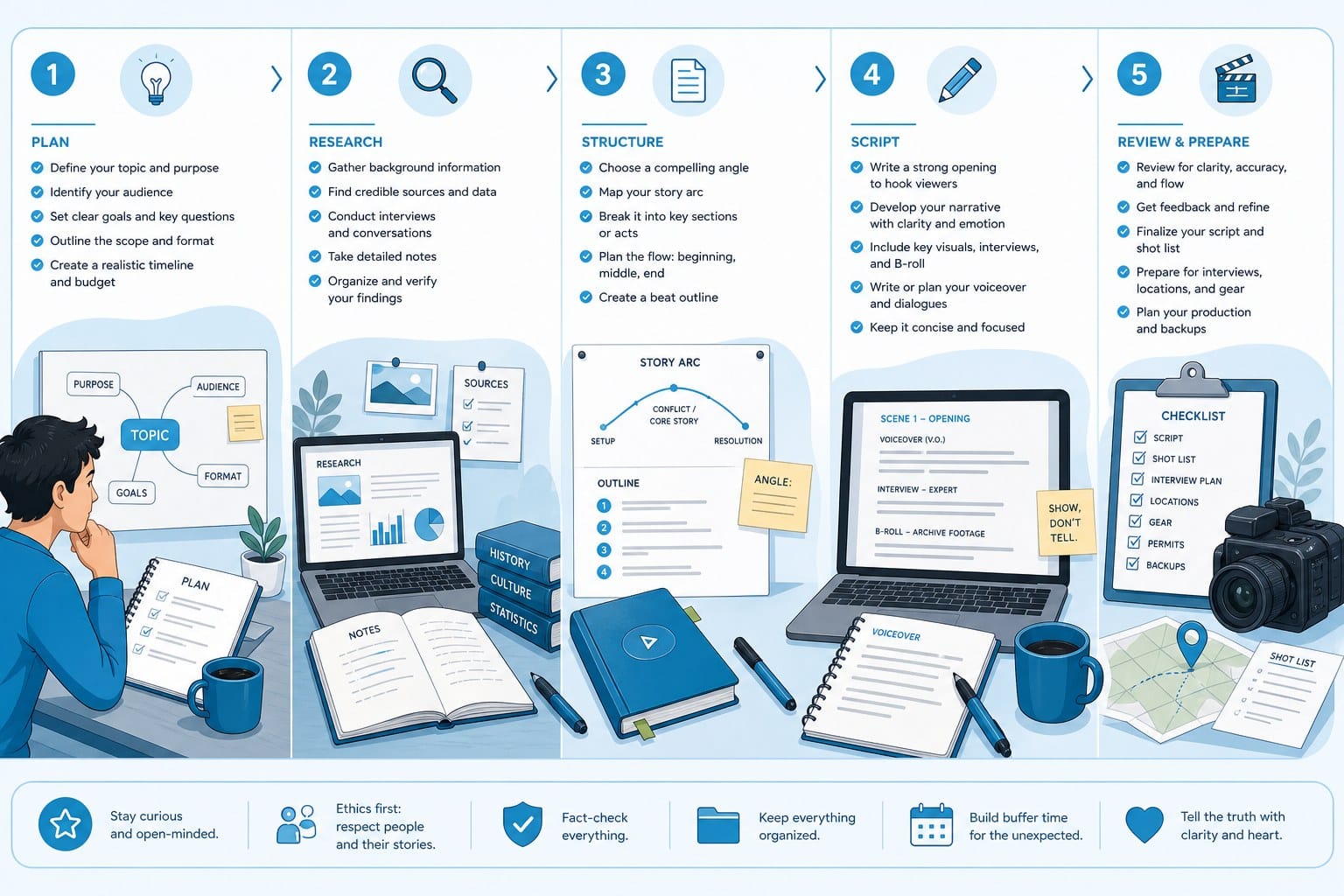
The planning phase is where most beginners lose time. They pick a vague topic, start writing without structure, and end up with a script that feels like a Wikipedia article read aloud over stock footage. The result is a video that might be technically complete but does not hold attention. Planning well before you write a single line of script is what separates documentary channels that grow from ones that stall after a few videos.
Start with a specific story, not a broad subject. The difference between a broad subject and a specific story is the difference between a research paper and a documentary. Instead of covering World War II, you might choose how one code-breaking mistake changed the outcome of the Battle of Midway. Instead of covering climate change, you might tell the story of why a small town in Alaska is sinking into the permafrost. Specific stories have clear beginnings, middles, and ends. That structure is what turns a research dump into a documentary that people watch all the way through.
Here is a planning framework that works well for new channels:
First, pick a niche you can commit to for at least twenty videos. Commitment matters because YouTube rewards channels that stay consistent within a topic. The algorithm learns what your channel is about and recommends it to relevant viewers. A channel that covers history in one video, then true crime, then science has a harder time building a targeted audience.
Second, build a list of thirty specific story ideas within your niche before you start producing. Having a large idea backlog prevents the panic that sets in when you finish your first video and have no idea what to make next. Good ideas come from reading books in your niche, following news in your niche, looking at what questions people ask in Reddit forums, and studying which topics your competitor channels have not covered well.
Third, research the top ten ideas on your list to see which ones have strong YouTube search demand. Use YouTube's search bar to see what autocomplete suggestions come up for your topic. Look at the view counts on existing videos about that topic. A topic with several videos in the hundreds of thousands of views and no clear dominant channel is a good target. A topic where one channel has ten million views on a definitive video is a harder entry point.
Fourth, choose your first video based on search volume plus personal interest. The personal interest part matters because your first few videos will take longer than you expect, and genuine curiosity about the topic keeps you motivated through the slower parts of production.
Research quality is what separates documentary channels that earn viewer trust from ones that get called out in the comments. AI tools can pull together background information quickly, but you should verify facts from primary sources when the topic involves real events, real people, or contested history. Documentaries carry an implicit promise of accuracy. Errors damage credibility fast, especially in niches like true crime or history where your audience often knows the subject better than you expect. When you use a specific statistic, name, or date in your script, trace it back to a reliable source before you publish.
Scripting a documentary video is a craft worth learning properly. The structure that works most reliably mirrors the structure used in narrative journalism and film documentaries:
The hook comes first. Drop the viewer into the most dramatic, surprising, or emotionally charged moment from the story. This should happen within the first sixty to ninety seconds and should make the viewer feel like they cannot stop watching until they find out how the situation resolves. A strong hook for a true crime documentary might drop you into the moment a detective discovers a critical piece of evidence. A strong hook for a history documentary might start at the pivotal battle before pulling back to explain how events reached that point.
The setup follows. Establish the context, the key figures, the time period, and the stakes. What is at risk? Who are the people involved? Why does this story matter? The setup gives viewers the foundation they need to follow what comes next.
Rising action moves the story forward. Walk through the sequence of events with enough detail to keep viewers curious about what happens next. Each section of your rising action should answer one question while raising another. That rhythm keeps viewers watching.
The climax is the turning point or revelation at the center of your story. This is what your hook was teasing. When you reach it, give it space. Do not rush through the most dramatic moment in a few sentences.
The resolution covers what happened after, what it meant, and why it still matters. Many documentary channels skip this section or treat it as an afterthought. That is a mistake. A strong resolution is what makes the viewer feel like their time was well spent and what makes them likely to subscribe.
The outro is a brief reflection or question that leaves the viewer thinking. This can be a philosophical observation about the topic, an open question the story raises, or a tease of a related video you have already published.
AI platforms like Cliptude can generate a full documentary script from a single prompt. You provide the topic, the angle, and the target length, and the platform researches the subject and structures the narrative for you. That draft gives you a strong starting point. Reading through the script carefully and adjusting anything that feels off is still worthwhile, particularly any factual claims that need sourcing or any sections where the narrative pacing feels rushed.
For voiceover, AI narration has improved dramatically in a short time. Modern AI voices can sound authoritative, calm, and clear, which is exactly what documentary narration requires. The difference between a good AI voice and a poor one comes down to pacing, inflection, and naturalness on proper nouns and technical terms. If you want to explore what different AI narration platforms offer before committing to one, this comparison of HeadCast AI alternatives for AI-narrated video creation gives you a useful overview of the options currently available.
Pacing is a production consideration you should think about at the scripting stage. Documentary videos on YouTube tend to perform best at lengths between twelve and twenty-five minutes for main content. That range is long enough to build a real narrative and trigger YouTube's mid-roll ad monetization, but short enough to hold attention through a full watch session. Shorter explainer documentaries in the eight to twelve minute range can also work well, especially early on when you are still building your production rhythm and want to publish more frequently.
Thumbnails deserve attention at the planning stage, not as an afterthought. For faceless documentary channels, the strongest thumbnails typically combine a dramatic image, bold text that teases the story, and high contrast colors that stand out in a feed. Look at what is working in your niche before you design your first one. The thumbnail and title together determine whether someone clicks. No amount of production quality saves a video that nobody opens. Spend at least as much time on your title and thumbnail as you do on any other single step in production.
Producing your videos with AI and scaling your output
Once your script is locked and your narration is ready, production is where AI makes the biggest time difference. Traditional documentary production at a professional quality level requires sourcing stock footage, licensing archival clips, designing lower thirds and title cards, editing everything to the narration track, adding and mixing music, and color grading the final cut. For a twenty-minute documentary, that process can take twenty to forty hours for someone who already knows what they are doing. For a beginner learning the tools as they go, it takes longer.
With an AI-powered platform, you can compress that timeline dramatically without sacrificing the visual quality that keeps viewers engaged.
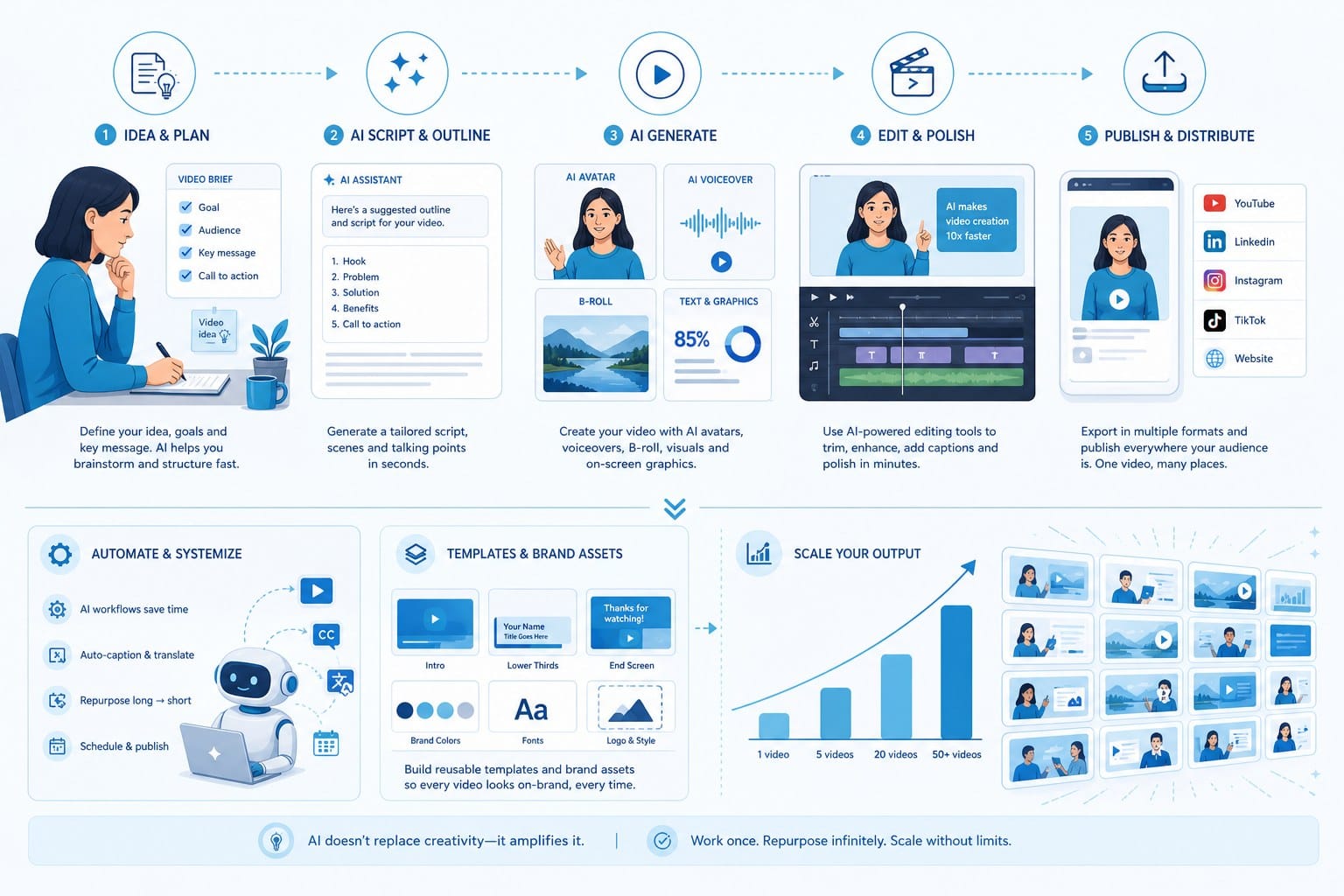
Here is what a modern AI video production workflow looks like for a faceless documentary channel, broken into the key steps:
Step one is inputting your script or prompt. A platform like Cliptude takes your script or even just a topic prompt and uses it to drive the entire production process. It handles research, scripting, footage sourcing, and editing in one workflow rather than requiring you to move between five different tools, manually matching each piece. For creators who are new to video production, this is the difference between a process that takes a few hours and one that takes a few days.
Step two is footage sourcing. The platform automatically pulls relevant stock footage and archival clips that match the narration. You can review these selections and swap anything that does not fit the visual tone you are going for. This step is where a lot of time gets saved. Manual stock footage research for a twenty-minute documentary can easily take three to four hours on its own. Having the AI pull an initial selection gives you a starting point to refine rather than a blank canvas to fill.
Step three is motion graphics and text overlays. Documentary videos use on-screen text, lower thirds (the name labels that appear when a person is introduced), data visualizations, and graphic inserts to reinforce key points and orient the viewer. AI platforms can generate these automatically based on your script. This is especially useful for data-heavy topics where showing a statistic visually is clearer than simply saying it aloud, or for history videos where a timeline graphic helps viewers follow a complex sequence of events.
Step four is review and export. You review the assembled cut, make any edits you want, and export the finished video. What used to take days can be done in hours once you have your script and narration ready.
For creators interested in animated documentary formats, the same AI-first approach applies. If you want to produce documentaries using 2D animation rather than stock footage, the process for doing that without any drawing experience is covered in detail in this guide on how to create 2D animations for YouTube without drawing skills. Animation works especially well for historical content where real footage does not exist, or for science topics where you need to visualize abstract concepts like particle physics, evolutionary biology, or astronomical scale. It also gives your channel a distinctive visual style that sets it apart from channels using generic stock footage.
If you are evaluating which AI video platform fits your workflow before you commit to one, this comparison of Synthesia vs InVideo: which AI video platform is right for you covers the key differences across two widely used options, including what each platform does well and where each one has limitations.
Monetization is a natural concern at this stage, so here is a realistic picture of how a faceless documentary channel can earn revenue over time.
YouTube ad revenue is the most visible income stream. Documentary content tends to attract older viewers with more purchasing power, which means higher CPMs. History, finance, and technology niches often see CPMs between eight and twenty dollars per thousand views, compared to entertainment or gaming niches that might sit at two to four dollars. Once you reach the YouTube Partner Program threshold of one thousand subscribers and four thousand watch hours in the past twelve months, ad revenue begins. That threshold is achievable within three to six months for a channel publishing consistently in a niche with real search demand.
Affiliate marketing adds a second income stream that does not require a large audience. If your niche overlaps with products or services your viewers actually use, affiliate links in your video descriptions can generate meaningful revenue even at modest view counts. A history channel might affiliate with book subscription services or online learning platforms. A cybersecurity channel might affiliate with VPN services. A science channel might partner with telescope retailers or science magazine subscriptions. The key is recommending things that genuinely fit your content rather than inserting unrelated affiliate links.
Sponsorships often become the largest income stream for mid-size documentary channels. Channels with engaged audiences in specific niches attract sponsorships from education platforms, software tools, subscription services, and financial products. Sponsors in the documentary space are often willing to pay more per video than sponsors in broader entertainment niches because the audience is more targeted. A cybersecurity channel with fifty thousand subscribers is worth more to a VPN company than a general entertainment channel with five hundred thousand subscribers, because the audience match is much tighter.
Content repurposing extends your reach without requiring new research. Short clips from your long-form documentaries can be edited into YouTube Shorts, Instagram Reels, and TikTok videos. A single twenty-minute documentary often contains three to five moments that work well as sixty to ninety second clips: a surprising statistic, a dramatic turning point, a little-known historical fact. Repurposing these clips exposes your channel to new viewers on platforms where short-form content gets pushed to non-followers automatically.
Scaling your output is where AI really earns its place in your workflow. Once you have produced three or four videos and refined your production process, the goal is to increase your publishing cadence without increasing your time investment proportionally. A realistic target for a documentary channel is one video per week. That pace is achievable for a solo creator using AI tools. Without AI, one video per week at documentary quality would require either an extremely fast and experienced producer or a team.
Consistency matters more than perfection, especially early on. YouTube's algorithm rewards channels that upload regularly and retain viewers. A video that is eighty percent as polished as your ideal but published on schedule will outperform a perfect video that ships three weeks late. Early in a channel's life, the algorithm is learning what your content is about and who to show it to. Regular uploads accelerate that learning process.
Keep a production calendar and plan your next four to six videos at all times so you are never starting from zero when it is time to produce. Batching similar steps speeds up each one. Do all your topic research in one session. Review all your scripts in another. Run all your exports together. Batching reduces the mental overhead of switching between different types of work and helps you spot patterns across videos, like hooks that consistently perform well or visual approaches that your audience responds to.
A simple quality checklist run before every upload prevents the small mistakes that erode viewer trust over time. Before publishing each video, confirm that the title is specific and searchable. Check that the hook lands within the first thirty seconds and raises a clear question. Listen to the narration and confirm it is clear, well-paced, and free of mispronunciations on key names or terms. Check that the visuals match the narration throughout, with no long stretches of generic footage disconnected from what is being said. Confirm the thumbnail matches the promise of the title. Make sure you have added the AI disclosure label if your video uses AI-generated realistic content. Check that the description is filled with relevant keywords, timestamps, and any relevant links.
Running that checklist takes fifteen minutes and prevents the kind of small errors that generate negative comments and suppress your click-through rate on future videos.
One last piece of advice that applies throughout the entire process: build your channel around topics you find genuinely interesting. That sounds soft, but it has practical consequences. Research is easier when you care about the subject. Your script will read better because your genuine curiosity shapes how you frame questions and structure revelations. When a video underperforms, as will happen to every creator regardless of skill level, your interest in the niche keeps you going long enough to figure out what to adjust rather than abandoning the channel entirely.
A faceless documentary YouTube channel built on AI production tools is one of the most viable content businesses available to a solo creator right now. The audience demand is real and growing. The tools are capable of producing content that meets viewer expectations. The business model works at multiple income tiers. What it takes is consistent execution, a willingness to learn from each video you publish, and enough patience to let the channel build momentum over the first few months before the results become obvious.
Ready to take the next step?
If you are ready to build your first faceless documentary video without hiring a team or learning video editing from scratch, Cliptude gives you a complete AI-powered production workflow in one place. From script to finished video, the platform handles research, narration, footage sourcing, motion graphics, and editing automatically. Start your first project today and publish your first documentary this week.