Can you monetize AI-generated YouTube videos

Table of contents
1. What YouTube actually says about AI-generated content and monetization
2. How to make AI-generated videos that actually get approved for monetization
3. Building a monetization strategy beyond just AdSense
So you want to know: can you monetize AI-generated YouTube videos? It is one of the most common questions I hear from creators who are exploring faceless channels, automated content pipelines, and AI video tools. The short answer is yes, you can, but there are real rules, real pitfalls, and some important nuances you need to understand before you start uploading. I am going to walk you through exactly what YouTube requires, what the platform looks for when it reviews monetization applications, and how to build AI-generated content that actually qualifies. Whether you are running a solo documentary channel, a listicle series, or an educational animation channel, this guide will help you understand what is possible and how to do it the right way.
What YouTube actually says about AI-generated content and monetization
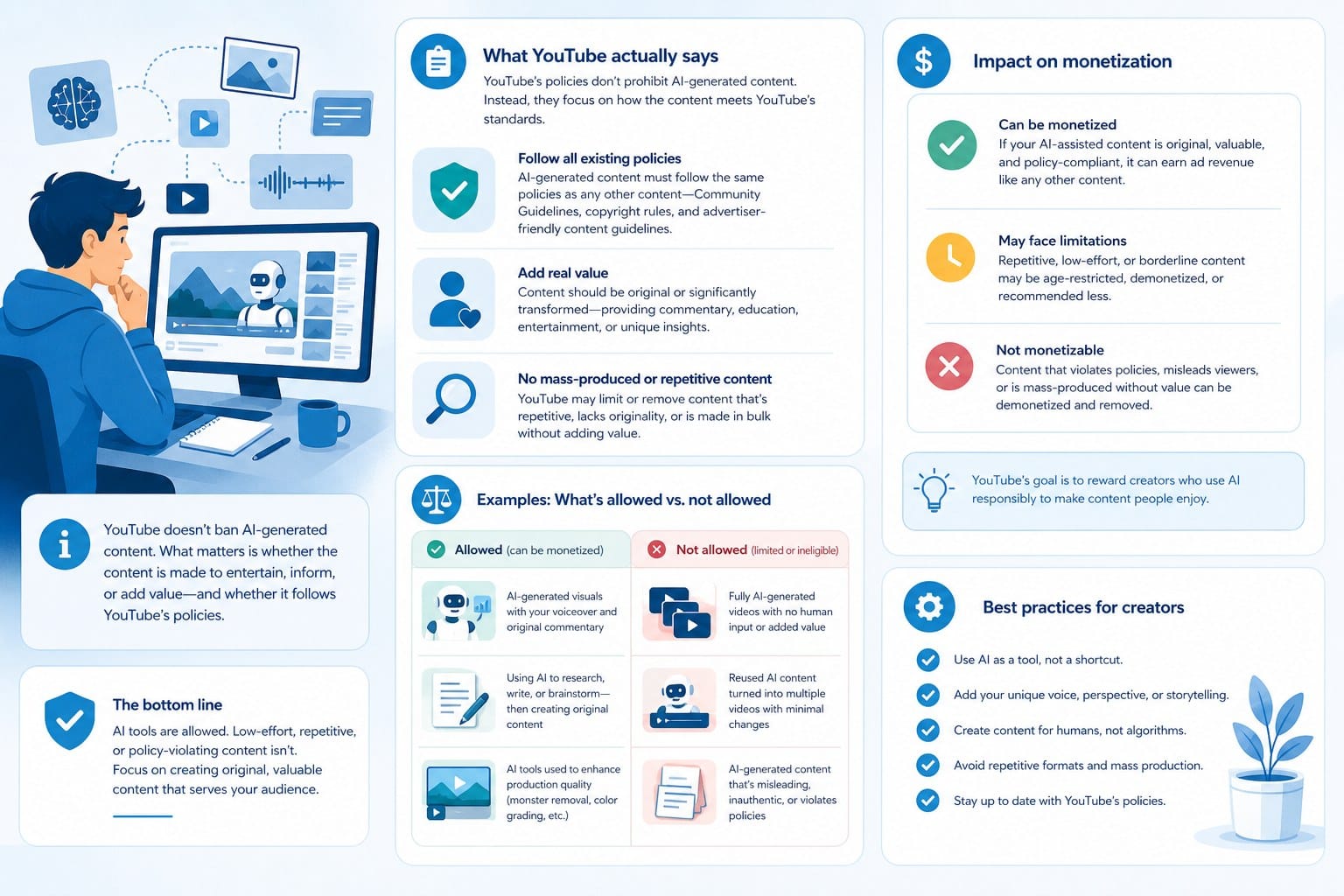
YouTube has not banned AI-generated videos. That is the first thing to get straight. The platform updated its monetization policies in 2023 and 2024 to address the rise of automated content, and the core message is this: YouTube cares about value and authenticity, not about the tools you used to create the video.
The YouTube Partner Program (YPP) requires channels to meet a few baseline thresholds before they can earn ad revenue. As of mid-2024, the standard tier requires 1,000 subscribers and 4,000 watch hours in the past 12 months, or 1,000 subscribers and 10 million Shorts views in 90 days. Once you hit those numbers, YouTube reviews your channel manually before approving you.
During that review, the team is looking for a few things. They want to see that your content is original, that it provides genuine value to viewers, and that it does not violate community guidelines or advertiser-friendly content policies. They are specifically looking out for what they call "repetitious content" and "low-effort mass-produced content."
This is where AI-generated videos get complicated. If you are using an AI tool to pump out hundreds of identical-looking videos with auto-generated voiceovers, recycled stock footage, and no editorial judgment, YouTube will likely reject your monetization application or remove existing monetization. They have been explicit about this. Their spam and deceptive practices policy covers channels that use automation to produce large volumes of low-quality content with no added value.
But here is the important distinction: AI-generated does not automatically mean low-quality or low-value. A well-researched 15-minute documentary on a niche topic, produced using an AI video platform, with an original script, unique narration, and thoughtfully sourced visuals, can absolutely qualify for monetization. The tool you used to assemble it is not the issue. The quality and originality of the output is what matters.
YouTube also requires you to disclose when your content contains "realistic" AI-generated material, particularly if it depicts real people, real events, or realistic-looking scenes that a viewer might mistake for genuine footage. In 2024, YouTube rolled out a disclosure label system for this. Failing to disclose qualifies as a policy violation and can lead to content removal or demonetization. So if your AI video includes a realistic AI-generated human face or a simulated news segment, you need to use the disclosure tool in YouTube Studio.
The good news is that most AI-generated YouTube videos in popular niches, such as history documentaries, top-10 listicles, explainer animations, and educational content, do not typically fall into that "realistic deception" category. They use narration, motion graphics, stock footage, and animation, which are all formats that have existed on YouTube for years. AI just makes it faster and more accessible to produce them.
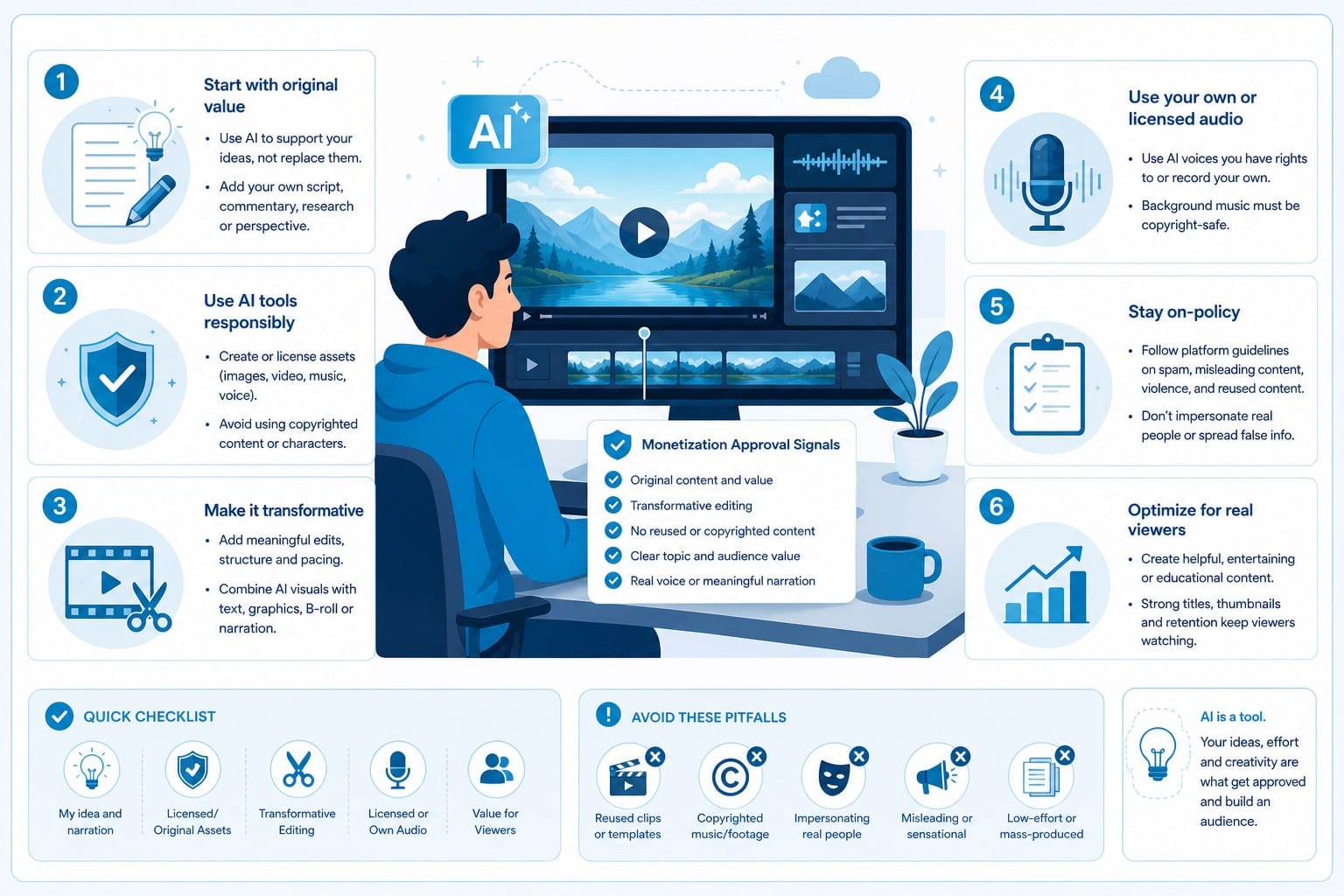
One more thing worth mentioning: copyright. For your channel to stay monetized, you need to own or have the rights to every asset in your video. This includes footage, music, images, and voiceovers. If your AI video platform sources footage from licensed libraries and generates original music or uses royalty-free tracks, you are in the clear. If it pulls in clips from copyrighted sources without a license, you will run into Content ID claims, which can strip your ad revenue or block your video entirely. Always verify what rights your AI platform grants you before uploading.
How to make AI-generated videos that actually get approved for monetization
Getting approved for YPP with an AI-generated channel is very achievable, but you need to approach it strategically. I want to give you a practical framework for building content that holds up to YouTube's review process and keeps advertisers happy over the long term.
The first principle is originality at the script level. This is where most low-quality AI channels fall apart. They use AI to rewrite existing articles or summarize Wikipedia pages verbatim, then slap a text-to-speech voice on top. YouTube's systems are getting better at detecting this kind of repackaged content, and so are human reviewers. Instead, you want your AI tool to start with original research and produce a script that brings a fresh angle, a unique structure, or depth that viewers cannot easily find elsewhere.
For example, if you are running a history documentary channel, do not just make a video called "The History of the Roman Empire" that covers the same ten points every other channel covers. Use your AI platform to research specific angles, like the economic collapse that preceded Rome's fall or the role of climate change in weakening the empire. A tighter, more specific topic with original framing signals to YouTube and to viewers that your channel adds something meaningful to the platform.
The second principle is production quality. YouTube does not publish a minimum quality standard, but ad buyers do care. Advertisers can choose to exclude low-quality inventory from their campaigns, which means even if your video is monetized, you might earn very little if the production looks cheap. Think about this from an advertiser's perspective: would a major brand want their ad running before your video?
AI video platforms vary enormously in output quality. Some produce stiff, obviously synthetic-looking results. Others produce polished, professional-looking videos that are genuinely watchable. The gap between those two categories matters a lot for monetization success. Tools that combine licensed footage libraries, motion graphics, realistic narration, and smooth editing tend to produce videos that perform better both in terms of viewer retention and ad revenue.
For creators building animation-style content, formats like whiteboard explainers and stickman animations have proven to be strong performers in the educational and explainer space. If you are curious about how AI is making those formats more accessible, I wrote more about that in this piece on AI stickman animation video maker for YouTube creators. These animation styles work particularly well for educational channels because they feel intentional and crafted rather than automatically assembled, even when AI handles most of the production work.
The third principle is watch time and audience retention. YouTube's algorithm rewards videos that keep people watching. If your AI-generated video loses 70% of viewers in the first 90 seconds, it is going to struggle to rank, grow your subscriber count, or earn meaningful ad revenue even if it is technically monetized. Watch time is also one of the signals that YouTube's review team looks at when deciding whether your channel is genuinely engaging or just generating filler content.
To improve retention, focus on strong hooks in the first 30 seconds, clear chapter structure so viewers know what they are getting, and a pacing that moves the story forward without dragging. AI platforms that let you control script pacing, visual transitions, and segment length give you more control over this than tools that are fully automated with no customization.
The fourth principle is niche consistency. Channels that cover a clear, defined topic tend to grow faster and monetize more reliably than channels that post random content across many subjects. Advertisers pay higher CPMs (cost per thousand views) in certain niches, including finance, technology, health, education, and business. If your AI-generated channel consistently covers one of those topics with quality content, you will attract both a loyal audience and higher-paying advertisers.
Faceless channels in the finance and business education space, for instance, have historically earned some of the highest CPMs on YouTube. A channel that consistently explains investing concepts, business case studies, or economic history using AI-generated narration and animation can realistically earn several dollars per thousand views, which adds up quickly once you have a library of content and consistent upload frequency.
Finally, think about your content disclosure practice. Even when disclosure is not technically required, being transparent with your audience about how you make your videos tends to build trust rather than erode it. Many successful faceless channels openly discuss their production process and their use of AI tools. It makes them relatable, not less credible. Viewers generally care more about whether the information is accurate and useful than whether a human hand-edited every frame.
Building a monetization strategy beyond just AdSense
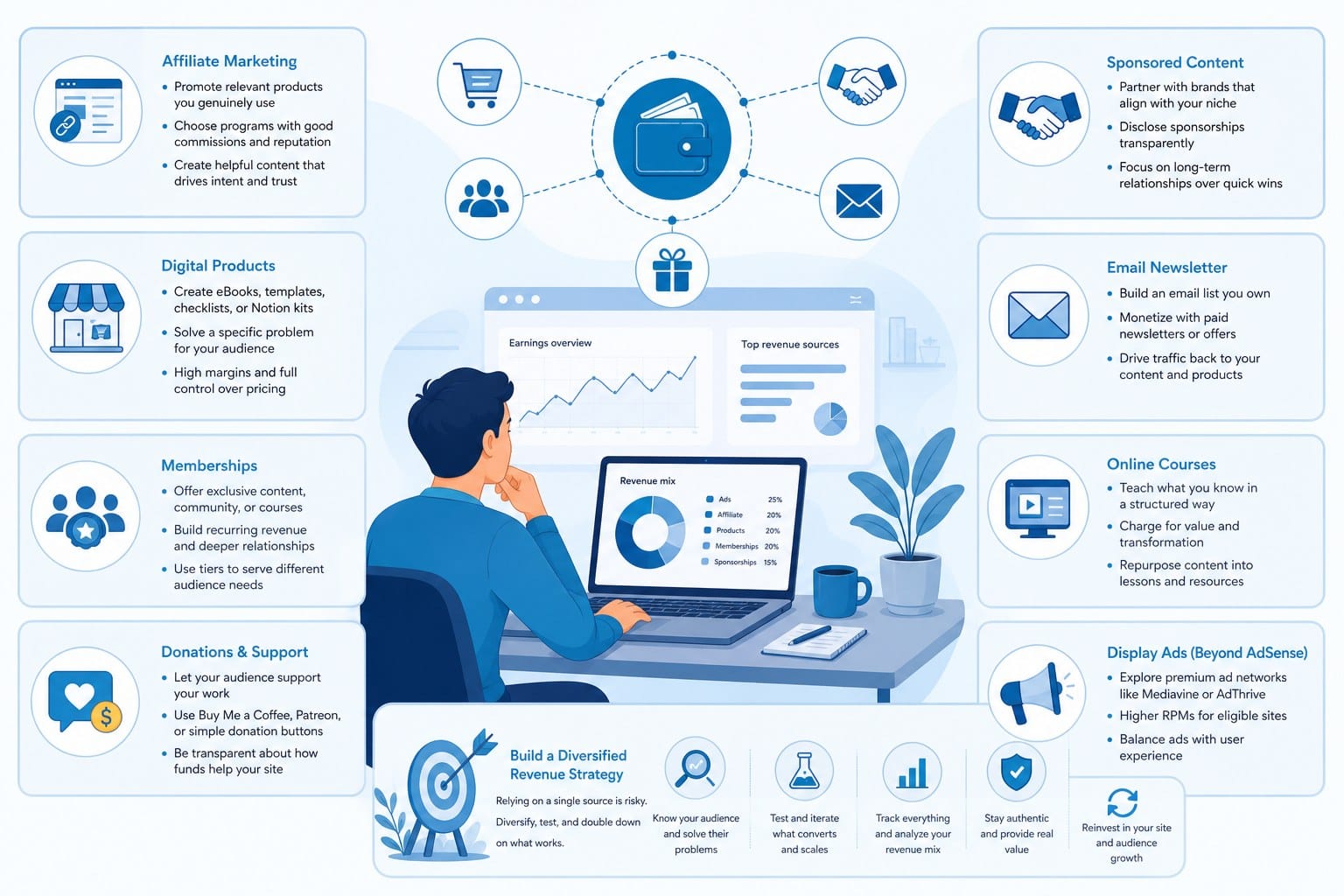
Ad revenue through the YouTube Partner Program is the most well-known way to monetize a YouTube channel, but it is far from the only option, and for AI-generated channels it is often not even the best first option. Understanding the full monetization picture helps you build a more sustainable content business.
I want to start with the numbers, because they matter for setting expectations. YouTube's standard ad revenue for general content typically falls somewhere between 1 and 5 dollars per thousand views, depending on the niche, audience location, and time of year. Q4 is generally the highest-earning quarter because advertisers spend more around the holidays. If your channel is in a high-CPM niche like personal finance or software, you might earn 8 to 20 dollars per thousand views. If you are in entertainment or gaming, it is usually on the lower end.
For an AI-generated channel producing one or two videos per week, reaching 100,000 views per month might take six to twelve months of consistent effort. At a 3 dollar average CPM, that is about 300 dollars per month from ads alone. That is real money, but it is not life-changing by itself. The channels that generate serious income combine AdSense with other revenue streams.
Affiliate marketing is one of the most effective secondary revenue streams for AI-generated channels, particularly in education, finance, technology, and product review niches. You recommend products or services in your videos and earn a commission when viewers make a purchase through your link. Amazon Associates is the most accessible affiliate program, but many software companies, financial services, and online education platforms offer their own affiliate programs with much higher commission rates.
The key is to only recommend things that are genuinely relevant to your content and useful to your viewers. A channel covering personal finance can naturally mention budgeting apps, brokerage platforms, or financial planning tools. A channel covering technology can cover software subscriptions or hardware. When the recommendation fits naturally into the content, conversion rates are much higher and the channel maintains credibility.
Sponsorships are another major revenue stream. Once a channel has a few thousand subscribers and consistent viewership, brands in the relevant niche will sometimes reach out directly to offer paid sponsorships. For faceless AI-generated channels, sponsorships work particularly well in the mid-roll format, where a brief sponsored message is inserted into the middle of the video. The channel's production style does not need to change and the sponsorship feels natural within the video format.
Digital products are a third option worth building toward. If your AI-generated channel covers a topic where viewers want to learn more, you can create templates, guides, mini-courses, or resource packs and sell them directly through a website or platforms like Gumroad or Payhive. A history channel might sell research guides. A business education channel might sell financial modeling templates. An educational animation channel might sell lesson plan resources for teachers. The channel itself becomes a marketing machine for your products.
For a deeper breakdown of the full picture of earning from YouTube without being on camera, I recommend reading this piece on how to make money on YouTube without making videos using AI. It covers the mechanics of faceless channel monetization in more detail, including how to structure your content strategy for long-term earning.
Now let me talk about YouTube Shorts monetization specifically, because it operates under different rules. YouTube began paying Shorts creators through the Shorts ad revenue pool in early 2023. The payout structure is different from long-form videos: YouTube pools ad revenue from Shorts feeds, takes out a portion for music licensing, and distributes the rest to creators based on their share of total views. The per-view earnings are generally lower than long-form, but Shorts are also faster and cheaper to produce, especially with AI tools.
Some creators use Shorts as a growth mechanism for their long-form channels rather than a primary revenue source. You post short clips or teasers from your long-form documentary content as Shorts, which drives subscribers to your main channel where your higher-earning long-form videos live. This is a smart strategy for AI-generated content because the marginal cost of producing a Short from existing long-form footage is minimal.
Channel memberships and Super Thanks are two additional YPP revenue streams available once you hit the monetization threshold. Memberships let viewers pay a monthly fee for perks like early access, exclusive content, or community badges. Super Thanks lets viewers pay to have their comment highlighted during a video. These tend to work better for channels with an engaged community around a topic the audience is passionate about, which is very achievable in niches like history, science, or economics.
If you are trying to decide which AI video platform to use for building your monetizable channel, the choice of tool matters more than most people realize. Not all platforms give you full commercial rights to the content you produce, and some have limitations on the footage libraries or audio tracks that can affect your ability to monetize. I did a detailed comparison of some of the major options in this article on Pictory AI vs InVideo alternatives for YouTube creators, which is worth reading if you are still evaluating your options.
For creators who want a platform that handles the full production pipeline from research through final edit, Cliptude is built specifically for that use case. It researches your topic, writes the script, sources licensed footage, generates motion graphics, and delivers a polished video ready to upload. The commercial rights are included, so what you produce is yours to monetize. If you are building a documentary channel, a listicle channel, or an educational animation channel, having a tool that handles the full workflow from a single prompt changes the math on how much content you can realistically produce and how fast your channel can grow.
The broader point is this: monetizing AI-generated YouTube videos is not a loophole or a trick. It is a legitimate content strategy that works when you treat it seriously. The creators who succeed at this treat their AI-generated channel like a media company. They plan their content calendar, research their niche, invest in quality production, and diversify their revenue streams from the start. The AI tools reduce the production burden enormously, but the strategy, the niche selection, and the audience-first mindset are still things that you bring to the table.
Ready to take the next step?
If you are ready to start building a YouTube channel that you can realistically monetize, Cliptude makes the production side much more manageable. You give it a topic or a script, and it handles the research, writing, footage sourcing, motion graphics, and editing for you. The result is a polished, upload-ready video that you own the commercial rights to. Head over to Cliptude to see how it works and start creating content that is built to grow.