How to make money on YouTube without making videos using AI


Table of contents
1. Understanding the faceless YouTube channel model
2. The revenue streams that actually pay on a faceless channel
3. How AI video generation actually works for this strategy
Most people assume YouTube success requires a camera, a ring light, and hours of editing every week. That assumption is wrong, and it has kept a lot of would-be creators on the sidelines longer than necessary. Faceless YouTube channels have been generating real income for years, covering everything from true crime to personal finance to science explainers, without a single on-camera host. What changed recently is that AI tools removed the last major obstacle: the production work itself. A solo creator can now go from a topic idea to a finished, polished video in under an hour. This guide breaks down exactly how the faceless channel model works, which revenue streams actually pay out, and how AI video generation fits into the workflow so you can build something that runs without burning you out.
Understanding the faceless YouTube channel model
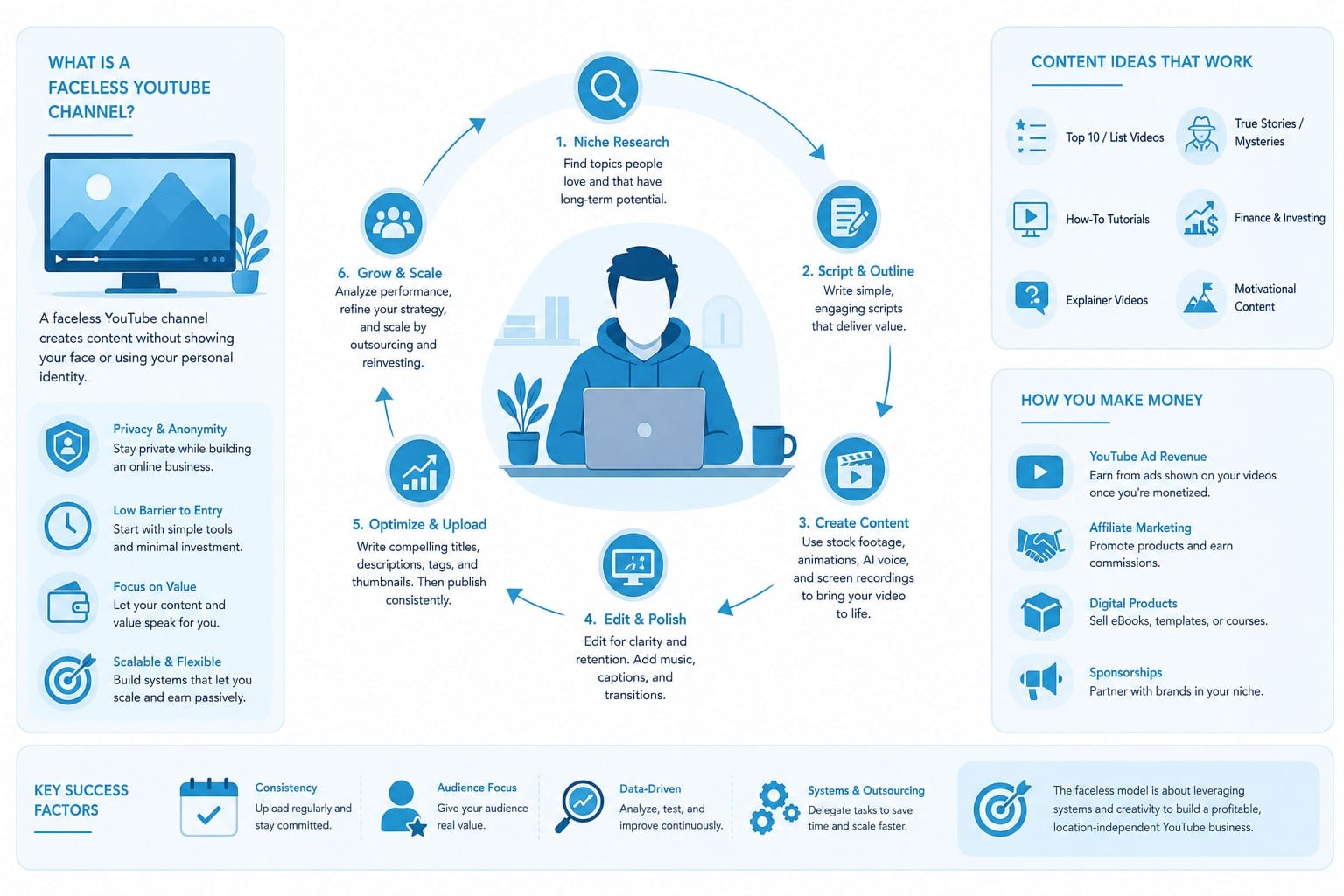
A faceless YouTube channel publishes videos regularly, grows an audience, and earns money through the same monetization methods every other channel uses. Nobody appears on camera. There is no talking-head setup, no personality-driven hosting, and no need for a recording studio or expensive gear. The difference between a faceless channel and a traditional one is entirely in how the content gets made.
This model is not new. Channels covering true crime, world history, science facts, and personal finance have accumulated millions of subscribers for years without showing a human face. What shifted recently is that AI closed the gap between having an idea and producing a finished video. That change is significant because it eliminated the main reason most people quit before they got traction.
Before AI tools became capable, running a faceless channel required a small team or a grueling personal workload. You needed someone to research topics, someone to write scripts, a video editor, and a voiceover artist. Hiring those people cost money. Doing it all yourself meant spending 20 or more hours on a single video. Most solo creators burned out before they hit 1,000 subscribers, which is the first monetization threshold YouTube requires.
Now a single person can prompt an AI platform, review the output, make light edits, and publish a polished 10-minute documentary or explainer in a fraction of the time it used to take. The quality is high enough to hold a viewer's attention, and holding attention is exactly what YouTube's algorithm rewards. When viewers watch your video through to the end or come back for more, the algorithm pushes your content to new audiences. That flywheel is the same for faceless channels as it is for any other format.
When people search for how to make money on YouTube without making videos, they are really asking two questions. First, how do I build a channel that does not depend on me being on camera? Second, how does AI make that realistic without a big team or a big budget? Both questions have clear answers.
The foundation of the model is picking a niche with consistent, repeatable demand. Think about the topics people search for over and over: how specific things work, historical events explained clearly, financial concepts broken down for beginners, science questions answered in plain language, ranked listicles comparing products or ideas. These are evergreen subjects. A video explaining how black holes form will attract views this year and five years from now. That kind of long-tail search traffic is what keeps a faceless channel earning long after the initial upload date.
Niche selection also affects how much money you make per view, which matters more than most new creators realize. YouTube pays advertisers different rates depending on the content category. A viewer watching a finance explainer is worth significantly more to an advertiser than a viewer watching entertainment content. Choosing a niche with strong advertiser demand from the start means your channel earns more from the same number of views. More on that in the next section.
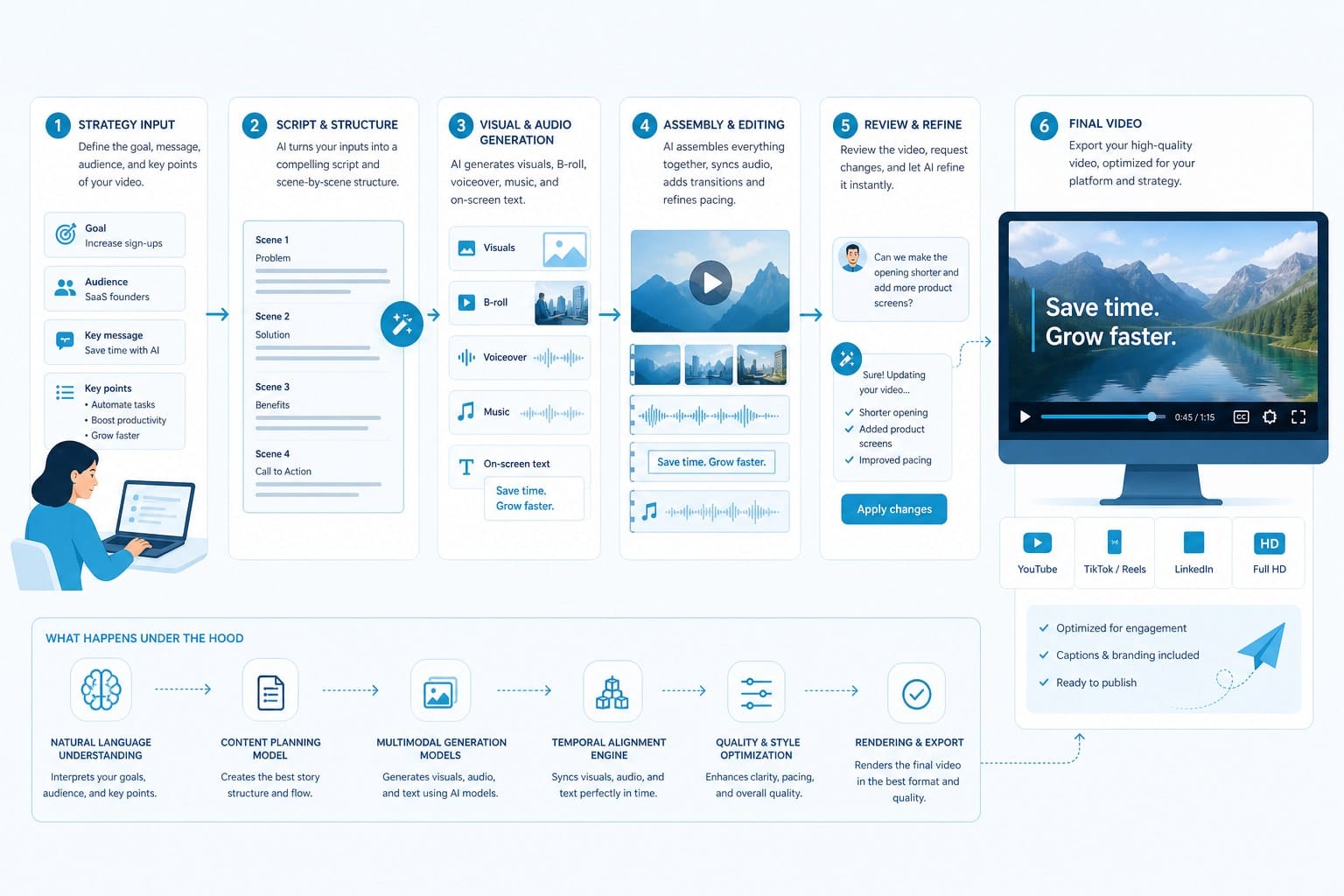
Once you have a niche, the workflow is straightforward. You identify a topic with search demand. You feed a prompt or a rough script into an AI video platform. The platform handles the research, scriptwriting, footage sourcing, voiceover, motion graphics, and editing. You review the result, fix anything that needs adjusting, and upload it with a keyword-optimized title and description. You repeat that process consistently and you have a content machine.
YouTube rewards consistency more than perfection. A channel that posts two well-researched videos per week will almost always grow faster than one that posts one polished video per month. The algorithm needs data to understand what your channel is about and who to show it to. More uploads give it more data faster. AI makes a two-per-week pace achievable for someone working part-time.
Here is what that consistency looks like in practice. After one month of posting twice a week, you have eight videos indexed in YouTube search. After three months, you have 24. Each video is a separate entry point for viewers to find your channel. Some will rank for search terms immediately. Others will pick up traffic slowly as they accumulate watch time. A growing library of videos in a specific niche builds compounding visibility over time, which is how faceless channels often reach monetization faster than channels posting less frequently.
The human role in this workflow is not zero, but it is fundamentally different from traditional video production. Instead of researching, scripting, recording, and editing, you are overseeing quality and making strategic decisions. Does this topic have enough search demand to be worth covering? Does the AI-generated script sound accurate and trustworthy? Is the pacing right for the audience? Those judgment calls matter, and they are where your time is best spent.
For creators who want a detailed look at how different AI tools fit the faceless channel production workflow, a comparison of Pictory AI vs InVideo alternatives for YouTube creators covers the key differences between platforms and where each one fits different content styles and budgets.
The revenue streams that actually pay on a faceless channel
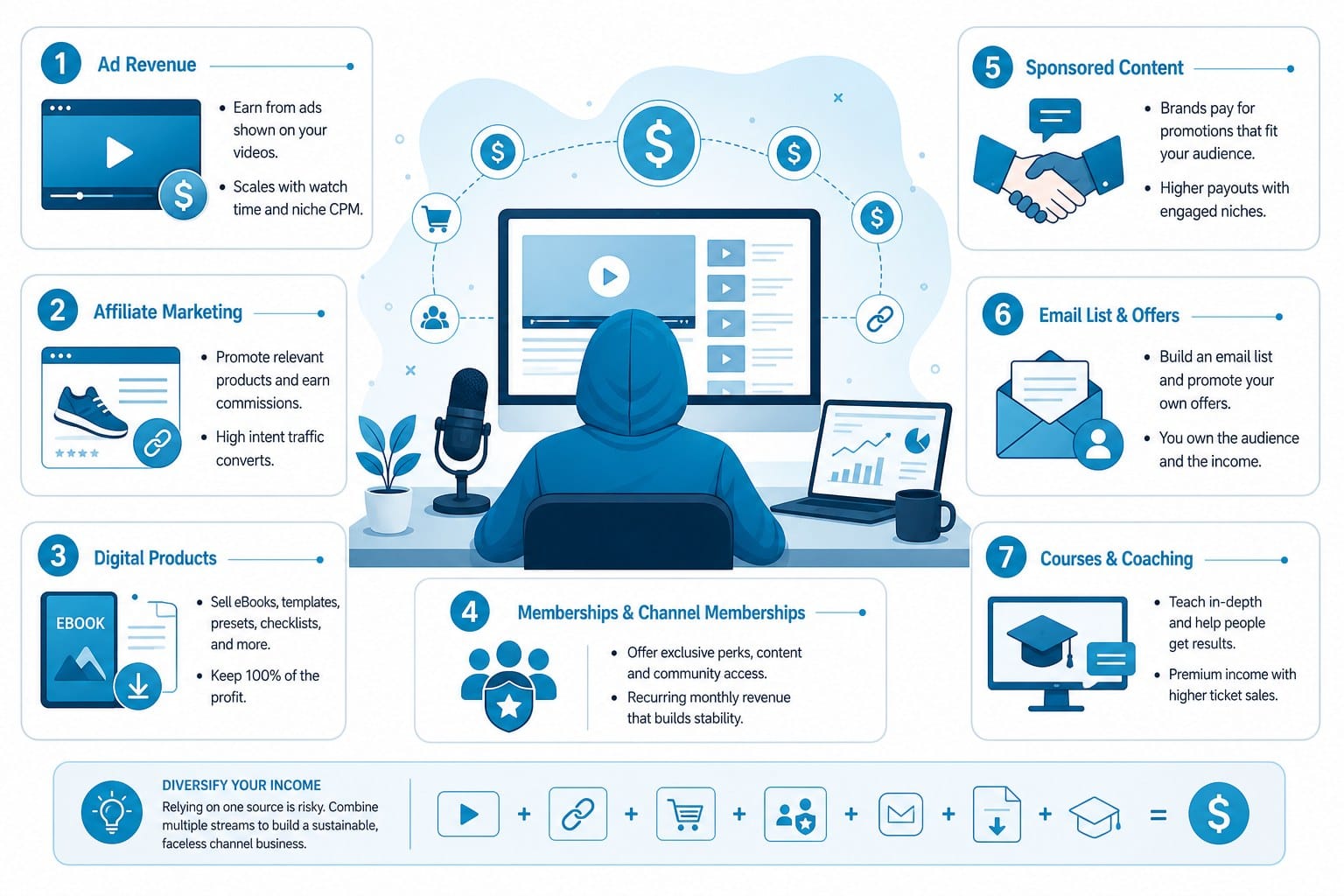
Getting into the YouTube Partner Program is the starting line, not the finish line. A lot of new creators treat ad revenue as the whole game. It is one piece of it, but depending on AdSense alone leaves significant money sitting untouched. The channels that build real income usually have three or four revenue streams working at the same time.
YouTube ad revenue through AdSense requires your channel to reach 1,000 subscribers and 4,000 watch hours within the past 12 months, or 1,000 subscribers and 10 million Shorts views within 90 days. Once you qualify and get approved, YouTube pays you a share of the ad revenue generated from your videos. The rate you earn per thousand views is called CPM, and it varies widely by niche. Finance, software, insurance, and business content regularly earns $10 to $30 CPM or higher. Entertainment and gaming content often lands much lower, sometimes under $2 CPM. Choosing a high-CPM niche from the start means the same number of views generates considerably more income. A channel earning $15 CPM in the finance space earns seven or eight times more per view than an entertainment channel at $2 CPM. That difference compounds over time.
Affiliate marketing is where many faceless channels quietly earn their largest checks. You include links in the video description to products or services relevant to your content. When a viewer clicks and completes a purchase or signup, you earn a commission. The connection between content and affiliate offer matters a lot here. A personal finance channel that recommends a budgeting app, an investment platform, or a financial book is pointing viewers toward something they already have a reason to want. A tech explainer channel recommending software tools does the same thing. The commissions on financial products and software subscriptions can be $50, $100, or more per referral. You do not need a massive audience to earn meaningful affiliate income. You need a targeted audience that finds your content trustworthy and useful. Smaller, focused audiences in high-value niches often outperform large, scattered audiences when it comes to affiliate revenue.
Sponsored content is the third major stream. Brands pay channels directly to feature a product or service in a video. Faceless channels qualify for sponsorships just as readily as personality-driven channels. What brands evaluate is audience demographics and engagement, not whether a face appears on screen. A faceless finance channel with 20,000 engaged subscribers can often command $500 to $2,000 for a sponsored segment, depending on niche and audience quality. At 100,000 subscribers in the right niche, those numbers can reach $3,000 to $10,000 per placement. Sponsorships at that level change the economics of a channel dramatically.
Beyond those three core streams, several others are worth understanding. Channel memberships allow subscribers to pay a monthly fee in exchange for perks like early access to videos, exclusive content, or community features. Digital products like PDF guides, spreadsheet templates, or short courses can be promoted directly to your audience through video descriptions and pinned comments. Some faceless channel operators build and then sell channels through online marketplaces, treating the channel itself as a product. A channel with an established niche, a consistent upload history, and early monetization can sell for a meaningful multiple of its monthly revenue.
Now here is where the AI angle becomes directly important to your revenue. AI-generated videos come with commercial rights on the platforms built for this purpose. That matters because it means you legally own the content you produce and can monetize it without copyright claims disrupting your earnings. If an AI platform does not explicitly grant full commercial rights for the videos it generates, you face real risk when running ads, accepting sponsorships, or selling the channel later. Always verify the licensing terms of any platform before you build a monetization strategy around it. Platforms designed for faceless channel creators address this directly.
YouTube Shorts adds another revenue layer that is easy to overlook. Short-form content on YouTube now has its own monetization program, and if you are already producing long-form videos, cutting them into Shorts or creating dedicated short clips around the same topics gives you more surface area on the platform. More videos across more formats means more chances for ad impressions, affiliate clicks, and subscriber growth. A viewer who finds your channel through a 60-second Short might then watch a 12-minute documentary on the same topic, generating far more watch time and ad revenue than the Short alone. AI tools that automate short-form content creation make this even more efficient to execute. The specific workflow for Shorts automation is covered in detail in this guide on AI YouTube Shorts automation: best tools for hands-free creation.
The practical picture of a faceless channel earning $3,000 to $5,000 per month almost always involves stacking multiple streams. Ad revenue alone rarely reaches that level without a large audience, which takes time to build. But ad revenue combined with two or three affiliate partnerships and one monthly sponsorship adds up fast, even at modest view counts, especially in a high-CPM niche. A channel earning $800 from AdSense, $1,200 from affiliate commissions, and $1,500 from a monthly sponsor is at $3,500 per month. None of those numbers require hundreds of thousands of subscribers. They require the right niche, consistent uploads, and a deliberate monetization setup from early on.
Something worth being direct about: none of this happens in the first few weeks. YouTube channels take time to build authority and accumulate search rankings. New videos often sit with minimal views for the first 30 to 60 days before the algorithm starts surfacing them. The advantage AI gives you is volume and consistency during that waiting period. Publishing more videos means building a larger library faster, which means more chances to rank for search queries, more total watch time accumulating, and faster progress toward monetization thresholds and sponsor conversations. Creators who commit to consistent AI-assisted publishing for three to six months tend to see results that look out of reach to people who are still trying to produce one video every few weeks entirely by hand.
One more thing worth flagging: niche authority compounds. When a channel consistently publishes accurate, useful content in a specific topic area, YouTube's algorithm starts associating that channel with that niche. Videos get recommended to viewers who have watched similar content. Search rankings improve across the whole library, not just on individual videos. That authority is what turns a modest channel into a durable income source. AI-assisted production is what makes building that authority fast enough to be worth pursuing.
How AI video generation actually works for this strategy
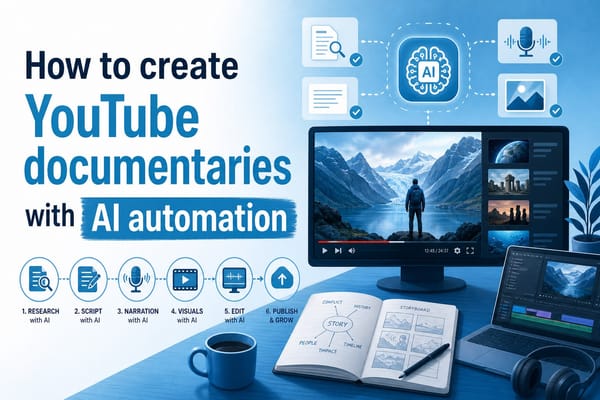
The mechanics matter here because understanding what AI actually does in this workflow helps you pick the right approach, set realistic expectations, and use your time well. When someone says they are making YouTube videos with AI without filming anything, they are not swapping in a single tool for one part of the process. They are replacing an entire five-stage production pipeline with software.
Traditional YouTube video production moves through five stages. Research involves figuring out what the video covers and gathering accurate, relevant information on the topic. Scripting turns that information into a structured narrative that holds a viewer's attention from the opening line to the final seconds. Visuals require finding or creating footage, photographs, graphics, or animations to pair with the narration. Audio involves recording or sourcing a voiceover and selecting appropriate background music. Editing assembles all of those elements into a finished video with proper pacing, transitions, and captions.
AI video platforms handle all five of those stages from a single starting point, which is usually a text prompt or a rough outline you provide. You tell the system what the video is about, specify the format you want, and it generates the rest. The major formats faceless channels use include documentary-style videos with voiceover narration and stock footage, animated whiteboard or motion graphic explainers, and listicle videos structured around ranked or numbered points.
For documentary-style content, the AI sources relevant licensed footage, writes a script structured for narrative flow, generates a natural-sounding voiceover, adds text overlays and motion graphics where appropriate, and produces a finished video ready for review. For animated explainers, it creates whiteboard-style or motion graphic animations synchronized with narration. For listicle content, it structures the script around a numbered format that performs reliably well in YouTube search and the suggested video feed because viewers know exactly what they are getting.
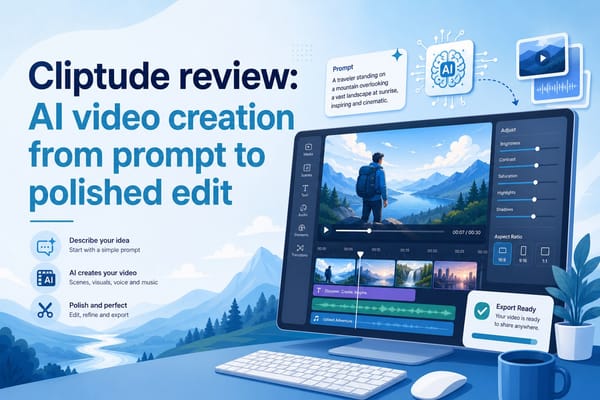
Here is what that process looks like from start to finish with a real example. Say I am building a faceless channel in personal finance. I identify a topic with strong search demand: how compound interest works, explained for beginners. I open Cliptude and type a prompt along these lines: create a 10-minute explainer video about compound interest for beginners, documentary style. The platform generates a structured script, sources footage of graphs and financial concepts from licensed libraries, adds a clear narration track, includes motion graphics to illustrate the numbers visually, and produces a video ready for review.
I watch it through from start to finish. I check that the script is accurate and that the visuals match the narration. I tighten the ending if the pacing drags. Then I upload the video to YouTube with a keyword-optimized title, a detailed description that includes the relevant search terms, and timestamps for each section. That full process takes roughly 45 minutes to an hour from prompt to published video. The equivalent manual production would take a full workday or more.
Doing that twice a week produces eight published videos in one month and 24 in three months. Those 24 videos are all indexed in YouTube search, all accumulating watch time, and all building the channel's topical authority in the personal finance niche. That library size is what accelerates growth, and it is genuinely difficult to build at that pace without AI handling the production.
Cliptude is built to handle this full pipeline. The platform researches the topic, writes the script, sources footage from licensed libraries, generates motion graphics, produces the voiceover, and delivers an edited video ready for your review. The credit-based pricing model means you only pay for what you actually produce, which keeps costs practical for a solo creator who is not publishing content every single day. The commercial rights included with the platform mean you can monetize everything you produce without licensing uncertainty hanging over your revenue.
Whiteboard and animation formats deserve specific attention because they perform particularly well for educational content. Viewers associate that visual style with clear, trustworthy explanations. A channel using well-produced whiteboard animations to cover science or history topics can build credibility quickly, even without a recognizable host persona, because the format itself signals that the content is explanatory and structured. If that format fits your niche, the detailed workflow for how AI handles whiteboard production specifically is covered in this guide on AI whiteboard video maker that scripts and animates for you.
One thing worth addressing directly: AI-generated videos still benefit from a human review step, and the best results come when the creator brings genuine judgment to the process. Is the script factually accurate? Do the visuals match what the narration is saying? Is the pacing appropriate for the audience the channel is targeting? These are questions a person needs to answer. You are not removed from the process entirely. Your role shifts from doing the production work to overseeing it, which is a far more efficient use of your time if your goal is building a channel that earns money rather than developing skills in video editing.
For creators scaling across multiple formats, working within a single platform that handles long-form documentaries, Shorts clips, and animated explainers keeps the workflow coherent. Switching between multiple specialized tools for different formats introduces friction and inconsistency. When your documentary episodes and your Shorts clips come from the same production pipeline, your channel's overall style stays consistent even as the format changes.
The commercial rights point deserves to be stated plainly one more time because it directly affects whether you can build a real business around what you produce. If the AI platform you use does not grant you full commercial rights to the videos it generates, you are exposed when you try to run ads, accept brand sponsorships, or sell the channel. Some platforms are ambiguous about this. Others are explicit. Verify the terms before you build anything around a platform.
YouTube's own policies around AI-generated content are still developing. As of now, channels can monetize AI-generated videos as long as the content meets YouTube's quality and originality standards and does not violate community guidelines. Disclosure requirements apply to synthetic media that could realistically be mistaken for depicting real people or events in misleading ways. Straightforward educational content, factual explainers, and listicle videos produced with AI do not typically trigger those disclosure requirements. Staying current with YouTube's creator policies is worth doing as the platform's rules continue to evolve.
The bigger picture here is that making money on YouTube without making videos the traditional way is not a shortcut around the work. It is a smarter allocation of effort. AI handles the production pipeline that used to consume most of a creator's time. You focus on picking topics with real demand, overseeing quality, optimizing your uploads for search, and building the monetization layer that turns views into income. That division of labor is what makes the faceless channel model genuinely sustainable for a solo creator working at scale, and it is the reason more people are building real income with this approach than at any point before.
Ready to take the next step?
If you are ready to start building a faceless YouTube channel without spending weeks learning video editing, Cliptude gives you the full production pipeline in one place. From your first prompt to a finished, polished video, the platform handles research, scripting, licensed footage, animation, voiceover, and editing so you can focus on growing your channel and earning from it. Visit Cliptude to see how it works and start producing videos that are ready to monetize.