
Free Urdu AI video generator for creators

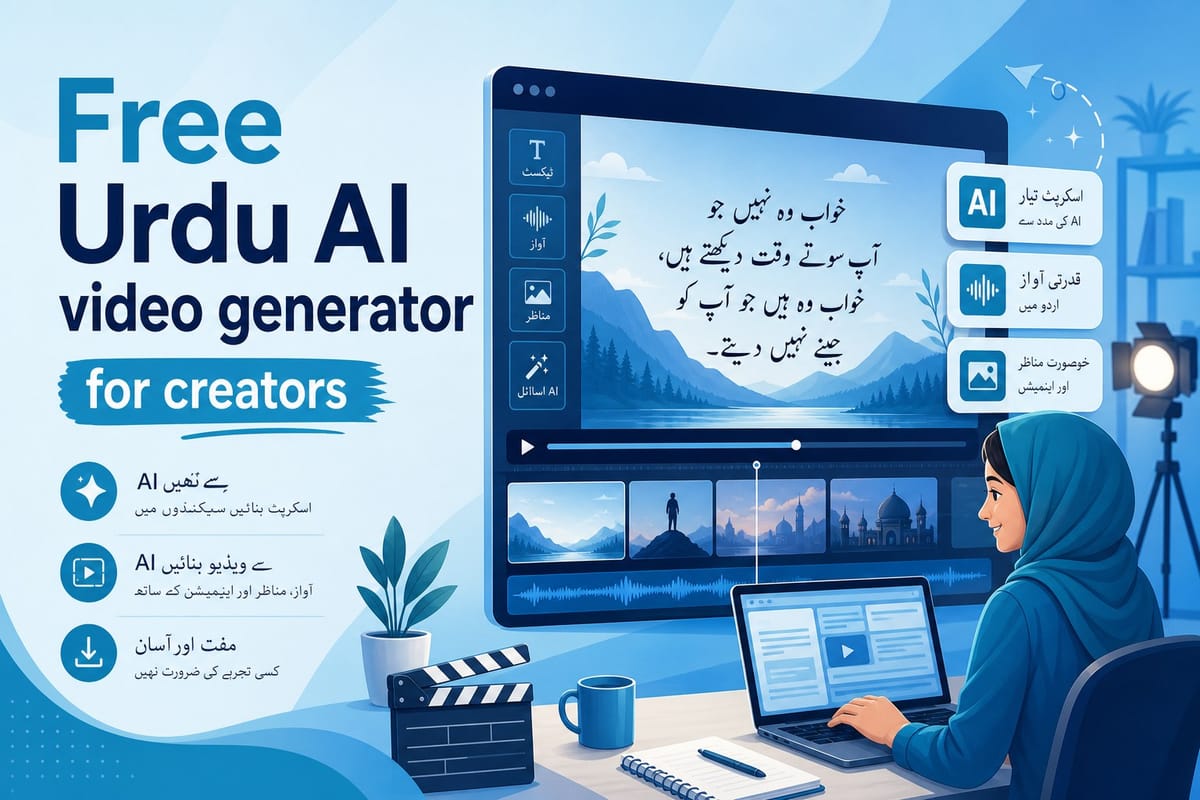
Table of contents
1. Why Urdu video content is a massive opportunity right now
2. What to look for in a free Urdu AI video generator
3. How to start producing Urdu videos with Cliptude
I want to create videos in Urdu, but I don't have a camera, a studio, or a video editing background. Sound familiar? If you run a faceless YouTube channel, a TikTok page, or an Instagram Reels account and you want to reach Urdu-speaking audiences, the production side can feel like a wall you can't climb. That's exactly why finding a reliable urdu ai video generator free option matters so much right now. In this article, I'll walk you through what to look for in an AI video tool that handles Urdu content, why Urdu is a smart language to target, and how Cliptude can help you produce polished, publish-ready videos from a simple prompt or script without touching a camera or editing timeline.
Why Urdu video content is a massive opportunity right now
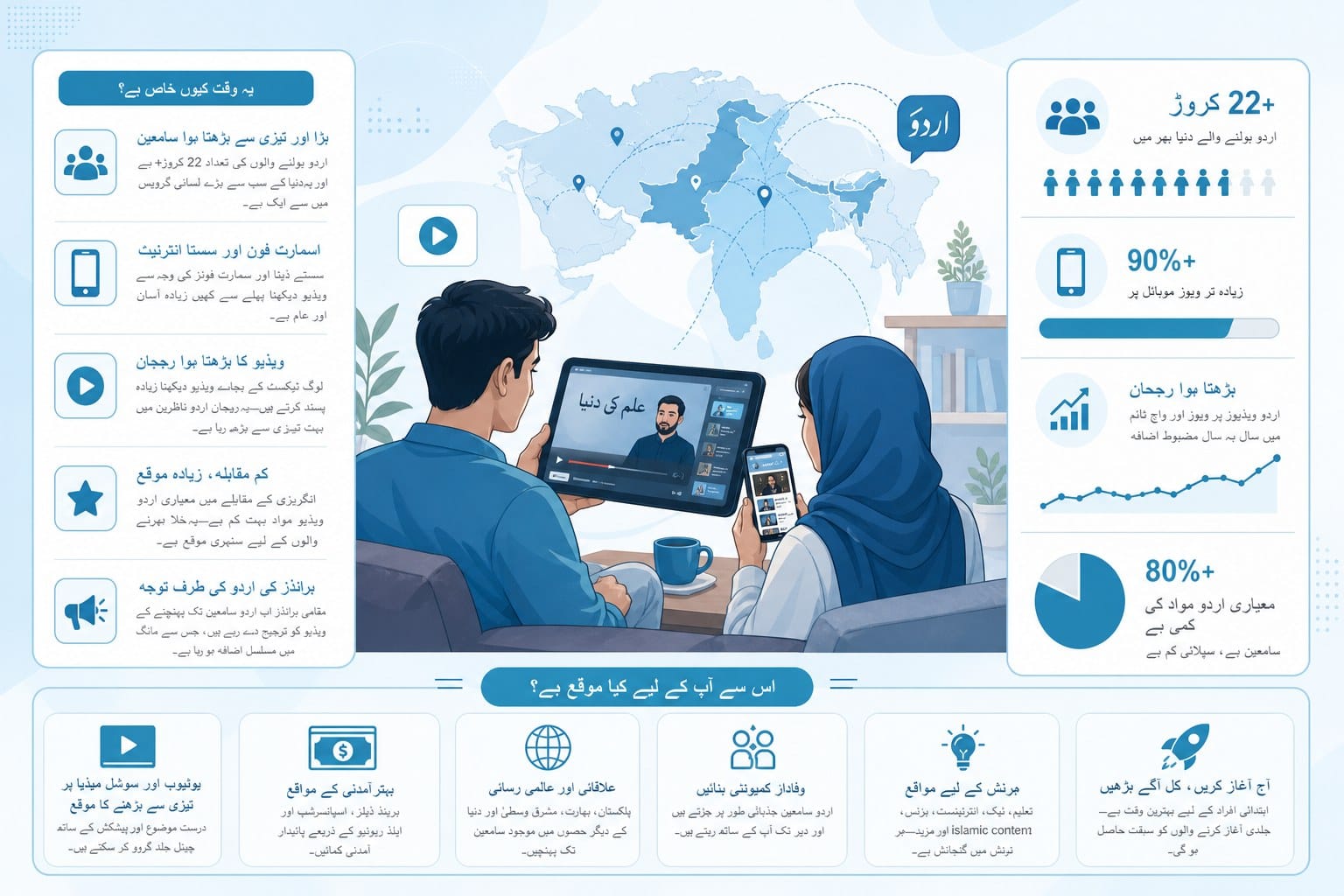
Urdu is the national language of Pakistan and is widely spoken across India, the United Kingdom, the United Arab Emirates, and large diaspora communities in North America. Conservative estimates put the number of Urdu speakers worldwide above 230 million. Despite that enormous audience, Urdu-language video content on YouTube, TikTok, and Instagram Reels is still significantly underserved compared to English, Hindi, or even Arabic content.
That gap is a real opportunity for creators. When you publish in a less crowded niche, your videos have a better chance of ranking in search results and getting surfaced by the platform algorithm. Creators have built substantial YouTube channels simply by targeting regional language audiences that bigger creators ignored because production felt too complicated or expensive.
Urdu audiences consume a wide range of content, and several formats perform especially well. Documentary-style videos about history, science, finance, and true crime pull strong watch-time numbers. Listicle videos like "Top 10 places to visit in Pakistan" or "5 habits of successful people" are consistent traffic drivers that are easy to produce at volume. Educational explainer videos on personal finance or health get shared heavily inside WhatsApp groups, which gives Urdu content an extra organic distribution channel that English content rarely benefits from in the same way. A single well-produced video on a topic like debt repayment or home remedies can circulate through dozens of family group chats and accumulate views for months after upload.
Another advantage is advertiser demand. As global brands increase spending to reach South Asian consumers both locally and in the diaspora, CPM rates for Urdu content on YouTube have been rising. Creators who established Urdu channels two or three years ago are monetizing them well now because they built their subscriber base early, before competition increased. The window to replicate that position still exists, but it won't stay open indefinitely.
The traditional barrier was always production. You needed to either speak fluent Urdu on camera, hire a voiceover artist, or find a video editor who understood the language and its script. Each of those options costs time, money, or both. AI changes that equation entirely. With the right platform, you can generate a fully produced Urdu video from a text prompt without any of those requirements. That's what makes searching for a urdu ai video generator free solution so relevant for solo creators and small media teams right now.
It's also worth noting that Urdu and Hindi share the same spoken form. Written Urdu uses Nastaliq script while written Hindi uses Devanagari, but the spoken language is mutually intelligible at a conversational level. Content you create for an Urdu-speaking audience often has genuine crossover appeal for Hindi speakers. That doubles your potential reach without doubling your workload. I explored a similar dynamic in the context of how to make an AI video in Nepali language, and the core logic applies directly here: regional language content is underproduced relative to demand, and AI tools are closing the production gap fast.
Finally, consider the faceless channel model specifically. Urdu audiences are comfortable with narration-driven, footage-based videos. Successful Urdu documentary channels regularly pull hundreds of thousands of views per upload without ever showing a host on screen. The narrator's voice carries the video, and supporting footage provides the visual layer. That means the faceless format, where an AI voiceover drives the video over stock footage, motion graphics, or animation, fits Urdu viewer expectations perfectly. You're not asking the audience to accept a format they're unfamiliar with. You're working within a format they already watch and enjoy.
For context, consider what that means for your production requirements. You don't need a camera. You don't need a studio. You don't need to speak Urdu fluently. You don't need to hire a voice actor or an editor. You need a script or a topic, an AI video platform capable of handling Urdu, and a publishing schedule. That's the entire production stack. And the output can be competitive with channels that spent far more to produce their content.
The creators who recognize this combination of low production cost, large underserved audience, and growing advertiser interest early are the ones who will be sitting on established Urdu channels two years from now when the niche gets more crowded. The window is open. The question is whether you step through it.
What to look for in a free Urdu AI video generator
Not every AI video tool handles Urdu well. Before you spend hours learning a platform only to discover it can't render Urdu script correctly or the voiceover sounds like a translation engine from 2010, you need to know which features actually matter for this specific use case. Let me break down the key capabilities you should evaluate.
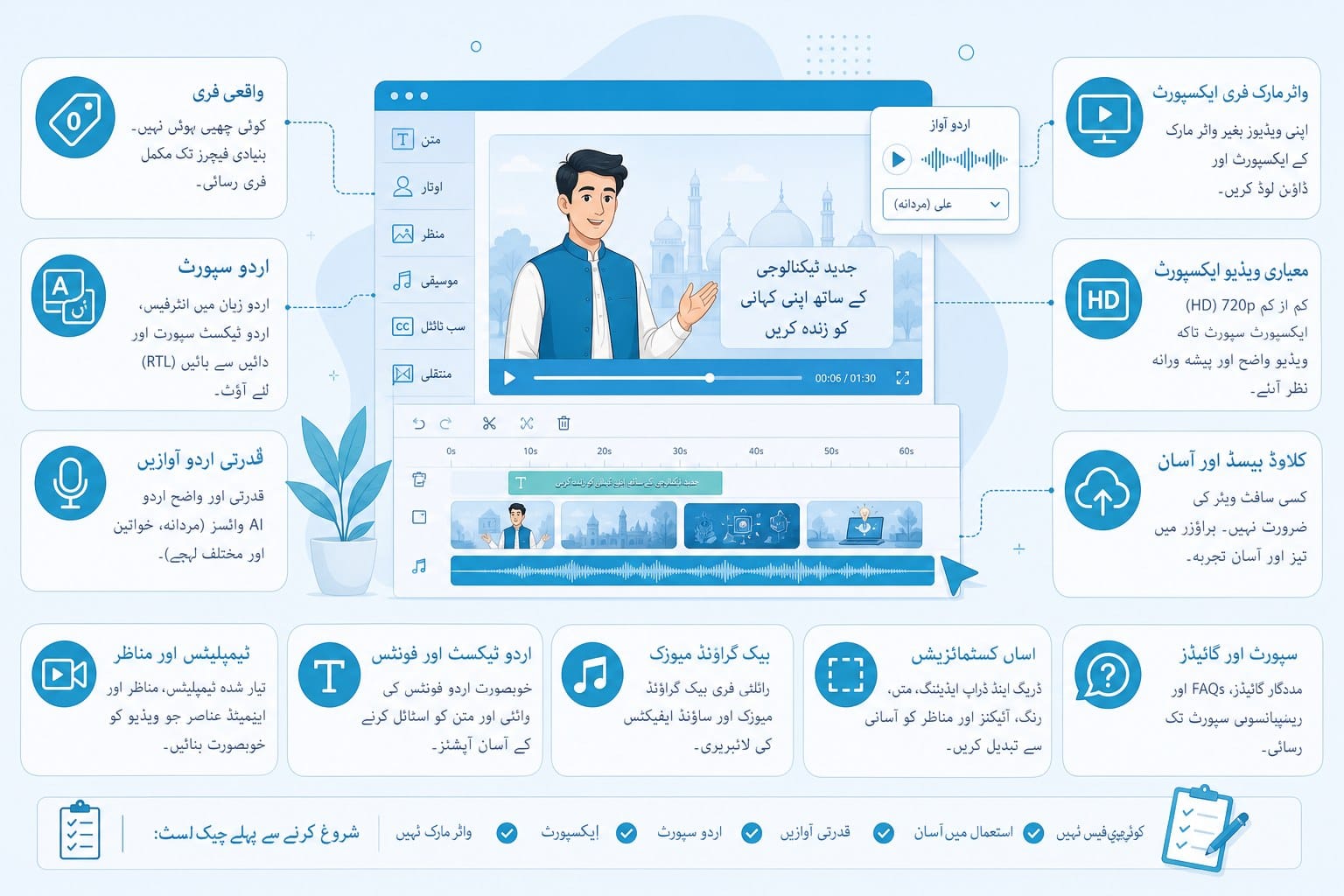
Native Urdu script support
Urdu is written in Nastaliq or Naskh script and reads right to left. Many AI platforms are built primarily around left-to-right Latin script, and their text rendering systems don't support right-to-left languages properly. If the platform doesn't explicitly support right-to-left text, your captions and text overlays will either display as garbled characters, render individual letters disconnected from each other, or simply not appear. Test this before committing to any tool. Paste a line of Urdu text into the caption or overlay field and confirm it renders cleanly and in the correct direction. This is a non-negotiable baseline.
Natural-sounding Urdu voiceover
This is probably the most important feature for Urdu content, and it's where most generic AI video tools fall flat. A stiff, robotic voice will drive viewers away regardless of how strong your script is. Urdu has a distinctive rhythm and intonation. The best AI voice systems for Urdu use neural text-to-speech models trained on native Urdu speech patterns rather than just running a generic voice through a language model. Listen to samples before deciding on any platform. The voice should sound like someone you'd hear on a Pakistani news broadcast or a well-produced YouTube education channel. If it sounds mechanical or mispronounces common Urdu words, move on.
Automated research and scripting
If you're a solo creator, writing every Urdu script from scratch is not a realistic long-term workflow. You'll burn out before you build a library. Look for a platform that can take a topic prompt and produce a full, well-structured script around it automatically. This is where most basic free tools fall short. They accept scripts you've already written, but they don't help you create them. A platform that handles research and scripting as part of the generation process saves you several hours per video, which compounds into weeks of saved time over the course of a year.
Footage and asset sourcing
A finished video needs more than a voiceover. It needs relevant footage clips, background music, text overlays, and motion graphic elements. The best platforms source all of this automatically based on the content of your script. You shouldn't have to manually browse stock libraries for every clip. When you're producing a documentary about the Mughal Empire, the platform should understand that your script calls for footage of historical monuments, maps, and period visuals, and pull appropriate assets without you specifying each one.
Output quality and format flexibility
YouTube requires at least 1080p resolution for monetization. Short-form platforms like TikTok and Instagram Reels need a vertical 9:16 format. A capable AI video tool should produce both horizontal and vertical outputs without requiring you to manually reformat or re-edit. Confirm resolution options before you commit, and check whether the platform exports clean files without a watermark on its usable plan tiers.
Pricing that reflects how creators actually work
Many platforms advertise free plans but restrict you to five-second watermarked previews. That's not genuinely useful for anyone who wants to publish consistently. What serious creators need is low-cost access with a clear path to scale. Usage-based credit pricing is the most practical model for most content creators, especially those just starting an Urdu channel. You pay for the videos you actually produce rather than subscribing to a monthly plan that charges you for capacity you don't use yet. This matters especially during the testing phase, when you're still figuring out which video topics and formats resonate with your audience.
Commercial rights
If you plan to monetize your Urdu videos on YouTube or produce content for clients, you need full commercial rights to the output. Some free tools include terms that prevent commercial use of generated content. Read the fine print carefully. A platform that restricts monetization is effectively unusable for anyone building a content business.
How Cliptude measures up
When I evaluated Cliptude against these criteria, it stood out as a strong match for Urdu content creators. The platform handles the complete production pipeline: research, scripting, voiceover, footage sourcing, motion graphics, music, and final editing, all triggered by a single prompt or script input. It supports multiple languages and output formats, including the documentary and listicle styles that perform best for Urdu audiences. It uses usage-based credit pricing, so you're not paying for an enterprise subscription before you've confirmed that the output meets your quality standard.
You can read a detailed overview of how the platform works here: Cliptude: the AI platform that turns prompts into polished videos.
I also want to address the "free" question directly, because it deserves honesty. Truly free AI video generation with professional-grade output is rare. The platforms that offer unlimited free access almost always limit resolution, add watermarks, cap video length, or restrict commercial rights. None of those constraints work for a creator who wants to publish monetizable content. The more realistic expectation is low-cost access with flexible scaling, not a permanently free tier that produces publish-ready videos indefinitely. Usage-based pricing gets you closest to that outcome because you control exactly how much you spend based on how many videos you produce.
If you've tested other platforms and found their Urdu output lacking, the comparison in Vidrush referral code alternatives and how Cliptude compares gives a clear breakdown of how different tools stack up for faceless content creators specifically. It's worth reading before you decide where to invest your time learning a new platform.
How to start producing Urdu videos with Cliptude
Let me walk through a practical workflow so you can see exactly how to use Cliptude to create Urdu video content, even if you have no video editing experience and no Urdu-speaking ability yourself.
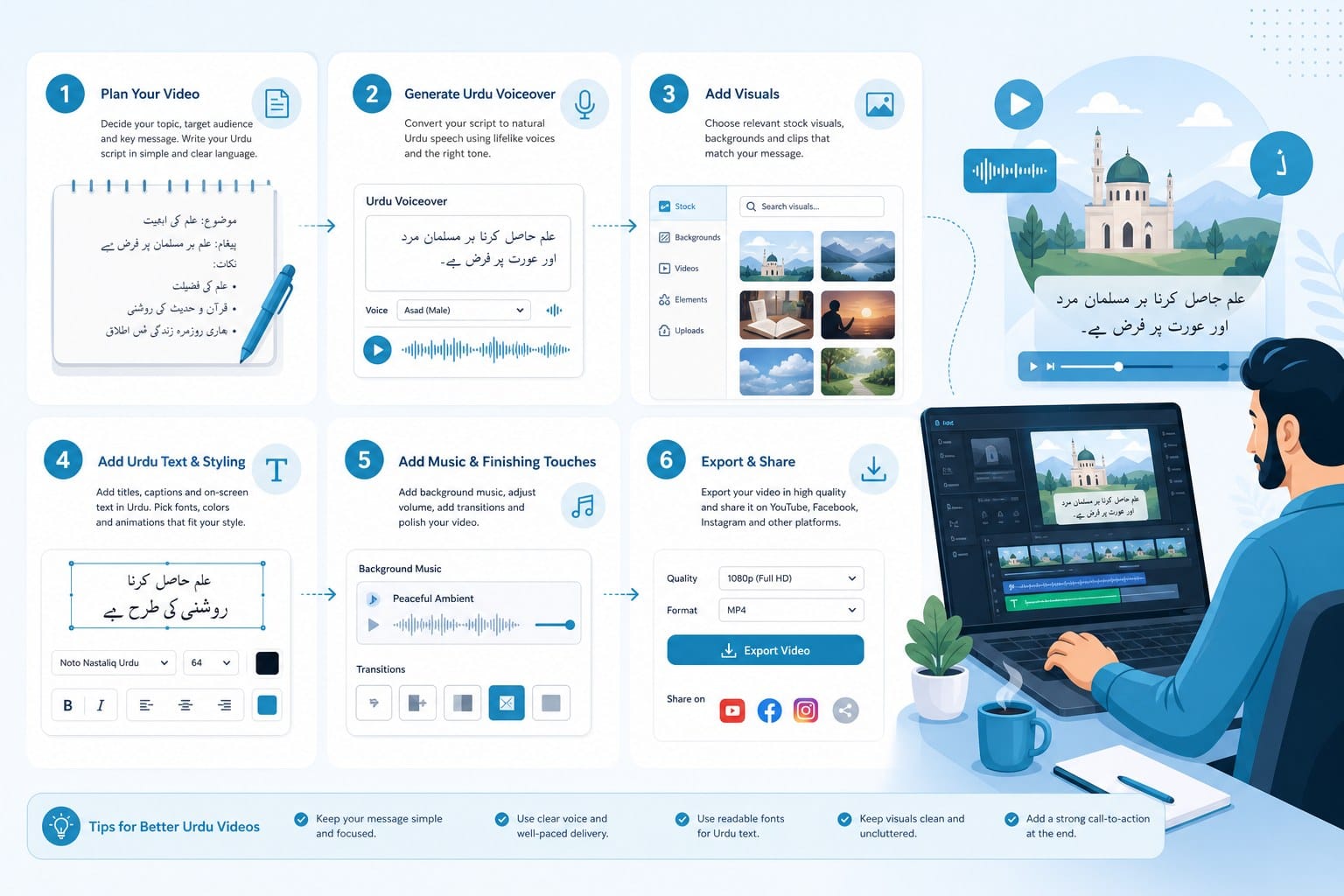
Step one: pick your topic and format
The most important decision you make before touching any tool is choosing what type of video to create. For Urdu audiences, documentary-style content performs consistently across view count, watch time, and subscriber growth. Topics like the history of Lahore, the science of fasting during Ramadan, the rise of Pakistan's textile industry, or the top ten inventions by Muslim scientists draw large engaged audiences that have genuine interest in the subject matter and watch through to the end.
Listicle formats convert well for both views and shares. Titles like "7 Pakistani foods you must try before you die" or "5 business lessons from the most successful entrepreneurs in Karachi" are the kind of content that gets clicked from search results and shared inside WhatsApp groups. They're also easy to produce at volume because the format is consistent from video to video. Once you've built a production workflow for a listicle, you can repeat it with a different topic in roughly the same amount of time.
For short-form content on TikTok and Instagram Reels, focus on single-insight videos. One fact, one historical story, one counterintuitive lesson per clip. Keep it under 60 seconds and front-load the most interesting detail in the first three seconds before the viewer scrolls away. Urdu short-form content is still an open field on most platforms, and algorithms actively push content in underserved languages to relevant audiences when engagement signals are strong.
Choose your niche before you choose your topic. A history channel, a personal finance channel, and a travel channel each attract a different type of viewer and serve a different advertiser category. Picking a lane early lets you build a consistent subscriber base faster than publishing across multiple unrelated topics.
Step two: enter your prompt or script
Open Cliptude and describe your video. You can be specific or broad depending on how much control you want over the output. A specific prompt might read: "Create a 10-minute documentary in Urdu about the history of the Mughal Empire, covering their architectural achievements, political structure, and cultural legacy. Use a formal but engaging narrator tone suitable for an educated general audience." That level of detail gives the AI clear direction on length, language, subject matter, scope, and tone.
If you prefer to give the platform more room to structure the content, a shorter prompt like "Urdu documentary about the Mughal Empire" works too. The platform researches the topic and builds the script structure on its own.
If you already have a finished script written in Urdu, paste it directly. The platform accepts both prompt-based and script-based inputs. For creators who are more comfortable writing in English but want Urdu output, you can write your prompt in English and specify that the video should be produced in Urdu. The AI handles language conversion as part of the generation process, so you're not required to write the script in Urdu yourself.
For short-form content, your prompt can be much more concise. "60-second Urdu Reel about the ancient city of Mohenjo-daro, conversational tone, one surprising fact per sentence" is enough to generate a complete vertical video script with voiceover.
Step three: review the generated script and voiceover
Before the platform renders the full video, you'll have an opportunity to review the script. Read through it carefully. Confirm that the Urdu text is accurate, the tone matches your channel's style, and the structure flows logically from the opening hook to the closing. Pay particular attention to proper nouns, dates, cultural references, and any statistics. AI-generated scripts are generally well-researched, but a quick editorial pass catches any issues before they make it into the final video.
If any section needs adjustment, edit it directly before approving. Changing a paragraph at this stage takes seconds. Catching an error after the video is fully rendered and uploaded takes much longer to fix.
Listen to the voiceover preview and confirm the pronunciation and pacing feel natural. Urdu has regional accent variations, and the tone appropriate for a formal documentary about the Mughal Empire is different from what you'd want for a casual cooking tip on TikTok. If the platform offers voice options, choose the one that fits your channel's established style. Consistency in voice across your uploads helps viewers recognize your content and builds a sense of channel identity even without a visible host.
Step four: let the platform source footage and assemble the video
Once you approve the script and voiceover, Cliptude sources footage clips, background music, and motion graphic elements automatically based on the content of your script. For a Mughal Empire documentary, it pulls in footage of historical monuments, aerial shots of relevant locations, archival-style map animations, and visual assets that reinforce what the narrator is describing at each moment. For a personal finance explainer, it might use motion graphics, on-screen text highlights, and clean background footage that keeps the viewer's attention on the information being delivered.
You don't manually select clips. The AI matches footage to script segments based on the subject matter and pacing of the narration. This is the part of the workflow that saves the most time for creators who previously built videos the traditional way. A faceless channel creator who used to spend six to eight hours per video sourcing footage, syncing it to a voiceover, and assembling an edit in a timeline can now get that entire step done automatically. The hours you save go back into research, topic selection, publishing strategy, and audience engagement.
For creators who want animated content rather than footage-based video, the platform can produce animation styles that sync with the narration. This works especially well for educational content where abstract concepts benefit from visual illustration rather than stock footage.
Step five: export and publish
Once the video is rendered, download it in the format your platform requires. For YouTube long-form content, export in 1080p horizontal. For Reels and TikTok, export in vertical 9:16. Cliptude produces output with commercial rights included, so you can publish directly to monetized channels without worrying about licensing restrictions.
When you upload to YouTube, pay close attention to your title, description, and tags. Use Urdu script in your title and description, not just Roman Urdu transliteration. Viewers who type Urdu search queries into YouTube predominantly use Urdu script. Including both script and transliteration in your description covers both search behaviors and improves your visibility across different segments of the Urdu-speaking audience. Add relevant tags in Urdu script as well, and fill out the full description with context about the video topic. A longer, keyword-rich description gives the algorithm more signals to work with when deciding who to recommend your video to.
Building a publishing system that scales
A few practical principles will help you grow faster once you start publishing regularly.
Consistency matters more than perfection at the start. An Urdu audience that finds a channel posting two solid videos per week will subscribe and return far more reliably than a channel that posts one exceptional video every six weeks. Build a schedule you can maintain with the production time you actually have, then stick to it.
Use Shorts and Reels as discovery tools even if your main content is long-form. Publishing a 30-to-60-second Urdu Short every few days dramatically expands your reach to new viewers who haven't found your main channel yet. A Short that performs well on its own can funnel hundreds of new subscribers to your long-form content, which is where your actual watch time and monetization revenue come from.
Engage with your comment section. Even brief responses to viewer comments signal to the algorithm that your channel has an active community. Urdu-speaking viewers who feel acknowledged in their own language are more likely to become regular subscribers and share your content with others.
For creators who want to run multiple channels simultaneously, the credit-based pricing model makes it financially practical. You can produce content for a history channel, a finance channel, and a travel channel without hiring a separate team for each. Each prompt becomes a new video. Each video becomes a potential revenue stream. The overhead stays low while the output scales.
The combination of low production cost, a large underserved audience, and growing advertiser interest in reaching South Asian consumers is exactly the kind of market condition that rewards early movers. Channels that establish themselves in the Urdu space over the next year will have a meaningful head start over channels that enter later when the niche becomes more competitive. Start with one clear niche, produce five to ten videos to test what resonates, and scale from there. Cliptude makes it possible to run that test quickly and cheaply, without a large upfront investment in equipment, software, or production staff.
Ready to take the next step?
Ready to start creating Urdu videos without a camera, editing software, or a production team? Head to Cliptude and turn your first prompt into a fully produced, publish-ready Urdu video today.



