
How to make an AI video in Nepali language

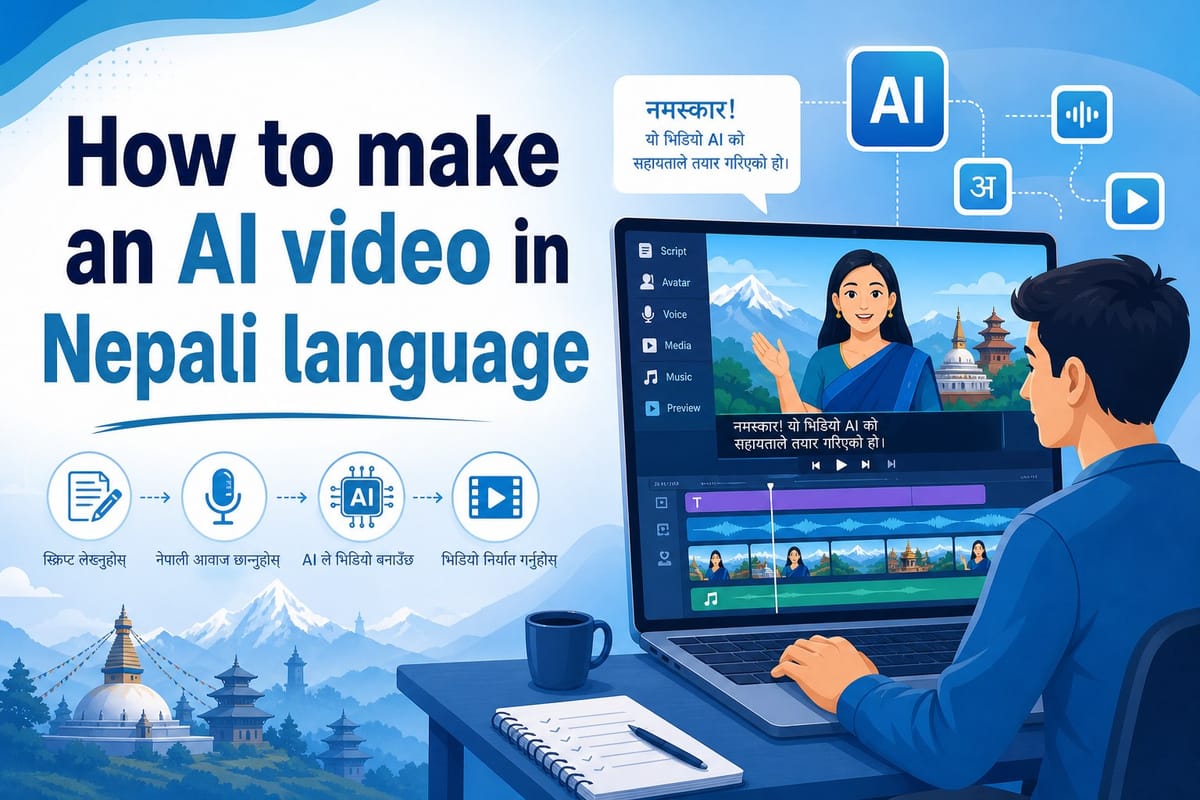
Table of contents
1. Why making AI videos in Nepali is a real opportunity right now
2. How to set up your workflow to create Nepali-language AI videos
3. Scaling your Nepali AI video channel and making it profitable
I want to show you exactly how to make an AI video in Nepali language, step by step. Whether you run a faceless YouTube channel, create educational content, or want to grow an audience in Nepal and the Nepali-speaking diaspora, this guide covers everything you need. The process is more straightforward than most people expect, and you do not need any video editing skills, a camera, or a recording studio to get started. AI video tools have changed the game for creators who want to produce professional content in regional languages, and Nepali is no exception. By the end of this article, you will know which tools to use, how to set up your workflow, and how to publish polished Nepali-language videos that your audience will actually watch.
Why making AI videos in Nepali is a real opportunity right now
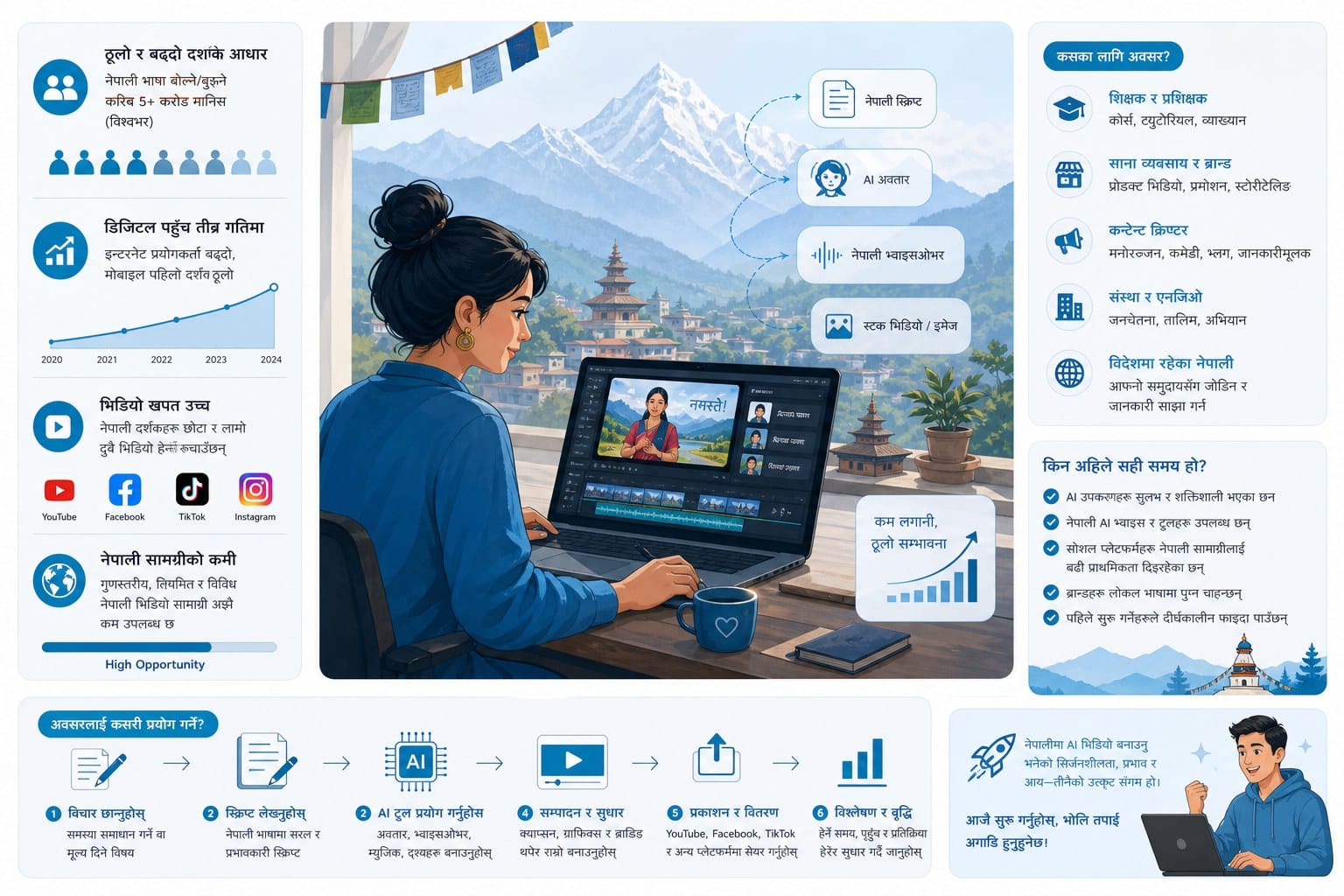
Nepali is spoken by roughly 17 million people in Nepal alone, with millions more across India, Bhutan, and the global diaspora in countries like the United States, Australia, and the United Kingdom. Despite that reach, Nepali-language content on YouTube and other platforms is still relatively thin compared to English, Hindi, or even Bengali. That gap is an opportunity.
When you produce high-quality video content in Nepali, you enter a space with lower competition and a highly loyal audience. Viewers who find content in their native language tend to watch longer, subscribe faster, and share more actively. That behavior translates directly into better watch time, stronger channel growth, and real monetization potential.
AI video tools make this opportunity accessible right now because you no longer need to hire a production team, a Nepali voiceover artist, or a professional editor to create polished content. Modern AI platforms handle scriptwriting, voiceover generation, footage sourcing, motion graphics, and editing automatically. You just supply a topic or a script, and the platform builds the video.
The timing also works in your favor because YouTube and other platforms are actively expanding their regional language support. Nepali-language channels are getting recommended to diaspora audiences worldwide, which means a video you publish today can reach viewers in Kathmandu, Darjeeling, Doha, and Dallas at the same time.
For faceless channel creators, this is especially powerful. You never have to appear on camera. You do not need to speak Nepali yourself if you are creating content for a Nepali-speaking audience. The AI handles the language layer while you focus on choosing topics your audience cares about. That separation of tasks is what makes scaling a Nepali-language channel realistic for a solo creator or a small team.
I have also seen creators use Nepali-language videos as a secondary channel strategy alongside their English content. They repurpose the same research and script structure, translate it into Nepali, and publish it on a separate channel. Because the production cost with AI tools is low, the second channel becomes nearly pure upside with minimal extra effort.
The market for educational content in Nepali is particularly strong. Topics like personal finance, health, technology explainers, history, and geography perform well because viewers in Nepal and the diaspora actively search for this information in their language. If you have knowledge in any of these areas, you already have a content advantage.
How to set up your workflow to create Nepali-language AI videos
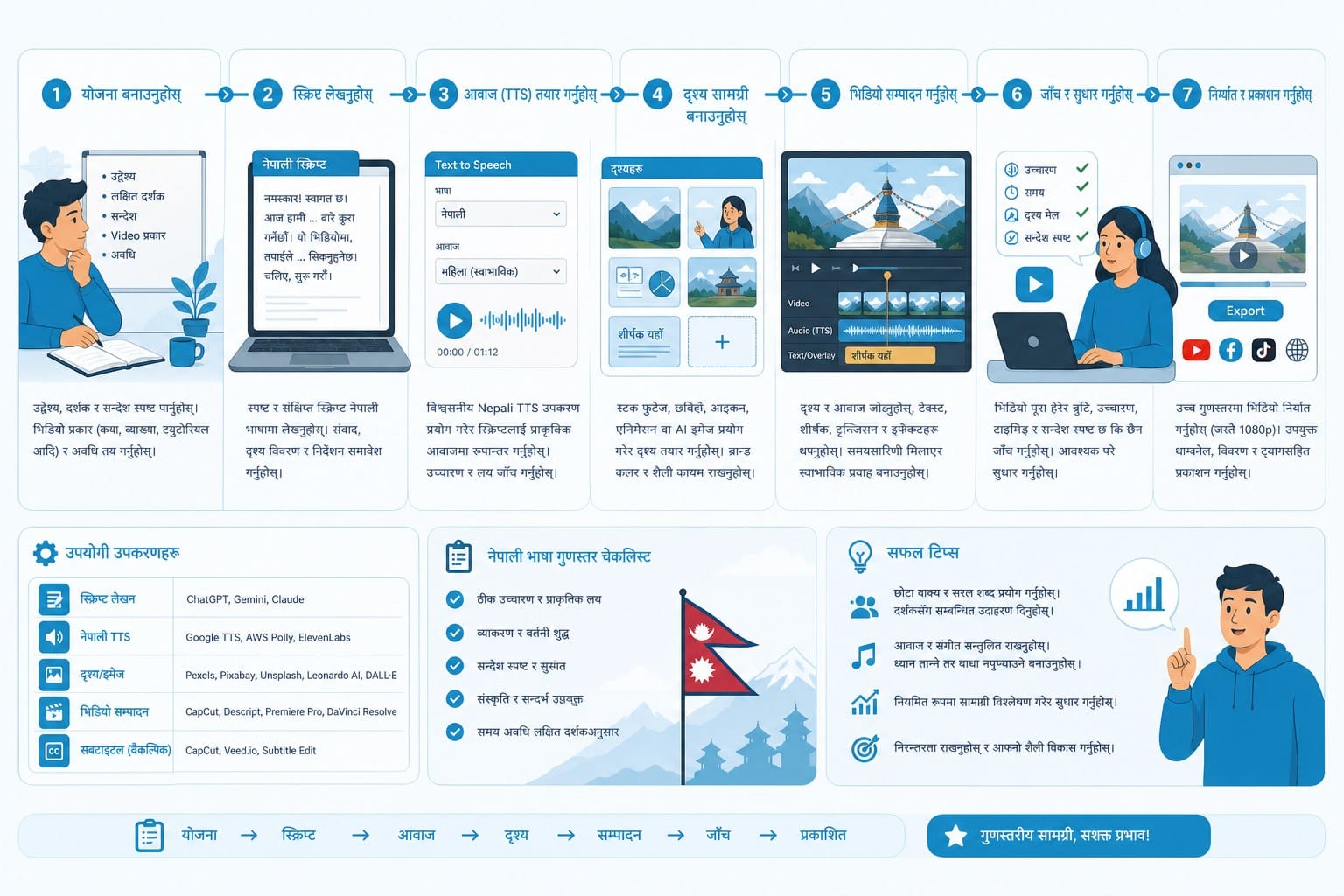
Learning how to make an AI video in Nepali language comes down to four core steps: choosing your topic, preparing your script in Nepali, selecting your AI video platform, and configuring the language and style settings correctly. I will walk through each one in detail.
Step 1: Choose a topic that works in Nepali
Start by thinking about what your Nepali-speaking audience actually searches for. Use YouTube's search bar and type queries in Nepali script to see what autocomplete suggestions come up. You can also use Google Trends and filter by Nepal to find topics with growing interest. Categories that consistently perform well include history of Nepal, Himalayan geography, Nepali festivals and culture, immigration and visa topics for Nepal citizens, health and wellness in the Nepali context, and technology news relevant to South Asia.
Pick a topic you can explain clearly, even if you are not an expert. AI tools will help you research and structure the content, but having a clear direction makes the whole process faster and the final video more focused.
Step 2: Write or generate your script in Nepali
You have two main options here. The first option is to write the script yourself in Nepali if you are comfortable with the language. Keep sentences short, use everyday vocabulary, and avoid overly formal or literary Nepali unless your audience expects that tone. Think about how a teacher or a trusted friend would explain the topic, and write in that voice.
The second option is to write your script in English and then translate it into Nepali. You can use translation tools to get a working draft, then review and edit it for natural flow. If you are not fluent in Nepali, find a native speaker to review the translation before you finalize it. A script that sounds natural in spoken Nepali will always perform better than a literal translation that feels stiff.
For creators who want the AI to handle the scripting step entirely, platforms like Cliptude: the AI platform that turns prompts into polished videos can generate full scripts from a simple prompt. You describe your topic and the key points you want to cover, and the AI writes a structured script ready for video production. You can then translate that script into Nepali or paste a Nepali-language script directly.
Step 3: Choose the right AI video platform
Not every AI video tool handles non-English languages well. When evaluating a platform for Nepali-language content, you need to check three things: voiceover language support, text rendering in Nepali script (Devanagari), and the ability to accept a custom script.
Voiceover support is the most important factor. The platform needs to either have a Nepali text-to-speech voice or allow you to upload your own audio narration. Some platforms support Nepali as part of a broader South Asian language pack. Others focus on English and a handful of European languages, which means you would need to handle the audio separately.
Devanagari script rendering matters if you want on-screen text, captions, or subtitles in Nepali. Not all video platforms render Devanagari correctly, so test this before you commit to a workflow. You can always add captions manually after the video is generated, but having the platform handle it natively saves significant time.
Custom script support is essential because you want to control the narration. Platforms that only work from a prompt and do not let you paste your own script are harder to use for regional language content. Look for platforms that accept a full script as input.
Cliptude gives you a flexible input system where you can work from a prompt or drop in your own script. The platform then handles footage sourcing, motion graphics, and editing automatically. For creators building Nepali-language faceless channels, that combination of script control and automated production is exactly what you need to move fast without sacrificing quality.
Step 4: Configure your video style and language settings
Once you have your platform and your Nepali script ready, set your video format. For YouTube long-form content, a documentary or explainer style works well for educational topics. For YouTube Shorts, TikTok, or Instagram Reels, choose a vertical format with faster pacing and punchy visuals.
If your platform offers animation styles like whiteboard or stickman animation, consider using those for educational explainer videos. Animation works particularly well for topics where stock footage is limited, and it gives your channel a distinct visual identity. For culturally specific Nepali topics where stock footage of Nepal may be limited in some libraries, animation is often the smarter choice.
Set your captions or subtitles to Nepali if the platform supports it, or plan to add them afterward using a caption tool. Captions are important for accessibility and also for viewers who watch with the sound off, which is a significant portion of social media viewers.
Finally, review the output before publishing. Even with strong AI tools, a quick review catches any errors in the script, pacing issues, or footage that does not match the narration. Budget ten to fifteen minutes for a final review and any adjustments before you export.
Step 5: Add finishing touches for Nepali audience expectations
Nepali viewers respond well to a warm, respectful tone. If your content covers cultural, historical, or religious topics, be accurate and show genuine respect for the subject. Check that place names, personal names, and cultural references are spelled correctly in both Nepali script and any romanized text you use.
Create a thumbnail that includes Nepali text, because thumbnails with the native language text consistently get higher click-through rates from Nepali-speaking audiences. Use bold, readable fonts and keep the text short, ideally three to five words that tease the video's main point.
Write your YouTube title, description, and tags in Nepali. This is one of the most underrated steps for channel growth. When you publish with Nepali metadata, YouTube's algorithm understands who to recommend your video to, and your content surfaces in searches conducted in Nepali rather than only in English results.
Scaling your Nepali AI video channel and making it profitable
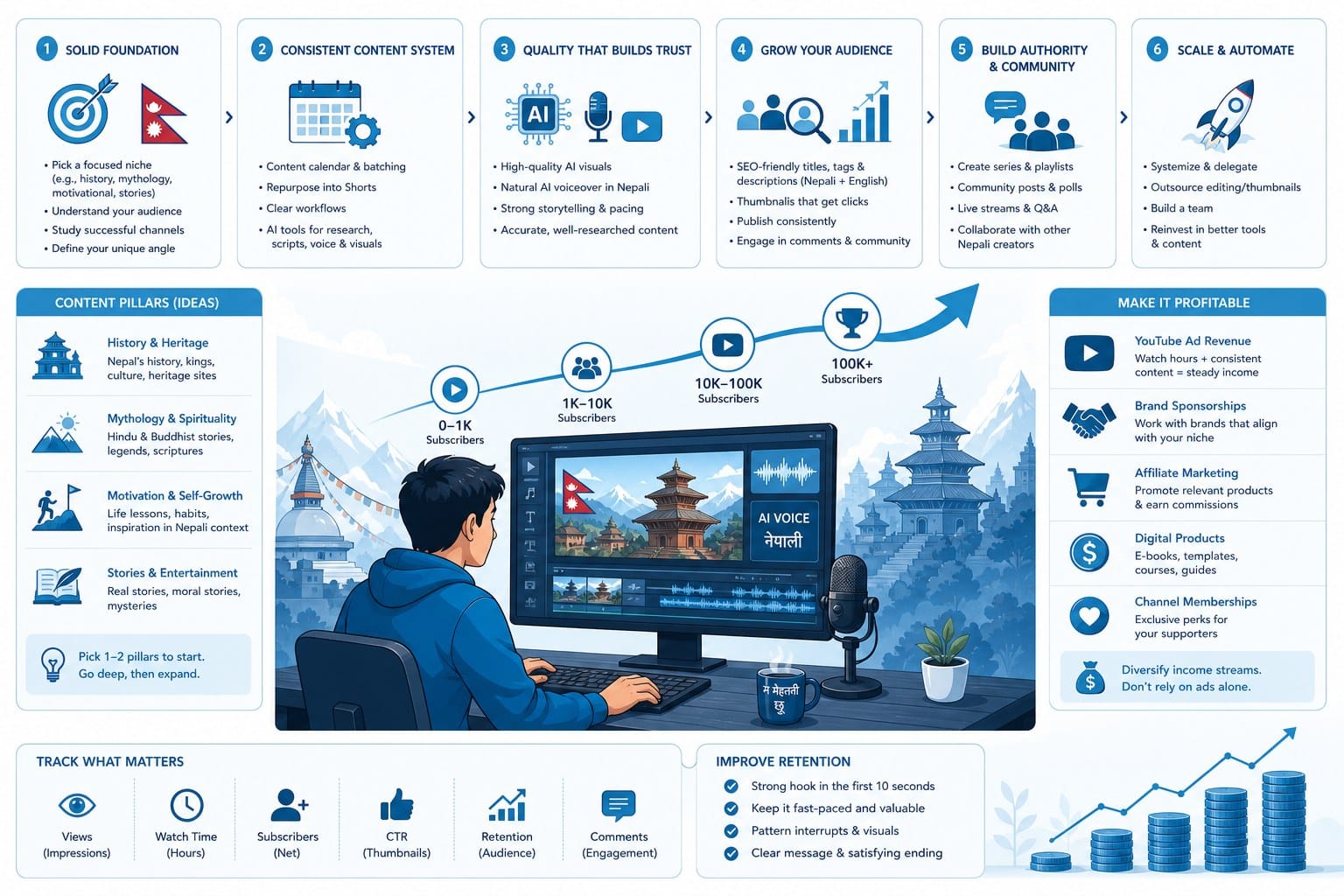
Once you have published your first few Nepali-language AI videos, the next goal is to build a consistent publishing schedule and start generating revenue. Scaling with AI tools is much more realistic than scaling a traditional video production workflow because the cost and time per video stays low even as your output increases.
Building a publishing schedule
Consistency matters more than volume in the early stages of a channel. Start with one video per week and hold that pace for at least three months before increasing. This gives you time to refine your workflow, see what topics perform best with your audience, and build up a catalog of videos that work together to drive subscribers.
Use a simple content calendar. Plan your topics four weeks ahead so you are never scrambling for ideas at the last minute. Group related topics together so you can publish them as a mini-series, which keeps viewers watching multiple videos in one session and boosts your overall watch time metrics.
With an AI video platform, producing one Nepali-language video per week is manageable even for a solo creator. The research and scripting step typically takes the most time, especially when you are translating or reviewing a Nepali script. As you get faster at the scripting step, you can increase your output to two or three videos per week without burning out.
Monetization options for Nepali-language content
YouTube AdSense is the most straightforward monetization path. To qualify, you need 1,000 subscribers and 4,000 watch hours in the past 12 months. Nepali-language channels can achieve this in six to twelve months with consistent publishing and good topic selection. CPM rates for Nepali-language content are generally lower than English-language content, but the lower competition means it is easier to rank and get views.
Channel memberships and Super Thanks are available once you reach the monetization threshold, and loyal Nepali-speaking audiences are often willing to support creators who produce quality content in their language. This is particularly true for diaspora viewers who feel a strong connection to content about their homeland culture, language, and history.
Affiliate marketing works well for educational and information-based Nepali channels. You can recommend products or services relevant to your audience and earn a commission on sales. Financial tools, learning platforms, and travel-related services all have affiliate programs that could be a natural fit depending on your channel's topic focus.
Sponsored content is another revenue stream that becomes available as your channel grows. Brands targeting the South Asian market or the Nepali diaspora may pay for sponsored segments in your videos. Because Nepali-language channels with a real audience are still relatively rare, you can often command reasonable sponsorship rates even at a smaller scale.
For creators who want to move beyond one channel, the AI video workflow makes it practical to run multiple channels simultaneously. You can operate an English-language channel and a Nepali-language channel in parallel, repurposing research and script structures across both. The AI platform handles the production for each channel independently, so you are not doubling your workload in a linear way.
Tracking what works and improving over time
Pay close attention to YouTube Analytics after you publish your first ten to twenty videos. Look at average view duration, click-through rate, and which topics bring in the most subscribers. In the Nepali content space, you will likely find that some categories consistently outperform others. Double down on those categories while you gradually test new topic areas.
Read the comments on your videos. Nepali viewers often leave detailed feedback about what they liked, what they want to see more of, and what could be improved. This feedback is genuinely useful for improving your scripts and your topic selection. Responding to comments also builds community loyalty, which helps with subscriber retention.
Compare your metadata strategy regularly. If a video underperforms, check whether the title, thumbnail, and tags are actually aligned with how your target audience searches. Sometimes a small change to the title or a stronger thumbnail is enough to restart a video's growth.
Look at your channel's audience retention graph for each video. If viewers drop off consistently at the same point, that is a signal that something in the script, pacing, or footage is not holding attention. Adjust your future scripts to address whatever caused the drop.
For creators who want to understand how AI video platforms compare before committing to one, reading comparison guides can save a lot of time and money. Articles like Vidrush referral code alternatives and how Cliptude compares and Vidrush referral code: Is Cliptude a better alternative break down how different platforms stack up across the features that matter most for faceless channel creators.
Long-term channel authority in the Nepali space
The creators who build lasting Nepali-language channels are the ones who treat content quality seriously from the beginning. It is tempting to publish quickly at low quality just to get videos up, but low-quality content rarely builds the subscriber loyalty you need for monetization.
Invest time in making sure your Nepali script is accurate, natural-sounding, and genuinely useful to your audience. Get feedback from native Nepali speakers on your early videos. Improve your thumbnail design over time by studying which thumbnails in your niche get the most clicks. These improvements compound over months and years.
Because you are using an AI platform to handle the heavy production work, you have more mental bandwidth to focus on the creative and strategic decisions that actually differentiate your channel. Use that bandwidth well. Think carefully about what your audience genuinely needs, and build a channel that earns their trust over time.
Nepali-language content creation with AI tools is still early enough that the creators who start now and build consistently will have a significant head start over those who wait. The workflow is accessible, the production cost is manageable, and the audience opportunity is real.
Ready to take the next step?
If you are ready to start making AI videos in Nepali language, Cliptude gives you the tools to go from a simple prompt or script to a fully produced video without any editing experience. The platform handles footage sourcing, motion graphics, voiceover, and editing automatically so you can focus on your topics and your audience. Visit Cliptude to explore how it works and start building your Nepali-language channel today.



