
How to create Kannada YouTube videos with AI

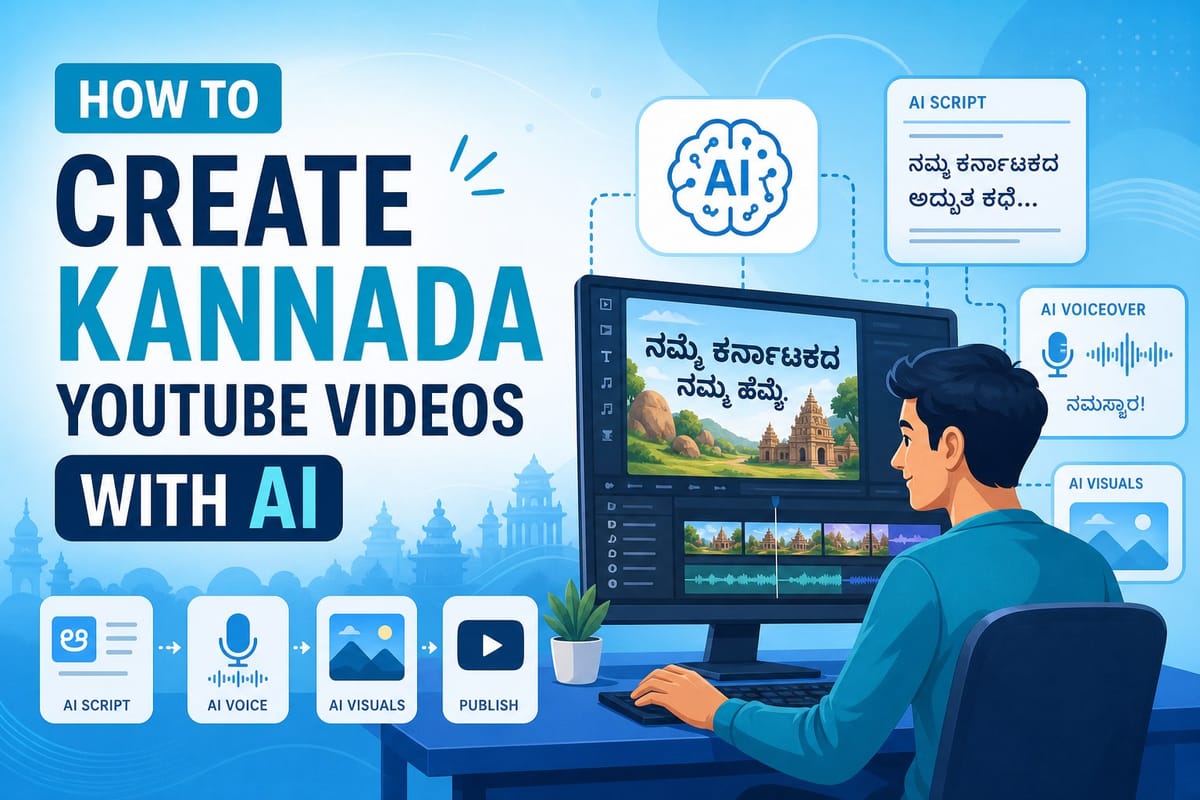
Table of contents
1. Why Kannada YouTube is worth your attention right now
2. How to actually build Kannada videos with Cliptude
3. Practical tips for growing a Kannada channel with AI-produced content
Kannada is one of India's oldest living languages, with over 44 million native speakers and a literary tradition stretching back more than a thousand years. Karnataka's growing internet population means there is a real and largely untapped audience for Kannada YouTube content. The problem is that producing high-quality videos consistently takes time, equipment, and editing skills that most solo creators simply do not have. This guide shows you how AI tools, specifically Cliptude, make it possible to create polished Kannada YouTube videos without a camera, a studio, or a professional editing background. Whether you want to cover Karnataka history, Sandalwood cinema, regional travel, or personal finance in Kannada, the same workflow applies.
Why Kannada YouTube is worth your attention right now
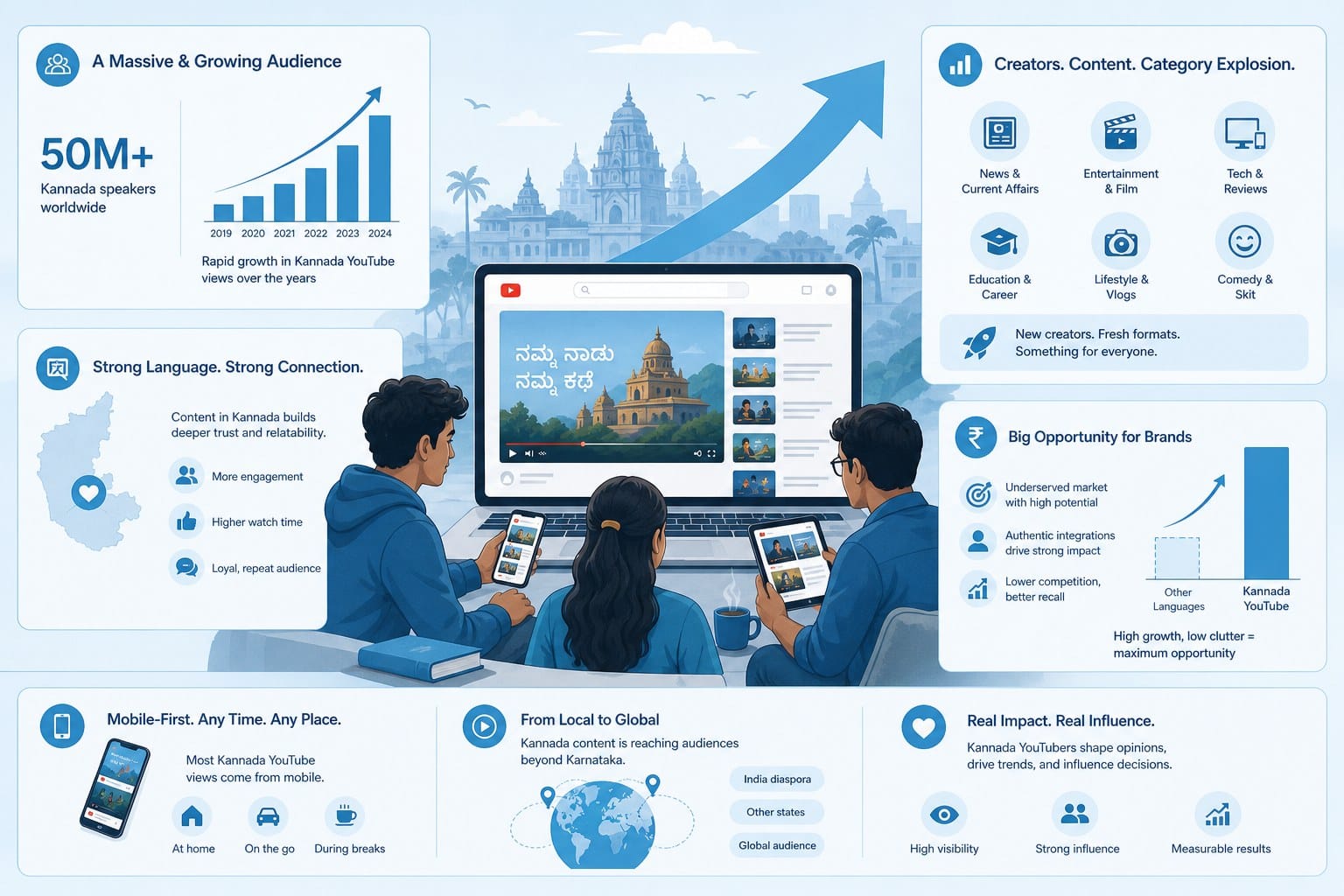
Kannada holds Classical Language status in India, a recognition that reflects a deep cultural and literary tradition going back to at least the 5th century CE. The Kavirajamarga, written around 850 CE, is considered one of the earliest works of Kannada literary criticism. Ancient Kannada inscriptions predate many European languages. That history gives Kannada speakers a strong sense of cultural identity, and that identity absolutely carries over into how they consume digital content. Viewers watch longer, comment more, and subscribe faster when a channel speaks to them in their own language and engages seriously with their culture.
The opportunity on YouTube right now is significant for several specific reasons. Competition in Kannada YouTube is far lower than in Hindi or English. A channel covering the Hoysala dynasty, Karnataka street food culture, Kannada cinema trivia, or financial literacy for urban Kannadigas is competing against a much smaller pool of creators than the equivalent English-language channel would face. YouTube's discovery algorithm rewards channels that hold viewer attention, and native-language content consistently outperforms translated or dubbed alternatives for watch time and session duration. When viewers feel genuinely spoken to, they stick around.
The advertiser side of the equation is also favorable. Bengaluru is one of India's wealthiest cities, home to a large tech-employed professional class. Advertisers targeting Karnataka's urban middle class, particularly in sectors like fintech, edtech, real estate, and consumer electronics, pay competitive CPM rates because that demographic has real purchasing power and genuine purchase intent. A Kannada channel covering personal finance or technology for that audience sits in a high-value advertising category.
Dialectal variety adds another layer of opportunity. Bangalore Kannada, the vernacular dialect spoken naturally by urban Kannadigas, is distinct from the formal literary register. A channel that narrates in the everyday speech patterns of Bengaluru's residents feels immediately accessible and authentic to that audience. Contrast that with the stiff, over-formal Kannada that sometimes appears in older broadcast media. Creators who match the actual speech of their target viewers build loyalty faster. You do not need to choose between sounding educated and sounding real. Good scripting handles both.
The cultural passion around Kannada is not abstract. The Gokak agitation of the 1980s, which pushed for Kannada to receive first-language status in Karnataka's school curriculum, drew enormous public participation and showed how deeply Kannada speakers feel about preserving and promoting their language. That same energy exists online today in the form of Kannada-language communities, fan forums for Sandalwood films, regional news comment sections, and WhatsApp groups where Kannada content gets shared widely. A well-made Kannada YouTube channel can tap directly into these networks.
Kannada cinema, the industry based in Bengaluru's Gandhi Nagar area and commonly called Sandalwood or Chandanavana, produces dozens of films each year and has a passionate national and diaspora fanbase. The global success of the KGF franchise brought Kannada cinema significant international attention and drove many non-Kannada speakers to explore the industry more deeply. That momentum created new audiences who are now actively looking for Kannada-language content about films, actors, directors, and industry history. A faceless channel producing well-researched Kannada cinema explainers or documentary-style profiles could publish several times per week and meet an audience that is already searching.
Historical content is another category with enormous untapped potential. Karnataka was home to some of the most powerful empires in Indian history. The Kadamba dynasty established one of the earliest independent Kannada kingdoms in the 4th century CE. The Chalukyas of Badami built extraordinary rock-cut temples and controlled territory across the Deccan. The Rashtrakutas were among the most powerful rulers in India during the 8th through 10th centuries. The Hoysalas created the intricate sculptural tradition visible at Belur, Halebidu, and Somnathapura. The Vijayanagara Empire, with its capital at Hampi, stood as one of the largest and most sophisticated states in 14th and 15th century Asia. Almost none of this history is covered in depth on Kannada YouTube. The gap between what exists and what an engaged audience would consume is enormous.
The practical production barrier has historically been what stops most creators from entering this space. Writing a script, recording a voiceover, sourcing footage, creating graphics, and editing everything together takes anywhere from 10 to 30 hours per video for a solo creator working without a team. At that pace, publishing two videos per week is genuinely unsustainable alongside any other work or life responsibilities. That production barrier is exactly what AI video generation tools are designed to remove.
Creators in other regional language markets are already demonstrating this with real channels and real audiences. The workflow used for AI-assisted content in related language communities, like the approach covered in this piece on Nepali content creation made easy with AI video tools, translates directly to Kannada. The audience on the other side of that workflow in Karnataka is larger, more urban, and more advertiser-attractive than many comparable regional markets. The timing is good. The tools exist. The audience is there.
How to actually build Kannada videos with Cliptude
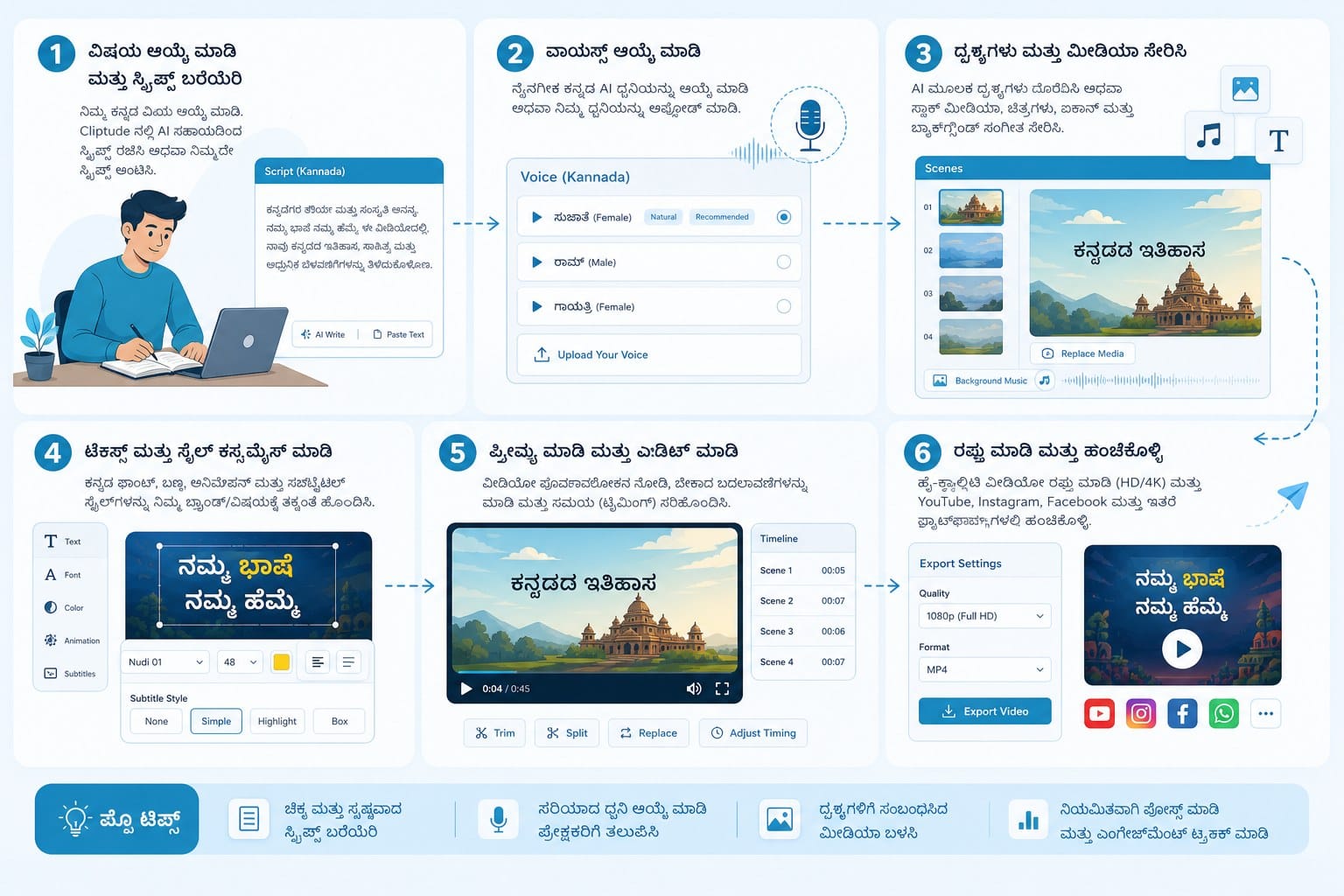
Cliptude is a text-to-video platform that handles the entire production pipeline from a single prompt or finished script. You do not need video editing experience. You do not need a stock footage subscription, a microphone setup, or a dedicated recording space. You give the platform a topic or a script, and it researches, writes where needed, sources footage, generates motion graphics, adds narration, and produces a finished video ready for upload. Here is exactly how that process works for Kannada content, step by step.
Step one: choose your content format
Kannada YouTube works well across several distinct formats, and knowing which one fits your channel's focus before you start saves a lot of revision time later. Long-form documentary-style videos work well for Karnataka history, profiles of literary figures, or deep dives into Kannada cinema's past. These typically run 10 to 20 minutes and are structured like mini-documentaries with a clear narrative arc, relevant footage, and authoritative narration. Listicle and explainer formats work well for travel content, food culture, or educational topics like personal finance and technology. These tend to run 8 to 15 minutes, move faster, and use a more conversational tone. Short-form content for YouTube Shorts works for quick facts, cultural moments, or film clips commentary and runs under 60 seconds. Cliptude supports all of these formats. You select the format at the start of your production and the platform structures the output accordingly.
Step two: write or enter your script
If you write well in Kannada, draft your full script and paste it directly into Cliptude. The platform takes your script and handles everything downstream: footage selection, graphic overlays, pacing adjustments, and final assembly. This approach gives you complete control over the specific language register, dialectal choices, and cultural references in your narration. If you are more comfortable writing in English or want to use the platform's AI drafting capabilities, you can enter your topic in English, review the generated script, and then translate and refine the narration text into Kannada before moving to production. Either path gets you to the same place.
Script quality is the single biggest factor in how good your finished video feels to a Kannada-speaking audience. Invest time here. A well-written script that uses natural Kannada phrasing, references places and figures your audience recognizes, and structures information clearly will make your channel feel authoritative and worth subscribing to. A rushed script that sounds translated or generic will not hold viewers regardless of how polished the visuals are.
For historical topics, specificity matters enormously. Do not write 'the Hoysala dynasty built many temples.' Write 'the Hoysala king Vishnuvardhana commissioned the Chennakeshava temple at Belur in 1117 CE after his victory over the Cholas at the Battle of Talakad.' Specific names, dates, places, and events give your narration authority and give viewers something concrete to remember and share.
Step three: generate your Kannada voiceover
This is the feature that makes faceless Kannada channels genuinely viable for solo creators. Cliptude supports multiple language outputs including Kannada, which means you can generate a natural-sounding Kannada narration directly within the platform without recording your own audio. You do not need a microphone, an acoustic setup, or the confidence to sit in front of a recording interface and deliver a performance. The platform generates the voiceover from your script text.
Choose a voice that matches your channel's tone. A documentary channel covering Vijayanagara history wants a confident, measured voice that sounds authoritative. A lighter travel or food channel might work better with a warmer, more conversational tone. Listen to available voice options and select the one that fits your content's personality before you finalize production.
For urban Bengaluru audiences specifically, the voiceover register matters. Overly formal literary Kannada can feel distant to viewers who speak Bangalore Kannada in daily life. Where possible, write your script in a register that sounds like a knowledgeable person speaking naturally rather than reading from a textbook. Your AI-generated voice will deliver whatever register you write, so the script choice drives the outcome.
Step four: select your video style and let Cliptude build
For documentary-style history content, Cliptude sources relevant footage automatically based on the content of your script. Sections about Hampi will pull footage of the Virupaksha temple and the stone chariot. Sections about Bengaluru's tech industry will pull urban footage that fits the context. You review the footage selections and swap out anything that does not fit the mood or accuracy you want. For explainer or educational content, whiteboard or animation formats often keep complex ideas visually cleaner than footage-based videos. A personal finance explainer works better with clean graphics showing numbers and timelines than with stock footage of people looking at phones.
Motion graphics, text overlays, transitions, and timing are all handled by the platform. You are not manually keyframing anything or matching audio to video frame by frame. The platform assembles the components and produces a draft that you review.
For creators wanting to build long-form documentary series, the full approach is laid out in this guide to how to create YouTube documentaries with AI in minutes. The principles apply directly to Kannada documentary topics like the Mysore Kingdom under the Wadiyar dynasty, the literary life of Kuvempu, or the political history of Karnataka's formation as a state in 1956.
Step five: review, refine, and export
Once Cliptude generates your video, watch it through from start to finish. Check that the footage selections make sense for each section of your narration. Check that the pacing feels right and does not drag or rush through important points. Check that on-screen text is accurate and spelled correctly in Kannada. Make any adjustments needed, then export.
The total time from entering your script to having a finished video ready to upload is a fraction of what traditional manual editing requires. A video that would take a solo creator 15 to 25 hours to produce manually can typically be reviewed and finalized in one to three hours using this workflow. That time difference is what makes publishing two or three times per week actually achievable without burning out.
Step six: upload with optimized metadata
Export your finished video and upload it to YouTube with a Kannada-language title, description, and relevant tags. Use both Kannada script and transliterated Kannada in your tags to capture viewers who search in either format. Your description should include the first two or three lines of your video's key content in natural language, since YouTube uses description text for indexing. Add timestamps for any video over eight minutes.
Thumbnail design deserves specific attention in Kannada YouTube. Thumbnails with clear Kannada script text immediately signal to the right audience that this content was made for them. Use high contrast colors, a single dominant visual, and Kannada text that captures the video's main hook or question. Thumbnails that feel local and culturally specific outperform generic designs for regional language content. Test different approaches in your first dozen videos and pay attention to click-through rate data in YouTube Studio.
Cliptude uses usage-based credit pricing, meaning you pay for what you actually produce rather than a flat monthly fee that charges you equally in high-output and low-output months. For a creator building toward a channel launch, this keeps early costs proportional to your actual production volume. As your channel grows and you want to increase publishing frequency, you scale credit usage accordingly. There is no financial penalty for months when life gets busy and you produce less.
Creators coming from other regional language production backgrounds will find this workflow immediately familiar. The same fundamental steps described in guides like how to create Urdu YouTube videos with AI apply here. The process is language-agnostic. What changes between different regional channels is the script language, the voice selection, the cultural specificity of your topics, and your understanding of your particular audience's expectations and interests.
Practical tips for growing a Kannada channel with AI-produced content
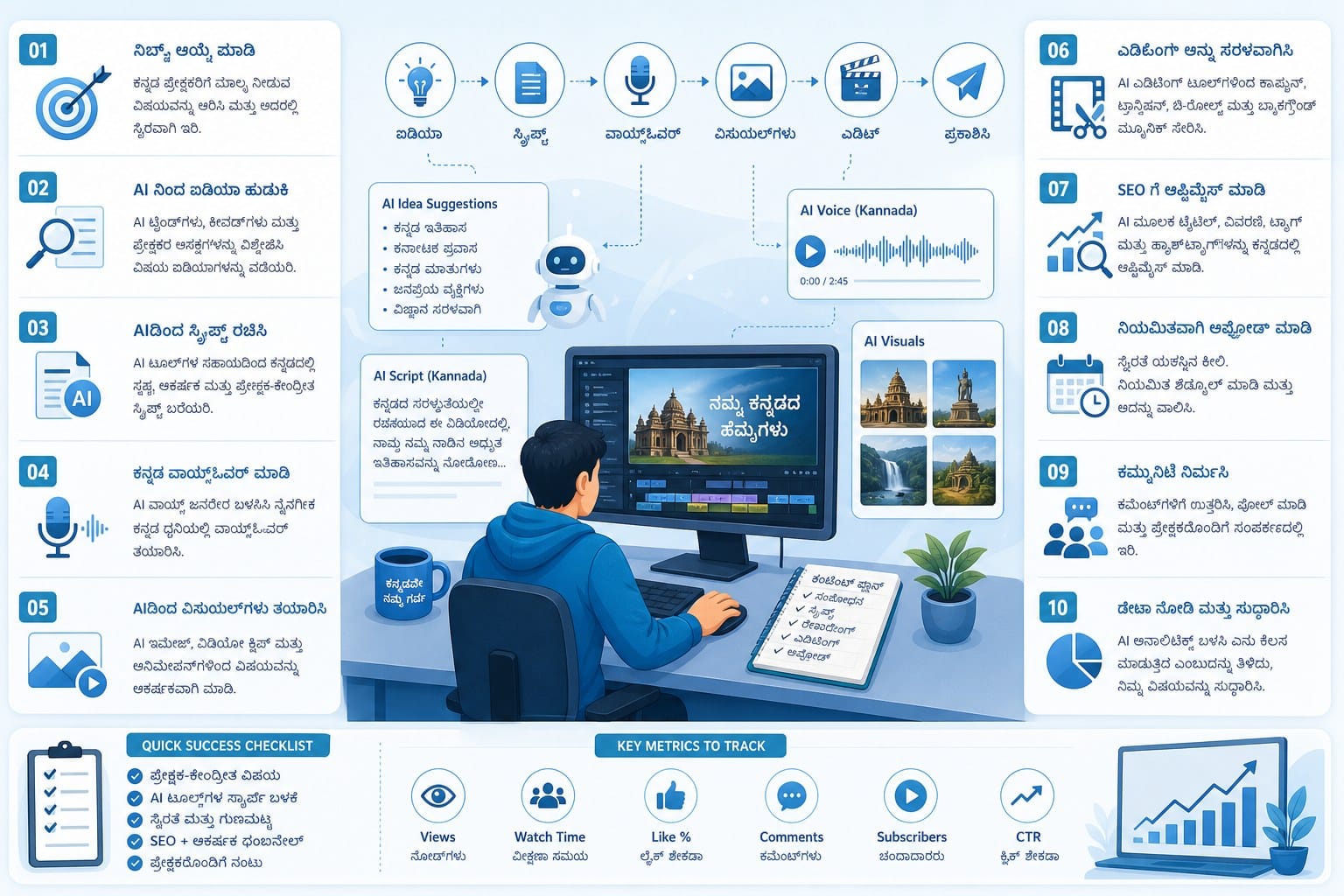
Producing videos efficiently is only part of what makes a Kannada YouTube channel grow. The other part is making smart decisions about topics, consistency, audience engagement, and long-term channel direction. Here is a detailed breakdown of what to focus on at each stage of building a Kannada faceless channel from scratch.
Find topics with real search demand before you produce anything
Do not guess at what your audience wants. Go to YouTube's search bar and type Kannada keywords to see what autocomplete suggests. Search for phrases like 'Karnataka history Kannada,' 'Bengaluru travel Kannada,' or 'Kannada finance tips' and look at what existing videos show up. Check how many views those videos have and how old they are. If a two-year-old video with average production quality has 200,000 views, that topic has demand. If almost nothing shows up, either the topic has no audience or it is genuinely wide open territory.
Look at existing Kannada channels and identify their weaknesses and gaps. A channel that covers Kannada cinema news but never produces historical content about classic Sandalwood films from the 1970s and 1980s is leaving a gap you could fill. A channel that covers Karnataka travel but only visits famous tourist spots and never covers lesser-known destinations like Shravanabelagola, Chitradurga Fort, or the Badami cave temples is missing searches that real travelers are making.
Karnataka's historical content gap on YouTube is particularly significant. Consider the breadth of material available. The Kadamba dynasty founded the first independent Kannada kingdom around 345 CE and their capital at Banavasi is one of the oldest continuously inhabited towns in South India. The Western Chalukyas of Badami built the rock-cut temples at Aihole, Pattadakal, and Badami between the 6th and 8th centuries. The Rashtrakutas, whose capital at Manyakheta near modern Kalaburagi was one of the largest cities in 9th-century India, controlled territory from the Himalayas to Sri Lanka at their peak. The Hoysala dynasty, ruling from Halebidu and Dwarasamudra, produced the most intricate sculptural temple architecture in South Indian history. The Vijayanagara Empire at Hampi commanded an army of over one million soldiers at its height and maintained diplomatic relations with Portuguese traders on the Konkan coast. The Mysore Kingdom under the Wadiyar dynasty and then Hyder Ali and Tipu Sultan stood as one of the most powerful states in 18th-century India. Each of these is a year's worth of content at minimum. Almost none of it is covered in depth in Kannada on YouTube.
Keep each video focused on one specific topic
A 12-minute video about the specific causes and events of the Battle of Talikota in 1565, which ended the Vijayanagara Empire's dominance, will perform better on YouTube than a 45-minute overview of Vijayanagara history in general. Focused topics rank better in search because they match specific search queries more closely. They hold viewer attention better because the entire video is about one thing the viewer came to learn. They are also easier to produce with an AI workflow because the research scope stays manageable and the narrative arc is clear.
Apply this principle across all your content categories. A travel video about the specific experience of visiting Hampi in two days, with practical tips about where to stay and which temples to prioritize, will outperform a vague 'Karnataka's best historical places' roundup. A personal finance video about the specific mechanics of Karnataka's property registration costs for first-time buyers in Bengaluru will outperform a general 'save money' video.
Write titles the way your audience searches, not the way you think
Kannada speakers in Karnataka search in multiple ways. Some viewers type in Kannada script. Some type in transliterated Kannada using English letters. Some mix Kannada and English in a single search, a common pattern in urban Karnataka where code-switching between Kannada and English is completely natural. Your video title and description should reflect this reality.
Test both Kannada-script titles and transliterated titles on different videos and watch the click-through rate data to see which format your specific audience responds to more strongly. Your channel's audience may skew toward one or the other depending on the age and educational profile of the viewers you attract. Let data guide this rather than assumptions.
Avoid keyword stuffing in titles. 'Vijayanagara Empire history in Kannada documentary 2024 Karnataka' is not a title anyone would say out loud or type naturally. 'ವಿಜಯನಗರ ಸಾಮ್ರಾಜ್ಯದ ಅಂತ್ಯ ಏಕೆ ಆಯಿತು?' (Why did the Vijayanagara Empire fall?) is how a curious Kannada viewer actually thinks and searches. Match your titles to natural human curiosity.
Publish consistently rather than perfectly
Two solid videos per week will grow your channel significantly faster than one perfect video per month. YouTube's algorithm rewards channels that publish consistently because consistent publication signals that a channel is active and trustworthy. Early in a channel's life, the algorithm is learning what your channel is about and who it should recommend it to. Regular publishing gives it more data to work with faster.
AI production tools make this consistency achievable because you are not bottlenecked by editing time. Set a content calendar at the start of each month. Decide your topics for the next four weeks in advance. Work through your Cliptude production queue in batches if possible, producing two or three videos in a session and scheduling them for staggered publication. Batching production is more efficient than producing one video at a time and reduces the cognitive overhead of constantly starting fresh.
In the first three months of your channel, treat every video as a learning opportunity rather than a performance. You are figuring out which topics resonate, which thumbnail styles drive clicks, and which video length holds your specific audience's attention. Do not over-invest in any single video during this period. Produce consistently, analyze honestly, and adjust based on what the data shows.
Invest seriously in thumbnails
Thumbnails do more click-earning work in regional language YouTube than in mainstream English content because they immediately signal cultural belonging. A thumbnail with bold Kannada script text tells a Kannada-speaking viewer 'this content was made specifically for you' before they read a single word of the title. That instant recognition drives higher click-through rates among your target audience.
Use high-contrast colors that stand out against YouTube's white background. Include one clear central image that communicates the video's subject visually. Add a short Kannada text hook, typically three to six words, that raises a question or promises a revelation. Avoid cluttering the thumbnail with too many elements. Simplicity and clarity at thumbnail size, which is small on most screens, outperforms detailed design every time.
Create three or four thumbnail variations for your first several videos and A/B test them using YouTube Studio's built-in testing tool once your channel has enough traffic to generate meaningful data. Small thumbnail improvements compound significantly over time as your video library grows.
Build genuine community with your Kannada audience
Kannada-speaking viewers who find a well-produced channel in their language are often genuinely excited about it. Regional language audiences tend to share content they love within their community networks more actively than mainstream English viewers do. A single enthusiastic viewer recommending your channel in a Kannada WhatsApp group or Facebook community can drive dozens of new subscribers. You cannot manufacture this, but you can cultivate it.
Reply to comments consistently in the first six months of your channel. Ask questions in your videos that invite viewer responses. Use the community tab to poll your audience about upcoming topic choices and let them feel ownership over the channel's direction. When viewers feel like they have a relationship with a channel rather than just consuming its output, they become advocates. That advocacy is worth more than any promotional tactic.
Post your videos in relevant Kannada-language communities, Karnataka history groups, Sandalwood fan forums, and Karnataka diaspora groups where your content genuinely belongs. Do not spam, but do share authentically in spaces where your content adds value to the conversation.
Understand your monetization options beyond AdSense
YouTube Partner Program eligibility requires 1,000 subscribers and 4,000 watch hours over the past 12 months. Once you reach that threshold, AdSense revenue begins. CPM rates for Karnataka audiences vary significantly by content category. Educational content, personal finance, career development, and technology explainers aimed at Bengaluru's professional class tend to earn substantially higher CPM rates than entertainment or general interest content. If you have a choice between two equally viable topic areas, the one serving higher-income urban Kannadigas is generally the better business decision.
Beyond AdSense, consider channel memberships once you have an engaged subscriber base. Members pay a monthly fee for exclusive content, early access, or community benefits. Sponsorships from brands wanting to reach Karnataka's Kannada-speaking market are available once your channel demonstrates consistent viewership. Local businesses, Karnataka-based startups, and national brands with significant Karnataka market presence are all potential sponsors for a well-positioned Kannada channel.
Digital products represent the highest-margin monetization option for most creators. The Kannada-speaking market is significantly underserved in terms of high-quality educational digital products in Kannada. A channel that builds genuine expertise and trust with an audience in any subject area, whether Karnataka history, financial literacy, technology skills, or career development, has a ready audience for e-books, courses, or paid community access in Kannada. These products can earn far more per viewer than AdSense ever will.
Set a realistic multi-month growth plan
Months one through three: focus entirely on publishing consistently and learning what your audience responds to. Produce at least two videos per week. Do not obsess over subscriber counts. Track click-through rate, average view duration, and which topics generate the most comments and shares. This data tells you where to double down.
Months four through six: start optimizing based on what your analytics show clearly. Identify your top five performing videos by watch time and click-through rate. Analyze what they have in common in terms of topic type, title format, thumbnail style, and video length. Make more content in that pattern while continuing to test new topic categories occasionally.
Months seven through nine: by this point you should be approaching or have crossed the Partner Program threshold. You have a body of work large enough to understand your channel's strengths, an audience that knows what to expect from you, and data that shows your growth trajectory clearly. Refine your content calendar to concentrate on your proven topic areas and begin thinking about secondary monetization options.
Month nine and beyond: you are operating a real channel with real audience data, real revenue, and a production system that works. The question becomes how to grow more efficiently, whether to expand into new content formats, and how to build the monetization mix that makes the channel sustainable long-term.
The Kannada-speaking internet audience is large, culturally proud, historically underserved by quality content, and increasingly online. AI production tools remove the biggest practical barrier most creators face, which is the enormous time and skill investment that manual video production requires. With Cliptude handling the production pipeline, you spend your energy on what actually builds a channel: knowing your audience deeply, choosing topics they genuinely want, and showing up for them consistently over months and years. The combination of a willing audience and accessible production tools has not existed in Kannada YouTube until very recently. That window is open right now.
Ready to take the next step?
Ready to build your Kannada YouTube channel without spending weeks on editing? Visit Cliptude and turn your first topic idea into a finished video today.



