
Nepali AI video generator for YouTube: create videos automatically

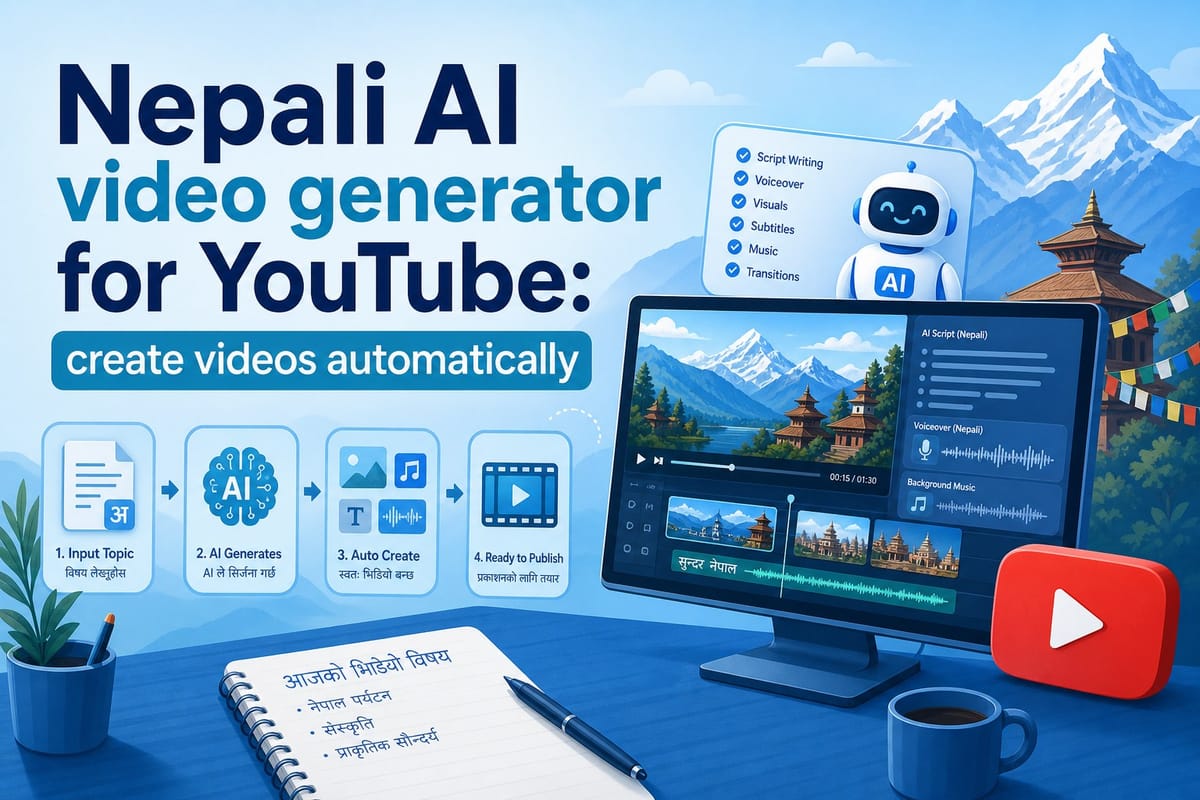
Table of contents
1. What a nepali ai video generator actually does and why it matters
2. How to use Cliptude to build a Nepali YouTube channel with AI video
3. Turning AI-generated Nepali videos into a real revenue stream
I want to show you something that is changing the way Nepali creators build YouTube channels. A nepali ai video generator lets you turn a simple text prompt into a fully edited video, complete with footage, voiceover, motion graphics, and subtitles. You do not need a camera, a studio, or a video editing background. You just need an idea and the right tool. In this article, I will walk you through how this works, why it matters for Nepali and South Asian creators, and how platforms like Cliptude make the whole process faster and more affordable than anything you have tried before.
What a nepali ai video generator actually does and why it matters
Let me break down what this technology actually does, because there is a lot of confusion around it.
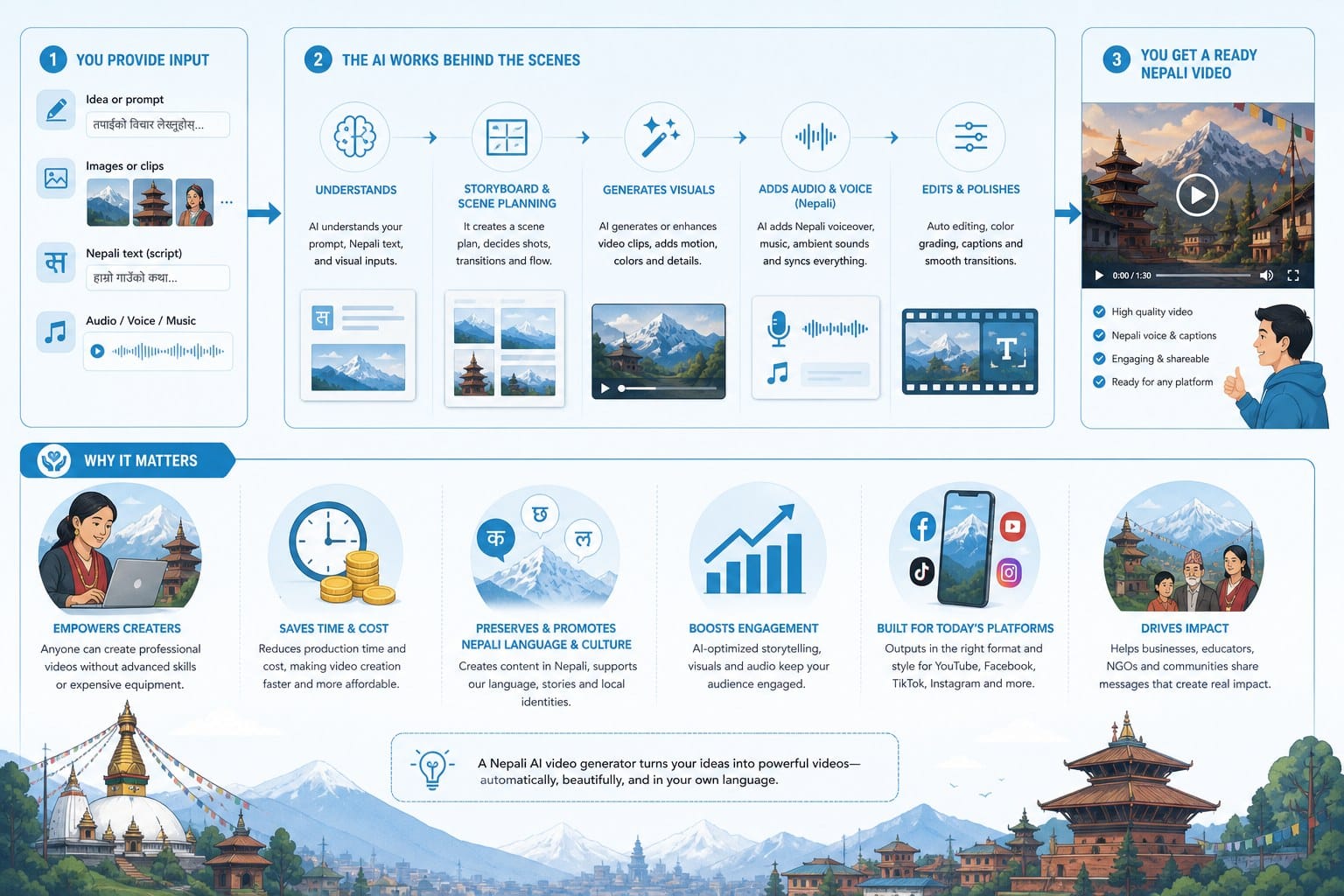
A nepali ai video generator is not just a slideshow maker. It is a system that takes your idea, your script, or even a single sentence prompt, and builds a real video from start to finish. That means it researches the topic, writes a script, finds or generates matching footage, adds motion graphics, times the cuts, and delivers a polished file you can upload directly to YouTube.
This is a big deal for creators in Nepal and the broader South Asian market for a few specific reasons.
First, the production cost problem is real. Setting up a proper video production setup in Kathmandu or any smaller Nepali city means buying cameras, lighting, microphones, editing software, and either learning to use all of it or hiring someone who can. That adds up fast. Many talented creators never start because the upfront cost is too high.
Second, the language and accent barrier holds people back. A lot of Nepali creators feel self-conscious speaking English on camera, and they worry that a Nepali accent will limit their audience. An AI video platform removes on-camera presence from the equation entirely. You can build a faceless YouTube channel that covers any topic, in any language, without ever showing your face or recording your voice.
Third, there is the time problem. Even experienced creators spend fifteen to twenty hours producing a single long-form YouTube video when you count research, scripting, filming, and editing. AI video tools cut that down dramatically.
So what does the workflow actually look like? With a platform like Cliptude, you start by entering a prompt. Something like 'Top 10 historical facts about Nepal' or 'How the Himalayan ecosystem works' or 'The rise of street food culture in Kathmandu.' The system takes that prompt and does the heavy lifting. It generates a structured script, pulls in relevant footage from licensed libraries, adds motion graphics and text overlays, and stitches everything together into a video that looks like a real production team made it.
For creators who want more control, you can also paste in your own script. That means you can write in Nepali, translate it, or work in a mixed format. The tool adapts to what you bring to it.
One thing I want to be clear about: this is not magic that requires zero effort. You still need to think about your niche, your target audience, and what kind of content will actually get views. The AI handles production, but your creative direction still matters. The best results come from creators who have a clear idea of what they want to make and use the AI to execute it faster.
For Nepali creators specifically, the opportunity here is significant. YouTube viewership in Nepal has grown steadily. Topics like Nepali history, travel, culture, mythology, food, and current affairs all have real audiences. A faceless channel covering Nepali heritage documentaries or top-ten listicles about Himalayan geography can build a real subscriber base without the creator ever appearing on screen.
I have also seen creators use AI video tools to build English-language channels about Nepal for international audiences. Someone in Pokhara can create a channel in English about trekking routes, Buddhist monasteries, or Nepali cuisine and reach viewers in Europe or North America who are curious about the region. The nepali ai video generator makes that kind of cross-cultural content production realistic for a solo creator.
If you are curious how this compares to building Hindi-language content, there is a useful breakdown in this article about how to make AI YouTube videos in Hindi with the right tools. Many of the same principles apply, and the parallel is helpful for understanding the South Asian creator context more broadly.
The bottom line is this: the technology now exists to produce professional-looking video content without a production budget, without being on camera, and without spending weeks on a single upload. For Nepali creators who have been held back by cost, language, or technical barriers, this is a genuine shift in what is possible.
How to use Cliptude to build a Nepali YouTube channel with AI video
I want to get specific here because the workflow matters. Understanding the steps helps you see where you save time and where you still need to make decisions.
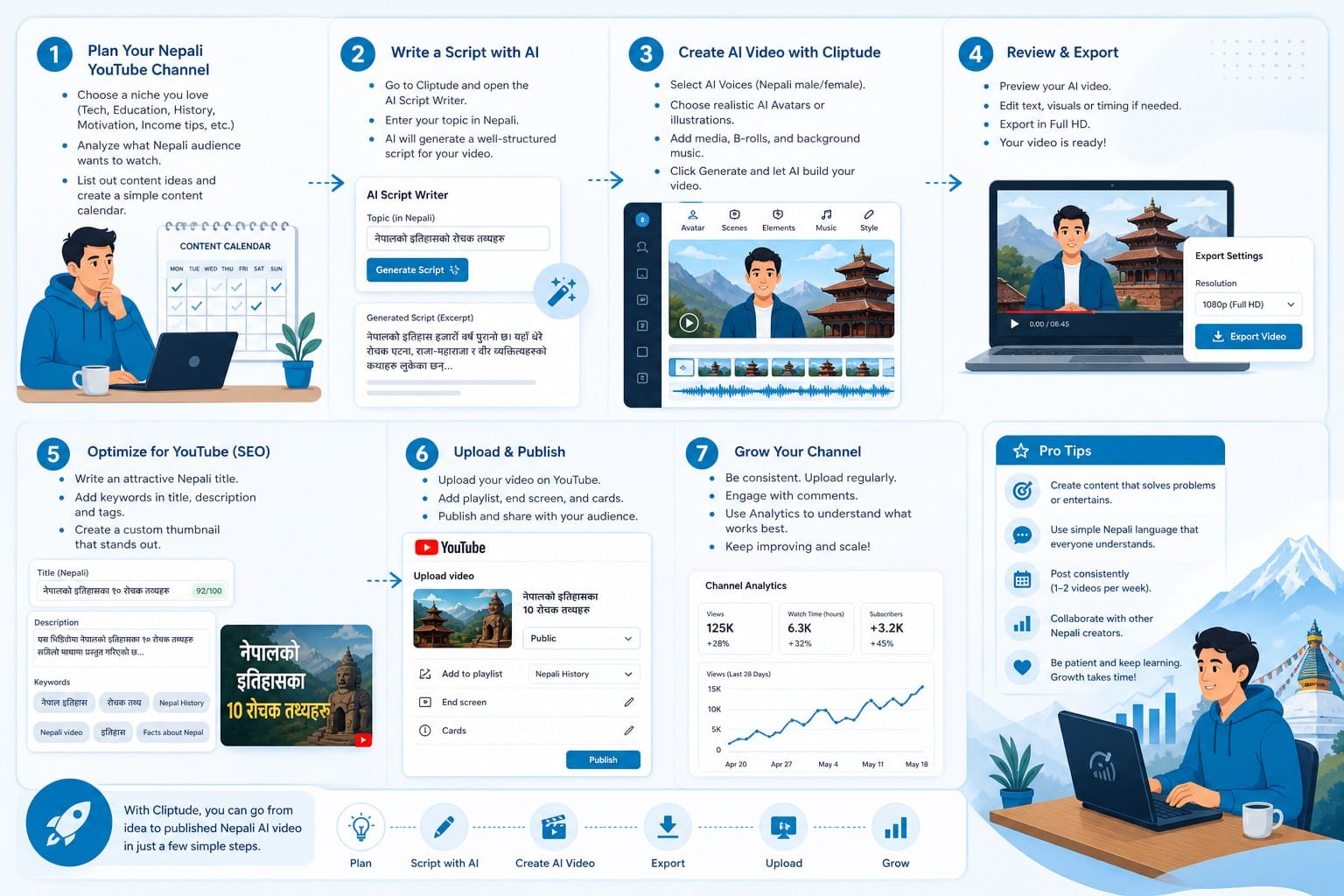
Cliptude is an AI-powered text-to-video platform built for exactly this kind of use case. It covers the full production pipeline: research, scripting, footage sourcing, motion graphics, and editing. You start with a prompt or a script and end up with a finished video. Let me walk through how that works for a Nepali creator.
Step one is choosing your content format. Cliptude supports several different video styles. Documentary format works well for topics like Nepali history, wildlife, or geography. Listicle format is great for 'Top 10' style videos that perform well on YouTube. Animation formats like whiteboard or stickman style work well for educational or explainer content. And there is a short-form format for YouTube Shorts, TikTok, and Instagram Reels.
For a channel focused on Nepali content, the documentary and listicle formats are strong starting points. They match the kind of content that tends to perform well in informational niches, and they do not require you to be on screen or to record your own voice.
Step two is entering your prompt. You do not need a long brief. Something like 'A documentary about the history of the Gurkha soldiers' or 'Ten facts about Mount Everest that most people do not know' is enough to get the system moving. If you have already written a script, you can paste it in directly.
The AI then builds the structure. It creates a script with a proper introduction, body sections, and a conclusion. It identifies the visual needs for each section and matches footage accordingly.
Step three is reviewing and adjusting. This is where your creative direction matters. You can look at the script, change the tone, add specific facts you want to include, or swap out footage that does not match your vision. You are not locked into the first output. You can refine it.
Step four is the final render. Cliptude produces a finished video file. That file includes the footage, any motion graphics or text overlays, timing, and structure. You can take it, do a final review, add your channel branding if you want, and upload it to YouTube.
Now let me talk about the credit pricing model, because it is relevant for creators who are thinking about cost.
Cliptude uses usage-based credit pricing. That means you pay for what you use rather than a flat monthly subscription. For a solo creator or small team just starting out, this is helpful because you are not locked into a recurring cost before you have validated whether the content is working. You can produce a few videos, see how they perform, and scale up as your channel grows.
For Nepali creators, this model makes sense. You might start with two or three videos per month, see which topics get traction, and then increase your output once you know what your audience responds to. The cost structure grows with your production volume rather than demanding a large upfront commitment.
Let me give you a concrete example of how this plays out in practice. Say you want to build a faceless YouTube channel about Nepali mythology. You have a list of topics: the story of Kumari, the legend of Pashupatinath, the mythological origins of the Bagmati river, the story of Indra Jatra. Each of those is a potential video. With a traditional production setup, each video might take ten to twenty hours. With Cliptude, you can move through a topic in a fraction of that time because the research, scripting, and editing work is handled by the AI.
You still need to review each video and make sure the facts are accurate. That is important. AI tools can get details wrong, so you should always check the script for factual accuracy before publishing, especially on topics like history and mythology where specific details matter.
But the overall time saving is real. Instead of spending two weeks on one video, you might spend two days reviewing and refining four or five videos. That kind of output velocity is what allows a small creator to build a channel that actually grows.
For creators interested in music video formats, Cliptude also handles that. If you want to create a visual accompaniment to a Nepali song or an original audio track, the platform can build a music video from that input. There is more detail on that specific format in this article about an AI music video generator: create professional videos from a prompt.
One more thing worth mentioning: commercial rights. When you produce videos with Cliptude, you get full commercial rights to the output. That matters if your goal is monetization. You can upload these videos to YouTube and pursue ad revenue, sponsorships, or other income streams without worrying about whether you have the right to use the content commercially.
Speaking of monetization, I will cover that in more detail in the next section, because it is one of the most common questions creators have when they start exploring AI video production.
Turning AI-generated Nepali videos into a real revenue stream
This is the part most creators actually care about. Making videos is only worth the effort if there is some path to income. Let me be direct about what is realistic and what the actual opportunity looks like for a Nepali creator using AI video tools.
First, the monetization question. Can you make money from AI-generated YouTube videos? The short answer is yes, but with some conditions attached. YouTube's monetization policies focus on whether your content is original, valuable, and follows their community guidelines. They do not ban AI-generated content as a category. What they do watch for is repetitive, low-quality content that does not offer real value to viewers.
That means the bar is not 'did a human make this?' The bar is 'is this good content that viewers actually want to watch?' If your AI-generated Nepali documentary is well-researched, accurate, and engaging, it can qualify for the YouTube Partner Program just like any other video. There is a thorough breakdown of this topic in this article about whether you can monetize AI-generated YouTube videos.
Now let me talk about the specific revenue paths that make sense for Nepali creators using an AI video generator.
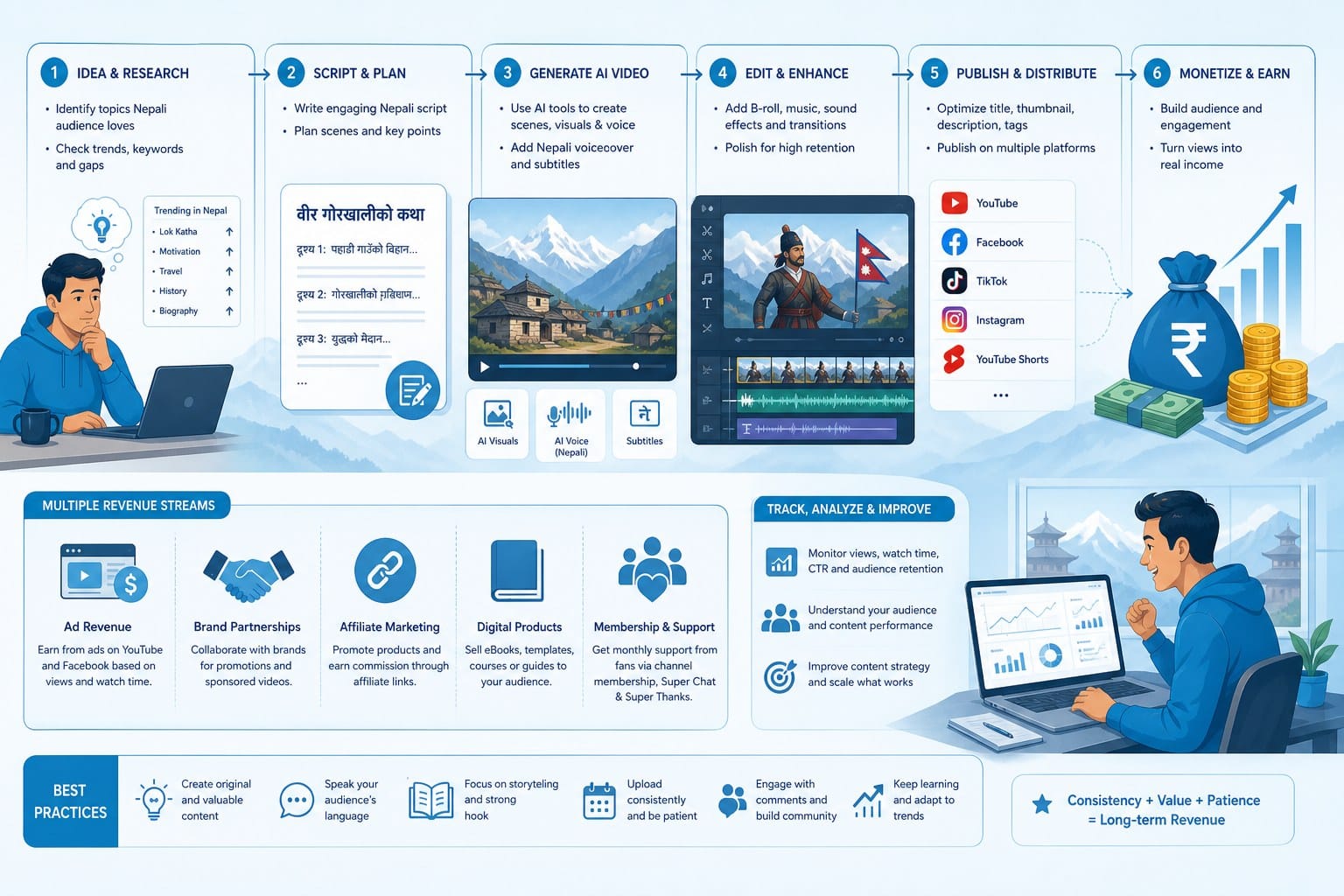
Ad revenue is the most obvious path. Once your channel hits the YouTube Partner Program thresholds (1,000 subscribers and 4,000 watch hours, or 500 subscribers and 3,000 watch hours for the newer monetization tier), you can earn from ads on your videos. For a faceless channel covering Nepali content, your CPM will depend on your audience geography. If you are attracting viewers from the US, UK, Canada, or Australia, your ad rates will be higher than if your audience is primarily in Nepal or India. That is a real consideration when you are choosing your content angle.
A Nepali creator who builds a channel in English about topics like Himalayan travel, Buddhist philosophy, or South Asian history can attract international audiences with higher CPMs. That is a strategic choice worth thinking about from the start.
For creators who prefer to build a Nepali-language audience, the CPM will be lower, but the audience loyalty and community engagement can be stronger. Both paths are valid. The AI video tool works equally well for either language.
Beyond ad revenue, there are other income streams worth considering.
Sponsorships are often more lucrative than ad revenue for smaller channels. A Nepali travel channel with ten thousand engaged subscribers can attract sponsorships from tourism companies, trekking agencies, or outdoor gear brands. The key is building an audience that is clearly defined and that advertisers want to reach.
Affiliate marketing is another option. If your channel covers topics like tech, travel gear, or books, you can include affiliate links in your video descriptions and earn a commission on purchases. This works even for smaller channels.
Digital products are a growing revenue stream for educational channels. If your channel covers Nepali language learning, Nepali history, or something like Himalayan cooking, you could create a PDF guide, a mini-course, or a recipe book and sell it to your audience.
The key insight here is that AI video production lets you move fast enough to actually test these approaches. You can produce content at a pace that allows you to see what works before you have invested months of effort in the wrong direction.
Let me give you a practical picture of what scaling looks like. Say you start a faceless channel about Nepali history and culture. In the first month, you upload eight videos using Cliptude. Some of them get traction, some do not. You learn from the data: which topics got the most views, which ones had the best watch time, which ones people clicked on from the thumbnail. In month two, you focus on the topics that worked and produce more of them. By month six, you have a channel with a real content library, real watch time accumulating, and a path to monetization.
This kind of iteration is only possible if you can produce content quickly enough to gather data. That is exactly what a nepali ai video generator makes possible. Traditional production timelines make it nearly impossible to iterate fast. You spend three weeks on a video and then spend another three weeks on the next one before you even know if the first one worked. AI production compresses that cycle.
I also want to address something that comes up a lot: the fear that AI-generated content will not perform as well as human-made content. This is understandable but not backed up by what is actually happening on YouTube. Faceless channels with AI-assisted production are growing across multiple niches. The audience does not care how the video was made. They care whether it is interesting, accurate, and worth their time.
The responsibility that falls on the creator is quality control. You need to review the script for accuracy. You need to make sure the footage matches the narration. You need to add your own perspective or curation to make the content feel intentional rather than generic. These are skills, and they matter. But they are much more accessible than the skills required to film, light, and edit video from scratch.
For Nepali creators specifically, there is a real gap in the market for high-quality English-language content about Nepal. There are millions of people around the world who are curious about Nepal: trekkers who want to learn more before they visit, diaspora communities who want to connect with their heritage, students studying South Asian history or geography, and general viewers who are drawn to stories about the Himalayas. That audience exists and is not being fully served by the current content landscape.
A creator with good knowledge of Nepal, good judgment about what makes an interesting story, and access to a tool like Cliptude can serve that audience and build a real channel in a niche that has genuine demand.
The combination of AI production speed, usage-based pricing that keeps costs manageable, full commercial rights, and a genuine content gap in the Nepali niche makes this a realistic opportunity rather than a theoretical one.
If you are serious about building a faceless YouTube channel around Nepali or Himalayan content, the tools are available right now. You do not need to wait for the technology to improve. You do not need a production budget or a camera or a studio. You need a clear niche, a content plan, and a platform that can handle the production work. That is a much lower barrier than it used to be, and it is worth taking seriously.
Ready to take the next step?
If you are ready to start building your faceless YouTube channel with AI-generated videos, Cliptude is built for exactly this use case. From Nepali history documentaries to listicles to educational animations, you can go from a simple text prompt to a finished, upload-ready video without a camera or editing skills. Visit Cliptude to see how the platform works and start producing content that can actually grow your channel.



