Can you monetize AI-generated YouTube videos

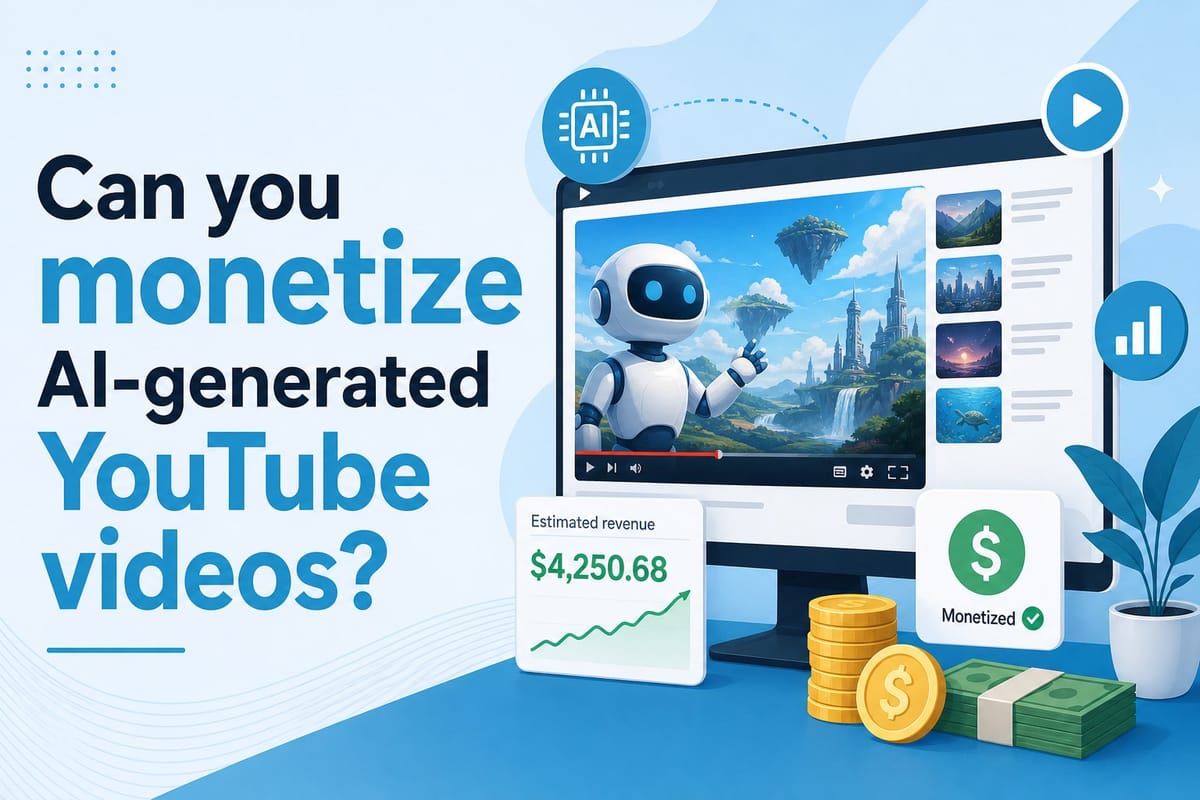
Table of contents
1. What YouTube actually says about AI-generated content
2. How to build a monetizable AI video channel the right way
3. Revenue streams beyond ads and how to maximize them
If you run a faceless YouTube channel or you are thinking about starting one, you have probably asked yourself whether you can actually monetize AI-generated YouTube videos. The short answer is yes, but there are real rules you need to follow and real pitfalls you need to avoid. YouTube's monetization policies have evolved quickly alongside AI tools, and what worked two years ago may get your channel flagged today. In this guide, I walk you through exactly how YouTube's systems evaluate AI-generated content, what you need to do to qualify for the YouTube Partner Program, and how to build a channel that generates consistent ad revenue without ever showing your face on camera. I also cover the revenue streams that serious creators add on top of ads once their channel gains traction, because ad revenue alone is rarely the ceiling for a well-built AI channel.
What YouTube actually says about AI-generated content
YouTube does not ban AI-generated videos. That is the first thing to get straight. The platform has been clear that the origin of a video — whether a human filmed it or software assembled it — is not the deciding factor for monetization. What matters is whether the content meets YouTube's advertiser-friendly content guidelines and whether it provides genuine value to viewers. Creators who treat those two requirements seriously do not run into trouble simply because they used AI tools to produce their videos.
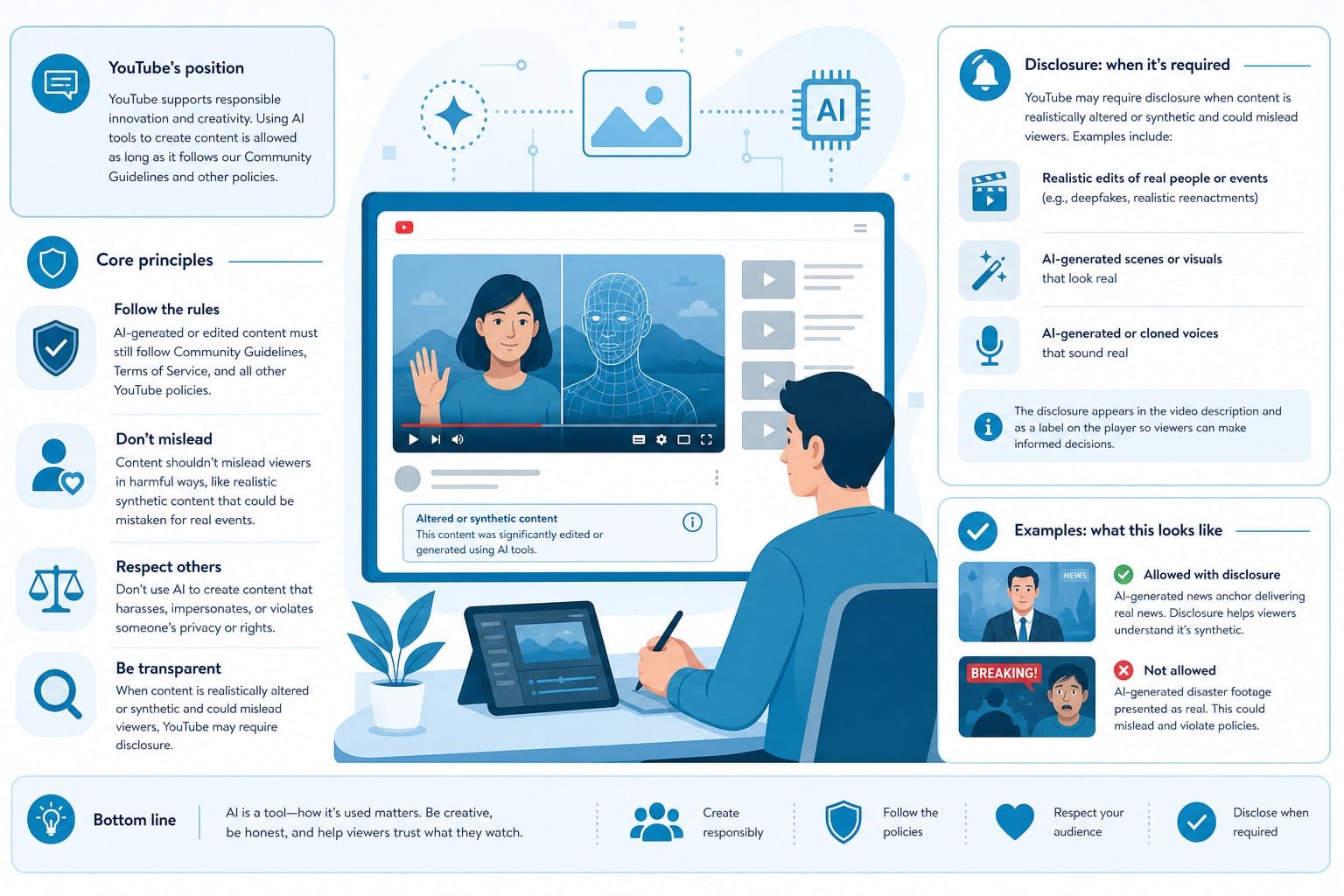
That said, YouTube introduced a specific disclosure requirement in 2023 that every creator using AI needs to understand. If your video contains realistic AI-generated content that viewers might mistake for real footage — a synthetic news anchor reading a script, a digitally cloned voice, fabricated footage of a real event — you must label it as altered or synthetic. You will find this option inside YouTube Studio under the details section of any upload. Failing to disclose realistic AI content can result in content removal, demonetization, or account suspension. YouTube has said it will enforce this rule more strictly over time, so building the disclosure habit now protects you later.
The disclosure rule does not apply to every AI-assisted video. If you use AI to write a script, generate motion graphics, animate characters, or create a voiceover that sounds clearly stylized rather than deceptively human, YouTube does not require a label. The line is whether a reasonable viewer could be misled into thinking they are watching real, unedited footage of the real world. A cartoon explainer about the solar system does not need a disclosure. A realistic AI anchor presenting fabricated breaking news does.
Beyond disclosure, YouTube's spam policies are the bigger hurdle for creators who want to monetize AI-generated YouTube videos at scale. YouTube explicitly calls out mass-produced, repetitive content as a policy violation. If you use AI to generate hundreds of nearly identical videos by swapping out a few words or images, YouTube will likely detect the pattern and demonetize your channel or remove the content entirely. The algorithm is trained to identify low-effort, templated uploads, and it has become more accurate at this over time. Channels that got away with spray-and-pray tactics in 2022 have largely been cleaned out of the Partner Program.
The practical rule is straightforward. Use AI to produce content that is genuinely useful, original, and varied. Do not use it to flood your channel with copy-paste videos dressed up with different thumbnails. Channels that treat AI as a content mill rather than a production tool are the ones that run into trouble, and the distinction is not hard to see from YouTube's side. A channel with fifty videos covering fifty meaningfully different topics in a consistent format looks very different to the algorithm than a channel with fifty videos that are structurally identical and swap out only the subject noun.
YouTube's monetization eligibility requirements have not changed just because AI exists. You still need 1,000 subscribers and 4,000 valid public watch hours in the past 12 months to join the standard YouTube Partner Program and unlock ad revenue. There is also a lower-tier entry point at 500 subscribers and 3,000 watch hours, which gives you access to channel memberships and Super Thanks but does not include ad revenue sharing. Both thresholds apply equally to AI-generated channels. There is no shortcut built into the policy for AI tools, and there is no penalty either. The channel lives or dies by the same performance metrics every other channel faces.
One more policy area worth understanding is copyright. AI tools that generate images, music, or voiceovers pull from training data, and the intellectual property landscape around that training data is still being sorted out legally. As a creator, your immediate concern is more practical: verify that the AI platform you use grants you commercial rights to the output. Some tools restrict commercial use on free tiers. Others have blanket commercial licenses for paying users. If you publish AI-generated content to a monetized YouTube channel without the right to use it commercially, you are exposed to copyright claims that can strip your ad revenue or remove your videos. Read the terms of service before you build a production workflow around any tool.
YouTube's own Content ID system can also flag AI-generated voiceovers or music if the underlying samples or training voices belong to a rights holder who has enrolled in Content ID. This is less common than it used to be as AI audio tools have matured, but it still happens. If you get a Content ID claim on a video, your ad revenue goes to the claimant rather than to you until you dispute it. The dispute process takes time and does not always resolve in your favor. Using platforms that generate fully original, rights-clear audio from the start is the cleaner path.
The bottom line on YouTube's policies is that they reward the same thing they have always rewarded: content that viewers actually want to watch, presented in a format that does not mislead or spam. AI is a production tool that can help you hit that bar faster and more consistently than manual production alone. It does not change what the bar is.
How to build a monetizable AI video channel the right way
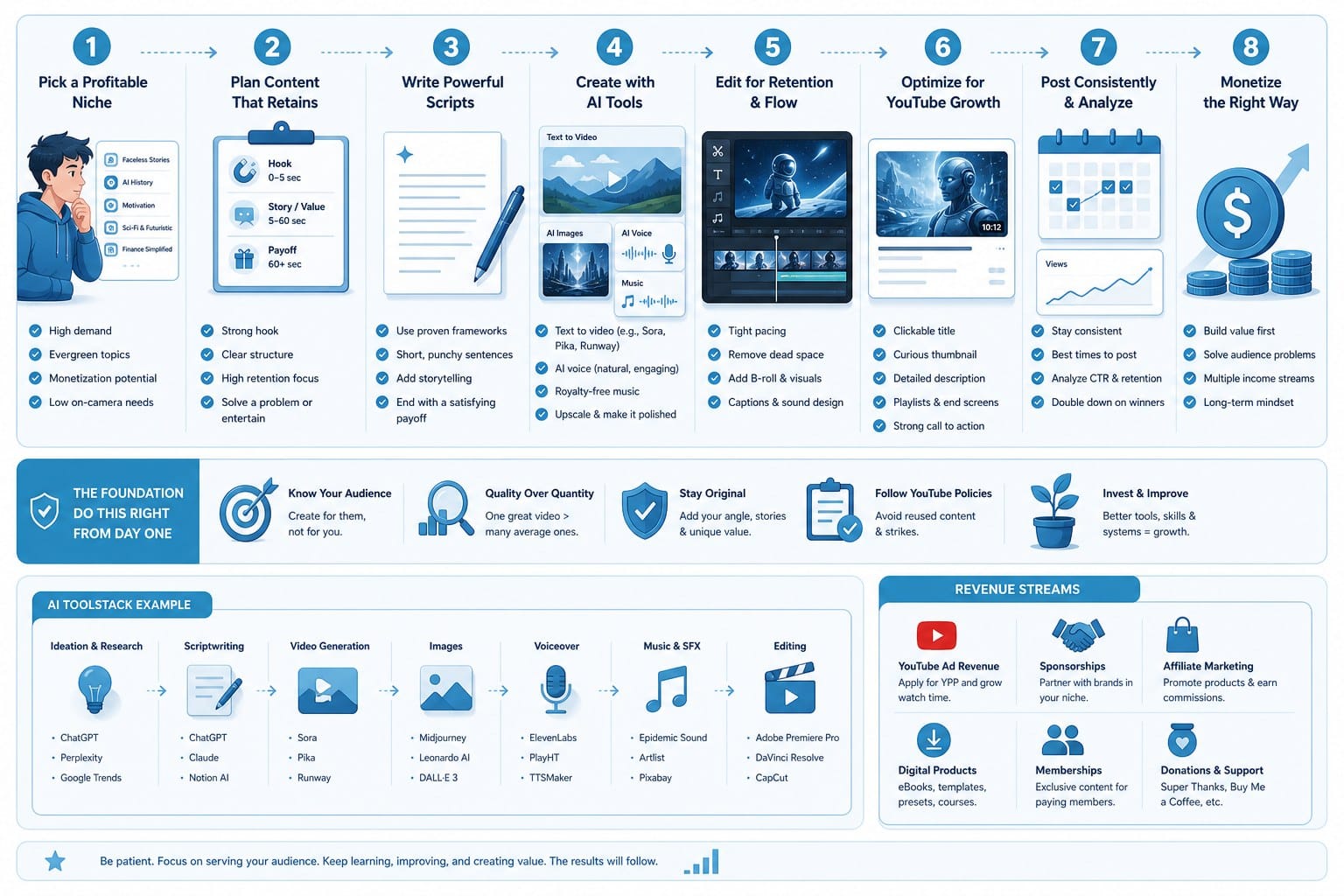
The creators who successfully monetize AI-generated YouTube videos share a few habits in common. They pick a focused niche, they produce content that holds viewer attention all the way through, and they use AI to handle the heavy lifting of production without letting it replace the editorial judgment that makes a channel worth watching. Getting those three things right is the difference between a channel that climbs to monetization in six months and one that stalls at 200 subscribers for a year.
Start with niche selection. Channels that do well with AI-generated content tend to cluster around a few formats: documentary-style explainers, ranked listicles, educational deep-dives, and animated walkthroughs. These formats work because they rely on information and storytelling rather than on-camera personality. You do not need a charismatic host when the content itself is compelling. A channel about historical events, science topics, personal finance, or technology can hold a large audience entirely through well-researched scripts, good narration, and clear visuals. The niche you choose also determines your long-term ad revenue ceiling, which is worth thinking about before you commit to a topic and build a library of content around it.
Script quality is the single biggest differentiator between AI channels that grow and ones that stagnate. A lot of creators make the mistake of letting AI write the entire script from scratch and publishing it without revision. Viewers notice when a script is vague, generic, or padded with sentences that say nothing. The giveaways are circular definitions, claims without supporting numbers, and transitions that exist only to fill time. None of that is inherently a viewer retention problem unique to AI — human writers produce the same flaws — but AI produces those flaws at speed and at scale, which means the problem compounds fast if you are not editing carefully.
The workflow that produces better results is to use AI to generate a first draft and a structural outline, then go back through the script to add specific facts, concrete examples, named sources, and a clear editorial point of view. That revision pass does not take long once you know what you are looking for, and it is what separates your channel from the hundreds of others using the same tools to cover the same topics. A video about the ten most fuel-efficient cars available in 2024 that includes real EPA ratings, real starting prices, and a clear recommendation based on a stated buying scenario will outperform a video that covers the same topic with vague superlatives and no specifics.
For listicle content specifically, the format rewards concrete framing. A video titled "10 countries with the highest average salaries in 2024" will outperform a vague "top countries to work in" video because the specific angle gives viewers a clear reason to watch all the way through — they want to see where the list lands, and they want to know if their expectations match the data. The curiosity loop that keeps people watching is built into the format when the topic is precise. You can read more about producing this kind of content efficiently in this guide on how to make listicle videos automatically with AI.
For educational and explainer content, animated formats like whiteboard or character animation are a strong choice for faceless channels. They look polished, they are easy to follow on mobile screens, and they do not require stock footage licensing for every concept you cover. Abstract topics like compound interest, evolutionary biology, or how a transformer model works are genuinely easier to explain through animation than through b-roll of stock footage that only loosely relates to the subject. If your channel covers topics like investing, health, or how systems work, animation gives you a visual vocabulary that stock footage cannot match. There is a detailed breakdown of how this works in practice in this article about an AI whiteboard animation maker that turns a prompt into an explainer video.
Upload consistency matters more for AI channels than for traditional channels, because AI allows you to produce at a pace that manual editing cannot match. If you can publish two or three well-researched videos per week instead of one, you give the YouTube algorithm more opportunities to recommend your content and you build watch hours faster. The 4,000-hour threshold is the slower milestone to hit compared to the 1,000-subscriber mark for most creators, and consistent uploads are the most direct way to close that gap. Treat the channel like a media operation with a publishing schedule rather than a creative project you update when inspiration strikes. The channels that reach monetization thresholds fastest are the ones that behave more like small editorial teams than hobbyists.
Thumbnails and titles deserve as much attention as the videos themselves. YouTube is a search and discovery platform, and no matter how good your video is, it will not earn ad revenue if nobody clicks on it. Thumbnails that perform well on AI channels tend to be simple, high-contrast, and readable at thumbnail size on a mobile screen. Faces, bold text, and clear visual contrast drive clicks across almost every niche. Since faceless channels cannot rely on a recognizable host face, bold graphic design and text-forward layouts do a lot of the work. Write titles that answer a specific question or frame a clear outcome. Vague titles like "You Need to Know This" perform poorly because they give the viewer no reason to click on your video over anyone else's.
Test different thumbnail and title combinations and track the results in YouTube Studio. Click-through rate is the most direct signal of whether your packaging is working. A rate between 5% and 8% is a healthy benchmark in most niches for established videos. New videos often start lower and climb as YouTube's recommendation system figures out who to show them to, so give each video a few weeks before drawing conclusions from early CTR data.
Watch time and audience retention are the metrics that determine how much ad revenue you earn per view. YouTube pays more per thousand impressions on videos that keep viewers watching longer, because advertisers pay a premium to reach audiences that are actively engaged rather than immediately bouncing. A ten-minute video where the average viewer watches eight minutes will earn significantly more than a ten-minute video where most viewers leave after ninety seconds. This is why script quality and structure matter so much. Front-loading all the interesting information and then padding the back half of the video is a common mistake that tanks retention. Distribute your strongest content throughout the video, and use chapter markers to signal to viewers that there is more value ahead.
One structural technique that works well in both listicle and documentary formats is to reveal one piece of information early that only fully makes sense in context of something revealed later. You are essentially telling the viewer they need to keep watching to understand something they already encountered. It is the same technique used in long-form journalism and documentary filmmaking, and it translates cleanly to the YouTube format when it is done without being manipulative about it.
Revenue streams beyond ads and how to maximize them
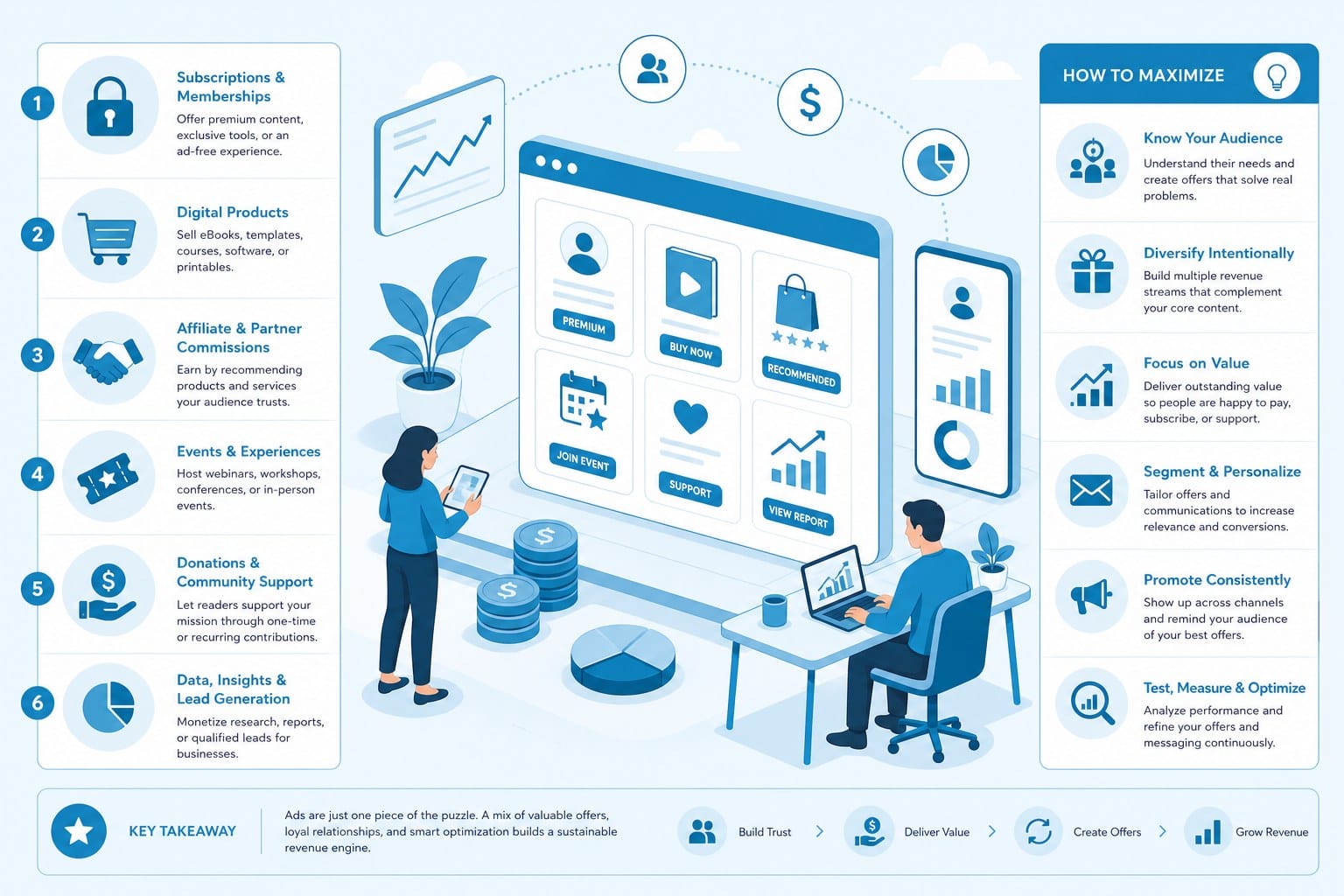
Ad revenue is the most talked-about way to monetize AI-generated YouTube videos, but it is rarely the highest-earning stream for channels that grow past the beginner stage. Understanding the full picture helps you build something more durable than a channel that lives and dies by CPM fluctuations or seasonal advertiser spending drops.
YouTube ad revenue varies a lot by niche, and the variation is large enough that niche selection should be treated as a financial decision, not just a creative one. Finance, insurance, software, and legal content typically earns CPMs between fifteen and forty dollars per thousand views in the United States. Entertainment or general knowledge channels might earn two to five dollars per thousand views in the same market. If you are building an AI channel specifically for monetization, choosing a high-CPM niche from the start is one of the most leveraged decisions you can make. A channel about credit card rewards, retirement investing, or business software tools will earn multiples of what a general trivia channel earns at the same view count, even with identical production quality and watch time metrics.
Geographic audience distribution also affects your CPM. Viewers in the United States, Canada, the United Kingdom, and Australia are worth significantly more to advertisers than viewers in most other markets. If your content draws a globally distributed audience, your effective CPM will be lower than what you see quoted as a niche benchmark, because those benchmarks are usually based on US-only estimates. You can see your actual audience location breakdown in YouTube Analytics under the Geography tab, and it is worth checking before you draw conclusions about why your CPM is higher or lower than expected.
Affiliate marketing layers on top of ad revenue without any additional production cost once your videos are published. If your channel covers product reviews, software comparisons, financial services, or any topic where viewers are actively making buying decisions, you can include affiliate links in your video descriptions and earn a commission on purchases that come through those links. The key is that the products need to actually fit your content. Viewers on educational channels are often high-intent buyers, especially for tools, courses, and services related to the channel's topic. A personal finance channel recommending a budgeting app with an affiliate program is a natural fit. The same channel recommending an unrelated physical product just because the commission rate is high will erode trust quickly and reduce the effectiveness of every future recommendation.
Amazon Associates is the most accessible starting point for affiliate marketing because it covers almost every product category and has a low barrier to entry. Category-specific affiliate programs through networks like Impact, ShareASale, or direct brand partnerships tend to pay higher commission rates for relevant niches. Software tools in particular often have affiliate programs paying 20% to 40% recurring commissions on subscriptions, which compounds into meaningful monthly income as your referred audience grows.
Sponsored segments inside videos are another income stream that AI channels can access once they build a real audience. A channel with 20,000 engaged subscribers in a specific niche is attractive to sponsors in that niche, even without millions of total views. Sponsors pay for targeted reach, and a focused niche channel delivers that more efficiently than a broad general audience channel. A channel about productivity tools that has 25,000 subscribers who are professionals actively looking for software recommendations is more valuable to a project management app than a general tech channel with 200,000 subscribers spread across every age group and interest level.
Rates for sponsored segments vary widely by niche and audience engagement. A mid-size channel in a high-value niche can realistically charge a few hundred to a few thousand dollars per integration. The typical structure is a 60-second to 90-second segment placed around the one-third mark of the video, which is when viewer retention is still high but the core content has already established credibility. Reaching out directly to brands whose products genuinely fit your content is often more effective than waiting to be discovered, especially for channels under 100,000 subscribers.
Channel memberships and digital products work best when your audience trusts your expertise and wants more depth than the free videos provide. If your AI channel is built around a topic you know well, you can sell a related course, template, or reference guide that expands on what the public videos cover. YouTube's built-in membership feature lets subscribers pay a monthly fee for perks like early access to videos, extended cuts, or community posts with additional detail. These income streams require more audience relationship-building than ad revenue, but they are also not subject to the CPM swings that come with seasonal advertiser budgets or algorithm changes.
For creators building out a Shorts strategy alongside long-form content, YouTube's Shorts monetization works differently from standard video ads. Shorts earn through a creator revenue pool based on views rather than CPM-based advertising, and the per-view payout is lower than long-form. However, Shorts serve a different strategic purpose: they reach a different recommendation surface inside the app, they can grow a channel's subscriber count faster than long-form alone, and subscribers who discover you through Shorts and then watch your long-form videos contribute directly to your watch hour accumulation. The two formats work well together when the Shorts are genuinely interesting clips rather than promotional trailers for the long-form content. You can read more about scaling this side of the operation in this guide on how to scale YouTube Shorts output with AI video automation.
One issue that catches AI creators off guard is commercial rights on the assets they use. When you generate footage, voiceovers, music, or graphics through an AI platform, you need to confirm that your license covers commercial use. Some platforms restrict commercial use to paid tiers. Others grant full commercial rights across all plans. Using commercially restricted content in a monetized YouTube video exposes you to copyright claims that can pull your ad revenue or take down the video entirely. The safest approach is to verify this before you build a production workflow around any tool, not after you have published fifty videos.
Cliptude grants full commercial rights to the videos you create on the platform. Whether you use it to produce a long-form documentary, a ranked listicle, a whiteboard explainer, or an animated short, the output belongs to you and you can monetize it freely on YouTube or any other platform. The credit-based pricing model means you pay for what you produce rather than a flat monthly fee whether you use the service or not, which keeps costs proportional to output as your channel scales up or down.
The practical progression for a profitable AI channel looks like this. You pick a niche with real CPM potential, commit to a consistent upload schedule, use AI tools to handle research, scripting, and editing, and apply your own editorial judgment to make sure each video is specific and useful rather than generic. You build toward the Partner Program thresholds, turn on ads, and then add affiliate links and sponsorships as the audience grows and trusts what you recommend. That sequence is realistic for a solo creator working part-time, especially with tools that compress the production timeline from days to a few hours per video.
The channels that fail are not failing because they used AI. They fail for the same reasons traditional channels fail: inconsistent publishing, unfocused topics, poor thumbnail and title optimization, and videos that do not hold viewer attention past the first two minutes. AI removes the production barrier that used to make consistent publishing impossible for solo creators. It does not remove the need to think carefully about what you are making and why someone would choose to watch it.
Ready to take the next step?
If you want to see how fast you can go from a topic idea to a finished, polished video, Cliptude is worth exploring. You give it a prompt or a script, and it handles the research, footage, motion graphics, and editing automatically. You can produce documentary-style long-form videos, animated explainers, listicle content, and Shorts all from the same platform, with full commercial rights included on every video you create. Visit Cliptude to create your first video and start building a channel designed for monetization from day one.