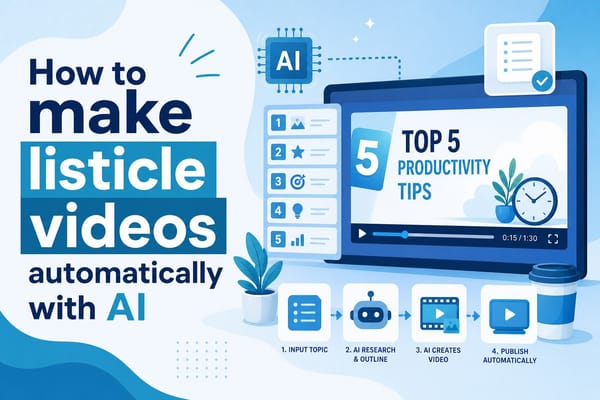
How to scale YouTube Shorts output with AI video automation

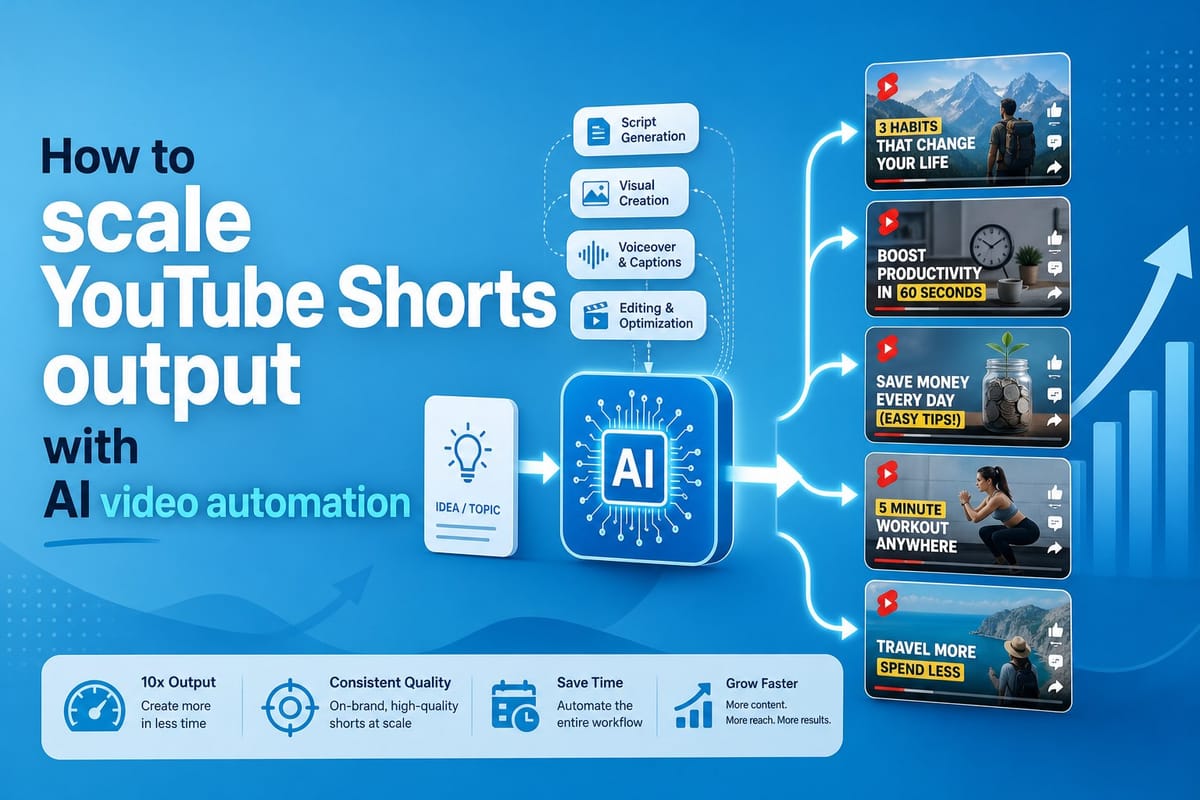
Table of contents
1. Why manual Shorts production breaks down at scale
2. How to build an AI-powered Shorts production pipeline
3. Making AI-generated Shorts actually perform on YouTube
Posting YouTube Shorts consistently is one of the hardest things to do as a solo creator. You need ideas, a script, footage, graphics, and edits, and you need all of that working together fast enough to keep up with an algorithm that rewards frequency. Most creators either burn out trying to do it manually or post sporadically and wonder why their channel stalls. AI video automation changes that equation. When you use ai video automation youtube shorts tools correctly, you can go from a single idea to a finished, polished Short in a fraction of the time it used to take. In this article, I want to walk you through exactly how to build that kind of system, what tools and workflows make it possible, and how platforms like Cliptude fit into the picture for creators who want to scale without sacrificing quality.
Why manual Shorts production breaks down at scale
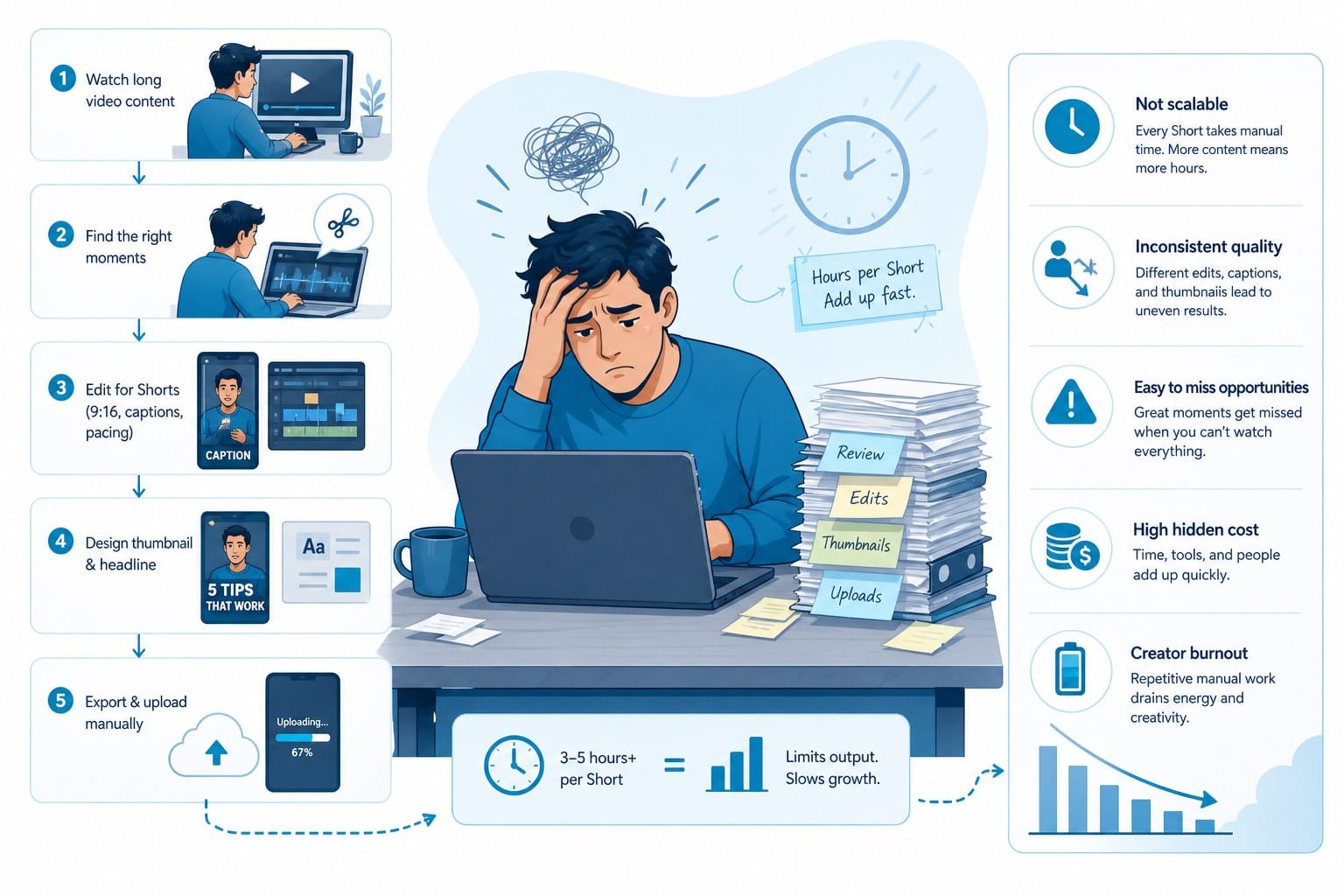
Let me start with the honest problem. A single YouTube Short that looks effortless to watch is not effortless to make. You need a hook that grabs attention in the first two seconds. You need a script that fits under 60 seconds but still delivers real value. You need footage that matches your topic, text overlays that are readable on a phone screen, and an edit that keeps momentum moving from the first frame to the last. That is five to eight separate tasks before you even think about uploading, writing a title, or choosing a thumbnail.
For one Short per week, a skilled editor can manage that. For three or four Shorts per week, which is what the algorithm tends to reward, the workload becomes a real problem. I have talked to plenty of faceless channel creators who started strong, posted ten or fifteen Shorts in a burst of energy, and then completely disappeared from their upload schedule because the production cost, in time and energy, was just too high.
The other issue is consistency of quality. When you are rushing to hit a posting schedule, quality suffers. A script written at midnight on a deadline looks different from one you spent an afternoon on. Footage sourced in a hurry ends up being generic stock clips that have nothing to do with your actual topic. The Short goes up, it underperforms, and you start to wonder whether Shorts are even worth the effort.
That is where ai video automation for YouTube Shorts comes in. It is not about replacing your creative judgment. It is about removing the mechanical repetitive steps that eat your time without adding anything uniquely human to the process. Researching what stock footage matches a topic, rendering transitions, syncing text to a timeline, those are all tasks a good AI system can handle. What you bring is the direction, the niche knowledge, and the understanding of what your audience actually wants to watch.
The creators who scale Shorts output successfully are the ones who build a repeatable system. They do not try to wing each video from scratch. They have a defined niche, a defined format, and a production pipeline that takes a topic and turns it into a finished video with minimal friction at each step. AI automation is what makes that pipeline fast enough to be sustainable.
Think about what that could mean practically. Instead of spending six hours producing one Short, you spend one hour supervising the production of three or four. Instead of skipping uploads because life got busy, you have a queue of ready-to-publish videos that keeps your channel active even when you are not. That is the compounding advantage that serious Shorts creators are building right now.
How to build an AI-powered Shorts production pipeline
Building a repeatable pipeline starts with being specific about your format. The biggest mistake I see creators make when they try to automate is that they keep their workflow too loose. They want AI to handle everything from topic research to final upload, but they have not defined what their Shorts actually look like. Before you automate anything, write down the answers to a few questions.
What is the length of your typical Short? Under 60 seconds, 30 to 45 seconds, or right at the 60-second cap? What is the tone? Educational and calm, fast-paced and energetic, or narrative and story-driven? What kind of visual style do you use? Stock footage with text overlays, animation, motion graphics, or a mix? Once you have those answers locked in, automation becomes much easier because the AI has a clear target to hit.
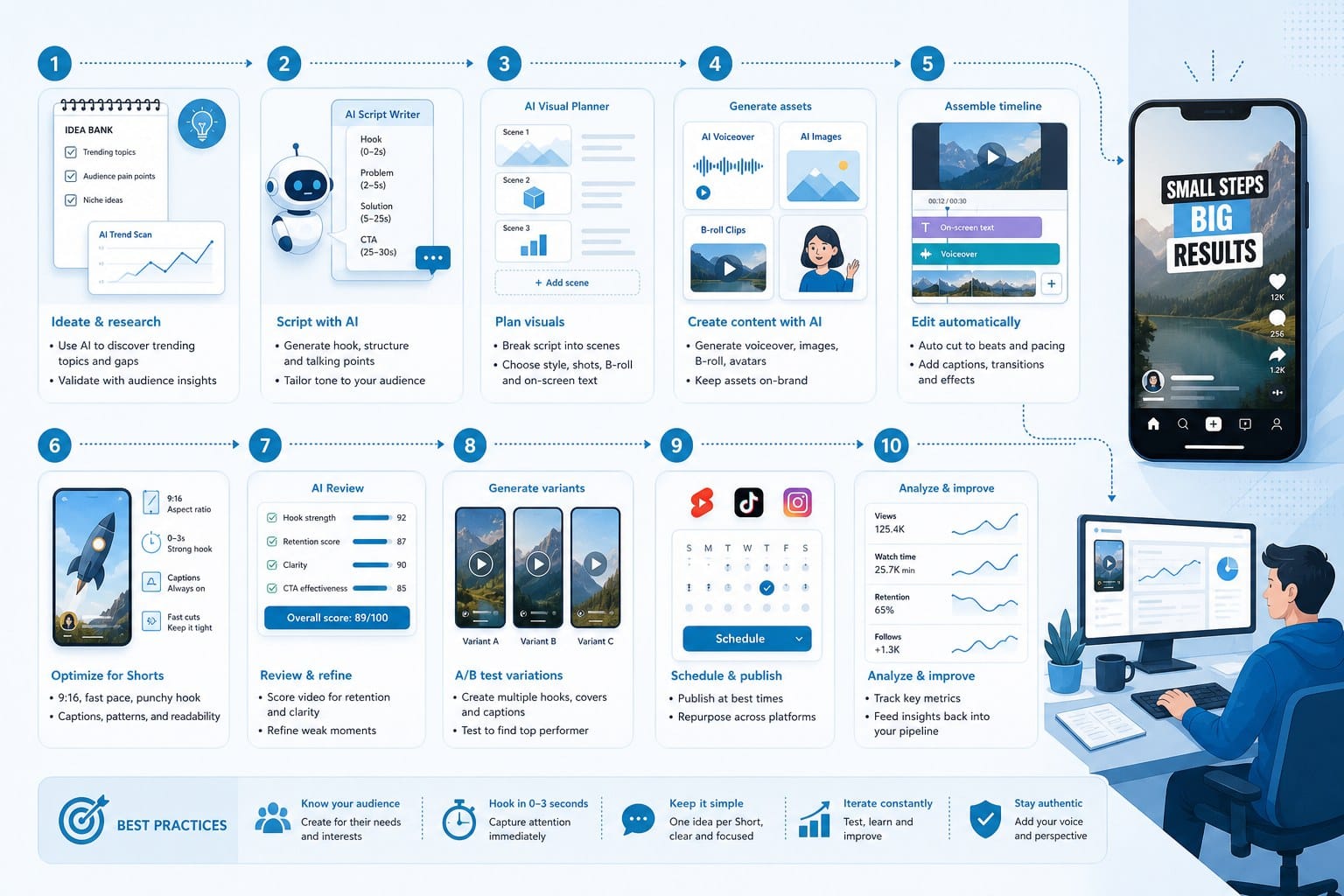
Here is how a well-built pipeline for Shorts actually works in practice.
Step one is topic sourcing. You need a steady stream of Shorts ideas that fit your niche. Some creators do this manually by scanning trending searches, YouTube Studio's research tab, or Reddit threads in their niche. Others use AI tools to generate topic batches based on seed keywords. Either way, the goal is to have a backlog of 20 to 30 approved topics at any given time so you never sit down to produce and face a blank page.
Step two is scripting. A Short script is short by definition, but it still needs to be good. The hook has to earn the next five seconds. The middle has to deliver the promised value. The end has to give the viewer a reason to watch another video or take some action. AI scriptwriting tools can draft a Short script in seconds, but the better platforms handle this as part of a larger production flow rather than as an isolated step. When scripting is connected to footage sourcing and editing in one system, the final video actually matches the script instead of being bolted together from mismatched parts.
Step three is footage and visuals. For faceless Shorts channels, this usually means stock footage, motion graphics, or animation. Sourcing footage manually is one of the most time-consuming parts of video production. You search a stock library, download clips, sort through them, import them, and realize half of them do not match the tone you needed. An AI system that can automatically source and match footage to your script topic cuts this step from an hour to a minute.
Step four is editing and rendering. This is where most solo creators spend the most time. Trimming clips, adding text overlays, timing transitions, adjusting audio, all of it adds up. AI-powered editing removes the manual timeline work by handling cuts, pacing, and on-screen text generation automatically based on your script.
Step five is review and publishing. Even with a fully automated pipeline, I recommend a quick human review before publishing. Check that the footage actually matches the topic, that the text is legible on a small screen, and that the hook is as strong as it can be. This review step takes five to ten minutes, not an hour, because the heavy lifting is already done.
Platforms like Cliptude are built to handle steps two through four in one connected workflow. You input a prompt or a script, and the platform researches the topic, sources footage, generates motion graphics, writes text overlays, and delivers a finished video ready for export. For creators running a faceless Shorts channel, this kind of end-to-end system is what makes posting at volume actually achievable. You can read more about how this kind of platform works for faceless channels in this breakdown of the AI video generator for faceless YouTube channels.
One thing worth emphasizing is that automation works best when you batch your production. Instead of producing one Short at a time, set aside a production block once or twice a week and run five to ten Shorts through your pipeline in a single session. This is faster than producing one at a time because you stay in the same mode, reviewing scripts together, checking footage together, and approving finals together rather than switching contexts repeatedly. A batch of ten Shorts produced in one afternoon gives you two to three weeks of daily posting without touching the pipeline again.
The other element of a good pipeline is a publishing schedule that matches your capacity. If your pipeline can reliably produce ten Shorts per week, post ten. If it produces five, post five. Consistency matters more than frequency up to a point, and nothing kills a channel's momentum faster than posting fifteen Shorts in a week and then going silent for three weeks because you burned through everything you made.
For creators who are also producing long-form content alongside their Shorts, the same AI production system can often handle both. A ten-minute documentary-style video and a 45-second Short require different scripts and pacing, but the underlying tasks, footage sourcing, motion graphics, editing, are largely the same. Running both formats through one platform keeps your production costs and time investment manageable even as your total output grows.
Making AI-generated Shorts actually perform on YouTube
Automation handles production. Performance is a different problem. I want to be direct about this because I see a lot of creators assume that if they can just post more Shorts, the algorithm will reward them automatically. Volume helps, but it is not the whole answer. The Shorts that perform well share specific characteristics that you need to engineer into your pipeline, not just hope for.
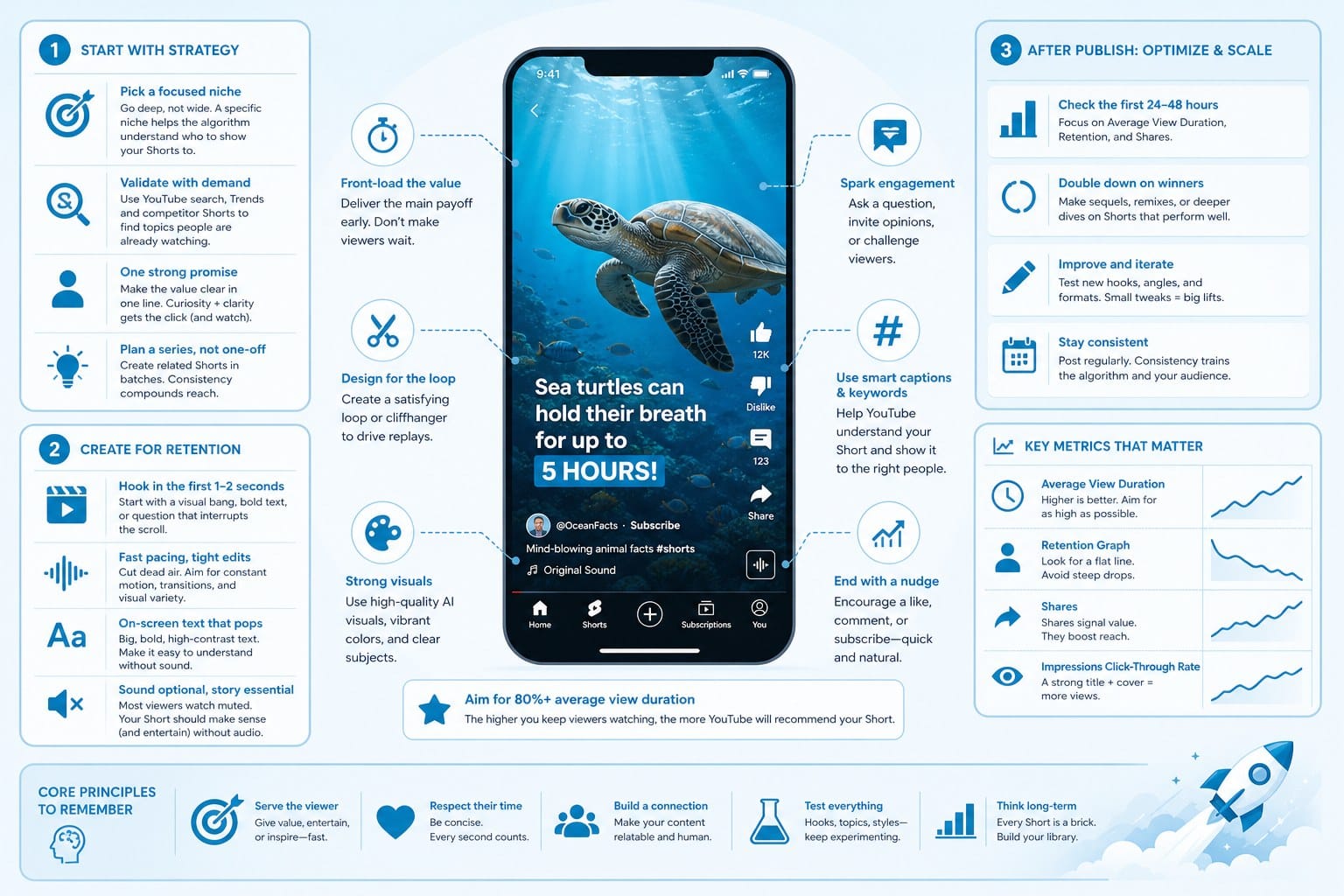
The hook is the most important factor. YouTube Shorts plays automatically in the Shorts feed. A viewer can swipe away in less than a second if the first frame does not catch their attention. Your hook needs to promise something specific and deliver it fast. Vague openers like starting with a statement that could apply to anything kill watch time immediately. Specific, curiosity-driven openers hold attention. The difference between a Short that gets swiped away and one that gets watched to completion is almost always in the first two to three seconds.
When you are using AI to generate scripts, pay attention to the opening line the system produces. If it is generic, rewrite it before you send the script to production. This is one of the places where your human judgment adds the most value in an otherwise automated pipeline. A platform like Cliptude lets you provide your own script or edit the AI-generated one before production begins, which means you can tighten the hook without giving up the automation benefits on everything else.
Retention curve is the second factor YouTube's algorithm cares about most for Shorts. The algorithm looks at how many viewers watch your Short to completion versus swiping away partway through. Shorts that hold viewers to the end get pushed to more people. Shorts that lose viewers early get buried. The best way to engineer strong retention in an automated Short is to keep the pacing tight and the information density high. Every few seconds should deliver something new, a new stat, a new visual, a new point. Dead air and slow transitions are retention killers.
This is where the editing quality of your AI platform matters. A platform that generates clean cuts, syncs text to speech naturally, and uses varied footage rather than repeating the same clip twice will produce better-performing Shorts than one that generates static or slow edits. When you are evaluating any ai video automation youtube shorts platform, look at the output quality of the actual edits, not just the feature list.
Engagement signals are the third lever. Comments, likes, and shares tell YouTube that real people found value in your Short. You cannot automate genuine engagement, but you can design your Shorts to invite it. Ending with a direct question to the viewer, asking them to share if they learned something, or leaving a small debate-worthy claim in the video all tend to generate more comment activity than a passive sign-off.
For faceless Shorts channels specifically, branding consistency is what builds subscriber loyalty over time. If your Shorts all look and sound different, viewers who enjoy one of your videos have no mental anchor to remember your channel by. If every Short uses a consistent color palette, a consistent text style, and a consistent pacing, repeat viewers start to recognize your content even before they see your channel name. AI production platforms that let you set style templates and apply them across every video make this kind of consistency automatic rather than something you have to enforce manually.
Monetization is worth addressing here too, because it is the goal for most creators scaling their Shorts output. YouTube's Partner Program requires 1,000 subscribers and 10 million Shorts views in 90 days for the Shorts monetization tier. Those numbers are achievable, but they require both volume and performance working together. A steady pipeline of well-produced Shorts that earn reasonable retention and engagement will compound over time in a way that sporadic posting never does. Creators using AI automation to post consistently at quality are building toward that monetization threshold faster than creators who are limited by manual production speed.
Commercial rights are another practical consideration. If you are monetizing AI-generated content or using it for branded channels, you need to know that the footage, music, and graphics in your videos are cleared for commercial use. Some AI video platforms source content with licensing restrictions that create problems the moment you start earning revenue from the videos. Cliptude's credit-based system includes commercial rights in what it produces, which matters when monetization is the end goal.
For creators who are already using other editing or production tools and want to understand where AI automation fits in relative to the broader market, this comparison of the best Gling alternative for AI video editing and production gives a useful frame for thinking about what different tools actually handle.
One practical tip for improving performance before you even look at analytics is to produce two or three variations of a Short on the same topic and post them as a small test batch. Change the hook, keep everything else the same, and see which version earns better retention. This kind of structured testing is much easier to run when your production pipeline is automated because making a second version of a Short costs you almost nothing in time. When production is fully manual, nobody runs these tests because the cost is too high. When it is automated, you can build a genuine understanding of what works for your specific audience.
Finally, do not overlook the upload metadata. The thumbnail on a Short matters less than on a long-form video because Shorts often play without a thumbnail view first, but the title still affects search discovery. A short, specific title that includes a keyword your audience actually searches for will earn more impressions from YouTube search than a clever but vague title. AI tools can suggest titles based on your script, but reviewing and approving the title yourself before posting is worth the extra 30 seconds. The combination of a strong AI-produced video and a well-chosen title is what turns your production pipeline into a channel growth engine rather than just a content treadmill.
If you want to explore how AI video generation can support a broader content strategy beyond just Shorts, this article on the best Vidu alternative for AI video generation without the limits covers how platform choice affects what you can actually produce at scale.
Ready to take the next step?
If you are ready to stop producing Shorts one painful video at a time and start building a real content pipeline, Cliptude is built for exactly that. You bring the topic or script, and Cliptude handles the research, footage sourcing, motion graphics, and editing to deliver a finished Short ready to publish. Whether you are running a faceless educational channel, scaling a niche listicle series, or trying to hit the posting frequency your channel needs to grow, the platform gives you professional-quality output without the production bottleneck. Visit Cliptude to see how credit-based AI video automation works and start scaling your Shorts output today.