How to create YouTube documentaries with AI automation

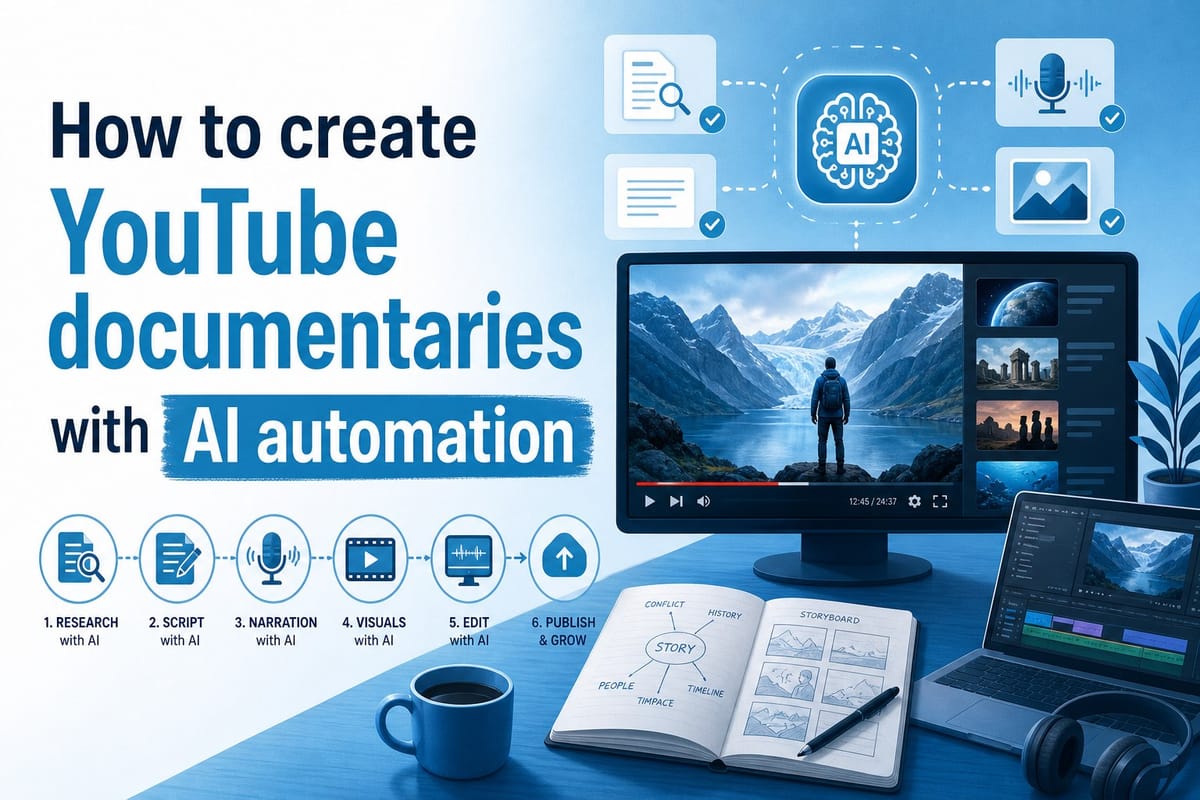
Table of contents
1. What makes a great YouTube documentary and why production usually stops people
2. How to use AI automation to build your documentary from prompt to finished video
3. Building a faceless documentary channel that can scale
YouTube documentaries are one of the most-watched content formats on the platform. Channels built around true crime, history, science, and corporate collapses pull millions of views without a single piece of original footage shot on location. The challenge has always been production. Writing a tight script, sourcing licensed video clips, adding motion graphics, and cutting everything into a coherent story used to take weeks and require a team. AI automation changes that equation. This post walks you through exactly how to build compelling YouTube documentaries using AI tools so you can produce professional-looking long-form content without touching a camera or hiring an editor.
What makes a great YouTube documentary and why production usually stops people
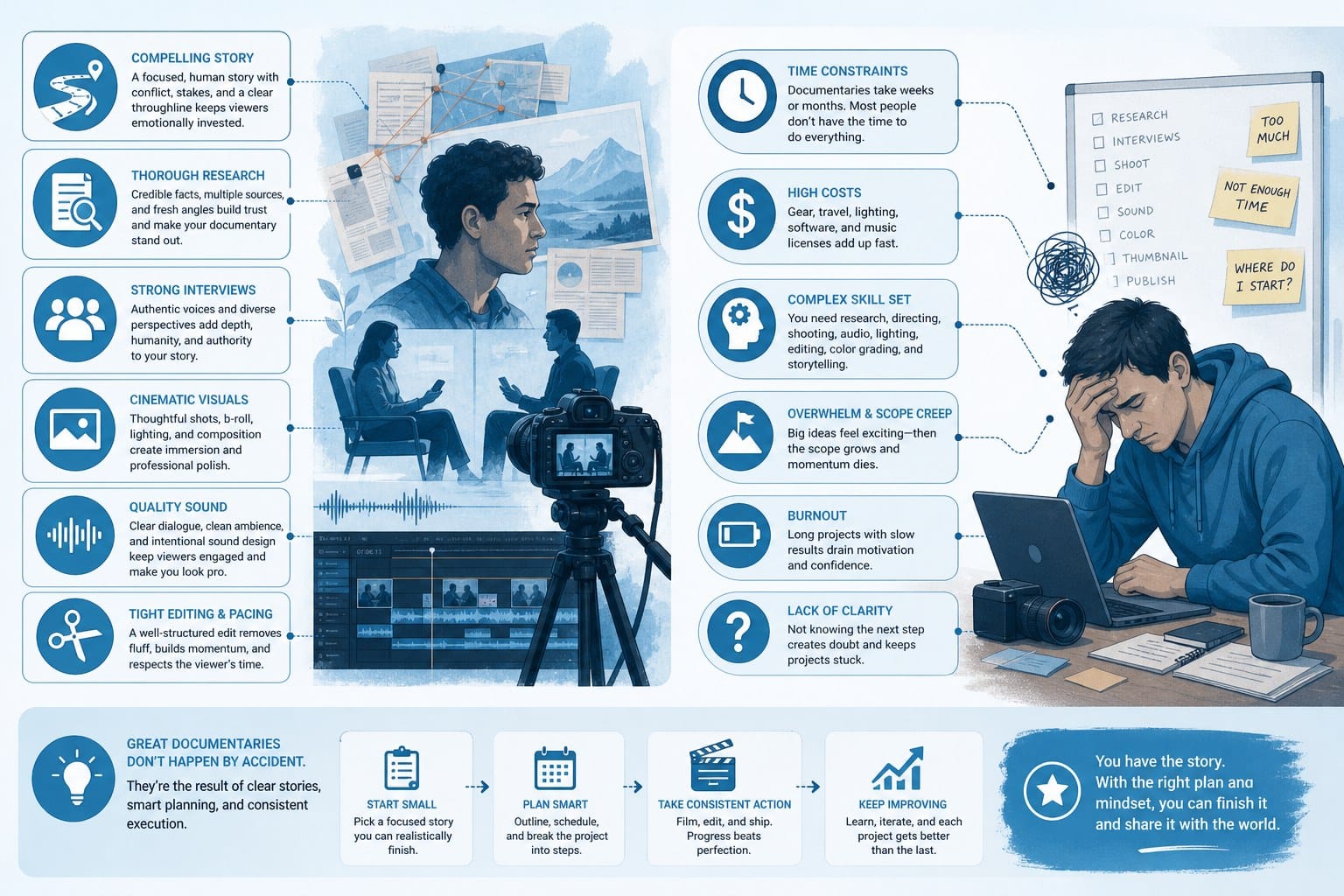
Before we talk about automation, it helps to understand what actually makes YouTube documentaries work. The format is different from a talking-head video or a quick explainer. A documentary tells a story with structure. It opens with a hook that makes the viewer feel something, builds tension or teaches something unexpected in the middle, and closes by resolving the question it raised at the start.
The best documentary channels on YouTube share a few consistent traits. They pick topics that already have a built-in audience. True crime, historical mysteries, corporate collapses, and scientific breakthroughs all perform well because people actively search for them. These channels maintain a visual style that feels premium even when the creator never appears on screen. And they script everything tightly so there is no filler. Viewers who sit down for a 30-minute documentary expect every minute to earn its place.
Think about what channels like Bright Sun Films or Company Man do well. They take a subject most people have a passing familiarity with, find the human angle underneath it, and structure the story so that even viewers who already know the ending keep watching. That storytelling discipline is what separates a documentary that gets recommended from one that gets abandoned at the three-minute mark.
The problem is that producing this kind of content is genuinely difficult. Research alone can take days. You need to read source material, verify facts, identify your story angle, and turn dry information into something emotionally engaging. Then you need a script. After that comes footage. You cannot grab any video clip you find online and drop it into your production. You need properly licensed material, which either costs money through stock footage platforms or requires hours of careful sourcing. Once you have footage, someone has to edit it. That means cutting clips to match narration timing, adding lower-third graphics to identify locations and people, layering in background music, and color grading the whole thing so it looks consistent from start to finish.
For a solo creator or a small team without video editing experience, that workflow is a wall. Many people have strong documentary ideas they never execute because the production barrier is simply too high. They know the story they want to tell. They just do not have the time or the skills to produce it.
AI automation removes that wall. It handles research, scripting, footage sourcing, graphics, and editing from a single starting point, which is usually a topic or a rough idea you already have in mind. The creator focuses on the story. The automation handles the production stack below it.
This is exactly the problem that platforms like Cliptude AI: the text-to-video platform that does it all were built to solve. The core idea is that a creator should be able to bring the story instinct and let the technology handle everything that would otherwise require a full production team.
It is worth being clear about what AI automation does not replace. It does not replace your judgment about which topics are worth covering. It does not fact-check sources for you or guarantee accuracy. And it does not substitute for the editorial eye you need to review a finished cut before uploading. What it does is compress the distance between having an idea and having a publishable video. That compression is significant enough to change whether documentary production is realistic for a solo creator at all.
Understanding the format requirements also helps you use AI tools more effectively. A documentary script has a different rhythm than a blog post or a marketing video. Sentences are shorter. Transitions between sections are explicit. The narrator guides the viewer through the story rather than assuming they already understand context. When you brief an AI system on your documentary topic, the more specific you are about format and tone, the more usable the output will be. We will get into exactly how to do that in the next section.
How to use AI automation to build your documentary from prompt to finished video
Let me walk through the actual production process step by step so you can see where AI fits into each phase and what you still need to bring yourself.
Topic research and angle development
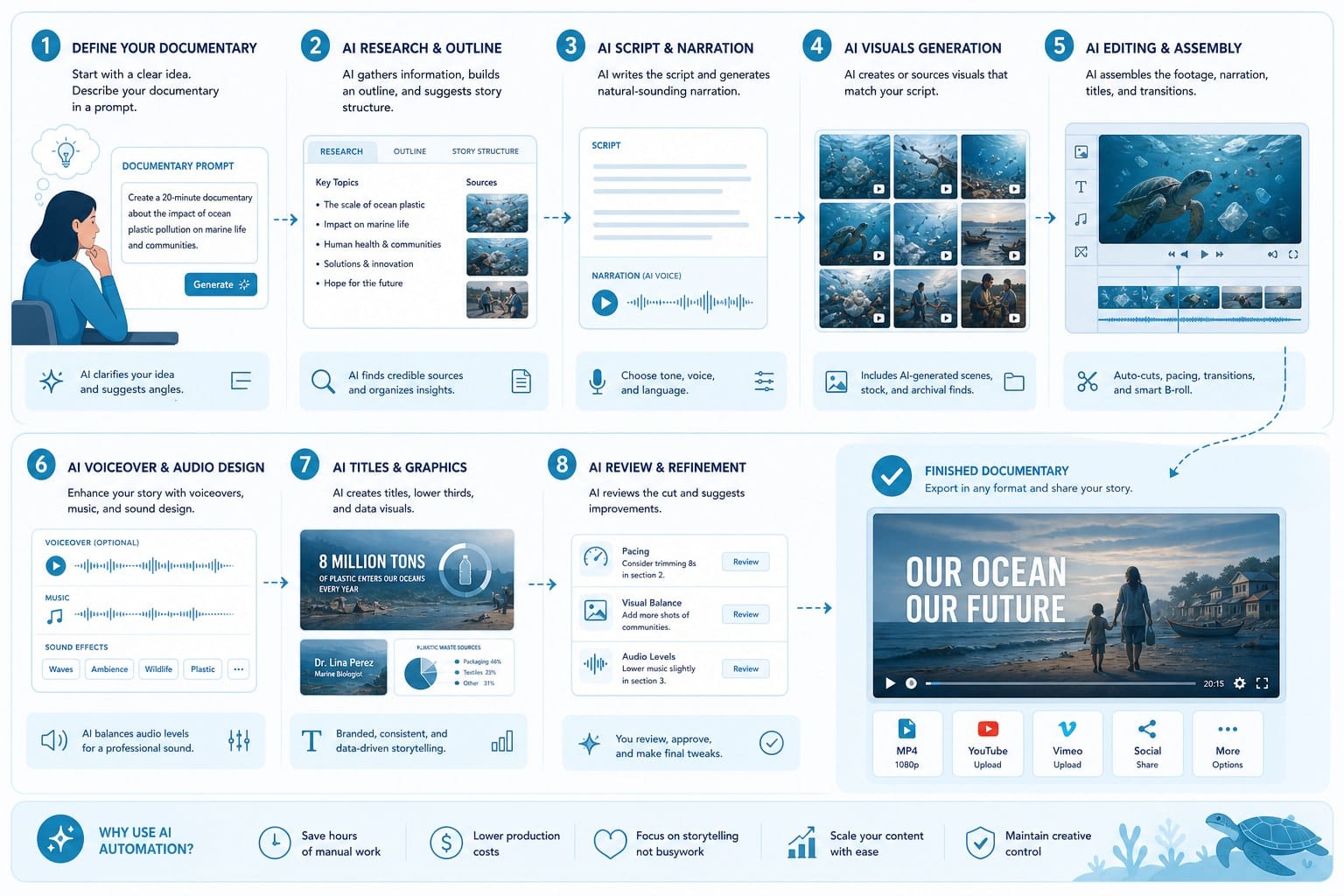
This is where most documentary creators spend the most time, and it is also where AI gives you the biggest head start. When you use an AI-powered platform, you can enter a broad topic and the system will research the subject, identify the narrative arc that makes the story compelling, and suggest an angle that fits the YouTube documentary format.
The best results come when you bring a specific question to the AI rather than just a subject. Instead of typing in Enron, try something like why did Enron's employees not see the collapse coming. That gives the AI a human lens to work from. Human lenses are what keep viewers watching. A documentary about a company going bankrupt is a business story. A documentary about why thousands of ordinary people trusted executives who were lying to them is a human story. The second one holds an audience.
You can also use this phase to test whether a topic has enough search demand to justify producing a full documentary. Tools like Google Trends and YouTube's search autocomplete show you what people are already looking for. If your specific angle matches existing search behavior, you have both a creative and an algorithmic reason to pursue it.
Scripting
A strong documentary script is written to be heard, not read. Sentences are shorter. Transitions are explicit. The narrator guides the viewer through the story rather than assuming they already know context. When AI generates a script from your prompt or research, it applies these principles automatically. It structures content with a cold open, a series of act breaks that build on each other, and a close that feels earned.
You should always review the script before moving forward and read it out loud to check pacing. A well-structured AI script might still have a sentence or two that sounds awkward when spoken. Catching those before you generate audio saves you from having to redo a section later. Look specifically for places where the script rushes through a complicated idea or where it spends too long on a detail that does not advance the story. Those are the same notes a human editor would give.
Also check the script for factual accuracy at this stage. AI research tools pull from large bodies of text, but they can misattribute quotes, get dates wrong, or conflate similar events. Verifying the key claims in your script before production begins is not optional if you want to maintain credibility with an audience.
Footage and visuals
This is one of the most practically impressive parts of AI-powered documentary production. Instead of spending hours searching stock footage sites, the system sources clips that match your script content automatically. It maps visuals to narration so that what the viewer sees supports what they hear.
For a documentary about Enron, that might mean aerial shots of Houston, archival-style footage of office environments, and stock clips of financial data on screens. For a documentary about the history of the Concorde, it might pull wide shots of airports, interior footage of passenger cabins, and graphics showing flight paths across the Atlantic.
Beyond raw footage, motion graphics add professional production value. Lower thirds that name locations or time periods, animated maps, text callouts, and transitions are generated and placed in context without you needing to open editing software. These elements are what separate a documentary that looks like a passion project from one that looks like it came from a production company.
Style matters here too. A historical documentary uses a different visual language than a corporate exposé. Muted colors, archival-looking footage, and serious music suit a World War II story. Sharper graphics and a faster cut pace fit a documentary about a tech startup implosion. AI platforms that specialize in video production handle these style variations because they generate and source assets based on content context rather than applying a single template to every project.
Audio and editing
AI voice synthesis has improved substantially in the last few years. The narration output sounds natural enough that most viewers do not register it as artificial. Background music is selected and mixed to sit under narration without overpowering it. The edit is assembled so that cuts happen at natural breaks in speech and visuals hold long enough for the viewer to absorb them without dragging.
The output is a polished video file ready to upload. For long-form YouTube documentaries, that might be anywhere from 15 to 45 minutes of finished content, produced in a fraction of the time traditional editing would require.
If you are curious how this same AI production logic applies to other formats, the article on how to make AI music videos from a text prompt shows how the underlying system handles a completely different creative challenge with the same starting-point simplicity. The production principles transfer across formats even when the creative output looks nothing alike.
What you bring to this process
The workflow above handles the production stack. What you bring is story instinct, editorial judgment, and topic selection. Those are not small contributions. They are the parts of documentary creation that actually determine whether a video finds an audience. AI produces the footage, the graphics, the edit, and the audio. You determine whether the story is worth telling and whether the finished product is good enough to publish.
That division of labor is what makes AI-powered documentary production genuinely useful rather than just fast. Speed without quality produces content that does not perform. The goal is to remove the production bottleneck so your time goes toward the decisions that actually matter.
Building a faceless documentary channel that can scale
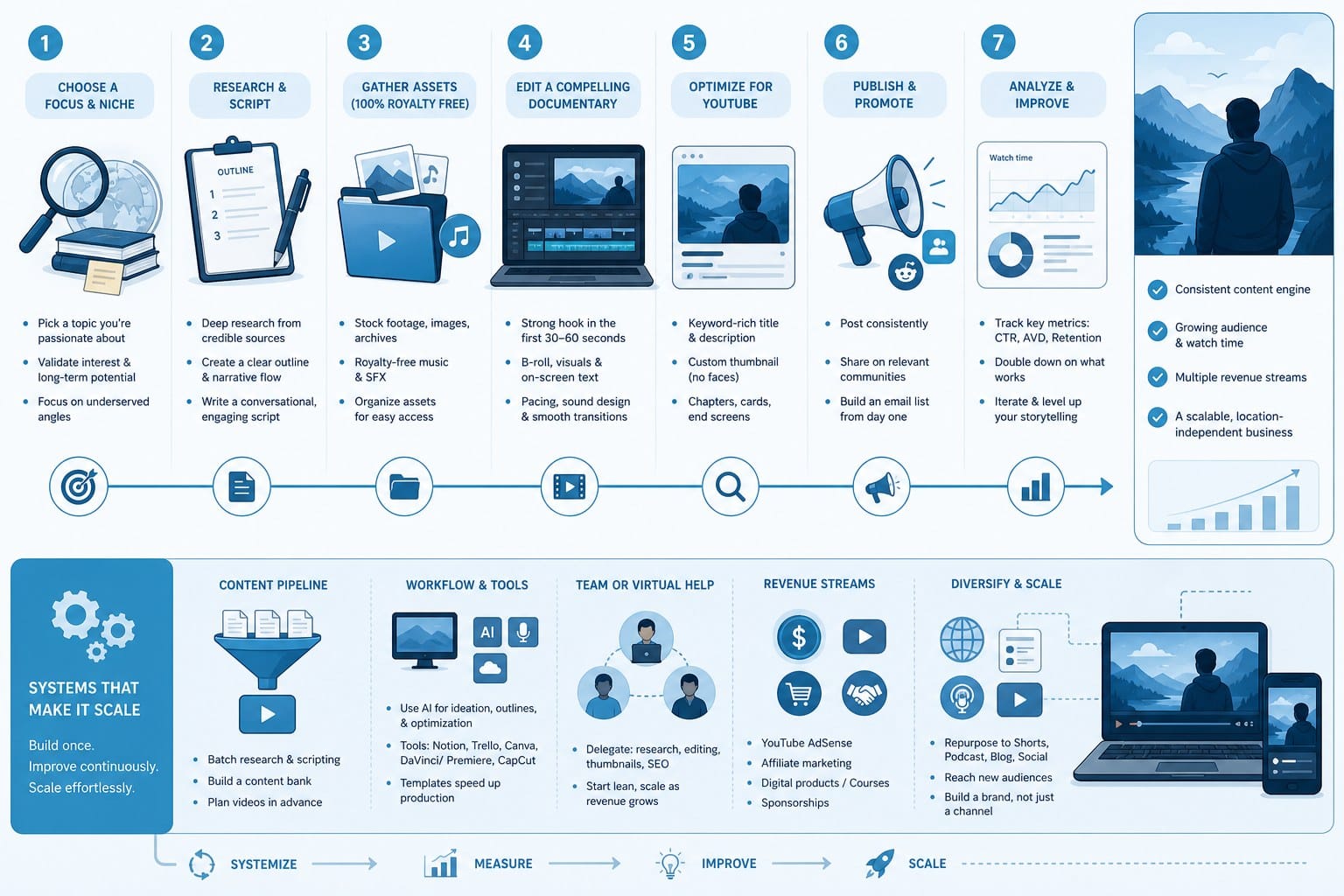
One of the main reasons creators are drawn to AI-powered documentary production is that it makes running a faceless YouTube channel actually sustainable over time. A faceless channel is one where the creator never appears on camera. The content is driven by narration, visuals, and storytelling rather than a host personality. This format has real advantages beyond privacy.
Why faceless documentary channels work at scale
First, they remove one of the biggest production bottlenecks. When you are not dependent on recording yourself, you do not need a filming day, a good backdrop, or a quiet room. You can produce multiple videos in parallel because the production steps are automated. A creator who previously published two videos a month can realistically publish six to ten once manual production steps are removed from their workflow.
Second, faceless documentary content ages better. A video where a host speaks directly to camera carries the visual signature of when it was made. Hair, clothing, background design, and camera quality all date a video. Narrated documentary content with clean visuals tends to look watchable for years, which matters significantly for long-tail search traffic. A documentary about the collapse of Toys R Us that you produce today can still pull search traffic three years from now if the production looks clean.
Third, the format is well-suited to monetization. Long-form YouTube documentaries hold viewers for longer sessions, which improves watch time metrics. Watch time is one of the strongest signals YouTube uses to recommend videos to new audiences. A 25-minute documentary that retains 60 percent of viewers drives more algorithmic growth than a 10-minute video with the same retention rate, because the total watch time per view is higher. Longer videos also carry more mid-roll ad slots, which increases revenue per view under YouTube's Partner Program.
Niche selection
The first decision for building a scalable channel is niche selection. The most successful faceless documentary channels pick a niche tight enough to build authority but broad enough to sustain years of content. True crime is the classic example, but it is also one of the most competitive spaces on YouTube. Underexplored niches like corporate disasters, medical mysteries, historical hoaxes, infrastructure failures, and technology collapses all have strong search demand with far fewer dedicated channels competing for that audience.
A channel focused specifically on retail collapses, for example, could cover Sears, Circuit City, Blockbuster, Bed Bath and Beyond, and dozens of others. Each video serves viewers who are searching for a specific topic. The channel as a whole builds authority with YouTube's recommendation system in that subject area. That authority compounds over time, pushing older videos to new viewers as the channel grows.
When evaluating a niche, look at three things. How many people actively search for topics in this category each month? How many established channels are already producing this content at high volume? And how many potential video topics exist within the niche? You want a space where the demand is real, the competition is not already saturated, and you can keep producing without running out of material.
Building your production system
Once you have a niche, the production workflow described in the previous section becomes your repeatable system. You bring the topic and the angle. The AI handles research, scripting, footage, graphics, and editing. You review, adjust, and approve. Then you upload. That loop should feel mechanical because it is meant to. The creative work happens in topic selection and editorial review. The production work is systematized.
Batching is one of the most effective ways to maintain a consistent publishing schedule. Instead of producing one video at a time, spend a weekend session generating scripts for four or five topics, reviewing them back to back, and queuing them for production. By the time the first one is uploaded and gaining traction, the next three are ready. That rhythm keeps your channel active without requiring daily work.
Monetization is worth planning before you start publishing. AI-generated videos produced through commercial platforms like Cliptude come with full commercial rights, which means you can monetize them through YouTube's Partner Program, through sponsorships, or through other revenue streams without licensing concerns. This detail matters because some free or low-cost AI tools produce content with restrictions on commercial use. If your goal is to generate income from your channel, confirm that the platform you use grants commercial rights explicitly before you start building your library.
Multi-format content from a single documentary
Scaling also means thinking beyond the main channel video. Clips from a 30-minute documentary can become YouTube Shorts, Instagram Reels, and TikTok videos. A single documentary topic can produce a full-length video, three or four short clips highlighting key moments, and a summary-style explainer, all from the same source material. That multiplies your content output without multiplying your workload.
AI platforms that handle both long-form and short-form production let you repurpose content automatically rather than manually re-editing it yourself. If you produce a documentary about the fall of Lehman Brothers, the most dramatic moments from that story already exist in your finished video. Pulling a 60-second clip about one specific decision that accelerated the collapse and publishing it as a Short requires almost no additional work if your platform supports it.
Evaluating your platform options
For creators comparing different tools to power this kind of workflow, it is worth reading through platform comparisons carefully. The article on Vidrush AI alternatives worth switching to in 2025 gives useful context on how to evaluate these platforms against each other based on what long-form documentary and faceless channel production actually requires. Not every AI video tool is built for content at this length or complexity.
Key things to evaluate when choosing a platform: Does it support long-form output at documentary length, or is it designed primarily for short clips? Does it source licensed footage automatically, or do you need to handle that separately? Does it grant commercial rights on output? And does the pricing model match how you plan to produce, whether that is a flat subscription or a pay-per-video structure?
The mindset that actually produces results
The creators who succeed with AI-powered YouTube documentaries are not the ones who treat the technology as a shortcut around the thinking. They are the ones who use it to free up their time for the parts of documentary creation that require human judgment: topic selection, story angle, fact verification, and final quality review.
AI handles the production stack. You handle the story instinct. That combination is what produces documentaries worth watching. The technology has been around long enough now that the novelty of AI-generated content is not a differentiator. What differentiates a channel is whether the stories are genuinely interesting and whether the production quality is high enough that viewers stay through to the end.
If you want to test this workflow before committing to it fully, Cliptude uses a usage-based credit model, which means you pay for what you produce rather than committing to a flat monthly fee regardless of output. That makes it practical to produce your first documentary and evaluate the results before deciding whether to build your entire channel around the platform.
Ready to take the next step?
Ready to start producing YouTube documentaries without a camera or editing software? Head to Cliptude and turn your first documentary idea into a finished video. Enter your topic, let the AI handle research, scripting, footage, and editing, and have something upload-ready faster than you would finish planning the production manually.