AI stickman animation maker that turns text into videos instantly

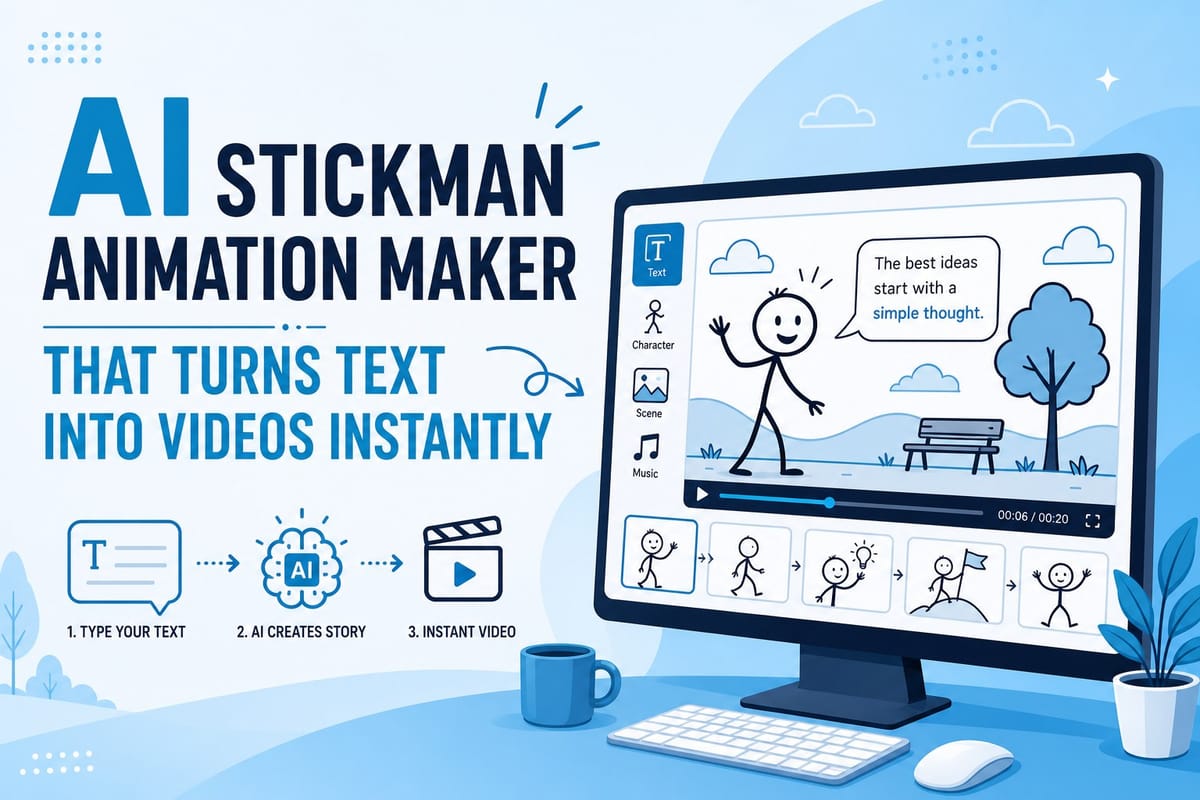
Table of contents
1. Why stickman animation still works in 2025
2. How an AI text-to-video platform handles animation from a prompt
3. Getting real results with AI-generated stickman videos on YouTube and short-form platforms
I have spent a lot of time watching creators struggle with video production. They have great ideas, solid scripts, and a real audience waiting for their content, but they get stuck the moment they need to actually make the video. Stickman animation keeps coming up as a solution because it looks clean, it tells stories well, and it does not require anyone to show their face on camera. The problem is that traditional stickman animation tools demand hours of frame-by-frame work, even for a short clip. That is where an ai stickman animation maker changes everything. Instead of drawing each pose manually or wrestling with a timeline, you type what you want and the AI builds the video for you. This article walks through how that process works, why stickman animation is such a powerful format for YouTube and short-form content, and how a platform like Cliptude can take you from a raw idea to a finished, polished video without any design skills at all.
Why stickman animation still works in 2025
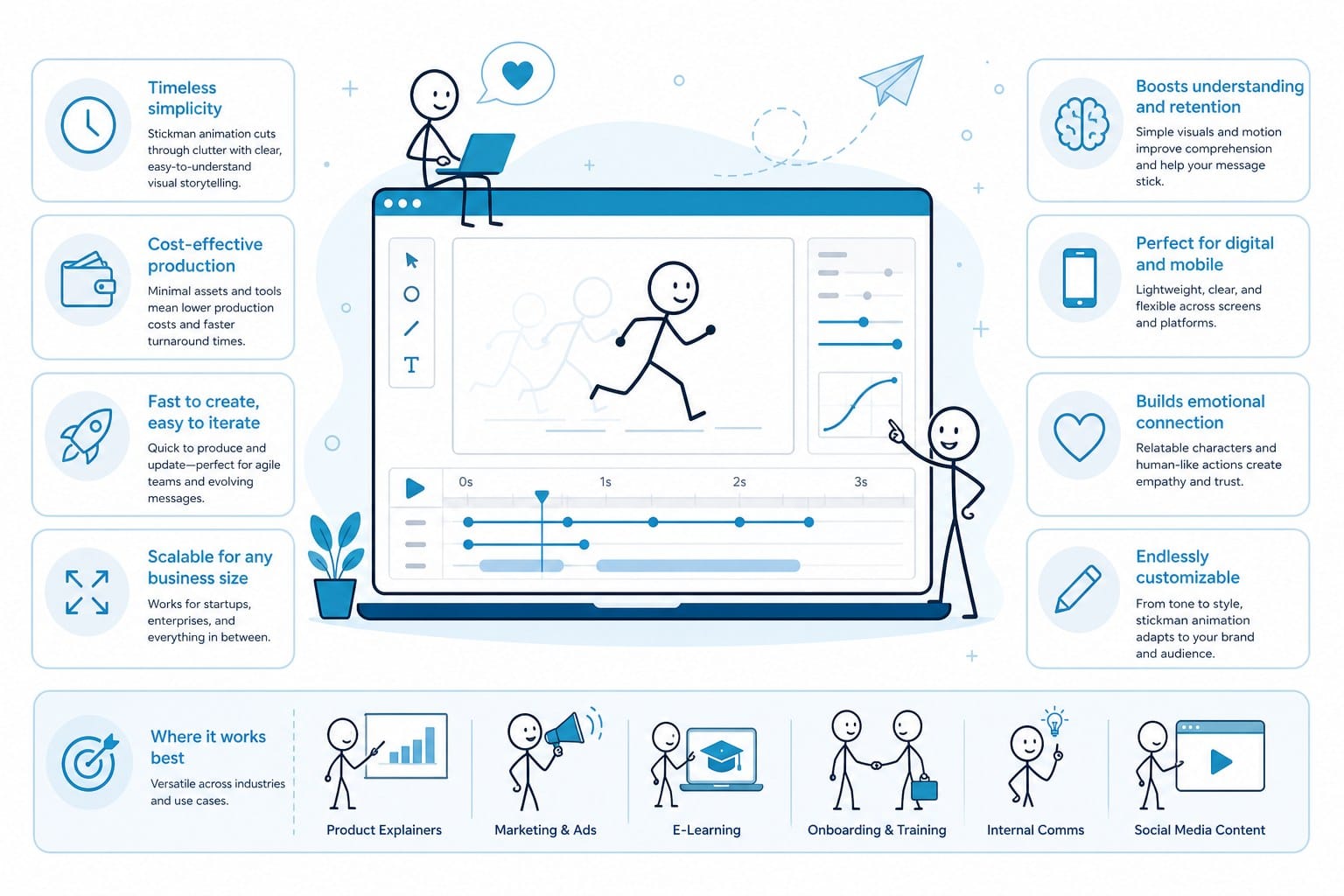
Stickman figures have been around since the earliest days of flip-book cartoons. They look simple, almost too simple, but that simplicity is exactly why they work so well for educational and explainer content. When you strip a character down to a basic outline, the viewer focuses on the idea being explained rather than the visual style. There is no complex costume to interpret, no facial expression to decode, and no production design competing with the message. The concept takes center stage and stays there.
Creators who run faceless YouTube channels have figured this out and leaned into it hard. A stickman walking up a bar chart to show rising inflation makes the data feel immediate. A stickman falling into a trap explains a common investing mistake faster than three paragraphs of text ever could. A pair of stickmen debating opposite sides of a historical argument gives the viewer a clear visual structure to follow without needing any additional explanation. These visual metaphors communicate instantly because they tap into patterns human brains already understand.
Stickman animation also ages well in a way that other formats do not. A whiteboard explainer video made five years ago does not look outdated the way a live-action talking-head video might, because the style was never trying to look current in the first place. The format is intentionally timeless. Content you publish today can still earn ad revenue or drive search traffic years from now, which matters a great deal for creators who are building a library of evergreen educational or documentary-style videos. Each video you publish is an asset that keeps working long after you upload it.
The production challenge has always been time. Hand-drawn stickman animation, even using software like Adobe Animate or simpler browser-based tools, requires you to create keyframes, set timing, export layers, and sync audio manually. A two-minute explainer can take four to six hours to produce if you are doing everything yourself. A five-minute video can consume an entire workday. Most solo creators and small teams simply cannot sustain that pace, especially when they are also managing scripts, thumbnails, SEO research, community engagement, and everything else that running a YouTube channel involves.
That production bottleneck is the exact gap an ai stickman animation maker fills. The AI handles the motion logic, the timing, and the visual storytelling layer while you focus entirely on the concept and the message. You type a prompt or paste a script, and the platform figures out how to translate those words into a moving visual story. This is not just a time-saver in the traditional sense. It fundamentally changes who can make this kind of content, because you no longer need years of animation experience or a significant production budget to get started.
For creators building monetized channels, this shift is operationally significant. You no longer need to hire a motion graphics artist or spend weeks inside an animation software tutorial before you can publish your first video. You can produce consistent, high-quality stickman-style content at a pace that was genuinely impossible before AI entered the production pipeline. More videos mean more opportunities to rank on YouTube, more chances to show up on TikTok's explore page, and more inventory to monetize through ads, sponsorships, or digital products.
One thing worth being direct about: stickman animation is not just a beginner format or a low-budget workaround. Some of the most-watched explainer content on YouTube uses exactly this style because it communicates clearly and keeps audience retention high. Viewers tend to stay engaged with animated explainers because the visuals keep moving and the story keeps progressing. There is always something new happening on screen, which reduces the chance someone clicks away out of boredom or distraction. A well-paced stickman video can out-retain a polished live-action video in the same niche because the animation itself is doing active work to keep attention.
Stickman animation also scales well across topics. Finance, science, history, philosophy, business case studies, self-improvement, true crime, geopolitics -- all of these niches have large, engaged YouTube audiences that respond well to the animated explainer format. You are not locked into one subject area or one style of storytelling. The format is flexible enough to cover almost any topic where clear explanation matters more than visual spectacle.
For creators who are just starting a channel, stickman animation removes one of the biggest early barriers: the fear of being on camera. Many people have real expertise and genuine things to say, but they either do not feel comfortable on screen or they do not have the equipment, lighting, or space for a quality live-action setup. Animated video eliminates all of those obstacles entirely. Your voice, your ideas, and your research carry the content, and the animation handles the visual layer. That is a much lower barrier to entry, and it produces content that can compete at a professional level from day one.
How an AI text-to-video platform handles animation from a prompt
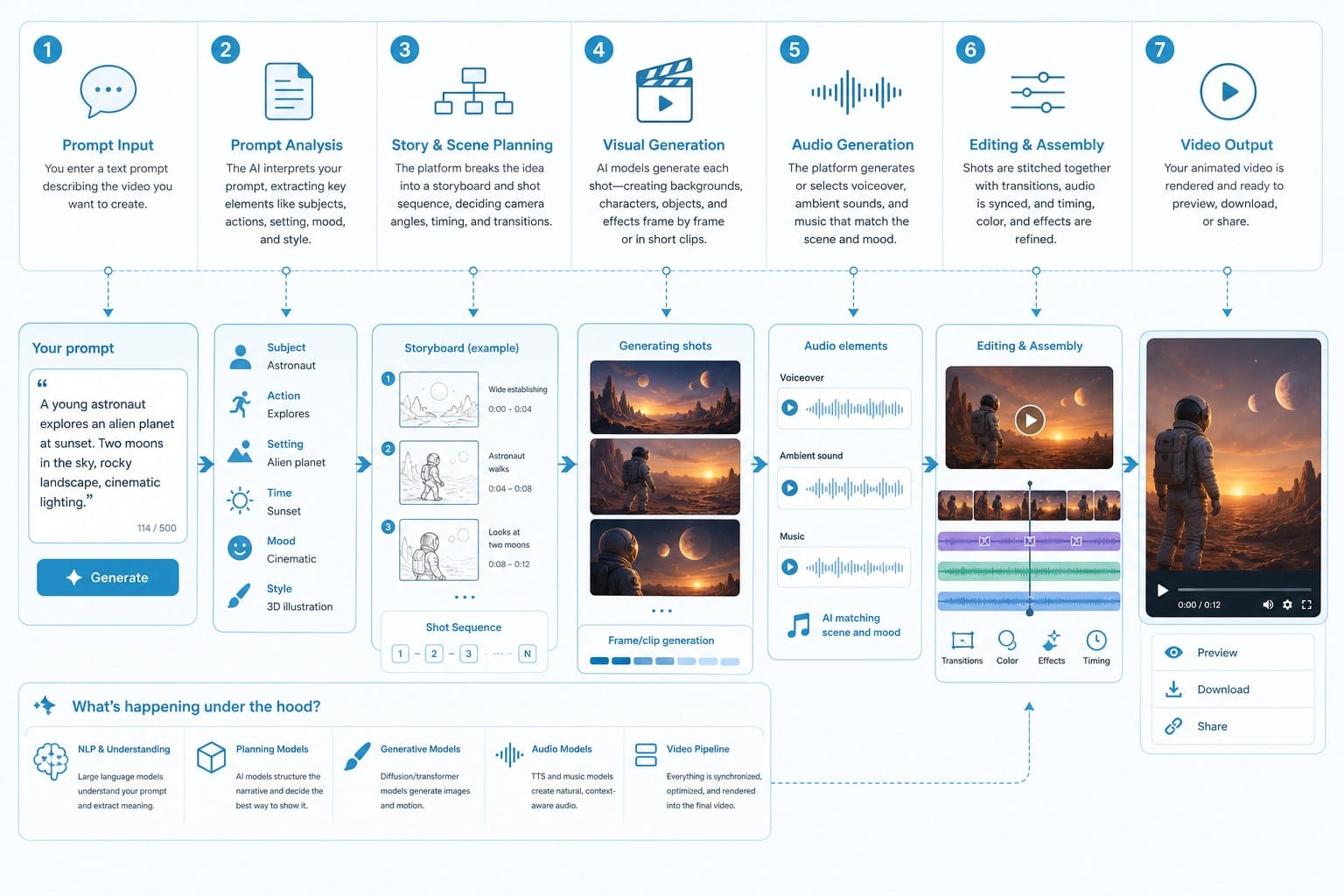
The phrase "turns text into videos instantly" sounds like marketing shorthand, but the actual process behind it is worth understanding in detail. When you use a platform like Cliptude, you are not just pressing a button and hoping the output is usable. There is a structured production pipeline happening behind the scenes that handles research, scripting, visual selection, motion graphics, audio, and final editing all at once, without requiring you to manage any of those steps manually.
The workflow starts with a prompt. It can be as simple as "explain how compound interest works for beginners" or as specific as a full script you have already written out. The platform takes that input and runs it through an AI pipeline that first evaluates whether the content would benefit from additional research. For factual topics like history, science, economics, or personal finance, the system can pull in relevant context to make the script more accurate, more complete, and more useful for the audience that will actually watch the video.
Once the script is ready, the platform moves to visual selection. For an ai stickman animation maker workflow, this means the system selects or generates animated sequences that match what the script is describing at each moment. A section about saving money might trigger a stickman dropping coins into a jar. A section about time pressure might show a stickman racing against a clock with a countdown ticking. A section comparing two options might display two stickmen on opposite sides of a scale. These visual metaphors are built into the animation logic so the output feels purposeful rather than random. The visuals are serving the script, not just decorating it.
Motion graphics get layered in automatically on top of the base animation. This includes text overlays that reinforce key points, arrows that direct the viewer's attention, transitions between scenes, and emphasis effects that make important moments land harder. The AI times all of these elements to match the pacing of the narration so the video flows naturally from one section to the next. You are not manually dragging anything around on a timeline or adjusting frame offsets to get the sync right. The system handles that synchronization automatically, which is one of the most tedious parts of traditional video editing.
The voiceover is generated using AI narration technology integrated directly into the platform. You can typically adjust voice style, speaking pace, and tone depending on the platform's settings. Cliptude is built specifically for YouTube-focused content creators, so the default output is optimized for the kind of retention-friendly pacing and clear delivery that tends to perform well on that platform. The narration does not sound robotic or stilted. It sounds like a competent presenter explaining something they actually understand.
Background music and sound effects are added during the final production pass. The platform selects audio that fits the tone and pacing of the video without overpowering the narration. This is another detail that solo creators often overlook when producing content manually, and getting it wrong can make an otherwise solid video feel amateur. Having it handled automatically and consistently is a genuine production quality improvement.
When everything comes together, you get a finished video that includes the animated visuals, the voiceover, the motion graphics, background music, and any additional audio elements the system has added. For most content formats, this full production process takes minutes rather than hours. You can review the output, make targeted adjustments to specific sections if needed, and export the final file ready for upload.
This end-to-end automation is what separates a true AI video production platform from a simple animation asset library. A basic animation tool gives you pre-built characters and a timeline editor, but you still have to handle every creative and technical decision yourself. A full production platform like Cliptude handles the entire pipeline so you can go from a typed idea to a publishable video without opening a separate editing application, sourcing your own footage, or recording your own audio.
For solo entrepreneurs and small content teams, this operational shift has real financial implications. Instead of budgeting multiple days for a single batch of videos, you can produce a full week's worth of content in a focused afternoon session. That kind of output capacity is what makes it possible to build a monetized YouTube channel from scratch without a production crew or a significant equipment investment. The marginal cost of producing one more video drops dramatically, which changes how you think about content strategy and channel growth.
The credit-based pricing model that Cliptude uses reflects how most serious creators actually work. You pay based on what you produce rather than committing to a fixed monthly seat fee for capabilities you might not use every week. If you need to publish ten videos in one month to hit a channel launch deadline and then slow down the following month, the usage-based model accommodates that without penalty. That flexibility matters for individual creators and small teams who do not have predictable, stable production volumes every single month.
You can read a detailed comparison of how this approach stacks up against other AI video tools in this breakdown of the best InVideo alternative for fully automated AI video production. The core difference comes down to how much of the production pipeline the platform actually owns versus how much it leaves for you to handle manually.
The quality question deserves a direct answer because it is the thing most creators ask first. The output from a well-built AI video platform is not a rough draft that requires heavy post-production before it is usable. The design goal is a video that is publishable as-is, or very close to it, after a light review. That means professional-looking animation with intentional motion, clear and natural-sounding audio, and pacing calibrated to keep viewers watching. For the most popular YouTube niches -- history, personal finance, science, self-improvement, business -- animated explainer content produced this way competes directly with lower-budget live-action alternatives and often outperforms them on retention metrics because the format holds attention more effectively than a static talking-head setup.
Getting real results with AI-generated stickman videos on YouTube and short-form platforms
Understanding how the technology works is one thing. Knowing how to use it strategically to grow a channel or support a business is something else entirely. The creators who get real traction with AI stickman animation are not just using the tool. They are using it inside a system that connects topic selection, production frequency, platform optimization, and audience retention into a repeatable workflow.
Topic selection is where everything starts. Stickman animation and animated explainer formats perform best when the information itself is the draw rather than the personality presenting it. If you are building a channel around a specific niche -- personal finance for recent graduates, world history, science explainers, business case studies, philosophy, geopolitics -- you are in territory where animation's strengths align directly with audience expectations. Viewers searching for "how does compound interest work" or "what caused the fall of the Roman Empire" want clear, well-organized information delivered efficiently. A well-made animated explainer delivers that faster and more accessibly than most alternatives.
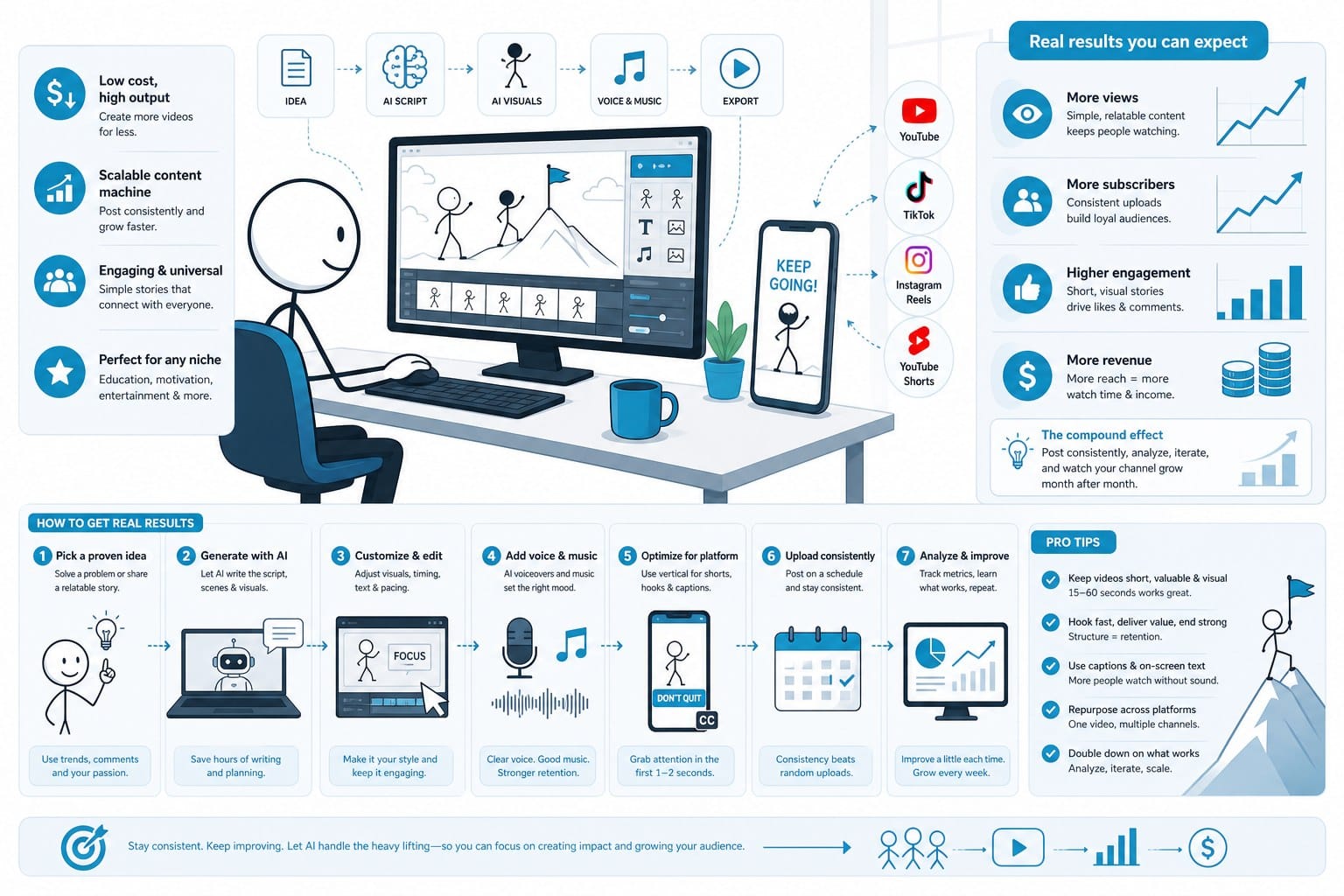
Keyword research drives the topic selection process. Before you generate a single video, you need to know which questions your target audience is actively searching for and which of those questions are being answered poorly by existing content. YouTube's own search suggest feature shows you what people are typing. Third-party keyword research tools show you estimated search volumes and competition levels. Once you have a list of high-interest, lower-competition topics, you can feed those directly into your AI video platform as prompts and start building a content library in a systematic and intentional way rather than guessing at what might work.
The script or prompt quality matters more than most creators realize at first. A vague prompt produces a vague video. A specific prompt that names the audience, the core question being answered, the key points to cover, and the desired tone produces a focused, useful video. You do not need to write a full script before you start, but giving the AI clear direction upfront saves you revision time on the back end. Think of the prompt as a creative brief. The more useful information you put in, the better the output you get out.
Consistency is the second major factor, and it is where the speed advantage of an ai stickman animation maker becomes a measurable competitive edge. YouTube's recommendation algorithm rewards channels that publish on a predictable schedule with consistent quality. If a competitor in your niche is publishing one animated video per week because they are producing everything manually, and you are publishing three videos per week using AI-assisted production, your channel accumulates indexed content faster, signals activity to the algorithm more frequently, and builds topical authority in your niche more quickly. Over twelve months, that compounding difference in output volume is significant.
Batching your production sessions is the practical way to maintain that consistency without burning out. Set aside a dedicated block of time each week or every two weeks to generate your next batch of videos in one focused session. Review and approve the outputs. Schedule the uploads in advance. Then step away from production entirely until the next batch session. This approach treats video creation like a system with defined inputs and outputs rather than a creative endeavor that requires constant attention and inspiration.
Audience retention is the third major factor and the one that most directly determines how the algorithm treats your content. A video that people watch all the way through gets recommended more aggressively than a video where most viewers drop off after thirty seconds. Animated content has a structural advantage here because something is always moving on screen and the story is always progressing. Viewers have less reason to click away compared to a video where a person sits at a desk talking without any visual variation.
But animation alone does not guarantee retention. The script has to be tight. Each section needs to earn the viewer's attention before moving to the next one. Transitions between topics need to feel natural rather than abrupt. The opening thirty seconds need to establish clearly what the video is about and why the viewer should keep watching. These are scripting and structure decisions, not animation decisions, and they are the part of the process where human judgment still adds the most value. The AI handles the production. You handle the strategic and creative direction.
Short-form platforms like TikTok and Instagram Reels require a different calibration. Videos are shorter, hooks need to land within the first two seconds, and the visual layout needs to work on a vertical screen at small sizes. AI video platforms that support multiple output formats let you repurpose the same core content across platforms without rebuilding everything from scratch. A five-minute YouTube explainer can yield a sixty-second vertical TikTok clip from its most compelling section. The efficiency gains stack across platforms, not just within YouTube.
For creators building toward monetization, the commercial rights question is foundational. Any content you plan to run ads on, use in sponsored integrations, or sell as part of a product needs to be content you actually own the rights to. Cliptude gives creators full commercial rights to the videos they produce on the platform, which means you can monetize through the YouTube Partner Program, brand partnerships, affiliate integrations, or any other standard creator revenue model without legal uncertainty. That clarity matters when you are building a channel as a business rather than a hobby.
The audience that often gets left out of this conversation is solo entrepreneurs and business owners who are not trying to become full-time content creators but who need professional video content to support what they already do. A financial advisor who wants to explain Roth IRA conversion strategies to prospective clients. A software founder who needs a clear product explainer for a landing page. A course creator who wants to supplement written lessons with animated visuals that make abstract concepts concrete. All of these people can use an AI video platform to produce polished content without hiring a video production agency or waiting weeks for a freelancer to deliver.
For that business use case, the stickman and animated explainer format is particularly well suited. It looks professional without looking expensive, which is the right impression for most business communications. It also explains complex ideas clearly and quickly, which is precisely what a business explainer video needs to accomplish. A two-minute animated explainer on a product landing page can do the work of several paragraphs of written copy, often more effectively because it holds attention better.
If you are comparing platforms and evaluating whether avatar-based tools or animation-based tools are a better fit for your use case, there are useful comparisons available. This article on the best Synthesia alternative for AI video without avatars or green screens explains the difference between presenter-style AI video and animation-based approaches clearly. If you are specifically looking at avatar-driven video tools, this breakdown of the best HeyGen alternative for AI-powered video creation at scale covers the landscape in more detail.
The learning curve on these platforms is genuinely low, which is worth stating directly because many creators assume there is a hidden complexity they will have to work through before getting usable results. You do not need to understand animation principles, keyframe logic, video editing workflows, or motion graphics theory to get good output. The platform abstracts all of that technical complexity away from the user-facing experience. What you do need is a clear sense of your topic, a working understanding of who your audience is, and the willingness to review output and give feedback when something needs adjustment. Those are skills most creators and entrepreneurs already have from doing other parts of their work.
The creators who get the most out of an AI stickman animation workflow are the ones who approach it as a repeatable production system rather than a one-time experiment. That means building a content calendar before you start generating videos. It means batching production so you are not making one video at a time. It means reviewing analytics regularly to understand which topics are getting watched, which ones are earning subscribers, and which ones are falling flat. It means feeding those insights back into the next round of prompts so each batch of content is better-informed than the last.
The AI handles the production workload. The strategic thinking, the audience understanding, and the content direction still come from you. That combination -- AI production speed plus human strategic direction -- is what makes it possible to build a serious content operation or a professional content marketing function without a large team or a large production budget. The barrier to entry is lower than it has ever been. The tools are capable enough to produce genuinely competitive output. What remains is the decision to start building the system and commit to running it consistently enough that it compounds over time.
Ready to take the next step?
If you are ready to stop spending hours on production and start publishing animated videos that actually hold audience attention, Cliptude is built for exactly that workflow. You bring the idea or the script, and the platform handles everything else -- research, animation, voiceover, motion graphics, editing, and final output. Head to Cliptude to see how it works and start creating your first video today.